Non-State Actors Winning Africa's Drone Wars
Armed groups deploy drones more effectively than states.
Model Diplomat3 min readAfrica
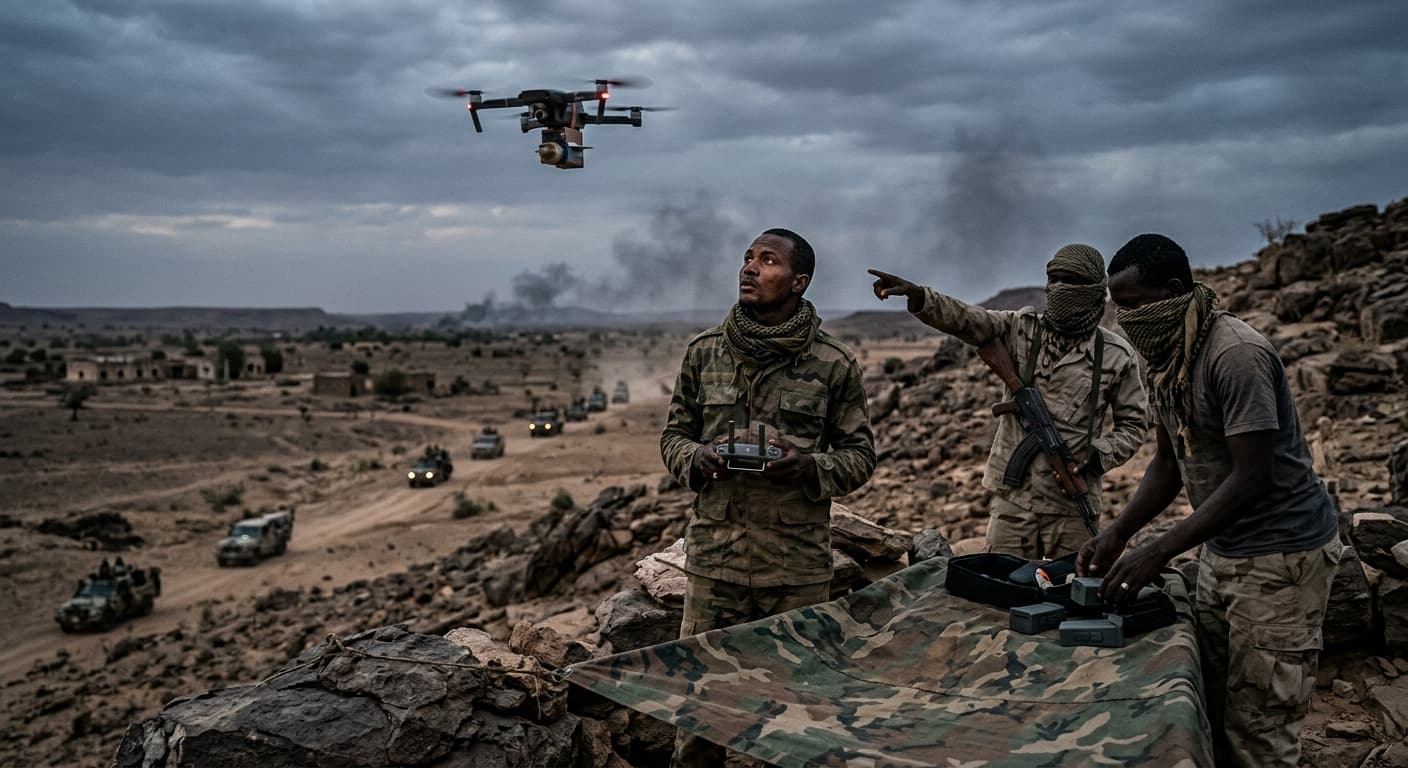
Nonstate Actors Are Beating African States at Drone Warfare
Rebel groups now wield cutting-edge drones more effectively than militaries they face, threatening decades of state air dominance
Insurgents are winning Africa's drone wars. On June 22, 2025, the Azawad Liberation Front (FLA), a Tuareg rebel group in Mali, deployed fiber-optic first-person-view drones against a Russian Africa Corps and Malian armed forces convoy, striking two vehicles in footage that circulated among militants Foreign Affairs. The strike was not a one-off. Between September 2023 and April 2025, the Sahel militant group JNIM launched over a dozen coordinated drone operations across Burkina Faso, Mali, and Togo, using kamikaze drones and surveillance feeds to guide ground assaults
Foreign Affairs. Across Africa, nonstate actors have weaponized drones in at least 17 countries—and they are now deploying these systems more effectively than the state militaries they face.
The scale of drone proliferation across Africa is staggering. Between 2020 and 2026, more than half of all recorded drone units acquired on the continent—1,054 of 1,959 total—arrived in that six-year window, according to open-source procurement data compiled by Military Africa Magazine covering 34 African nations and 21 supplier countries Small Wars Journal. China, Turkey, and Israel control 60 percent of that volume: China supplied 587 units across 20 countries, Israel 325 units (176 to Morocco alone), and Turkey 291 units, with its Bayraktar TB2 becoming the continent's most widely distributed platform at 143 units across 11 countries
Small Wars Journal. Yet the asymmetry cuts against states. Militant groups like JNIM and ISWAP acquire cheap commercial quadcopters—purchased online, modified with explosives—while African militaries remain dependent on foreign suppliers for parts, sensors, training, and software support
Africa Defense Forum. This dependency gap is widening precisely as insurgent drone tactics accelerate.
Why Insurgents Have the Edge
Nonstate actors outpace state militaries on three decisive factors: speed of adaptation, cost efficiency, and operational integration. The FLA deployed fiber-optic drones—technology that emerged from the Ukraine-Russia war's innovation laboratory—in Mali within roughly a year of their battlefield debut in Eastern Europe. Similarly, JNIM has integrated drone reconnaissance and strike into combined-arms operations systematically since 2023, using drone footage to coordinate ground advances and sustain propaganda value Foreign Affairs. By contrast, most African state militaries lack effective counter-drone systems, allowing insurgent operators to operate with near-impunity. Nigeria's Chief of Defence Staff has publicly acknowledged the counter-UAS gap; most Sahel armies have no systematic counter-drone program at all
Military Africa. The result is predictable: when a $5,000 quadcopter outfitted with explosives can overrun a forward operating base, static defense collapses. Across the Sahel, Nigeria, and Somalia, the tactical trend runs consistently in insurgents' favor.
What Comes Next
The immediate watch point is whether African states move from procurement to operational integration before next-generation threats materialize. The continent saw the first AI-powered autonomous drones deployed by militant groups in 2025; swarm attacks remain unconceived but not unconceivable Africa Defense Forum. The strategic bet is whether states like Nigeria, Ethiopia, and Egypt can translate drone imports into indigenous counter-drone manufacturing and doctrine before insurgents field systems they cannot jam or intercept. Domestic producers exist—Nigeria's Terra Industries operates Africa's largest drone facility with capacity for ten thousand units annually—but capability diffusion from offense to defense remains nascent
Military Africa. The Africa International Defence Exhibition (AFRIDEX) scheduled for October 2026 in Lagos will be a test: if African procurement officials leave with contracts rather than brochures for counter-UAS systems, states may begin narrowing the gap. If they do not, the next FLA attack will not be an outlier. It will be routine.
Discover more

India
Vijay's Political Rise vs Silent Tamil Nadu
Actor Vijay's popularity surges across Tamil Nadu even as campus student politics fades, raising fresh questions about youth engagement and future power.

US Politics
Senate Repeals Minnesota Mining Ban for Twin
The Senate's repeal of a 20-year mining moratorium in Minnesota allows Twin Metals to proceed, raising concerns over environmental impacts and foreign ownership.

US Politics
U.S. House Passes Alert Act for Aviation
The House passed the ALERT Act 396–10, replacing the ROTOR Act after Pentagon intervention, impacting aviation safety regulations.

Economics
Fed's Amex AML order puts correspondent banking on notice
Federal Reserve's Amex AML order requires board-level controls and a 90-day plan; OCC fined the bank $350 million over enterprise-wide deficiencies.