Zimbabwe's Term-Extension Law Redraws Rules
A constitutional amendment extends Mnangagwa's presidency to 2030.
Model Diplomat9 min readSouthern Africa
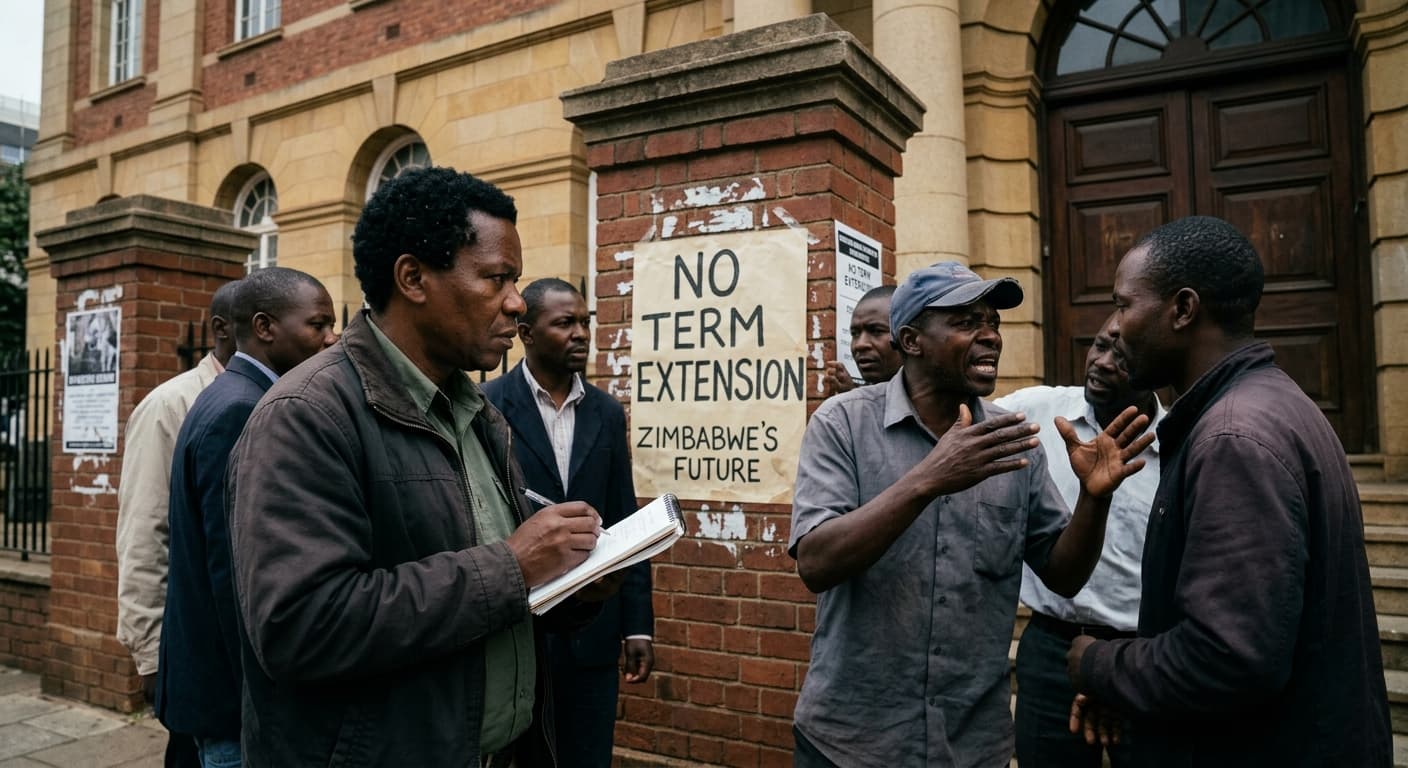
Zimbabwe's Term-Extension Law Redraws Southern Africa's Rules
Mnangagwa signed a constitutional amendment on July 7, 2026, delaying elections to 2030 and letting parliament pick the president — a template SADC's next wave of incumbents is watching closely.
Zimbabwe's President Emmerson Mnangagwa signed the Constitutional Amendment (No. 3) Act into law on July 7, 2026, extending his term to 2030, stretching parliamentary and presidential mandates from five years to seven, and abolishing direct presidential elections in favour of a parliamentary vote. The immediate story is that an 83-year-old strongman bought himself two extra years. The bigger one is that Southern Africa — long the continent's cleanest region on term limits — has just imported the "constitutional coup" playbook from Togo, Rwanda and Central Africa, and the Southern African Development Community has neither the appetite nor the machinery to push back.
That is the thesis of this piece: the amendment matters less for what it does to Zimbabwe than for what it signals to every SADC incumbent facing a 2027–2030 deadline — Filipe Nyusi's successor in Mozambique, Duma Boko in Botswana, Hakainde Hichilema in Zambia, and the ANC-led coalition in Pretoria. It is a live demonstration that a two-thirds parliamentary majority, a compliant Constitutional Court and a passive region can override the anti-third-termism architecture that Southern Africa spent two decades building.
What the law actually does
Government spokesperson Nick Mangwana confirmed the signing on the morning of July 7. According to News24, Mangwana said Mnangagwa had "assented to" the Constitutional Amendment (No. 3) Act, closing a process that began with a ZANU-PF congress resolution in August 2024.
Five operative changes take effect. Presidential and parliamentary terms move from five to seven years. The 2028 general election is deferred to 2030. Mnangagwa's current term, due to expire in 2028, runs until 2030. Direct presidential elections — a feature of every Zimbabwean vote since 1990 — are abolished. The next president will be chosen by a joint sitting of the National Assembly and Senate, the Anadolu Agency reported.
The vote was not close. The BBC reported 216 lawmakers backed the bill in the National Assembly on June 18, against 42 opposed — 29 above the two-thirds threshold of 187. The Senate followed on June 24 by 75 votes to four, according to
Ukweli Times. More than 30 opposition Citizens Coalition for Change (CCC) MPs crossed the aisle to vote with ZANU-PF,
Al Jazeera reported.

The referendum ZANU-PF refused to hold
The 2013 constitution — negotiated with the then-opposition MDC as a firewall against a Mugabe-style life presidency — anticipated exactly this manoeuvre. Section 328(7) states that any amendment "the effect of which is to extend the length of time that a person may hold or occupy any public office" cannot apply to the incumbent, and must be submitted to a referendum. A second referendum is required for a sitting president to benefit.
ZANU-PF Treasurer General Patrick Chinamasa argued on X that the bill "elongates the electoral cycle" rather than the term, and told supporters bluntly: "There will be no referendum. Full stop." That quote is reported verbatim in an Institute for Security Studies analysis by Peter Fabricius, which describes the amendment as a "constitutional coup."
David Coltart, the CCC mayor of Bulawayo and one of the 2013 constitution's drafters, rejected the distinction: the text limits "the length of time that a person may hold or occupy a public office," he told ISS, "so it doesn't matter how one couches" the change. The Constitutional Court sided with the government, dismissing legal challenges on technical grounds on June 17 — the day before the National Assembly vote — with more cases pending in the High Court. That sequencing is what a June 26 Brookings analysis by Chipo Dendere and Miles Tendi calls the collapse of "established channels."
The African Charter on Democracy, Elections and Governance, to which Zimbabwe is a signatory, makes this messier still. Article 23 explicitly lists as an unconstitutional change of government "any amendment or revision of the constitution or legal instruments, which is an infringement on the principles of democratic change of government." The full charter text is available on the African Union website. In practice, the AU Peace and Security Council has only ever activated Article 23 once — against Burundi in 2015. The ISS analysis notes the PSC "has remained largely inactive" when democratic backsliding wears a legal costume.
The Chiwenga problem inside ZANU-PF
The most consequential loser in Harare is not the opposition. It is First Vice-President Constantino Chiwenga, the retired general who commanded the November 2017 tanks that toppled Robert Mugabe. Chiwenga's reward, according to a succession pact widely reported inside ZANU-PF, was to take over from Mnangagwa in 2028. That promise is now formally dead.
A March 2025 ISS analysis by Fabricius quoted Brian Raftopoulos of the University of Cape Town warning of "real danger" of upheaval, though he doubted a full-blown coup. Since then, Mnangagwa has systematically removed Chiwenga loyalists from senior military posts while retaining the allegiance of Defence Forces Chief General Philip Valerio Sibanda. War veteran Blessed "Bombshell" Geza — a Chiwenga ally expelled from ZANU-PF's Central Committee — has used YouTube livestreams to call for an "uprising," drawing tens of thousands of viewers but no mass street action,
Al Jazeera reported in April 2025.
Constitutional lawyer Justice Mavedzenge told a SAPES Trust seminar that Mnangagwa's plan is "an attempt by President Mnangagwa himself to cling on to power, but also to roll out some dynastic plans" — a reference to positioning a family member to succeed him after 2030. If accurate, that reading reframes the amendment. It is not merely a two-year extension; it is a bridge to a Mnangagwa-family transition that Chiwenga is expected to be neutralised before, not during.
The regional signal — and why SADC will not act
Southern Africa was the last African subregion where term limits were still respected as a norm. Between 2010 and 2019, roughly two-thirds of African presidents who reached term limits stepped down, according to an ISPI analysis by Andrea Cassani. Mozambique, Namibia, Botswana, Zambia and Malawi all delivered peaceful handovers. Zimbabwe's amendment breaks that streak.
The playbook is not new — it is imported. Togo's 2024 constitutional overhaul, which converted a presidential system to a parliamentary one and let Faure Gnassingbé re-emerge as an unelected "President of the Council of Ministers," is the immediate template. A Centre for International Governance Innovation analysis by Maram Mahdi documents the pattern from Guinea to Chad: constitutional manipulation now precedes most African coups, and often substitutes for them. An
ISS piece calls it "lawfare" and lists Zimbabwe, Togo, DRC and Zambia's Lungu-era Constitutional Court manoeuvres as the leading Southern and Central African cases.
SADC's response will be silence, for three structural reasons. First, Angolan President João Lourenço, who chaired the bloc through 2025 and remains an influential voice, has spent his diplomatic capital on demanding the West lift sanctions on Zimbabwe, not on policing Harare's constitution. That April 2024 SADC declaration is on the record via Angop. Second, the AU's 2026 chair is Burundi's Évariste Ndayishimiye, whose own party rewrote term limits in 2018; he is a poor candidate to invoke Article 23. Third, Ghana's John Mahama, who will chair the AU in 2027,
signed 10 MoUs with Mnangagwa in April 2026 and welcomed Zimbabwe's offer to host the 2027 AU Mid-Year Summit. Harare is being wired into the continent's diplomatic circuitry as this amendment moves.
The economic backdrop — and the quiet Chinese win
The amendment does not land in a collapsing economy, which matters for how it will be received. On July 7 — the same day Mnangagwa signed the law — the IMF announced a staff-level agreement with Harare on the first review of the 10-month Staff-Monitored Program that began in February. The Fund cited growth of over 6.6 percent in 2025, inflation down to 4.1 percent, and a projected primary surplus. Mining exports rose 79 percent in value in the first quarter of 2026 after a ban on unprocessed mineral exports.
The winner of that policy shift is not the Zimbabwean state. It is Chinese lithium capital. Zhejiang Huayou Cobalt, Sinomine, Chengxin and Yahua now dominate Zimbabwe's lithium sector, according to Al Jazeera. Huayou has built a $400m lithium sulphate plant; Sinomine is planning a $500m facility at Bikita. Zimbabwe holds Africa's largest lithium reserves, and the beneficiation policy is pushing that value chain onshore — but into Chinese-owned processing infrastructure. Farai Maguwu of the Centre for Natural Resource Governance told Al Jazeera that "there is no tangible evidence that value addition has created meaningful jobs." Stability until 2030 is precisely what those long-cycle capital investments require. Beijing did not lobby for the amendment. It does not have to.
The Brookings analysis notes the second-order effect: with Western capitals shifting from democracy promotion to transactional trade — and Washington adding fresh Zimbabwe sanctions in 2025 — ZANU-PF's argument that sanctions cause the economic pain has more purchase than at any point since 2000. The 99.4 percent "yes" rate in the government's own public consultations is farcical, but the underlying calculation is not: a growing economy, single-digit inflation and Chinese-anchored mining revenues buy Mnangagwa political space that Mugabe never had in his last decade.
What to watch
- High Court challenges, July–September 2026. Human rights activist Youngerson Matete and multiple citizen-plaintiffs have cases pending seeking to void enactment for lack of a referendum. The Constitutional Court has been hostile; a High Court injunction is unlikely but possible.
- ZANU-PF Politburo movements on Chiwenga. Watch for cabinet reshuffles or a formal demotion of the First Vice-President before the party's next congress. His removal would signal that the succession war is being resolved by attrition, not confrontation.
- SADC Summit, August 2026 (Madagascar). The bloc's response — or non-response — to the amendment will set the tone. Expect a communiqué on sanctions, silence on the constitution.
- AU Mid-Year Summit 2027 in Harare. If it proceeds as offered, Zimbabwe will host the continent's leaders while operating under a legislature-chosen presidency. That is the diplomatic normalisation the amendment was designed to secure.
- IMF second SMP review, late 2026. A completed program would clear the path to arrears clearance talks. Political governance is not formally part of the SMP; the Fund's willingness to keep engaging is itself a data point.
Diplomat View
The consensus reading of Mnangagwa's July 7 signature — that this is a familiar African strongman buying time — misses the strategic content. Two years is not the point. The point is the mechanism: a parliament-elected presidency with seven-year terms is a permanent architecture, not a personal fix. It survives Mnangagwa and it survives Chiwenga. Whoever controls ZANU-PF's parliamentary caucus in 2030 controls the presidency without ever facing a national vote. That is a qualitative change in Zimbabwe's political system, not a quantitative one.
The forecast: SADC will issue no censure; the AU Peace and Security Council will not invoke Article 23; the Constitutional Court will dismiss remaining challenges by end-2026; and at least one other Southern African incumbent — most likely in Mozambique or Eswatini — will float a variant of the seven-year, parliament-elected model within 24 months. What would falsify this call: a Chiwenga-aligned faction inside the security services forcing Mnangagwa to concede early elections, or a mass mobilisation on the scale of the 2017 anti-Mugabe crowds. Neither looks likely from where the war veterans, the churches and the CCC stand on July 8, 2026. The base case is quiet consolidation.
The Bottom Line
Zimbabwe's July 7 amendment is Southern Africa's Togo moment: a legally packaged extension of executive power that the region's watchdog institutions are structurally unable to challenge. The immediate winner is Mnangagwa; the durable winners are the ZANU-PF parliamentary machine and the Chinese lithium investors who need political stability through 2030. The loser is not democracy in the abstract — it is the specific 2013 firewall that Southern Africa spent a decade telling the rest of the continent to copy.
Discover more

US Politics
SNAP Food Assistance Faces Legal Challenges
In 2026, SNAP faces stricter eligibility rules and mounting legal challenges, threatening food assistance for the millions of Americans who rely on the program.

US Politics
White House Pressures Congress for Crypto Leg
The Trump administration's push for the CLARITY Act aims to reshape crypto regulation, impacting trillions in market value and the Trump family's wealth.
Global Politics
Trump's Conflicting Messages on Iran War
Trump's mixed messages on Iran reflect a strategy of audience management, benefiting Tehran amid a complex geopolitical landscape.

Economics
Fed's Amex AML order puts correspondent banking on notice
Federal Reserve's Amex AML order requires board-level controls and a 90-day plan; OCC fined the bank $350 million over enterprise-wide deficiencies.