Niue's Independent Foreign Policy Success
A microstate's strategic diplomatic expansion beyond New Zealand.
Model Diplomat3 min readoceania
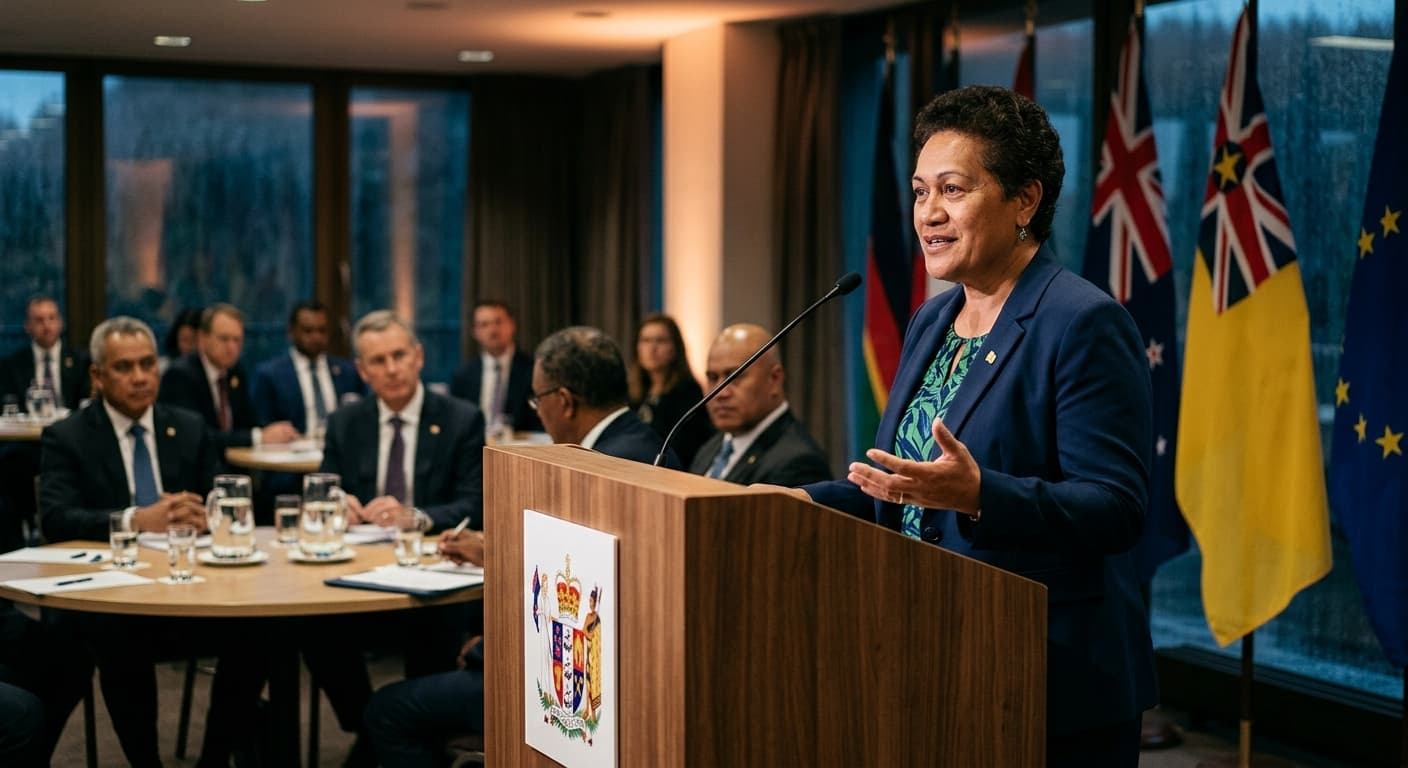
Niue's 2,000-Person State Is Running Its Own Foreign Policy — And Winning
A microstate with no military and 2,000 citizens is building independent diplomatic reach beyond New Zealand. The strategy is quiet, pragmatic, and driven entirely by survival.
The Model Diplomat's updated country profile on Niue, refreshed on June 10, captures something easy to miss: one of the world's smallest self-governing states is methodically constructing an independent foreign policy — and it's working. The profile details how this Polynesian island, in free association with New Zealand since 1974, has moved well beyond its constitutional dependency. Niue now maintains three overseas consulates, engages directly with major powers, and pursues climate diplomacy at the highest multilateral levels — all while New Zealand remains the financial and security backstop, supplying roughly 78% of Niue's foreign assistance between 2008 and 2022.
The power dynamic is counterintuitive. Niue holds no military, no full UN membership, and a population smaller than a mid-sized apartment building. Yet Premier Dalton Tagelagi has converted existential vulnerability into diplomatic leverage. The island's first National Strategic Road Map, running 2016–2026, explicitly targeted outward diplomatic expansion as a core pillar. By 2024, Niue had opened its third consulate — in Tokyo, joining existing missions in Wellington and Brussels — following a fifteen-minute meeting between Tagelagi and then-Japanese Prime Minister Kishida at the 10th Pacific Islands Leaders Meeting, as
Modern Treatise reported in January 2025.
The strategy is diversification, not alignment
Niue's diplomatic playbook is disciplined and transactional. It takes aid and development partnerships where they're offered — from Japan on infrastructure, China on grant-funded projects, India on climate adaptation — without drifting into anyone's sphere of influence. The United States formally recognized Niue as a sovereign and independent state in September 2023, a move Al Jazeera described as part of Washington's broader Pacific push to counter Beijing. But Niue has shown little interest in becoming anyone's geopolitical pawn. The government's first National Security Strategy, noted in the Model Diplomat profile, frames threats through the lens of climate adaptation, maritime domain awareness, cyber risk, and cultural heritage protection — not great-power competition.
The numbers tell the same story. New Zealand's 2024 pledge of over NZ$20 million for a renewable energy project targeting 80% of Niue's power needs, documented by Grokipedia, reinforces Wellington's central role. But Niue has simultaneously cultivated relationships that give it options: the 2023 US recognition, the 2024 establishment of ties with the Marshall Islands, and sustained engagement with Japan and the Pacific Islands Forum. None of these displace New Zealand — but they mean Niue no longer depends on a single patron.
Why it matters
This matters because Niue is a leading indicator of how Pacific microstates are navigating the region's intensifying geopolitical contest. At the Pacific Islands Forum summit in September 2025, climate change and security dominated the agenda — but notably, the forum's donor partners including China and the US were barred from attendance after a dispute over Taiwan's status. Niue operates comfortably in this environment: present at every multilateral table it can access, aligned with no one's agenda but its own.
Niue also demonstrates a model for size-constrained diplomacy. It has no formal political parties — candidates run as independents and form governing coalitions — which reduces ideological capture of foreign policy. Tagelagi's government can pivot toward Beijing's infrastructure offers or Washington's climate funding without triggering a domestic political crisis. The constraint is capacity, not political will.
What to watch next
The National Strategic Road Map expires in 2026. The successor framework — and whether it doubles down on independent diplomatic capacity — is the next decision point. Also watch whether Niue pushes for fuller UN participation. It already belongs to WHO, UNESCO, and other specialized agencies, but lacks a General Assembly seat. A bid for observer status or upgraded participation would signal just how far this microstate intends to go. New Zealand's reaction — supportive or territorial — will reveal whether the free-association model stretches or snaps under the weight of Niue's quiet ambition.
Discover more

US Politics
SNAP Food Assistance Faces Legal Challenges
In 2026, SNAP faces stricter eligibility rules and mounting legal challenges, threatening food assistance for the millions of Americans who rely on the program.

India
Yamini Aiyar on Modi's Federalism Shift
Yamini Aiyar critiques Modi's shift from equity-based to performance-based federalism, highlighting implications for India's political landscape.
India
700 Activists Accuse PM Modi of MCC Breach
Over 700 activists allege PM Modi breached election code with a televised address attacking opposition parties just before state elections.

Conflict & Security
Drone Warfare Killing Aid Workers at Unprec
Over 1,000 humanitarian workers killed in three years as cheap armed drones collapse legal protections. Gaza, Sudan, Ukraine, and DRC see deliberate targeting of aid convoys and hospitals with zero prosecutions.