Nigeria's $20bn gas bet prioritizes industry
NNPC signs six gas deals, focusing on domestic needs over exports.
Model Diplomat8 min readAfrica
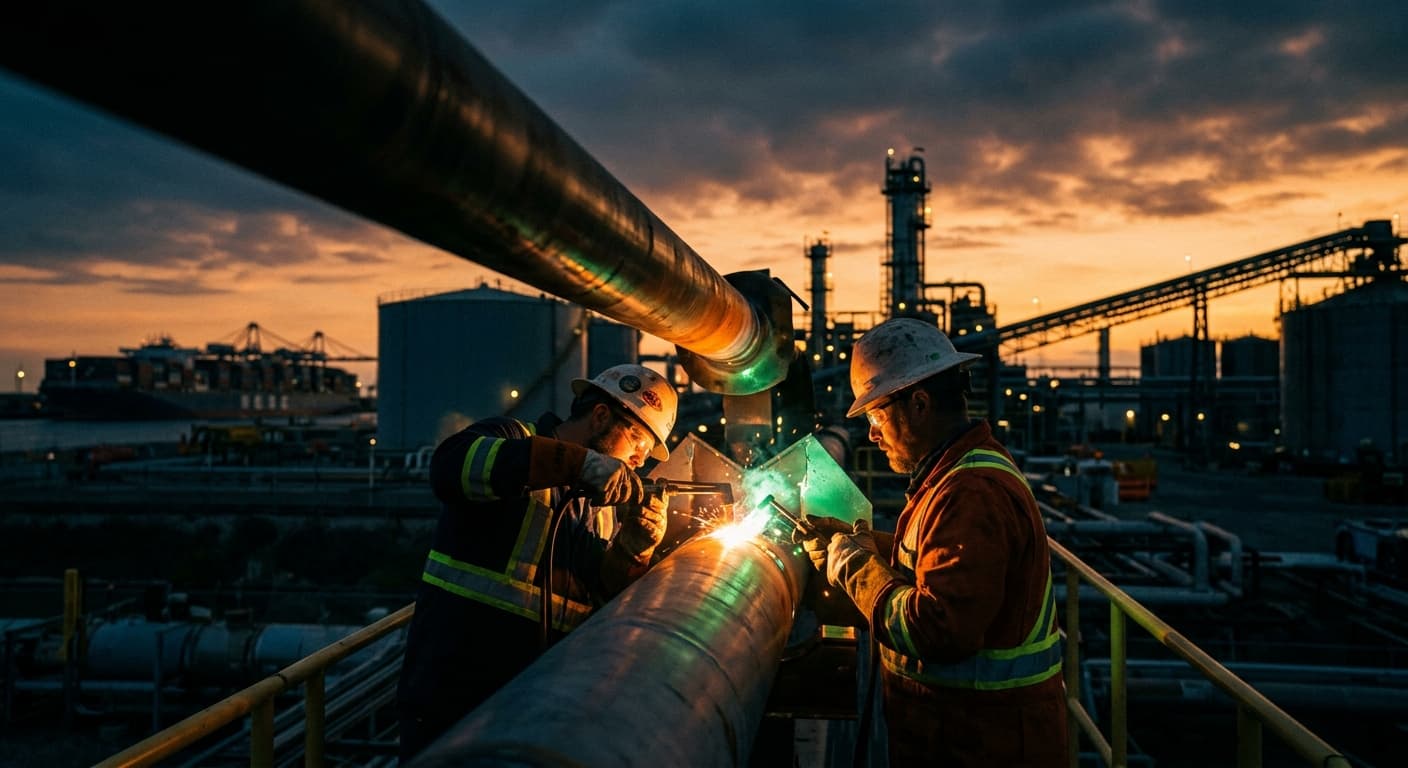
Nigeria's $20bn gas bet: Abuja picks industry over exports
Nigeria's NNPC signed six landmark gas deals on July 8, 2026, anchoring a $20bn pivot that prioritises domestic industry over Europe's LNG diversification agenda.
Nigeria's state oil company is quietly rewriting the terms on which Africa's largest gas reserves reach world markets — and Europe is the loser. On July 8, 2026, the Nigerian National Petroleum Company Limited (NNPC Ltd) inked six agreements on the sidelines of the 25th Nigeria Oil and Gas (NOG) Energy Week in Abuja, ring-fencing roughly 1 billion standard cubic feet per day for domestic industry and a single floating LNG project before any molecule reaches the long-planned Nigeria–Morocco pipeline. Group CEO Bayo Bashir Ojulari framed the package as "igniting the engine of Nigeria's industrialisation," but the strategic message is sharper: Abuja is treating gas as a domestic industrial input first, an export commodity second, and a climate-transition fuel only in the language it uses to sell the strategy abroad.
The scale is not incremental. NNPC disclosed that it has signed more than US$20 billion in Gas Sale and Purchase Agreements over the past twelve months, covering 1.29 billion cubic feet per day (bcf/d) of long-term LNG feedgas and a further 750 million cubic feet per day earmarked for Dangote Refinery and DFL FZE, according to Daily Trust. Total national gas production has climbed to 7.5 bcf/d, driven by the completion of the River Niger crossing on the Ajaokuta–Kaduna–Kano (AKK) pipeline and the commissioning of the ANOH Gas Processing Plant.
What was actually signed
The Abuja package has three distinct workstreams, and they should not be conflated.
First, an industrial anchor: NNPC Ltd signed a Memorandum of Understanding and a 20-year Gas Sale and Aggregation Agreement with Ajaokuta Steel Company Limited (ASCL), committing 3 million cubic feet per day of firm contract volume and 47 mmscf/d of interruptible volume to power the long-mothballed steel complex, Champion Newspapers reported. Ajaokuta's chief executive Prof. Nasir Abdulsalam called it a "turning point," according to
Independent Nigeria — a plant idle for four decades finally has feedstock.
Second, the LNG anchor: the NNPC/Seplat joint venture signed a 15-year Wet Gas Sale and Purchase Agreement to deliver 200 mmscf/d to UTM FLNG, Nigeria's flagship floating liquefaction project. The volume commitment is the missing piece for lenders; NNPC expects the project to reach a Final Investment Decision in Q4 2026, according to The Guardian Nigeria.
Third, the network reform: three Network Entry Agreements — with Chevron Nigeria Ltd, AGPC and NNPC Exploration & Production Ltd — migrate legacy gas-supply contracts onto Nigeria's new Gas Transportation Network Code, injecting up to 800 mmscf/d into the national pipeline grid for power plants and gas-based industries. TheStar reports the Chevron leg alone will materially improve pipeline flexibility on the Escravos–Lagos system.
Add the six deals together and the pattern is unambiguous: of every ten cubic feet newly committed on July 8, roughly eight are staying in Nigeria.
The angle: domestic-first is a break with the export playbook
The prevailing Western narrative — echoed in policy briefs from the German Marshall Fund and Morocco's
Policy Center — is that Nigeria is Europe's escape route from Russian gas and the geographic anchor of the 5,600-km African-Atlantic Gas Pipeline (AAGP). The Atlantic Council concurred in an October 2025 assessment that AAGP could become "the most important piece of infrastructure on the entire continent" if it clears sales and transit agreements with eleven countries, according to a report on
natural gas in Africa's transition.
That thesis assumes gas surplus. Nigeria no longer has one to spare — at least on paper. With 210.54 trillion cubic feet of proven reserves but current production of only 7.5 bcf/d, of which some 3 bcf/d already goes to LNG exports and 1.5 bcf/d to domestic use, the marginal molecule is now spoken for by domestic industry, according to the Policy Center's April 2025 analysis. Ojulari's own remarks at NOG made the priority explicit: gas is "the only product that can have that level of industrial impact on Nigeria, more than any other hydrocarbon."
The counter-signal to Europe is not rhetorical. Petroleum Minister Heineken Lokpobiri used the same stage to defend fossil fuel investment in blunt terms: "You guys have used fossil fuels to industrialize. You want us to industrialize without energy?… Africa is accountable for 3% of global emissions but [others] are responsible for 97%," he told delegates, per Daily Trust. That is not a climate posture. It is a bargaining position.
Who wins, who loses
The clearest winner is Aliko Dangote. Of NNPC's $20 billion gas-sale book, 750 mmscf/d — nearly a quarter of current national output — flows to Dangote Refinery and its DFL FZE affiliate. The Financial Times reported in March 2026 that Dangote plans a 1.4 million bpd refinery expansion backed by a $5 billion Afreximbank facility, FT confirmed. Long-term domestic gas at regulated prices is the input that makes that math work.
The second winner is UTM Offshore. Its floating LNG project has spent three years chasing bankability; a 15-year firm feedgas contract from the NNPC/Seplat JV changes the credit profile overnight and puts the project on track for FID before year-end.
The third — and least anticipated — winner is Nigerian independent producers. Petroleum Minister Lokpobiri said Nigerian independents now account for over 60% of national oil output following IOC divestments in 2023–2024, and the Network Entry Agreements route their gas onto NNPC's transportation code on standardised terms. That is a structural transfer of leverage from majors to indigenous operators.
The loser column is longer than Abuja will admit. Europe's diversification planners lose the near-term Nigerian option: an "export-first gas strategy" of the kind the GMF warned against is precisely what NNPC is refusing to run. The AAGP, championed by King Mohammed VI and framed by the Policy Center as a 30 billion cubic metres-per-year lifeline from West Africa to European buyers, still lacks the long-term supply contracts a $25 billion pipeline needs to reach FID. Every cubic foot booked domestically at NOG is a cubic foot not available to anchor that line.
Nigeria's own climate ledger is the other loser. The IMF's 2025 Selected Issues Paper on Nigeria noted that Nigeria has pledged a 20% unconditional emissions cut by 2030 and net-zero by 2060 under its Nationally Determined Contribution, and estimated its Energy Transition Plan requires $410 billion of additional investment. The
World Bank's 2026 National Energy Compact for Nigeria explicitly conditions its support on a "Gas Master Plan and gas flaring policy consistent with Nigeria's 2060 net zero targets." Locking in 20-year and 15-year gas offtakes for steel and LNG is a long shadow to cast over that arithmetic.
The Ajaokuta bet and the emissions math
Ajaokuta is not incidental — it is the ideological centre of the package. A steel complex built in the 1980s and never commissioned, it has become shorthand for Nigerian industrial failure. NNPC's MoU commits both sides to producing "raw materials for oil and gas pipes" domestically, explicitly for the AAGP and the third phase of the Escravos–Lagos Pipeline System.
The tell is that Abuja is willing to divert regulated-price gas — inevitably below export parity — to make it work. That is a subsidy in all but name. The IMF has warned that "adjustments to better align domestic natural gas prices with export-parity levels" are needed to attract upstream investment; NNPC's Ajaokuta contract runs in the other direction.
On climate, the numbers cut both ways. IMF staff modelled that under current policies Nigerian emissions still reach 515 Mt CO₂e by 2030 — 10% short of the NDC pathway — and that further reductions depend heavily on cutting methane and gas flaring, which they flagged as a domestic supply opportunity. Nigeria endorses the World Bank's
Zero Routine Flaring by 2030 initiative but has repeatedly missed interim milestones; the country was named among ten states accounting for 75% of global flaring, according to the Bank's own communications. Piping formerly flared gas into industry is climatically defensible. Piping it into a 15-year LNG offtake is a bet that gas remains a "transition" fuel long enough to amortise the ship.
The regional geometry
The domestic-first pivot has second-order consequences beyond Abuja's control. West African neighbours have been counting on Nigerian gas — via the West African Gas Pipeline extension and eventually AAGP — to underwrite gas-to-power in Benin, Togo, Ghana, Côte d'Ivoire and Senegal, with the Policy Center noting that about 8% of Nigeria's projected domestic gas is earmarked for pipeline exports under the Decade of Gas plan.
If NNPC continues to book 20-year domestic tranches at the pace of the last twelve months, that 8% ceiling becomes politically hard to raise. Morocco's calculation — that Nigeria's gas plus Moroccan geography equals Europe's second-track supply corridor — depends on Nigerian gas volumes that Abuja is now visibly committing elsewhere. The Trans-Saharan Gas Pipeline through Niger and Algeria, endorsed at various points by Sonatrach and NNPC, faces the same squeeze — with the added complication that Niger's post-2023 political trajectory has weakened ECOWAS coordination on the corridor.
What changes the forecast
Three things would move the needle. First, the pace of AKK completion: NNPC put the pipeline at 72% complete in April 2025; if it reaches Kano within twelve months, the northern industrial demand centre absorbs whatever surplus remains. Second, UTM FLNG's Q4 2026 FID — if it slips, the 200 mmscf/d could be re-routed to AAGP anchor volumes. Third, the July 2026 Seplat CEO recommendation for a harmonised gas legislation would, if enacted, create the single legal instrument European financiers need before writing AAGP cheques.
Diplomat View
The July 8 deals are not a diversification story dressed as an industrial one — they are the opposite. Nigeria under Ojulari and Tinubu has made a strategic choice to convert its gas reserves into steel, refined fuels and captive LNG revenue at home, and to let European buyers wait or pay more. The forecast: AAGP will not reach Final Investment Decision in 2026 or 2027, and Nigeria's contribution to EU LNG imports — 5% in the first half of 2025, per the German Marshall Fund — will grow only marginally through 2028, capped by domestic offtakes signed this week. What would change the forecast: a European sovereign or IFI writing an anchor equity cheque for AAGP of $3–5 billion by mid-2027, or a collapse in Dangote Refinery gas demand freeing 400+ mmscf/d back into the export pool. Absent either, Europe's second track runs through Doha and Washington, not Dakhla.
What to watch next
- Q4 2026: UTM FLNG Final Investment Decision — the direct test of whether the 200 mmscf/d commitment is bankable.
- COP31 (November 2026): whether Nigeria updates its NDC to reflect 20-year gas offtakes and net-zero-2060 alignment, or seeks Article 6 carbon credits to offset them.
- AAGP steering committee: Morocco–Nigeria feasibility update expected before end-2026; watch for a revised route or a delayed FID timeline.
Nigeria remains central to Global Politics — but on gas, the geometry is being redrawn from Abuja outward, not from Brussels inward.
Discover more

US Politics
House Ethics Committee Pushes Sexual Miscond.
The House Ethics Committee has shifted responsibility for sexual harassment settlement records to the Office of Congressional Workplace Rights, complicating disclosure efforts.

US Politics
SNAP Food Assistance Faces Legal Challenges
In 2026, SNAP faces stricter eligibility rules and mounting legal challenges, threatening food assistance for the millions of Americans who rely on the program.
India
Women’s Reservation Bill 2026
The Constitution (131st Amendment) Bill, 2026 was defeated in Lok Sabha, revealing deeper political conflicts over women's reservation and delimitation.

Conflict & Security
Drone Warfare Killing Aid Workers at Unprec
Over 1,000 humanitarian workers killed in three years as cheap armed drones collapse legal protections. Gaza, Sudan, Ukraine, and DRC see deliberate targeting of aid convoys and hospitals with zero prosecutions.