Niger Declares Russia Main Partner in Sahel
Niger's foreign minister praises Russia amid security failures.
Model Diplomat7 min readAfrica
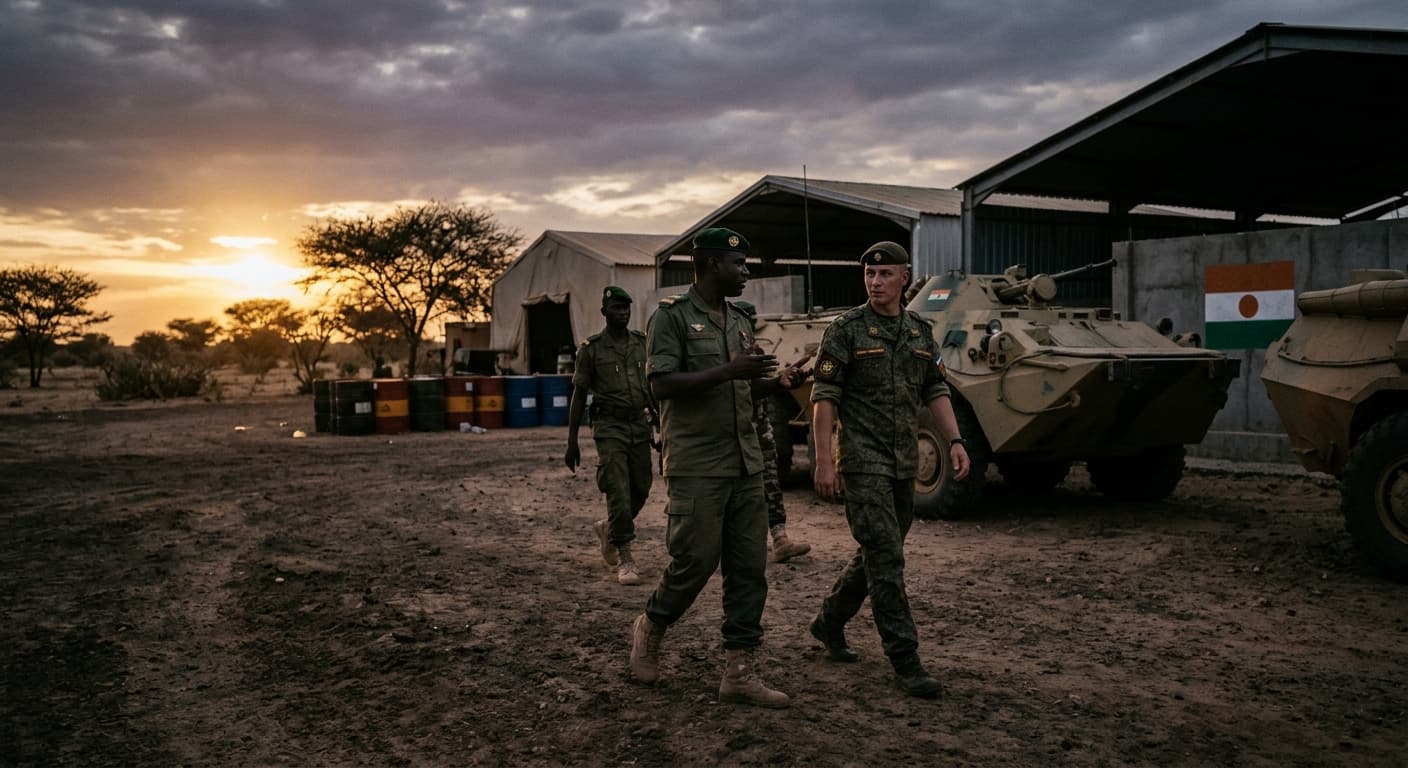
Russia's Sahel Bet: Niger Anoints Moscow, But Africa Corps Is Losing Ground
Niger's foreign minister called Russia the Sahel's "main partner" against terrorism on July 8, 2026 — even as JNIM overruns towns Moscow's forces once secured.
Niger's Foreign Minister Bakary Yaou Sangaré declared Russia the Alliance of Sahel States' "main partner" in counter-terrorism at a July 8 ministerial in Niamey with Sergey Lavrov — a political blessing that lands precisely as the military argument for the partnership is collapsing. Africa Corps has just been driven out of Kidal, JNIM is blockading Bamako, and the Malian defence minister who built the Russia relationship is dead. The declaration matters less as a security statement than as a hedging device: the juntas need Moscow's political cover to keep Western pressure at bay while they quietly recalibrate toward Rosatom and, tentatively, toward Washington.
What was actually announced in Niamey
Sangaré's remarks came at the second Russia–AES ministerial, held during Lavrov's first official visit to Niger, RT reported. The foreign minister said the AES was "satisfied" with defence agreements signed with Moscow, and Lavrov confirmed Russia had completed its embassy network across the alliance with the Niamey mission. Putin, Lavrov added, has invited the three junta chiefs to the third Russia-Africa Summit in Moscow.
The joint communiqué language echoes what Lavrov's ministry has repeated since the April 3, 2025 Moscow ministerial that produced the first formal AES–Russia statement: shared commitment to a "multipolar world," rejection of "neo-colonial practices," Russian support for building the capacity of the AES joint force. A Russian embassy document circulated in Dakar puts it plainly:
Moscow "supports our Sahel friends in the fight against terrorism by strengthening the capabilities of their national armies and the Joint Force".
Read against the battlefield, that rhetoric is hollowing out. On April 25–26, 2026, JNIM and the Tuareg-dominated Azawad Liberation Front launched coordinated attacks that killed Malian Defence Minister Sadio Camara — the architect of the Russia partnership — and forced Africa Corps to abandon Kidal, a town Wagner had captured in November 2023. The International Crisis Group called it an unprecedented multi-front strike;
the Stimson Center described it as "a pivotal turning point" that exposed both Malian and Russian vulnerabilities. By May, JNIM was throttling supply routes to Bamako.
The power dynamic: who has leverage over whom
The reflexive reading is that Moscow now dictates terms in the Sahel. The evidence points the other way. The juntas hold the leverage — because Russia's ability to deliver security has visibly declined while its need for African political wins has grown.
Three data points make the case. First, casualties. The Centre for Democracy and Development's West Africa Security Tracker recorded 12,964 conflict fatalities across West Africa in the first half of 2025, with Burkina Faso alone accounting for 3,539 — 27% of the regional total. The 2025 Global Terrorism Index
ranked Burkina Faso the country most affected by terrorism worldwide, with a quarter of all extremist attacks globally in 2024 occurring inside its borders. Under Russian tutelage, the Sahel has become the world's deadliest terrorism theatre.
Second, force structure. RAND estimates roughly 1,000 Russian contractors in Mali and only 100–300 in Burkina Faso; Al Jazeera puts
Niger's contingent at around 100. Africa Corps arrived to replace Wagner after Yevgeny Prigozhin's death, but as the Real Instituto Elcano notes,
80% of its personnel are former Wagner fighters with the same operational culture — and Ukraine's demands keep siphoning off the best of them.
Third, delivery. Foreign Affairs argued in a March 2026 assessment that Russia is "losing the Sahel" because it has been "long on theatrics and short on actual resources." The essay flagged that Niamey terminated its signals-intelligence partnerships with both Ankara and Moscow in spring 2025, "citing the poor quality of their telephonic intercept systems — a pointed reminder that Sahelian regimes are nobody's clients."
What Moscow actually delivers now: cover, uranium, nuclear symbolism
Strip away the counter-terrorism framing and Russia's Sahel offer is legible. It sells three things the juntas cannot buy elsewhere: sovereign political cover against Western sanctions, an alternative buyer for uranium the West has effectively blacklisted, and the symbolism of civil-nuclear cooperation that plays to popular demand for "energy sovereignty."
On uranium, the Niger junta nationalised the Somair mine in June 2025 after stripping Orano of its licences at Imouraren and Arlit. Roughly 1,000 tonnes of yellowcake sits stranded in Niamey. An
international arbitration tribunal ruled in September 2025 that Niger cannot sell or transfer the stockpile, and French prosecutors have opened an investigation into "organized theft for the purpose of serving the interests of a foreign power." Rosatom is the only realistic buyer willing to defy that order.
On the political side, Hudson Institute analyst Zineb Riboua notes that Moscow is "combining security, energy, and mining deals" to offer "a package of regime-survival tools that Western governments are either unwilling or unable to provide." Rosatom has signed civil-nuclear MoUs with all three AES states — a bet that binds them to Russian training pipelines and fuel supply chains "for decades."
Then there is the AES's collective rejection of Western legal architecture. On September 22, 2025 the alliance announced joint withdrawal from the International Criminal Court, calling it an "instrument of neocolonial repression." Niger formally lodged its withdrawal instrument on June 18, 2026; the
ICC Presidency confirmed receipt on July 1, noting the withdrawals take effect in June 2027 under Article 127(1).
Human Rights Watch called it a "betrayal" of victims. This matters because
BBC Monitoring documented 1,486 civilian casualties caused by Malian forces and their Russian allies between January 2024 and March 2025. Moscow benefits from a legal vacuum Africa Corps now operates inside.
The Washington counter-move — and why the juntas welcome it
The story's second-order beneficiary is not obvious. It is the Trump administration.
In early 2026 the State Department dispatched Bureau of African Affairs head Nick Checker to Bamako, in what the Council on Foreign Relations described as an effort to "chart a new course" and "move past policy missteps." AFRICOM's deputy commander General John Brennan had already signalled "targeted, limited intelligence sharing" with the three juntas. The BBC reported that Washington now
wants to "engage" all three AES states, and unlike the Biden administration or ECOWAS, "does not regard the Russian military presence as a threat to regional stability."
The juntas' calculation is straightforward: play Moscow and Washington against each other, refuse to be anyone's client. This is why Sangaré's July 8 "main partner" formulation matters — it is a public reassurance to Moscow at the exact moment Niamey is quietly exploring US mediation on the uranium stockpile crisis. The Atlantic Council flagged that Tchiani is "considering returning the uranium to Orano" with quiet US brokerage. That is not the behaviour of a Russian satellite.
The regional security implication: containment is failing
The strategic consequence extends well beyond the AES triangle. JNIM has moved south. The BBC's jihadist-media monitoring team documented over 280 JNIM-claimed attacks in Burkina Faso in the first half of 2025 alone, double the same period in 2024. The group is now
operational in 11 of Burkina Faso's 13 regions and infiltrating Benin, Togo, Ghana and Côte d'Ivoire.
The Institute for Security Studies notes the AES Unified Force — 6,000 troops headquartered in Niamey since December 2025 — is procuring equipment "from Russia, Turkey, Iran and China," a deliberate diversification designed to avoid dependence on any single external patron. Chatham House warned in April 2025 that the AES–ECOWAS rupture has
gutted the intelligence-sharing that once contained the insurgencies. Coastal states now bear the spillover costs of a Sahel security architecture built on Russian rhetoric and Malian bravado.
The historical parallel is instructive. In 2014 the same three states, backed by France and the UN, formed the G5 Sahel Joint Force. It failed because it lacked political cohesion and adequate funding. The AES Unified Force is its third iteration under a new patron — and if ISS Africa is right that its success depends on rebuilding ties with coastal neighbours, Russia offers nothing on that dimension. Moscow cannot mediate with Abuja, Accra or Abidjan. Only Washington and the African Union can.
Diplomat View
The Niamey declaration should not be read as consolidation of Russian influence — it should be read as a political receipt the juntas are issuing Moscow to keep the relationship warm while its military value drains. Africa Corps has become a regime-protection service, not a counter-insurgency force. The evidence: Kidal lost, Camara dead, Bamako blockaded, Burkina Faso now the world's terrorism epicentre, and Sangaré's "main partner" line delivered at a ceremonial ministerial rather than after a battlefield win.
The falsifiable call: if the third Russia-Africa Summit in Moscow later this year produces a binding Rosatom purchase agreement for the Niamey yellowcake stockpile, Russia's leverage hardens and this analysis is wrong. If instead the stockpile moves under quiet US mediation — as the Atlantic Council anticipates — then the juntas have used Moscow's political cover to buy negotiating room with Washington, and the "main partner" rhetoric is exposed as tactical. Watch the uranium, not the communiqués.
What to watch next:
- Russia-Africa Summit, Moscow (late 2026): Whether Tchiani, Goïta and Traoré attend in person, and whether a Rosatom-Niger uranium offtake deal is announced.
- June 2027: AES withdrawal from the Rome Statute takes formal effect; the Sahel Criminal and Human Rights Court proposed in June 2025 must be operational or the accountability vacuum widens.
- AES Unified Force operational tempo: First cross-border joint operations expected in the second half of 2026 — a genuine test of whether Moscow's "capacity-building" claims have any content.
- Orano arbitration and US mediation track: Any movement of the 1,000-tonne Niamey yellowcake stockpile will be the clearest signal of which patron the
Niger junta is actually choosing.
The Bottom Line
Niger's declaration that Russia is its "main partner" against terrorism is a diplomatic hedge, not a strategic verdict — issued at the moment Africa Corps has visibly failed to hold ground in Mali, Burkina Faso has become the world's most terrorised country, and the juntas are quietly courting Washington to break the Orano uranium impasse. Moscow now offers regime protection, political cover, and civil-nuclear symbolism; it no longer offers battlefield victory. If the Sahel's next inflection point is the Niamey yellowcake — and it almost certainly is — the winner will be whoever mediates its release, and that is unlikely to be Russia.
Discover more
US Politics
House Ethics Committee Pushes Sexual Miscond.
The House Ethics Committee has shifted responsibility for sexual harassment settlement records to the Office of Congressional Workplace Rights, complicating disclosure efforts.
US Politics
SNAP Food Assistance Faces Legal Challenges
In 2026, SNAP faces stricter eligibility rules and mounting legal challenges, threatening food assistance for the millions of Americans who rely on the program.

US Politics
Next Generation Republicans
A leaked survey shows 39% of Republicans under 30 do not identify as MAGA, revealing a split in the GOP's future leadership.

Conflict & Security
Drone Warfare Killing Aid Workers at Unprec
Over 1,000 humanitarian workers killed in three years as cheap armed drones collapse legal protections. Gaza, Sudan, Ukraine, and DRC see deliberate targeting of aid convoys and hospitals with zero prosecutions.