Nexperia's Split Signals Chip Decoupling
The Netherlands and China navigate a tech war outcome.
Model Diplomat8 min readEurope

The Hague's Nexperia Reset Is Papering Over a De Facto Chip Decoupling
The Netherlands says it is "cooperating extremely well" with China on Nexperia. In reality, the company has already split in two — and that outcome, not the diplomacy, is the template for the next phase of the tech war.
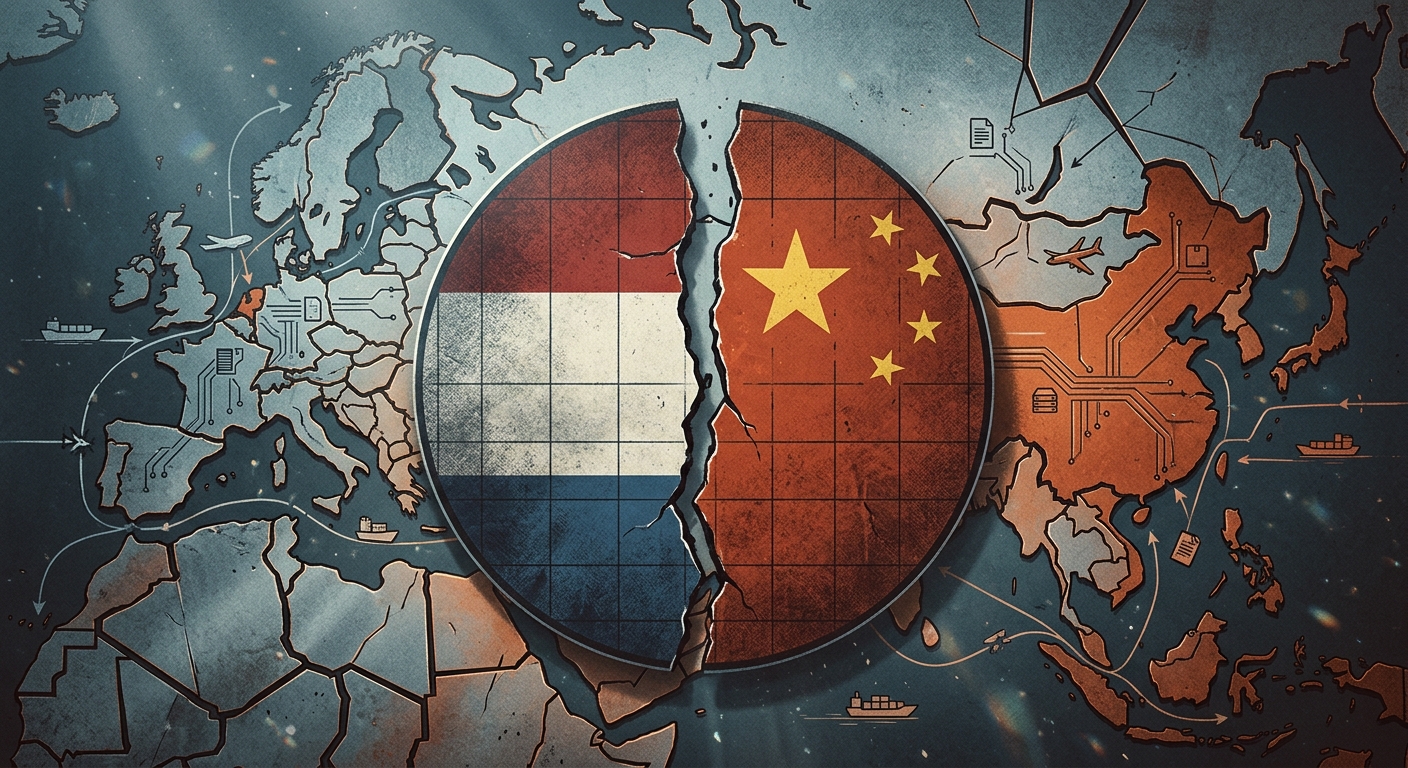
Dutch Trade Minister Sjoerd Sjoerdsma flew to Beijing on July 7, 2026 — the first visit by a Dutch trade minister to China since 2018 — to declare the Nexperia dispute effectively contained. It isn't. The company Wingtech Technology bought for $3.63 billion in 2018 has been quietly cleaved in two: Nexperia China has declared operational independence from its Dutch parent and is now buying wafers from alternative Chinese fabs, according to a company statement in May reported by Reuters. That is not a governance dispute headed for resolution. It is a completed corporate decoupling that both governments have decided to bless — and it is the clearest signal yet of how mid-tier semiconductor supply chains will actually split under US–China pressure: not by decree, but by fait accompli.
The Bloomberg-style read: The Hague avoided a rupture with Beijing by trading process for outcome. It kept the Enterprise Chamber ruling that stripped Wingtech of its voting rights, suspended the emergency order that triggered China's retaliation, and let Nexperia's Chinese unit walk away with the branded Chinese business. Europe kept the IP, the front-end fabs in Hamburg and Manchester, and — for now — the appearance of strategic autonomy. Beijing kept a domestic legacy-chip champion no longer subject to Dutch or American jurisdiction. Both capitals can call it a win. Carmakers, who nearly ran out of the $0.50 diodes that make electric-window switches work, quietly agree.
What Sjoerdsma actually agreed to in Beijing
Sjoerdsma met Chinese Commerce Minister Wang Wentao on July 7 and told reporters the two governments "wanted to make a clean break with the previous period in which there were a lot of frictions and a lot of problems," per the Reuters wire carried by KELO. The language matters. He is not promising to reverse the Dutch court ruling that removed Wingtech founder Zhang Xuezheng as CEO. He is not restoring Wingtech's voting rights. And Beijing, tellingly, is no longer publicly demanding those things as preconditions.
That is a sharp reversal from December 31, 2025, when China's Ministry of Commerce called on The Hague to "immediately correct its mistake" and cease "improper administrative interference" in the company, as reported by Al Jazeera. What changed between January and July was not Dutch policy — it was the corporate reality on the ground. Once Nexperia China began sourcing wafers from alternative Chinese suppliers and Wingtech consolidated its onshore business, Beijing no longer needed the European entity restored. It had already built the replacement.
The primary document The Hague wants you to read carefully
The Dutch case rests on a Kamerbrief — a formal letter to parliament — from Economic Affairs Minister Vincent Karremans dated November 19, 2025. It is available on the official parliamentary record and is the single most authoritative document in the file. Karremans wrote that without intervention, Nexperia's European "front-end production" would have disappeared "in the short term" as a result of CEO conduct, taking with it "the last knowledge, expertise and capacity of Nexperia in Europe":
"Without intervention, the European 'front-end production' of the company, as a result of the CEO's actions, would have disappeared from Europe in the short term. With that, the last knowledge, expertise and capacity of Nexperia would have disappeared from Europe, and this would have come at the cost of the resilience of the Dutch and European economy."
That framing — resilience, not sanctions enforcement — is what let The Hague suspend the order on November 19 without admitting error. The Rijksoverheid statement describing the original September 30 emergency order stresses that the Goods Availability Act is deployed only "when there really is no other option" and is not targeted at "other companies, the sector, or other countries." That disclaimer is doing an enormous amount of diplomatic work.
Why the "we don't take orders from Washington" line is thin
Dutch officials have consistently denied that the Nexperia intervention was a response to US pressure. Court papers released by the Enterprise Chamber say otherwise. Documents cited by the BBC show Dutch authorities told Nexperia that "it is almost certain that the CEO will have to be replaced to qualify for the exemption from the entity list" — because the "Chinese owner is problematic." The trigger was a September 29, 2025 rule by the US Bureau of Industry and Security extending Entity List controls to any firm at least 50% owned by a listed company. Wingtech has been on the list since December 2024.
That timing is the entire story. The US shifted its rule on September 29. The Dutch invoked their emergency law on September 30. Anyone insisting these are unrelated is not reading calendars.
The Hague's real dilemma was structural: it holds jurisdiction over ASML, the world's monopoly supplier of extreme-ultraviolet lithography tools, and cannot afford to become the weak link in the allied export-control coalition. Losing Nexperia's IP to a Wingtech under US sanctions would have handed Washington a pretext to escalate secondary sanctions against Dutch firms. Losing carmaker supply to a Chinese retaliation would have handed Beijing a pretext to squeeze ASML customers in China. The intervention was the least-bad move — and the eventual corporate split was the least-bad settlement.
The MATCH Act is the reason July matters
Sjoerdsma's Beijing charm offensive is not happening in a vacuum. On April 2, 2026, US Representative Michael Baumgartner introduced H.R. 8170, the Multilateral Alignment of Technology Controls on Hardware (MATCH) Act — a bipartisan bill that would impose countrywide US export controls on covered semiconductor manufacturing equipment and, critically, extend jurisdiction over "allied supplier country" tools if allies do not adopt equivalent controls. A Senate companion,
S. 4281, followed on April 13. The House version was ordered reported on April 22.
The bill is aimed squarely at ASML's deep-ultraviolet (DUV) lithography systems and — as an American Enterprise Institute report published this spring lays out — at the servicing contracts that keep China's installed base of DUVi machines operational. If MATCH becomes law, the Netherlands faces a choice: adopt US-aligned countrywide controls, or watch Washington claim extraterritorial jurisdiction over Dutch equipment. Sjoerdsma told Reuters he is "confident that the very strict Dutch controls" ensure sensitive material does not reach China. That is a signal to Congress, not to Beijing.
The Nexperia settlement, in that light, is a hedge. The Hague is showing Washington it can be tough on Chinese ownership of European chip IP — and showing Beijing it will not be a lever for US extraterritorial escalation. Neither audience is fully persuaded.
The unexpected winner is not a chipmaker
The obvious losers are visible. Wingtech's Shanghai-listed shares fell 10% on the Dutch intervention announcement, per Al Jazeera. Volkswagen and Volvo warned of temporary plant shutdowns during the six-week Chinese export block, and the European Automobile Manufacturers' Association told the
BBC that supplies "would only last a few weeks" without exemptions.
The less obvious winner is the German auto sector's second-source strategy. Because 70% of Nexperia's European-made wafers travel to China for packaging, the crisis forced Bosch, Continental, and Infineon to accelerate the qualification of non-Chinese assembly-and-test lines they had penciled in for 2028. Once qualified, those lines don't get de-qualified. The Nexperia dispute has quietly locked in a partial reshoring of legacy-chip back-end packaging to Southeast Asia and Europe that no European Commission directive had managed to trigger. This is the second-order effect that will outlast the diplomacy.
A parallel report from the Hague Centre for Strategic Studies, published July 3, argues that Chinese interference in Dutch strategic sectors is "systemic and long-term" and identifies semiconductors as the highest-risk sector. The think-tank framing gives The Hague political cover to keep the Enterprise Chamber ruling in place indefinitely, even while normalising bilateral trade — a stance Dutch analyst Rem Korteweg and colleagues at
Clingendael have described as "technological de-risking" rather than decoupling.
The historical parallel: this is CFIUS 2018, not Huawei 2019
The right analogue for Nexperia is not the Huawei blacklisting of 2019. It is the forced 2018 divestiture of MoneyGram from Ant Financial, blocked by the US Committee on Foreign Investment in the United States. In both cases, a Chinese-owned asset in a Western jurisdiction was unwound not through outright expropriation but through a combination of regulatory pressure and corporate exhaustion. In both cases, the Chinese parent kept the domestic market and lost the international one. In both cases, the political story sold as "national security protection" masked a quieter industrial realignment.
The Nexperia template is now available to any European government facing a similar problem. Germany could invoke its Foreign Trade Ordinance against a Chinese-owned firm tomorrow and cite The Hague's precedent. That is the export product of this diplomacy — not a settlement, but a playbook.
What to watch next
- September 30, 2026 — the Wbg order lapses automatically at the one-year mark unless renewed, per the
minister's own letter. A quiet non-renewal would confirm the corporate split is final.
- MATCH Act floor action — the House bill was ordered reported on April 22, 2026; a floor vote before the November US election would force The Hague to commit publicly on DUV servicing in China.
- Wingtech's appeal at the Enterprise Chamber — a ruling restoring even partial voting rights would reopen the corporate governance dispute Sjoerdsma just declared closed.
- China's civilian-use exemption regime — Beijing has never defined "civilian use," per
BBC reporting on Trade Commissioner Maroš Šefčovič's confirmation of the exemption. Any narrowing would signal Beijing sees the truce as unraveling.
Diplomat View
The Nexperia dispute has been marketed on both sides as a diplomatic incident to be resolved. It is not. It is a completed decoupling being retroactively legitimised. The Dutch keep the fabs, the IP, and the ASML relationship they cannot afford to lose; Wingtech keeps a Chinese-domiciled legacy chipmaker Washington can no longer touch through Dutch jurisdiction. The forecast: The Hague will let the Wbg order expire in September without renewal, Wingtech will not regain voting control of Nexperia Europe, and by year-end Nexperia China will be operating as a de facto separate company with a rebranded identity within 18 months. What would change this call: a MATCH Act passage that forces the Netherlands to impose retroactive servicing bans on ASML tools in China — which would collapse the current bilateral truce and reopen the export-block cycle. Absent that, the mid-tech supply chain has just shown the world how it splits: through corporate exhaustion, not through decree. Every EU capital watching should now assume that any Chinese-owned strategic asset on European soil is subject to the same eventual severance — and act accordingly.
Related: Global Politics
Discover more
India
Rajnath Singh's Durga Squad for 2026 Polls
Rajnath Singh's Durga Squad promised women's safety in Bengal but has since disappeared from the agenda, revealing BJP's true priorities.

US Politics
SNAP Food Assistance Faces Legal Challenges
In 2026, SNAP faces stricter eligibility rules and mounting legal challenges, threatening food assistance for the millions of Americans who rely on the program.
Global Politics
Xi Jinping Calls China-Russia Ties 'Precious'
Xi Jinping's description of China-Russia ties as 'precious' reflects a strategic imbalance, with Beijing dictating terms in the partnership.

Economics
Fed's Amex AML order puts correspondent banking on notice
Federal Reserve's Amex AML order requires board-level controls and a 90-day plan; OCC fined the bank $350 million over enterprise-wide deficiencies.