Nepal Rastra Bank Holds Rates, Signals Change
Central bank maintains rates, hints at narrowing interest corridor.
Model Diplomat8 min readAsia
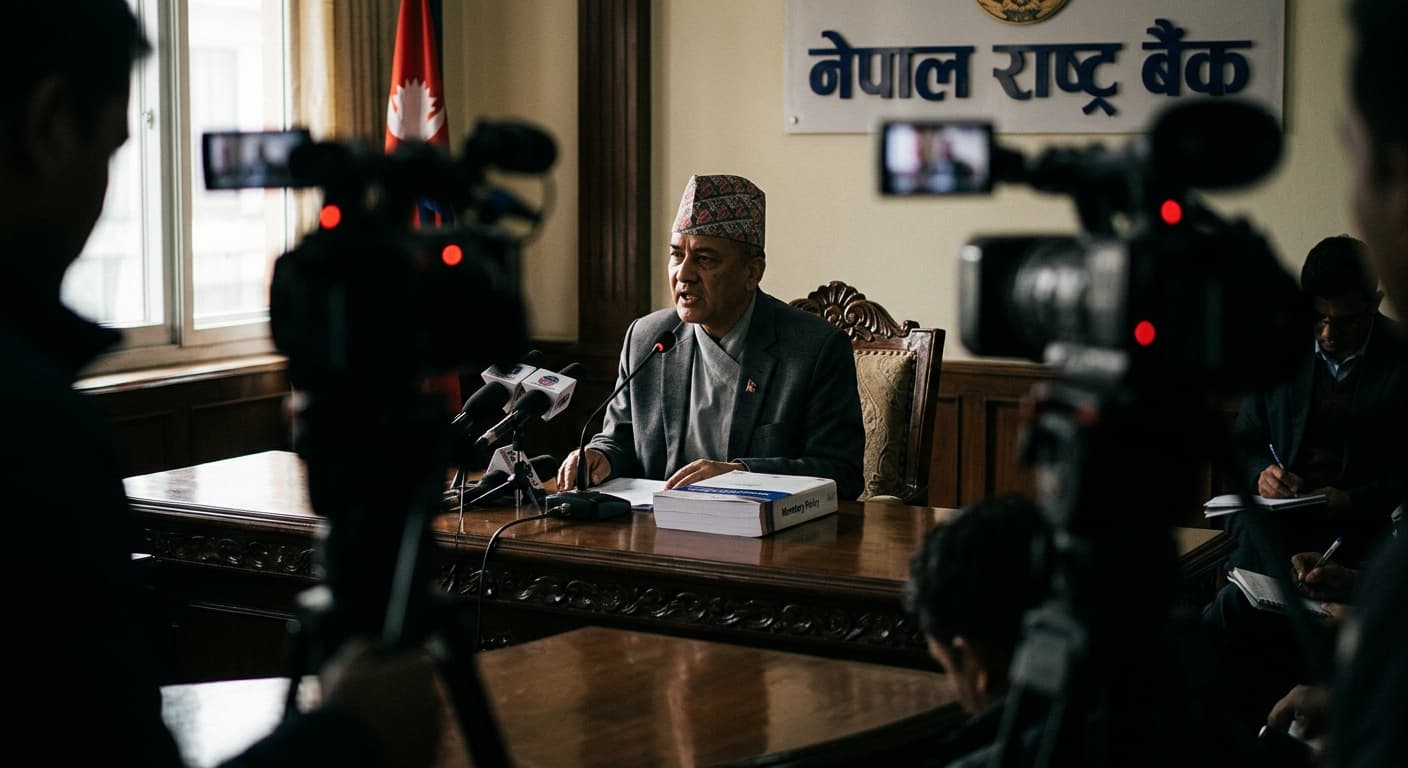
Nepal Rastra Bank Holds Rates, Signals Narrower Corridor for FY 2026/27
Nepal's central bank kept the policy rate at 4.5% on July 7, 2026, and promised to narrow a 325-basis-point corridor — a technical fix that is really about broken monetary transmission.
Nepal Rastra Bank held its policy rate at 4.50% on July 7, 2026, but the load-bearing sentence in Governor Bishwa Nath Poudel's speech was not about rates — it was about the corridor. Poudel pledged to "gradually narrow" the 325-basis-point band between the bank rate (6.0%) and the deposit collection rate (2.75%), an interval nearly seven times wider than the Reserve Bank of India's. The real story is not the pause; it is Kathmandu quietly admitting that with inflation at a record 1.7% and excess liquidity swamping the banking system, the "policy rate" has stopped functioning as one — and that fixing the plumbing now matters more than another cut.
The decision, unveiled in the Monetary Policy for Fiscal Year 2083/84 (2026/27), keeps the standing deposit facility rate at 2.75% and the bank rate at 6.0%, according to NEPSE Trading's summary of the release. On paper it is a status-quo call. In practice, it locks Nepal into a regime that its own regulators — and the IMF — say has been misfiring for two years.
The pause behind the pause
The macro backdrop makes the "hold" easier to read. The World Bank's April 2026 Nepal Development Update recorded headline inflation collapsing to 1.7% year-on-year in H1 FY26, down from 5.0% a year earlier, and well below the NRB's 5.0% ceiling, in its Nepal Development Update. Real GDP growth, meanwhile, was revised down to 2.3% for FY26 in the same report, weighed by the September 2025 unrest and Middle East spillovers. That is a textbook case for cutting — which the NRB in fact did during the H1 review, taking the policy rate from 5.0% to 4.25% before the FY26/27 document restated it at 4.5% as the new headline reference.
So why stop cutting now? Two reasons. First, the Kathmandu Post reported that the NRB is betting on a 7% growth target that the new single-majority government elected March 5 wrote into its budget — a number the IMF calls implausible but which the central bank does not want to be seen sandbagging. Second, and more consequentially, oil is back. The IMF's April 2026
Article IV report warns that "inflation is projected to pick-up from current low levels" as Middle East war premia feed through global fuel prices, with Nepal's currency peg to the Indian rupee transmitting India's imported inflation almost mechanically. Cutting further into a fuel-price upturn would risk overshooting the 5.5% ceiling by mid-2027.
Poudel put it more plainly in the policy document itself: if inflation pressure builds and the low-cost economy fails to translate liquidity into growth, "the interest rate corridor will be gradually narrowed as necessary," per Lagani News, which published the full text.
The corridor is the story
That corridor sentence is where the analysis has to focus. The NRB's own 2025/26 policy document conceded that to strengthen interest-rate-based transmission "it is essential to narrow the existing gap between floor and ceiling of the corridor in line with international best practices," according to the Nepal Rastra Bank. A year later, the gap is still 325 basis points. The Reserve Bank of India runs a 50-basis-point corridor. The European Central Bank effectively operates a 25-basis-point band. Nepal's is an outlier not by degree but by category.
Why does this matter beyond central-bank plumbing? Because in Nepal, the "policy rate" has become fictional. The IMF's Article IV finds that "strong FX inflows and deposit growth, driven in large part by remittances, and weak credit growth have led to a significant increase in excess liquidity and kept the interbank rate and interest rates on open market operations near the lower bound of the interest rate corridor." Translation: banks are so awash in cash that they lend to each other at rates near 2.75%, not the 4.5% the NRB flags as its stance. A working paper published by the NRB's own Economic Research Department in 2026 quantified the problem: the weighted interbank rate broke through the corridor floor on virtually every day the central bank did not run a Standing Deposit Facility auction, with a one-sided p-value of 0.00000101, per Victor Kumar Sapkota's NRB Working Paper 62/2026. Running the SDF cut the probability of a floor breach by more than 90%.
That is the number that reframes today's decision. The NRB is not so much easing or tightening as trying to rebuild a control system that has been leaking for two years. Narrowing the corridor — likely by lifting the SDF and cutting the bank rate in tandem — would compress that leak.
The winners: banks and the NEPSE
The immediate beneficiary is the equity market. NEPSE reacted to the July 7 statement with a sharp gap-up; BBC Nepali reported that the index closed at 2,760 on the first trading day after the announcement, up from 2,731 the session before, in its post-policy analysis. Two provisions did the work. The NRB raised the single-obligor margin-lending cap from NPR 150 million to NPR 250 million per bank, and floated a review of the 15%-of-paid-up-capital cap on microfinance dividends — both directly pumping leverage into a market where, as NEPSE information officer Murahari Parajuli told BBC Nepali, "the biggest expectation was cheap credit that can then flow into shares."
That expectation is unusually explicit. Nepal's stock market has been rising against monetary theory — indices up while lending rates were also low — because retail investors have replaced institutions as the marginal buyer, and because bank credit to the "unproductive" real-estate and equities complex is the residual outlet when private-sector loan demand is dead. Broad money grew 15.2% year-on-year to mid-April 2026 while private-sector credit expanded only 6.5%, according to the NRB's own annual review cited by Lagani News. The gap — nearly 9 percentage points — is the excess liquidity that has to go somewhere. On July 8, it went into equities.
Commercial banks, the second winner, get a triple gift: cheaper wholesale funding, a wider lending margin than any regional peer offers, and new NRB permission to invest in foreign government bonds to soak up excess NPR — a de facto sovereign carry trade the central bank is now explicitly sanctioning.

The losers: depositors, the IMF timetable, and the growth story
Real deposit rates rose in H1 FY26 because nominal rates barely moved while inflation collapsed to 1.7%, the World Bank noted. Savers — disproportionately older, rural and remittance-dependent households — are being paid to hold cash, but only until fuel prices bite. When inflation returns to the 4–5% band the IMF projects, real returns on the NPR 6-plus trillion parked in the banking system flip negative. That is a slow-motion political problem the NRB has not addressed.
The IMF is the more immediate loser. Nepal's Extended Credit Facility programme, now at its seventh review, is explicitly conditioned on making the interest rate corridor operational. IMF staff in the April 2026 Article IV consultation urged the NRB to increase "the volume of open market operations, enhancing liquidity forecasting, and ensuring a separation between monetary policy formulation and operational implementation" — a polite way of saying: pick a rate, defend it, and stop letting the finance ministry's cash flows dictate the interbank curve. The FY26/27 policy commits to "structural, regular, and emergency" liquidity operations, but the numerical target — a narrower corridor — remains "gradual." Fund staff wanted a date. They did not get one.
Growth is the third loser, at least in the near term. IMF projections put FY25/26 GDP at 3.0%, well below the government's 7% target and the World Bank's 2.3% estimate. Non-performing loans at Nepali banks rose to a gross ratio of 5.4% by mid-January 2026, the World Bank reports, and asset-quality forbearance measures in this monetary policy — including easier restructuring for stressed borrowers and expanded EV lending — signal that the NRB is protecting bank balance sheets rather than driving new credit. Cutting rates further in that environment would push more liquidity into equities, not factories.
The regional parallel
The most useful comparison is not India but Bangladesh. Both are small, remittance-dependent South Asian economies with pegged or heavily managed exchange rates. Bangladesh Bank, facing sticky 9-10% inflation, sits at a 10.0% policy rate. Nepal, importing India's disinflation through its rupee peg, sits at 4.5%. Same neighbourhood, 550 basis points apart — because Nepal's monetary policy is, functionally, subcontracted to Mumbai.
That is why the corridor matters more than the rate. India cut its own repo rate to 5.5% in June 2025 and held there through mid-2026 despite rupee pressure from the Iran war, according to the Financial Times. Nepal cannot diverge meaningfully from that path without breaking the peg — the "nominal anchor" the NRB reaffirmed in this policy. What it can do is fix its own interbank market so that when RBI moves, Nepali transmission moves with it. That is what a narrower corridor buys.
What to watch next
Three concrete catalysts will test whether the July 7 signal was substance or theatre.
- First-quarter review, mid-October 2026. If the NRB has actually cut the bank rate or lifted the SDF by then, the corridor thesis is real. If the corridor is unchanged, Poudel's pledge was cosmetic.
- Nepal Rastra Bank Act amendments. The draft, before parliament since April, is a Fund structural benchmark; passage by the winter session would formalise NRB independence in liquidity operations. Failure delays the eighth ECF review.
- September 2026 inflation print. If CPI breaches 3.5% on fuel pass-through, the NRB's "flexibility" clause activates — expect tightening via the corridor floor before the headline rate.
Diplomat View
The pause is defensible. The signal is not enough. Nepal's central bank is treating a broken transmission mechanism as a communications problem — promising to narrow a corridor "gradually" while the interbank rate sits 175 basis points below its own policy rate, and while excess liquidity is inflating equities faster than it is financing production. The forecast: without a hard corridor-narrowing move — 50 basis points on the bank rate, or a matching SDF hike — by the October review, monetary policy will remain an ornament, and the FY26/27 growth story will depend entirely on fiscal spending and reconstruction, not credit. What would change this call: an unscheduled circular between now and October that lifts the SDF above 3.25%, or a Fund review that pushes NRB Act passage forward. Either would be the first sign that Poudel intends to use the tools he inherited rather than describe them.
The Bottom Line
Nepal Rastra Bank did not pause because policy is calibrated — it paused because policy no longer transmits. The FY26/27 monetary statement is a promise to rebuild the corridor before the next rate cycle begins; if that promise is not turned into a dated action by October 2026, the "policy rate" will remain a headline number that neither banks nor markets actually price off.
Discover more
India
700 Activists Accuse PM Modi of MCC Breach
Over 700 activists allege PM Modi breached election code with a televised address attacking opposition parties just before state elections.
India
Congress Accuses Modi of Stalling Women's Law
Congress accuses Modi of stalling women's reservation law by linking it to delimitation, revealing a deeper electoral strategy.

US Politics
SNAP Food Assistance Faces Legal Challenges
In 2026, SNAP faces stricter eligibility rules and mounting legal challenges, threatening food assistance for the millions of Americans who rely on the program.

Economics
Fed's Amex AML order puts correspondent banking on notice
Federal Reserve's Amex AML order requires board-level controls and a 90-day plan; OCC fined the bank $350 million over enterprise-wide deficiencies.