NATO's Black Sea Shield Expands to Neptun
Trilateral pact enhances security for underwater infrastructure.
Model Diplomat7 min readEurope
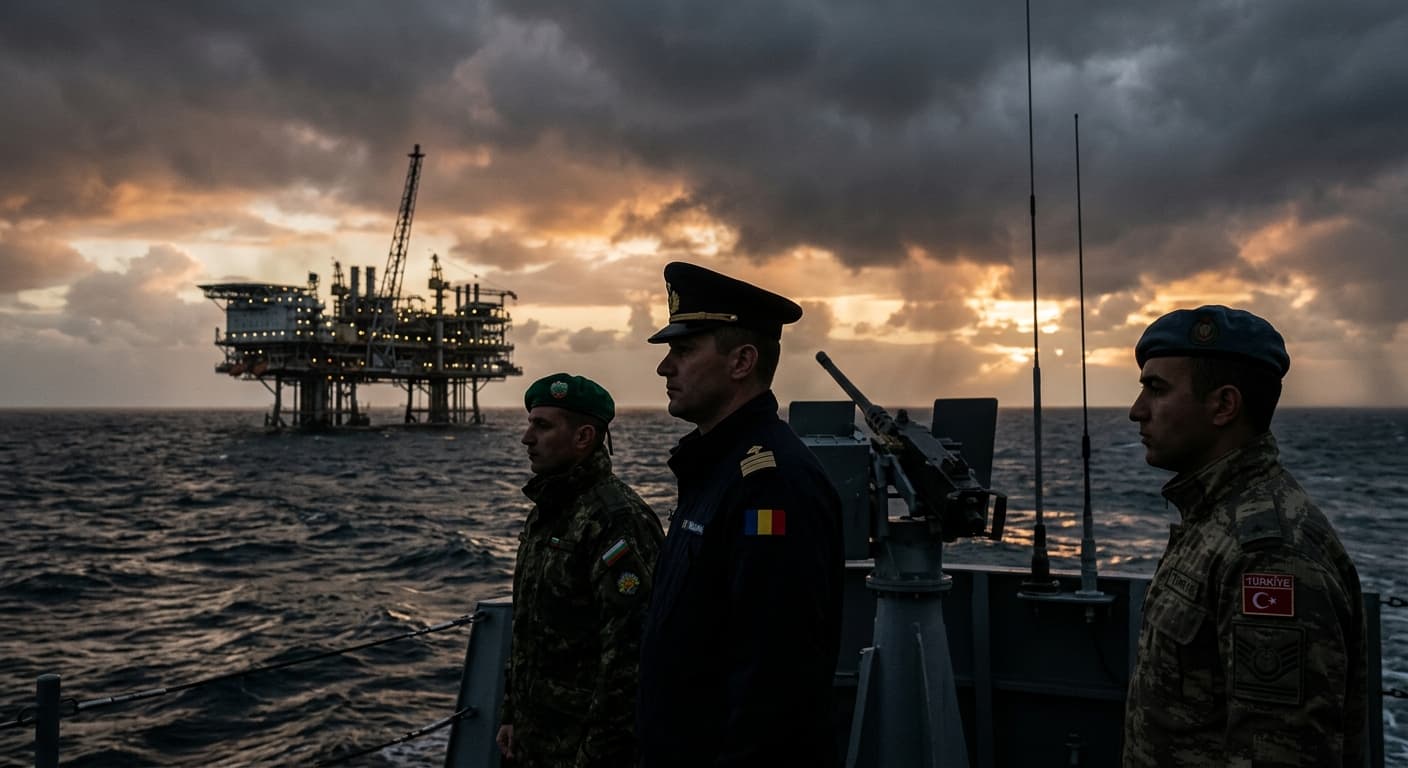
Ankara's Black Sea deal quietly extends NATO's shield to Neptun Deep
Romania, Bulgaria and Türkiye expanded their trilateral Black Sea mine group on July 8, 2026, to cover critical underwater infrastructure — a hedge as U.S. forces pull back and Russian sabotage risk moves south.
Romania, Bulgaria and Türkiye signed an amendment on the sidelines of the Ankara NATO summit on July 8, 2026, extending the mandate of their Mine Countermeasures Black Sea Task Group beyond drifting mines to the protection of critical underwater infrastructure — a two-line legal change that quietly repositions the alliance's southern flank around a single commercial fact: Romania's Neptun Deep gas field comes online in 2027, and neither Bucharest nor Sofia has a navy large enough to guard it alone. The real subject of the amendment is not mines. It is pipelines, cables and offshore gas rigs sitting outside NATO's Article 5 territorial waters at the exact moment Washington is drawing down.
The document was inked by Romanian interim defence minister Radu Miruță, his Bulgarian and Turkish counterparts, and disclosed by the Romanian Ministry of National Defence, according to Romania Insider; Turkish state agency
Anadolu confirmed the timing and characterised the change as adding protection of critical underwater infrastructure to the task group's missions. On the same day, command of the group rotated from Türkiye to Bulgaria, with Romania's minehunter M 271 Captain Constantin Dumitrescu joining the 11th activation from July 9 to 24 alongside the multinational BREEZE 2026 exercise.
The document reframes a mine-clearing pact as an anti-sabotage pact
The trilateral was born narrow. On January 11, 2024, Turkish Defence Minister Yaşar Güler, Romania's Angel Tilvar and Bulgaria's deputy defence minister Atanas Zapryanov signed a memorandum in Istanbul to clear the drifting Russian and Ukrainian mines threatening the Black Sea grain corridor, Al Jazeera reported at the time. Türkiye insisted the format stay closed to the three littoral NATO members, with door left open to others only "when the conditions are formed" — a Montreux-friendly workaround the
Middle East Institute described as a possible first step toward, but not the equivalent of, a Standing NATO Mine Countermeasures Group for the Black Sea.
Wednesday's amendment breaks that ceiling. The Romanian defence ministry, quoted by Romania Insider, says the task group's remit now explicitly extends across "Romania's Exclusive Economic Zone, not only as a deterrence measure but also as an immediate response instrument" — deterrence and immediate response, not mine hunting: the language of counter-sabotage. It brings the trilateral into direct alignment with NATO's Maritime Centre for the Security of Critical Undersea Infrastructure, which the alliance stood up at the Vilnius summit in July 2023 and which CSIS notes has until now focused on the Baltic, North Atlantic and High North.
The Warsaw-based Centre for Eastern Studies has been arguing for a year that the trilateral was the natural vehicle for exactly this kind of extension. In a June 2025 commentary, OSW analyst Kamil Całus suggested the three states could stand up a joint coordination centre in Constanța, Varna or Istanbul on the model of Command Task Force Baltic. The Ankara amendment does not go that far — but it puts the legal predicate in place.
The real driver is Neptun Deep, not floating mines
Follow the money and the geography. Romania's Neptun Deep block holds an estimated 100 billion cubic metres of gas and, once OMV Petrom and Romgaz bring it online in early 2027, will produce 8 bcm a year at peak — enough to turn Romania into the European Union's largest gas producer, according to the New Strategy Center. Türkiye's Sakarya field is projected to deliver 11 bcm annually in its second phase, with recoverable reserves of roughly 710 bcm cited in a
NUPI–New Strategy Center working paper. Bulgaria's Khan Asparuh block is being appraised by a TotalEnergies-led consortium.
None of these platforms sit inside NATO territorial waters. All sit inside exclusive economic zones, where the Atlantic Council warned this month that offshore rigs "lie in exclusive economic zones outside NATO's territorial waters and Article 5 protection, making them tempting targets for Russian hybrid tactics." Germany has already signed a contract with OMV Petrom to import Black Sea gas post-2027 as part of its Russian-hydrocarbon exit, per the New Strategy Center's
Critical Infrastructure Study. That gives Berlin a direct stake in the survival of an undersea pipe that runs 160 kilometres from the Romanian shoreline through waters Russia has demonstrably been willing to mine, blockade and, at Nord Stream in 2022, blow up.
The Ankara text is the security wrapper for the commercial deal.
Russia's shadow-fleet playbook has arrived in the Black Sea
The threat model is no longer theoretical. Since the Nord Stream sabotage, at least 11 undersea incidents have been recorded in the Baltic, according to a March 2025 Al Jazeera investigation. In December 2024, Finnish special forces boarded the Cook Islands–flagged tanker Eagle S after it dragged its anchor across the Estlink 2 power cable and four data cables — an incident the
Carnegie Endowment traced to Russia's shadow oil fleet. NATO responded with Operation Baltic Sentry and a memorandum of understanding among Baltic allies in January 2025.
The Black Sea has been quieter — until recently. OSW reported this month that in late 2025 merchant vessels were attacked in Türkiye's exclusive economic zone, Russian reconnaissance drones repeatedly violated Turkish airspace over the winter, and war-risk insurance costs jumped; a Russian strike also hit a Turkish-flagged LNG tanker in Odesa and a Bayraktar drone facility near Kyiv, per
Foreign Affairs. Finland's intelligence service warned in early 2025 that an eventual Ukraine ceasefire would free up Russian and proxy assets for sabotage elsewhere — including, by implication, southward.
The subtext: NATO 3.0 without the Americans
The amendment lands in the middle of an alliance-wide re-pricing of U.S. commitment. At the Ankara summit, U.S. Defense Secretary Pete Hegseth announced a six-month review of U.S. force posture in Europe following a public dispute over allied support for the Iran war, per CFR — a secondary source; no Pentagon primary document has been published. The Pentagon has begun a phased withdrawal of warplanes, destroyers and submarines from NATO countries,
Al Jazeera reported ahead of the meeting. Secretary of State Marco Rubio called the summit "probably the most important meeting in NATO's history" — a phrase whose subtext European officials read as a warning.
Against that backdrop, the trilateral is being sold in Ankara as proof of the "NATO 3.0" bargain outlined by CSIS — Europeans handling regional security first, Americans providing extended deterrence and ISR from farther back. Türkiye, which generates roughly 65% of the recognised maritime picture in the Black Sea by naval and air assets, is the load-bearing pillar. Brookings analyst Aslı Aydıntaşbaş has argued for two years that this "Montreux-friendly" trilateral is
the specific formula that reconciles Ankara's veto on non-littoral warship deployments with Bucharest's push to internationalise Black Sea security. The Ankara amendment operationalises that formula for infrastructure.
Chatham House's Black Sea programme, which has been urging exactly this kind of expansion since 2025, calls the trilateral demining framework "a promising model of functional cooperation" that could be extended into other domains. Ankara has just done that.
Who wins, who loses
Türkiye is the operational winner. The amendment cements Ankara's role as the region's indispensable maritime security provider without opening the Bosphorus to Standing NATO Maritime Groups from outside the basin. Turkish thinking, as captured by the Atlantic Council's Turkey programme, has always favoured "regional ownership" — a scaled-down BLACKSEAFOR run by littoral states, with NATO endorsement but not NATO command. Wednesday's document delivers that formula.
Romania is the strategic winner. Neptun Deep is Bucharest's single largest bet on post-Russian energy leverage in Southeast Europe. A trilateral legal umbrella — cheap, deniable-of-escalation and Montreux-compliant — is the closest thing to Article 5 coverage Romania can get for infrastructure sitting 160 km offshore. Its foreign ministry has, in parallel, joined the EU-US Joint Declaration on the Security and Resilience of Submarine Cables in August 2025 and is pitching Constanța to host the EU's planned Black Sea Maritime Security Hub.
Bulgaria gets a free ride and a headache. Sofia lacks the naval mass to lead the mission — buying second-hand submarines and rated, in OSW's assessment, the most passive of the three on Russia. The six-month command rotation lands on Bulgaria on July 9 regardless. If a cable is cut or a rig is nudged during Sofia's watch, the political cost is Bulgarian.
Russia is the intended loser — the more interesting losers are London, Berlin and The Hague. All three would have preferred a full Standing NATO Mine Countermeasures Group in the Black Sea. Two British-donated minehunters have been sitting in the UK since 2023, unable to transit the Turkish Straits under Ankara's wartime application of the Montreux Convention, as the
BBC reported. The amendment locks in the trilateral-only architecture that keeps them there.
Diplomat View
The Ankara amendment is best read as the security clause of Romania's 2027 gas contract with Germany, dressed in NATO uniform. It commits the alliance to nothing that the alliance had not already agreed to at Vilnius in 2023, but it moves the operational instrument — a live, activated, ten-times-deployed naval task group — from mines to pipelines and cables at exactly the moment U.S. capacity in Europe is contracting. Our call: within 18 months, expect the trilateral to acquire a permanent coordination cell (Constanța is the likeliest host) and to publish rules of engagement modelled on CTF Baltic. What would revise this forecast: a Ukrainian ceasefire that lifts Türkiye's Montreux closure, at which point Ankara loses its incentive to keep the framework closed and non-littoral allies push their way in. Absent that, the trilateral is now the Black Sea's actual security architecture. NATO is the letterhead.
What to watch next
- July 9–24, 2026 — 11th MCM Black Sea activation during BREEZE 2026, first mission conducted under the expanded mandate; Bulgarian rotational command.
- Late 2026 — European Commission expected to formalise host country for the Black Sea Maritime Security Hub under its May 2025 strategy; Romania is the leading bidder.
- Early 2027 — First gas from Neptun Deep; the operational test of whether "critical underwater infrastructure" language in the amendment translates into a standing patrol presence around OMV Petrom's platforms.
- January 2027 — Six-month rotation returns command to Romania; Bucharest is expected to push publicly for non-littoral NATO participation.
Discover more

US Politics
SNAP Food Assistance Faces Legal Challenges
In 2026, SNAP faces stricter eligibility rules and mounting legal challenges, threatening food assistance for the millions of Americans who rely on the program.

India
BJP's Misunderstanding of Women's Quota Needs
The BJP's linking of the Women Reservation Bill to delimitation risks delaying women's empowerment in India, misreading the aspirations of female voters.

India
Congress Accuses Modi of Stalling Women's Law
Congress accuses Modi of stalling women's reservation law by linking it to delimitation, revealing a deeper electoral strategy.

Conflict & Security
Drone Warfare Killing Aid Workers at Unprec
Over 1,000 humanitarian workers killed in three years as cheap armed drones collapse legal protections. Gaza, Sudan, Ukraine, and DRC see deliberate targeting of aid convoys and hospitals with zero prosecutions.