NATO's Ankara Arms Blitz: Turkey Cashes In
Turkey benefits from NATO arms deals amid U.S. scrutiny.
Model Diplomat8 min readEurope
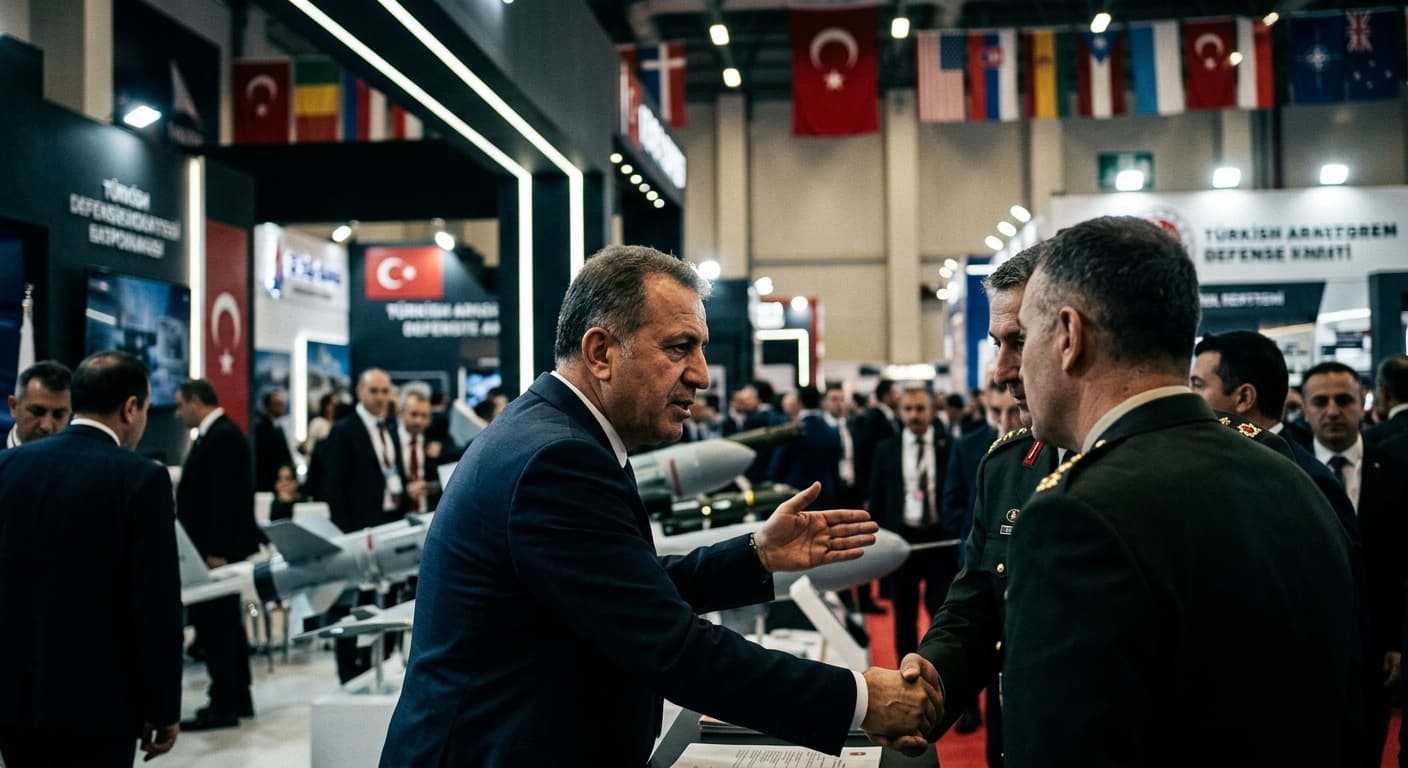
NATO's Ankara Arms Blitz: Turkey Cashes In as Trump Watches
NATO leaders unveil tens of billions in arms deals at the July 7–8 Ankara summit, staging burden-sharing for Trump while rehabilitating Turkey's defense industry.
NATO Secretary-General Mark Rutte opened the alliance's Defence Industry Forum in Ankara on July 7, 2026, promising "a massive amount of new contracts" worth tens of billions of dollars — a choreographed display of European burden-sharing aimed squarely at Donald Trump. The blitz is less about arming Ukraine or deterring Russia than about buying continued American commitment to Europe. The real beneficiary is the host: Turkey's defense industry, which is converting summit stagecraft into F-35 readmission talks, engine export approvals, and a pipeline of NATO contracts that would have been unthinkable when Ankara bought Russian S-400s in 2019.
According to NATO's own summit overview, European allies and Canada increased core defense investment by $139 billion in nominal terms in 2025 alone, with some allies on track to hit the 5% of GDP target — agreed at last year's Hague summit — well before the 2035 deadline. In a June 24
Atlantic Council appearance, Rutte told the Washington audience the Ankara industry day would produce "big contracts being signed, which will give a clear signal … we are better at it" than Russia. The deals are a political product first, a procurement one second.
The Ankara stage was built for one audience
Trump arrived in Ankara after weeks of grievance-airing about American defense spending relative to allies, and after Defense Secretary Pete Hegseth announced a six-month review of U.S. force posture in Europe at the June ministerial in Brussels. The Center for Strategic and International Studies noted in its pre-summit analysis that Hegseth also told allies U.S. "annual NATO dues" would be "contingent on other countries meeting their defense spending targets" — a reference to the roughly €4.6 billion in NATO common funds the United States helps underwrite through a 14.9% cost-sharing formula.
That is the leverage the Europeans are trying to neutralize with contracts. As NPR reported, Ambassador to NATO Matt Whitaker previewed the summit by saying Trump "fully expects that all allies will step up immediately and get on the path to 5% and do it with urgency." Rutte, meeting Trump in the Oval Office on June 24, brought easel charts labeled "The Trump Trillion" — a running tally of allied spending commitments since 2017 — to feed the president's authorship narrative before the trip. The Atlantic Council's
defense spending tracker noted a first in recorded NATO history alongside the summit: Norway has surpassed the United States in defense spending per capita.
The strategy is working on the numbers. The Stockholm International Peace Research Institute reported on April 27, 2026, that European NATO members collectively spent $559 billion on defense in 2025, up 14% in real terms year-on-year — the sharpest annual increase in Central and Western Europe since the end of the Cold War. Germany crossed 2% of GDP for the first time since 1990, with spending up 24% to $114 billion. Spain jumped 50% to $40.2 billion. CSIS estimates that NATO's topline defense spending has
grown 23% in real terms since 2022, with European allies and Canada up 54% over the same period.
| Country | 2025 spending (US$ bn) | Change vs. 2024 | % of GDP |
|---|---|---|---|
| Germany | 114 | +24% | 2.3% |
| United Kingdom | 89.0 | -2.0% | ~2.4% |
| France | 68.0 | +1.5% | ~2.1% |
| Spain | 40.2 | +50% | ~2.0% |
| Poland (top by GDP share) | >45 | double-digit | >4.0% |
Source: SIPRI, 27 April 2026; NATO Secretary General's Annual Report 2025.
Rutte's pre-summit press conference framed the industry forum as the "platform where we showcase how we're working with industry" to deliver on the 5% pledge. In practice, the choreography reverses roles: Europe is now selling its rearmament to Washington rather than the other way around. That inversion is what the German Marshall Fund called
Europe's "defense moment" — a window that is equally an opportunity and a vulnerability, since American drawdown is now a stated policy, not a threat.
Turkey is the unexpected winner
Ankara has spent seven years on the outside of Western high-end aerospace after buying Russia's S-400 in 2019 got it expelled from the F-35 program and sanctioned under CAATSA. Phasing Turkey out of the F-35 supply chain alone cost the Pentagon $500–600 million and forced Lockheed Martin and Pratt & Whitney to relocate roughly 80% of previously Turkish-supplied parts. That freeze is now unwinding at speed.
On June 24, Trump told reporters he would "probably do something that makes Turkey happy" on F-35s and engine sales for Ankara's indigenous KAAN fighter, according to BBC Türkçe. Vice President JD Vance confirmed that a formal review by Hegseth's team was underway to determine whether Turkey could be legally readmitted. Two days later, Reuters — as
BBC Türkçe summarised — reported that Trump had notified Congress of a pending sale of F110 engines for the KAAN, the powerplant Turkey needs until its indigenous TF35000 turbofan reaches integration in 2032. Middle East Institute Turkey program director Gönül Tol told Reuters the engine sale is "a promise easier to keep" than F-35 readmission — and that the question of whether "a new page can be turned in the bilateral relationship depends on it."
The scale of Turkey's rehabilitation is best measured in signed deals, not rhetoric. In October 2025, Erdoğan and UK Prime Minister Keir Starmer signed an $11 billion contract for 20 Eurofighter Typhoons — approved by Germany, Italy and Spain, and described by London as the biggest fighter export deal in a generation.
BBC coverage tallied 6,000 British jobs at BAE Systems and 1,100 in the south-west linked to the deal. That followed a $7 billion order for 40 F-16s from Washington. Turkey now hosts
3,000 defense industrial companies — a figure Rutte specifically highlighted — and defense and aerospace exports hit an all-time high of $10.05 billion in 2025, up 48% year-on-year, according to Brookings analyst Aslı Aydıntaşbaş's
June 2026 study. Turkey has emerged as one of NATO's leading suppliers of 155mm artillery ammunition and drones — precisely the categories European industry cannot scale fast enough.
The Foreign Affairs journal captured the pivot in a July piece titled "Turkey's Quiet Realignment", reporting that in December 2025, "after years of insisting Turkey would purchase a second batch of S-400s, Erdogan asked Putin to take back the missile defense system." Ankara is now co-producing SAMP/T missile defense with France and Italy, Germany has deployed an additional Patriot battery with 150 troops to Turkey, and NATO is building a multinational corps on Turkish soil due by 2028. Brookings' Aaron Stein argues Turkey's pivot back to Europe reflects
a lesson learned: after seven years of congressional friction, "there is little, if any, interest in Ankara to go through the exasperating experience of seeking congressional approval for American arms in the future."
The Council on Foreign Relations argued in a July 2 essay that the summit itself legitimizes Erdoğan just as his domestic crackdown intensifies. That is the trade-off Europeans have accepted: Turkey holds the geography — the Bosphorus, the Black Sea, the Levantine flank — and it produces the categories of ammunition Europe cannot scale. Aydıntaşbaş's Brookings paper notes the ceiling: Turkey remains a "mid-tier exporter, ranking the world's 11th-largest," dependent on Western sub-systems and components even as it exports finished platforms.
The Ukraine subtext: Europe pays, Washington watches
The second choreographed message in Ankara is that Europe now underwrites Ukraine. According to a pre-summit briefing circulating in Moscow-linked media on July 6, European leaders will announce an aid framework worth at least €140 billion ($160 billion) over two years — with the United States as "one notable absconder." That figure tracks the EU's autumn 2025 negotiations over frozen Russian assets, which after Belgian objections produced a
€90 billion loan backed by EU budget headroom rather than seized Euroclear reserves. A senior European Council source told BBC the loan would be repaid only when Russia paid reparations.
The financing model that survives is the Prioritised Ukraine Requirements List, or PURL, launched by Trump and Rutte in July 2025. Under PURL, European allies and Canada buy American weapons — including Patriot interceptors — and hand them to Kyiv; Rutte told Atlantic Council listeners the mechanism now supplies "nearly 90% of [Ukraine's] air defences." Germany's Foreign Minister Boris Pistorius announced an additional €2 billion package at the October Ukraine Defence Contact Group in Brussels, with Kyiv's own estimate of 2026 defence needs at $120 billion — half from national resources, half from partners.
That is the arrangement Ukrainian President Volodymyr Zelensky will press to expand when he speaks alongside Rutte at the ATO Congresium at 14:00 on July 7, per the official media programme. Zelensky arrives after Russia's most intense strike campaign in months;
BBC reported on July 7 that he will demand additional air defense systems in Ankara following overnight strikes. Rutte's Atlantic Council speech described recent Russian attacks on a Ukrainian shopping center and a UNESCO-listed historic monastery as "brutal acts of a weakened Russia."
A second, quieter Ankara deal illustrates the pattern: Canadian Prime Minister Mark Carney announced on July 6, hours before boarding for Turkey, that Ottawa had selected Germany's TKMS — a Thyssenkrupp subsidiary partnering with Norway — to build up to 12 submarines worth C$20–30 billion for the boats alone, and C$40–50 billion including operations. The bid beat South Korea's Hanwha Ocean. It is Canada's largest defense procurement in history — and no U.S. yard was in the running.
What to watch
- The F-35 review: Vance said the White House will "announce" a conclusion when reached. A Trump–Erdoğan bilateral is scheduled on the summit sidelines; a decision at or immediately after Ankara would validate the entire Turkish rehabilitation arc.
- U.S. force posture review: Hegseth's six-month Pentagon review runs to roughly December 2026. It will determine which U.S. formations remain in Europe and where PURL funding is directed.
- PURL scaling: Watch whether the Ankara communiqué expands PURL beyond air defense to include long-range strike munitions, the category Zelensky is now openly requesting.
- Belgian assets question: The €140 billion European framework floated in Ankara depends on a legal formula for Russian frozen assets that Belgium's Bart De Wever has so far blocked at Euroclear.
The Bottom Line
The Ankara summit is not primarily about weapons — it is about who pays for the alliance's next decade, and Europe is buying continuity from Trump with contracts. Turkey is the beneficiary that reveals the trade: seven years after S-400 sanctions, Ankara is being handed F110 engines, Eurofighters, a multinational NATO corps on its soil, and the biggest defense industry stage the alliance has ever built. If the F-35 review clears Turkey before year-end, historians will date the beginning of "NATO 3.0" — Europeanised in leadership, Turkified in production — to July 7, 2026.
Discover more

India
BJP's Misunderstanding of Women's Quota Needs
The BJP's linking of the Women Reservation Bill to delimitation risks delaying women's empowerment in India, misreading the aspirations of female voters.
India
Congress Accuses Modi of Stalling Women's Law
Congress accuses Modi of stalling women's reservation law by linking it to delimitation, revealing a deeper electoral strategy.
US Politics
SNAP Food Assistance Faces Legal Challenges
In 2026, SNAP faces stricter eligibility rules and mounting legal challenges, threatening food assistance for the millions of Americans who rely on the program.
Conflict & Security
Guatemala: El Niño 2026–27 becomes regional security test
UNICEF: 25.8M children face El Niño risks in Latin America; Guatemala maps 188 municipalities for drought and food insecurity amid regional security test.