NATO's $50bn Arms Deals in Ankara Summit
A look at NATO's $50 billion arms deals and their implications.
Model Diplomat9 min readEurope
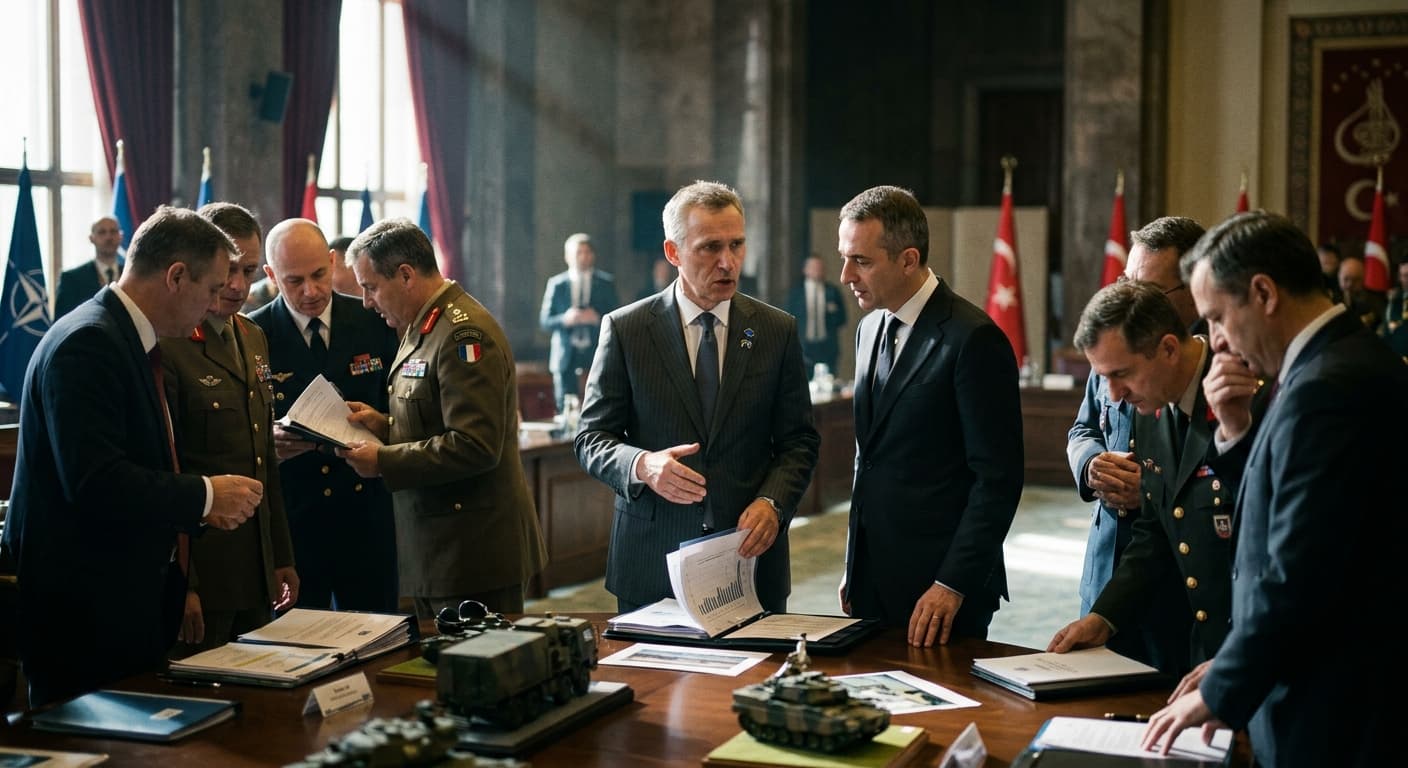
NATO's $50bn Ankara arsenal — and the bill Trump won't accept
NATO's Ankara summit unveiled more than $50 billion in arms deals to placate Donald Trump, but the biggest winners are European primes — not US ones.
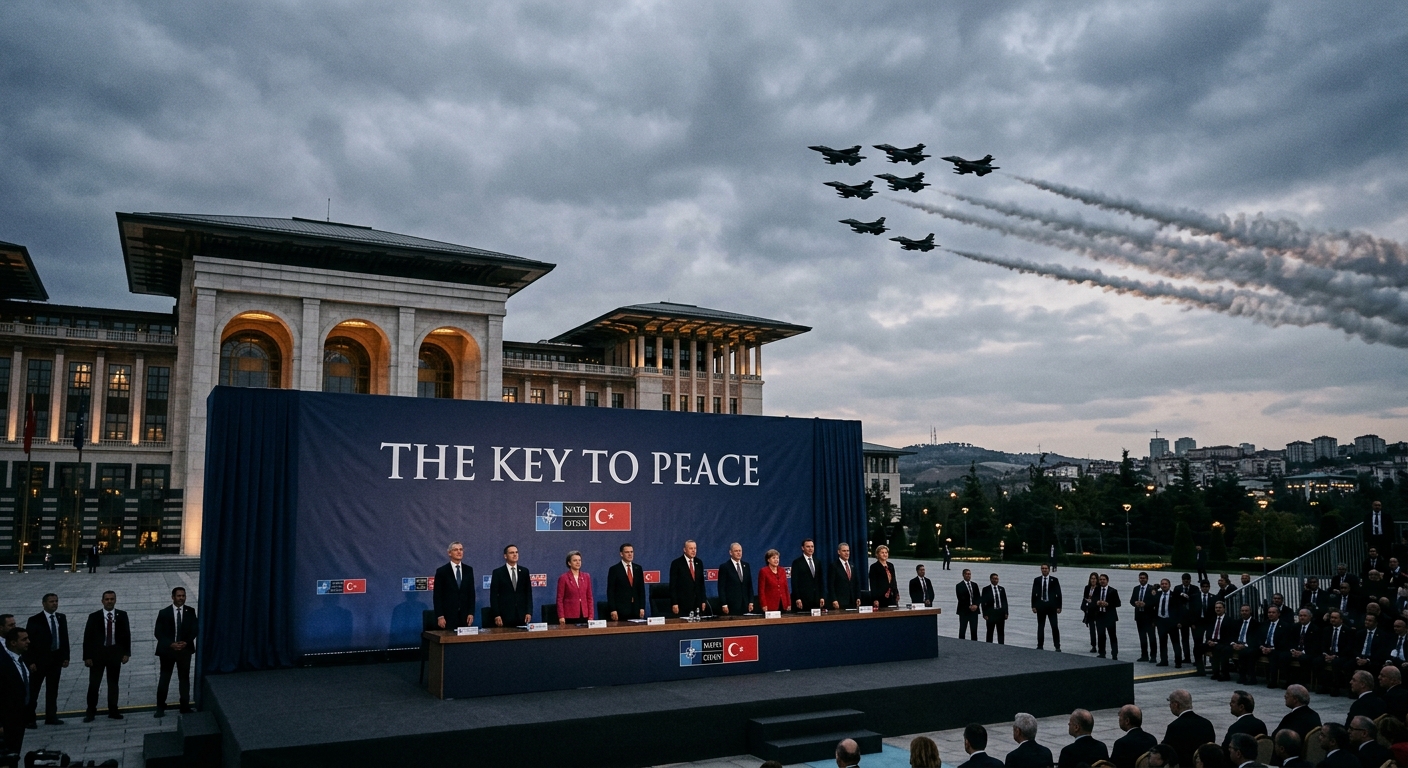
NATO allies rolled out at least $50 billion in signed and pledged defence contracts at their Ankara summit on July 7, 2026, in what Secretary General Mark Rutte called a "transatlantic defence industrial revolution" — and what Donald Trump promptly dismissed as insufficient loyalty. The Ankara "big reveal" is being sold as burden-sharing, but the contract sheet tells a different story: the flagship deals — GlobalEye early-warning aircraft, Deep Precision Strike missiles, A400M airlift — went to Swedish, British-led and European primes, not to the US industrial base Trump is publicly demanding be fed. That inverts the political narrative of the summit. Europe is buying its way into strategic autonomy while paying just enough Northrop Grumman and Boeing invoices to keep the White House from walking off the ramp.
The deal sheet, and what it actually says
The Ankara Summit Defence Industry Forum was choreographed for one audience. Rutte took the stage on July 7 to announce what he framed as concrete follow-through on last year's Hague pledge to spend 5% of GDP on defence by 2035, a commitment described by the European Parliamentary Research Service as the summit's central deliverable.
The headline announcements, per NATO's own briefing and reporting from BBC News and
Al Jazeera:
- A UK-led Deep Precision Strike consortium of 12 states committing more than £37 billion ($50 billion) over a decade for a long-range missile with a stated reach of up to 1,250 miles.
- The replacement of NATO's ageing 14-aircraft E-3 AWACS fleet with Saab GlobalEye at roughly $400–450 million per airframe, with deliveries from 2030 if contracts land soon.
- A letter of intent by Norway, Finland, Germany and Denmark for up to five Northrop Grumman MQ-4C Triton high-altitude drones — the first Triton buy by the alliance itself.
- An eight-nation Integrated Air and Missile Defence package worth about $26 billion, including Turkish contributions to a layered "Steel Dome" architecture, as reported by
BBC Türkçe.
- A $40 billion, five-year drone build-up and a pledge to quintuple NATO's drone-operator pool by 2027.
- New A400M transport and A330 MRTT tanker contracts led by Airbus, plus a Turkish $300 million contribution to NATO's Alliance Persistent Surveillance from Space programme.
Add in Ukraine-facing deals — Norway's 3 billion kroner ($306.2 million) for ballistic-missile defence and new bilateral production agreements Zelensky signed with Estonia, the Netherlands and Denmark — and the Ankara clearing-house comfortably clears the $50 billion mark trumpeted by the Turkish daily Türkiye and picked up by Caliber.Az.
The unspoken part: Europe is quietly displacing US primes
Read past the press releases and the pattern is inverted from the 2010s. The single largest procurement decision — replacing NATO's owned-and-operated AWACS fleet — was awarded to Sweden's Saab, not to Boeing, which built the original E-3s. Airbus, not Lockheed Martin or Boeing, won the strategic-airlift refresh. The UK-led Deep Precision Strike cuts Raytheon and Lockheed out of the political frame entirely, even if US components remain in supply chains. Only the Triton buy — five aircraft, letter of intent — feeds a US prime at the headline level.
Sophia Besch of the Atlantic Council put the underlying dynamic bluntly in a Carnegie Endowment roundtable: "The more Europeans spend, the more they will demand design authority and intellectual property rights." That is exactly what the Ankara ledger shows. Europe is not just buying more; it is buying differently.
Between 2020 and 2025, European allies' defence spending rose 62%, according to IISS figures cited by Al Jazeera. Rutte told his July 6 pre-summit press conference that European allies and Canada spent an additional $258 billion on defence in 2025 and 2026 combined, and are already averaging roughly 4% of GDP on defence and defence-related items — a data point NATO's own
pre-summit briefing reiterated. But money is only half the story. The Congressional Research Service, in a briefing prepared for the summit by analyst Paul Belkin, notes that Rutte's stated ambition is "NATO 3.0: a stronger Europe in a stronger NATO," explicitly meaning "an alliance that is less dependent on the United States, but in which the United States remains firmly rooted."
That is a polite way of saying: keep the US treaty commitment, replace the US kit.
The scale of that ambition is set by the IISS estimate that fully replacing critical US conventional capabilities in Europe — long-range strike, ISR, satellite assets, integrated air defence, strategic lift — would cost around $1 trillion and take a decade or more. Ankara's contracts are not that trillion. They are its opening tranche.
Trump: the disappointed customer
Trump arrived in Ankara on July 7 in a foul mood, and did not hide it. "Very disappointed with NATO," he told reporters, according to Al Jazeera. Speaking of European allies who declined to help in the US-Israel war on Iran earlier this year, he added: "I said I don't want that kind of help. We didn't need any help at all. In a way I was testing people." He also revived his call for the United States to acquire Greenland, a Danish territory whose status Copenhagen has repeatedly said is non-negotiable — a point BBC security correspondent Frank Gardner, reporting from Ankara,
noted directly.
The Pentagon is meanwhile going beyond rhetoric. Defence Secretary Pete Hegseth in June ordered a six-month review of US force posture in Europe, and the administration announced a phased withdrawal of warplanes, destroyers and submarines from NATO countries. On May 1, 2026, the Department of Defence confirmed the drawdown of about 5,000 US troops from Germany — a figure the DoD press secretary confirmed at the May 1 briefing.
Jack Watling, senior research fellow at RUSI, drew the operational line neatly when quoted by Al Jazeera: "Less US infantry or armour in Europe has an impact on messaging but little else. The withdrawal of US air power has a more tangible impact." That is why the GlobalEye and Deep Strike deals matter more than the Triton letter of intent. Europe is buying exactly the capabilities the US is pulling.
Only five NATO members are projected to reach the alliance's 3.5% core defence spending target in 2026, according to NATO data cited by Al Jazeera. Rutte demanded "clear, concrete and credible plans" from the rest; NPR reported that the White House's line, delivered by US ambassador to NATO Matt Whitaker, was that "President Trump fully expects that all allies will step up immediately and get on the path to 5% and do it with urgency."
Trump wants two things that increasingly point in opposite directions: European countries spending more on US-made weapons, and European countries relieving the US of its European defence burden. Ankara delivered the second. On the first, the contract sheet is thinner than the White House will publicly acknowledge.
The Turkey angle nobody wanted to talk about
The summit was choreographed around Recep Tayyip Erdogan. Trump was greeted at the airport by the Turkish president in person, walked arm-in-arm across the tarmac while a band played the Stars and Stripes and Turkish F-16s trailed red-white-blue smoke overhead — a scene Gardner described as "a metaphorical red carpet." Trump himself said publicly he might not have attended a summit not hosted by Erdogan.
Underneath the pageantry, Turkey extracted concessions. Sanctions were lifted; Ankara pressed for readmission to the F-35 programme, from which it was ejected in 2019 after buying Russian S-400s. Turkish contractor ASELSAN was written into the Ankara "Steel Dome" architecture with early-warning radars and low-orbit military communications solutions. The Turkish-made Atmaca cruise missile was slotted into the alliance's $1.6 billion Strike Capabilities basket, alongside guided systems from other allies, according to BBC Türkçe.
Turkish analyst Alper Coşkun, writing for Carnegie, captured the calculus: Turkey wants "to retain a decisive role in the European pillar of transatlantic security," while Washington will "prefer a less compliant Turkish posture vis-à-vis Europe." Ankara's deal-making at its own summit was a bid to keep both doors open — and to lock in customer relationships with European partners now buying serious quantities of drones and missiles.
What the primary documents actually say
The Congressional Research Service report prepared for the summit is unusually candid. It concedes that Rubio has characterised Ankara as "probably one of the more important leaders' summit[s] in the history of NATO" and that Trump's "disappointment" with allies "will have to be addressed." It also lays out the legal-financial architecture Europe is now assembling in parallel: the EU's €800 billion Readiness 2030 plan, which allows up to €650 billion of extra national defence borrowing, plus the €150 billion Security Action for Europe (SAFE) loan instrument for common procurement — funds from which US firms are being partially excluded, as the
IISS Military Balance 2026 has documented.
The SIPRI commentary on the 5% target flags the hard number: if all NATO allies hit the target in 2035, they would spend around $2.9 trillion annually on core defence, requiring roughly $1.4 trillion more per year than in 2024. Germany alone would spend $329 billion; France $221 billion. As SIPRI notes, "only nine countries in the world had a military burden of 5 percent or more" in 2024, and most were petro-states or dictatorships. That is the fiscal cliff Europe has voluntarily walked to — and the order book European primes are now racing to fill.
Ukraine is the second-order beneficiary. The European Parliament briefing records that allies discussed a new €70 billion military assistance package to be announced in Ankara, of which roughly €30 billion could come from the EU's €90 billion loan facility. Zelensky's Ankara ask was concrete: more Patriot batteries and interceptors, additional air-defence for what the
Atlantic Council documented as Russia's ballistic-missile-heavy new bombing pattern. Ukraine now shoots down roughly 80% of cruise missiles but less than one-third of ballistic missiles — a gap the Patriot pipeline is not yet closing.
Diplomat View
The Ankara summit will be remembered less for the $50 billion price tag than for the ownership structure of the contracts underneath it. Our call: NATO's transatlantic defence industrial base is bifurcating in slow motion, and Ankara accelerated it. The alliance's political glue is holding — Trump attended, took the podium and signed nothing hostile — but the industrial base is quietly re-nationalising toward European and select non-US NATO primes. Saab, Airbus, MBDA, Rheinmetall, ASELSAN and the emerging UK-led consortium are the structural winners; US primes will keep the Triton- and Patriot-scale deals but will not recapture the AWACS-tier prestige buys. This forecast would be wrong if two things happen: the Pentagon's six-month posture review, reporting by mid-November, reverses course and re-commits US airpower to Europe on pre-2025 lines; or Trump conditions Article 5 assurances on quantified US-content shares in European procurement, forcing SAFE and EDIP to reopen. Absent both, Ankara was the moment "NATO 3.0" became a procurement fact, not a slogan.
The next six months will determine whether Ankara was a turning point or a photo opportunity. The contract sheet says turning point.
What to watch:
- November 15, 2026 — Hegseth's Europe force-posture review lands. It will name which US wings, ships and units leave. That number sets the ceiling on how quickly Europe must actually field the capabilities announced in Ankara.
- September 30, 2026 — Rutte's deadline for allies to submit "credible plans" for reaching 5% of GDP. Spain, Belgium, Canada and Italy are the marginal cases; a public reprimand from Trump against any of them will test whether the Ankara unity survived the ride home.
- Mid-2027 — Deep Precision Strike prime-contractor down-select. If a US firm is not in the lead-integrator role, it is confirmation that the industrial centre of gravity has crossed the Atlantic eastward for the first time since 1949.
Discover more

US Politics
SNAP Food Assistance Faces Legal Challenges
In 2026, SNAP faces stricter eligibility rules and mounting legal challenges, threatening food assistance for the millions of Americans who rely on the program.
India
Congress Accuses Modi of Stalling Women's Law
Congress accuses Modi of stalling women's reservation law by linking it to delimitation, revealing a deeper electoral strategy.
India
700 Activists Accuse PM Modi of MCC Breach
Over 700 activists allege PM Modi breached election code with a televised address attacking opposition parties just before state elections.

Conflict & Security
Drone Warfare Killing Aid Workers at Unprec
Over 1,000 humanitarian workers killed in three years as cheap armed drones collapse legal protections. Gaza, Sudan, Ukraine, and DRC see deliberate targeting of aid convoys and hospitals with zero prosecutions.