NATO's £37bn missile bet: Europe builds its
Europe's move to develop long-range missiles amid US withdrawal
Model Diplomat8 min readEurope
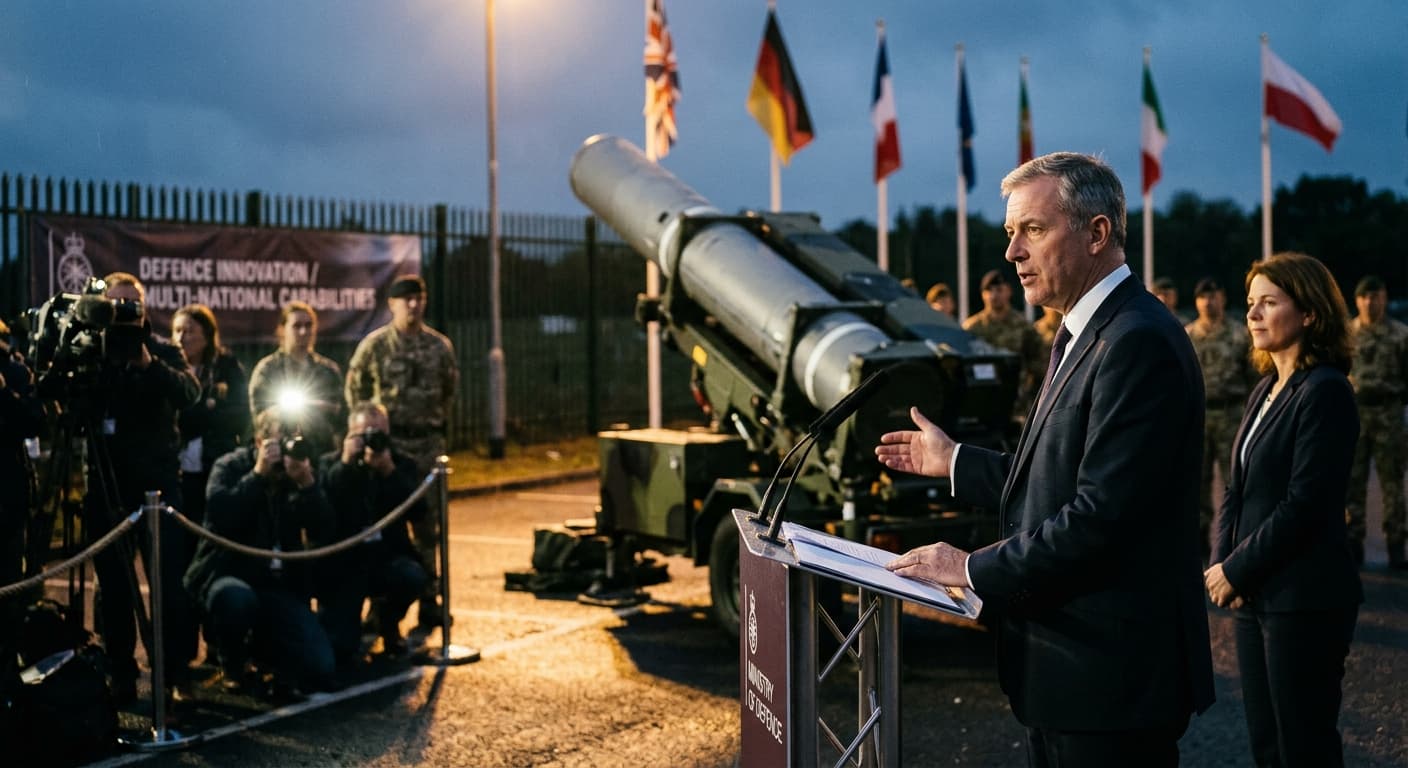
NATO's £37bn missile bet: Europe builds its own Tomahawk
NATO allies pledged £37bn ($50bn) at the July 2026 Ankara summit for a UK-led Deep Precision Strike missile — Europe's biggest move yet to end its reliance on US long-range firepower.
Twelve NATO allies pledged more than £37bn ($50bn) over ten years to develop a European long-range missile capable of hitting targets up to 2,000km away, in a UK-led programme unveiled on the eve of the Ankara summit on July 8, 2026. The Deep Precision Strike coalition is not a weapons contract — it is a strategic decoupling. It gives Europe the one capability Washington has always held over its allies (conventional deep strike into Russian rear areas), and it does so at the precise moment the Trump administration is drawing down US forces from the continent. The pledge will not produce a fielded missile until the 2030s. The signal it sends to Moscow and to the Pentagon lands now.
The deal, in specifics
The programme, announced by Number 10 and confirmed by BBC News, commits a dozen European NATO members to a joint development effort under the European Long-Range Strike Approach (ELSA) — the framework France, Germany, Italy, Poland, Sweden and the UK launched in July 2024. Britain and Germany are the anchor nations, jointly leading what UK MoD documents call the "2,000km+" cluster, according to the
ELSA communiqué published by GOV.UK, which has now transitioned into standalone Implementation Groups tasked with development and procurement rather than requirements-setting.
Prime Minister Keir Starmer framed the announcement as "help[ing] bring European allies together to keep NATO safe for years to come" — the diplomatic register. Foreign Secretary Yvette Cooper supplied the operational one, telling BBC News the initiative sends "a clear message to President Putin: NATO is stronger, more European and ready to defend our citizens against the long-term threat posed by him and the Russian state." The Deep Precision Strike weapon itself, according to a UK Ministry of Defence release, will be "among the most advanced systems ever designed by the UK, coming into service in the 2030s," with a range exceeding 2,000km. The BBC reported the weapon is intended to strike targets from roughly 300km out to potentially 1,250 miles (2,000km) away with "pinpoint accuracy."
Britain and Germany already agreed the underlying bilateral structure. Their Trinity House Agreement, signed in October 2024 and confirmed by GOV.UK, commits both governments to "rapidly develop extended Deep Precision Strike capabilities, to provide a conventional deterrent in Europe." The July 2025 UK–Germany Friendship and Bilateral Cooperation Treaty then locked Deep Precision Strike in as one of
17 priority projects, with a stated aim of delivering "a capability within a decade." The Ankara £37bn pledge is the money finally arriving behind that political architecture.
The pledge sits within a broader Ankara summit haul that ABC News put at more than $72bn, including new Airbus transport aircraft and a Swedish GlobeEye replacement for NATO's ageing AWACS fleet. Netherlands defence minister Dilan Yesilgoz separately told Reuters, as reported by
Al Jazeera, that The Hague alone would sign more than €3bn in "concrete plans" with Belgium, Britain and Germany.
The real target isn't Moscow — it's Washington
The strategic logic is not that Europe wants offensive parity with Russia. It is that Europe no longer trusts the United States to provide it. The International Institute for Strategic Studies estimated in November 2025 that replacing the most critical US conventional capabilities in Europe — long-range strike, ISR, satellite assets, integrated air and missile defence — would cost roughly $1 trillion and take a decade or more.
That number is the shadow price of the £37bn pledge. US Defence Secretary Pete Hegseth used a NATO defence ministers' meeting last month to announce a six-month review of US force posture in Europe. A European Parliamentary Research Service briefing prepared for the Ankara summit is explicit: Washington now expects European allies "to assume primary responsibility for most of NATO's conventional defence in Europe by 2027," and the US has announced a phased withdrawal of warplanes, destroyers and submarines from NATO countries. On that clock, Deep Precision Strike's 2030s delivery date looks almost late — a point Ukrainian President Volodymyr Zelensky pressed at Ankara when he warned, as reported by
BBC News, that "Europe needs affordable mass-produced anti-ballistic systems as soon as possible… this cannot wait until 2030 or beyond."
Trump has not made the political backdrop subtle. On the opening day of the summit, Al Jazeera reported him declaring he was "very disappointed with NATO" and singling out Italy, Germany and France as countries that had "turned us down." Only five NATO members are projected to meet the alliance's new 3.5% GDP core-defence target in 2026, according to the same report. US Ambassador to NATO Matt Whitaker told reporters, as cited by
NPR, that "President Trump fully expects that all allies will step up immediately and get on the path to 5% and do it with urgency." A
Chatham House assessment of the UK Defence Investment Plan called Starmer's spending package "billions of pounds short" of what the 2025 Strategic Defence Review demanded — which is why Number 10 needed the £37bn ELSA headline to carry it into Ankara.
The historical parallel — inverted
The last time European capitals debated where to base 2,000km-range missiles, the year was 1979 and the launchers were American. The NATO Double-Track decision put US Pershing II ballistic missiles on West German soil, triggered the largest peacetime protests in postwar Europe, and ultimately produced the 1987 Intermediate-Range Nuclear Forces Treaty — which collapsed in 2019 when the Trump administration withdrew, citing Russian non-compliance with the SSC-8 cruise missile, as Al Jazeera has documented.
The 2026 version inverts the pattern. This time the missiles being developed are European; the launch platforms will be German, Polish, Swedish and British; and the political initiative sits in London and Berlin rather than Washington. The IISS paper notes that all six ELSA partners are now pursuing ground- and sea-launched cruise and ballistic options in the 1,000–2,000km+ band — precisely the class of weapon the INF Treaty was written to ban. Paris and London, both nuclear powers, treat their conventional deep-strike ambitions as a complement to the deterrent. Berlin and Warsaw, as the IISS analysis puts it, see the same missiles primarily as "deterrence by punishment against Russia."
The winner nobody names: MBDA
Follow the industrial base. The company that stands to capture the largest single share of the £37bn is not American — it is European, and it already exists. MBDA, the Franco-British-Italian missile joint venture that builds Storm Shadow, is the natural prime for both the UK–France "Stratus" cruise-missile successor and the UK–Germany 2,000km+ effort. According to a UK government release from July 10, 2025, the Storm Shadow replacement alone is already forecast to "sustain 1,300 high-skilled jobs in the UK." Storm Shadow's operational track record in Ukraine — cited across
Al Jazeera coverage at roughly $1m per round and used to strike Russian bunkers and ammunition dumps — is the reference point European planners will use to sell the £37bn cheque to voters.
The commercial losers are Lockheed Martin and RTX. Every Deep Precision Strike missile Europe builds is one less Tomahawk (Raytheon) or Precision Strike Missile (Lockheed) it buys off the shelf. The IISS paper is candid: Berlin has adopted a "two-track" approach, buying US Typhon launchers in the interim while co-developing its way out of dependence. That interim purchase is not trivial — the periodic Tomahawk and SM-6 rotations announced at NATO's 2024 Washington summit were what triggered Russia's abandonment of the INF moratorium in the first place, as BBC News reported. But Germany's willingness to underwrite the 2,000km+ cluster with Britain is the more consequential half of the two-track: it locks in a European industrial base that will still be there when the Tomahawks rotate out.
There is also a quieter loser: the EU institutions in Brussels. The Deep Precision Strike coalition is built on the E5 format (UK, Germany, France, Italy, Poland) and the ELSA six — intergovernmental structures that deliberately bypass the EU's €150bn SAFE defence loan facility, from which the UK was excluded last year after rejecting an entry fee, as BBC News reported. Post-Brexit Britain is now the anchor of Europe's most sensitive weapons programme — a result the European Commission did not design for.
Moscow's problem — and its lever
Russia has already priced this in, and armed the response. In August 2025 the Russian Foreign Ministry formally abandoned its self-imposed moratorium on intermediate-range missile deployments, citing the pending US Tomahawk rotations in Germany and the ELSA effort. Al Jazeera quoted Dmitry Medvedev blaming "NATO's anti-Russian policy" and warning of "further steps." Vladimir Putin, in a July 2024 speech reported by
Al Jazeera, had already framed European long-range missiles as a return of the 1980s Pershing II crisis — "flight time to targets on our territory of about 10 minutes."
There is one more Ankara subtext worth naming. The BBC's Frank Gardner, reporting from the summit, noted the shared allied fear that once the Ukraine war ends, Russia "will pursue a rapid rearmament programme and be in a position to threaten NATO territory within four years." That is the timeline European planners are actually working to. Deep Precision Strike will not be ready in four years. What Ankara did was signal to Moscow — and to a US administration that may or may not honour Article 5 by 2030 — that Europe is now serious enough about the follow-on decade to write a £37bn cheque on it.
What to watch next
- End-2026: US force-posture review conclusions under Hegseth, which will set the baseline for how much conventional US strike capability remains in Europe as ELSA ramps.
- 2027 procurement decisions: The UK–Germany 2,000km+ cluster is due to move from joint study phase into concrete design selection; contract awards to MBDA or a consortium prime will reveal how much of the £37bn is genuinely new money versus rebranded national spending.
- Russia's countermove: Deployment of Oreshnik or additional intermediate-range systems in Belarus and Kaliningrad, following the August 2025 moratorium withdrawal, will define the arms-control terrain European leaders inherit.
Diplomat View
The £37bn Deep Precision Strike pledge is best read as Europe pricing an insurance policy against the United States, not against Russia. The forecast: by 2030, the UK–Germany axis will have replaced Paris as the operational centre of gravity for European conventional deterrence, MBDA will emerge as the continental prime, and the coalition will have expanded quietly to include the Nordics and possibly the Netherlands. What would revise that call: a Trump-Putin deal that freezes the Ukraine war on Russian terms and pulls US Tomahawks back out of Germany would kneecap the political case for the pledge and expose it as expensive symbolism; a genuine German constitutional-debt reset that front-loads spending into 2027–28 would accelerate it. The falsifiable test is procurement, not press releases. If MBDA has not signed a demonstrator contract by the end of 2027, the coalition is a communiqué. If it has, Europe has begun — for the first time since 1945 — to build strategic strike weapons without American permission.
The Bottom Line
Europe's £37bn Deep Precision Strike coalition is not a missile programme. It is a hedge against the possibility that the United States will not be there to fire the missiles Europe currently depends on. Whether it delivers a working weapon in the 2030s matters less than whether it survives the political turbulence of the next two years. The signal to Moscow and Washington has already been sent. The question is whether anyone in either capital believes it. *
Discover more

India
BJP's Misunderstanding of Women's Quota Needs
The BJP's linking of the Women Reservation Bill to delimitation risks delaying women's empowerment in India, misreading the aspirations of female voters.

US Politics
House Ethics Committee Pushes Sexual Miscond.
The House Ethics Committee has shifted responsibility for sexual harassment settlement records to the Office of Congressional Workplace Rights, complicating disclosure efforts.

India
Congress Accuses Modi of Stalling Women's Law
Congress accuses Modi of stalling women's reservation law by linking it to delimitation, revealing a deeper electoral strategy.

Conflict & Security
Drone Warfare Killing Aid Workers at Unprec
Over 1,000 humanitarian workers killed in three years as cheap armed drones collapse legal protections. Gaza, Sudan, Ukraine, and DRC see deliberate targeting of aid convoys and hospitals with zero prosecutions.