NATO Condemns Russia, China Nuclear Threats
NATO's statement highlights nuclear tensions with Russia and China.
Model Diplomat7 min readGlobal

NATO Condemns Russia, China Nuclear Threats as NPT Collapses
NATO's April 21, 2026 statement singled out Russia's nuclear rhetoric and China's opaque buildup — and previewed the alliance's post-arms-control playbook.
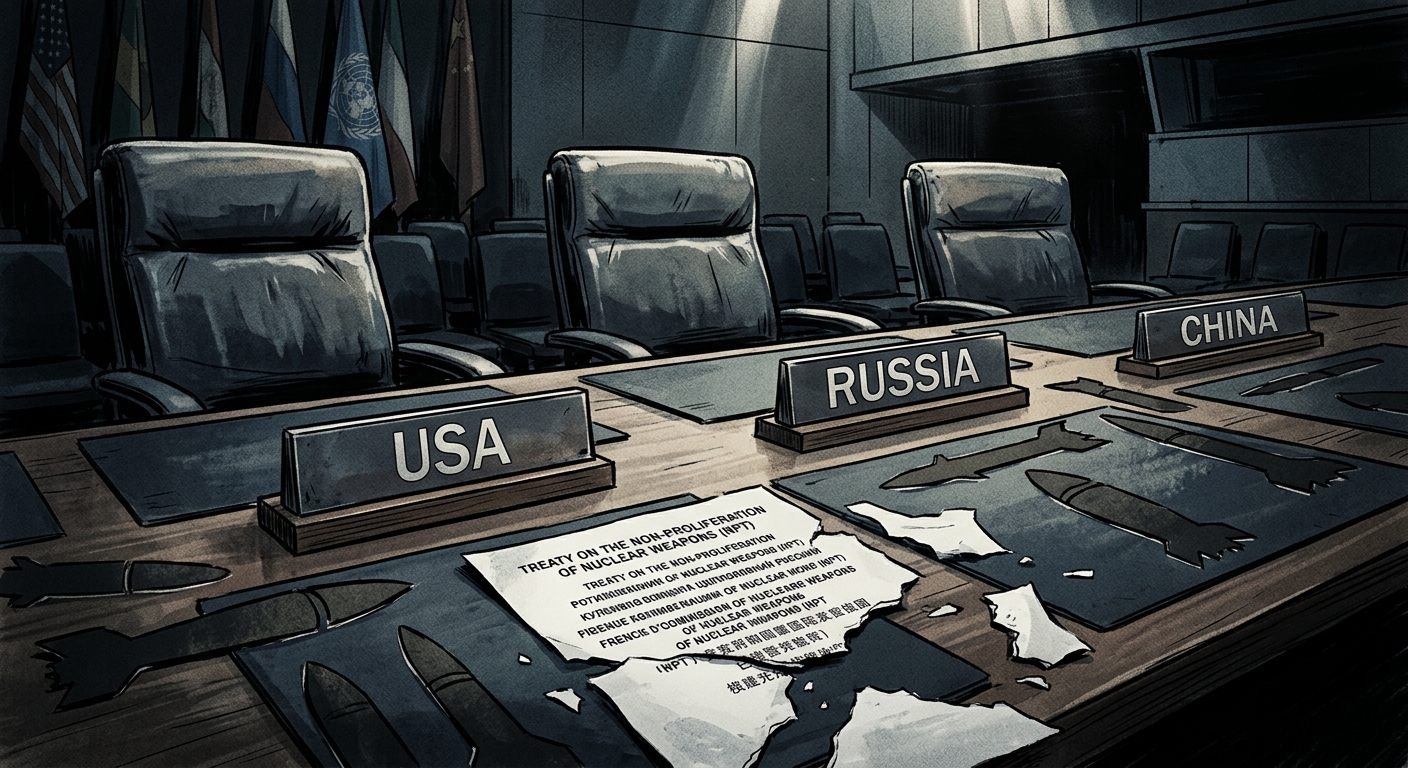
NATO's 32 members issued a joint statement on April 21, 2026 accusing Russia of "irresponsibly threatening nuclear rhetoric" and China of "rapidly expanding and diversifying" its arsenal "without transparency" — the sharpest collective language the alliance has used on nuclear posture since Moscow's 2022 invasion of Ukraine. The condemnation was not spontaneous outrage. It was a scripted opening move for a diplomatic season that has since ended in wreckage: the Non-Proliferation Treaty Review Conference collapsed without consensus on May 22, and the New START treaty had already expired on February 5. The thesis of this piece: NATO's statement is less a warning to Moscow and Beijing than an alibi for the West — a pre-positioned narrative that lets the alliance keep modernising its own nuclear forces while pinning blame for the death of Cold War arms control on the two capitals that will not sign the next one.
The statement, read carefully
The North Atlantic Council statement, released ahead of the 11th NPT Review Conference, ran ten paragraphs. The load-bearing sentence is paragraph five, which reads verbatim:
"Russia has violated crucial arms control commitments and employed irresponsibly threatening nuclear rhetoric. China continues to rapidly expand and diversify its nuclear arsenal without transparency. Both have increased ties with States that seek to proliferate nuclear weapons and undermine international arms control."
The text is posted on NATO's official site and was reinforced nine days later, on April 30, by Assistant Secretary General Boris Ruge before the UN General Assembly. In
remarks to the RevCon, Ruge cited a striking figure: "According to publicly available information, China will build eight nuclear warheads over the course of this conference." Reuters, in its April 21 wire carried by
Yahoo News, noted the alliance also pointedly encouraged "the United States' pursuit of multilateral strategic stability" — code for pulling Beijing into any successor to New START.
Two things are missing from the statement. The first is any reference to the Treaty on the Prohibition of Nuclear Weapons — the 2021 ban treaty backed by 94 states — except a line rejecting it as legally binding on NATO members. The second is any concrete allied concession. NATO commits to "transparency" and "risk reduction" in the abstract but pledges no cut, no cap, no numerical target. That asymmetry — demanding restraint of adversaries while codifying modernisation at home — is the argument Russia and China will make for the rest of the decade.
Why the timing matters: the arms-control scaffolding is gone
The strategic backdrop is the most important fact in the story. On February 5, 2026, the New START treaty — the last binding constraint on the U.S. and Russian strategic arsenals — expired. UN Secretary-General António Guterres called it a "grave moment for international peace and security," per the BBC's coverage. President Donald Trump rejected Vladimir Putin's offer of a one-year extension, telling Truth Social he wanted a "new, improved and modernized" deal. Foreign Minister Sergey Lavrov told the Russian parliament on February 11 that Moscow would abide by the 1,550-warhead cap "only while the United States does not exceed the outlined limits," according to
Al Jazeera.
That handshake is the entire architecture of restraint that now stands between the world's two largest nuclear powers.
Into that void, NATO's April statement lands not as diplomacy but as narrative pre-emption. It fixes the blame for the vacuum on Moscow's rhetoric and Beijing's opacity — before any Global South delegation could arrive in New York and ask why the P5 modernise while the disarmament pillar of the NPT rots. The Egmont Institute's Bruno Tertrais, in an April 21 CSDS in-depth paper, framed the RevCon exactly this way: "a battle between competing narratives about the evolution of the global nuclear order," in which Russia and China would "aggressively promote the idea that NATO's nuclear sharing arrangements and extended nuclear deterrence are supposedly at odds with the NPT."
They did. In its 2026 National Report to the RevCon, documented by MP-IDSA, Moscow argued that NATO nuclear sharing with non-nuclear-weapon states in Europe was a "destabilising factor" and a national-security threat. Beijing's working paper backed the position and called on nuclear-weapon states to "remove their nuclear weapons deployed overseas." NATO's April 21 pre-buttal — insisting nuclear sharing is "fully consistent with the NPT" and predates the treaty — was written to be read alongside those documents, not in isolation.
The numbers behind the alarm
The China piece of the statement rests on hard, if contested, data. The Pentagon's 2025 China Military Power Report, analysed by Breaking Defense, assessed that Beijing's stockpile "remained in the low 600s through 2024" and remains on track for more than 1,000 warheads by 2030. SIPRI's
Yearbook 2026, released in June, put the global inventory at 12,187 warheads in January 2026, of which 9,745 sit in active military stockpiles — with China's arsenal growing faster than any other's in percentage terms.
Beijing's counter-argument is doctrinal: it maintains a no-first-use policy and, as Foreign Ministry spokesperson Lin Jian restated on February 5, "China's nuclear forces are not on the same level as those of the United States and Russia, and China will not participate in disarmament negotiations at this stage." The Observer Research Foundation's
November 2025 analysis called this posture "strategic ambiguity as the weapon" — rhetorical commitment to arms control paired with the fastest quantitative buildup of any P5 state.
Russia, by contrast, is not building fast — it is signalling loudly. RUSI proliferation fellow Darya Dolzikova told the BBC that Moscow's push into exotic systems like the Poseidon nuclear-armed torpedo and the Burevestnik cruise missile is driven by concern over penetrating U.S. air defences, sharpened by Trump's proposed "Golden Dome" homeland shield. Pavel Podvig of UNIDIR, quoted by NPR, added that Russia is cash-strapped from the Ukraine war and treats nuclear parity with Washington largely as a matter of "pride." That distinction matters: NATO conflates Chinese growth and Russian rhetoric under one accusatory paragraph, but the two drivers require different responses.
The RevCon collapse — and who won it
Whatever NATO's statement hoped to seed, the RevCon it prefaced ended in failure. On May 22, after four weeks of negotiations, the conference closed without a consensus outcome, the third such failure in a row. The UN Secretary-General's spokesperson expressed his "disappointment." Carnegie's Nicole Grajewski, writing on
May 28, noted that the U.S. delegation blamed "the inability of some NPT States Parties to take Iran's threat to global nonproliferation seriously" — meaning Russia and China — while Iran accused Washington and its allies of "abusing the treaty."
The proximate cause was Iran-related language. The deeper cause, as ETH Zurich's Center for Security Studies wrote in June, is that "all are also modernising their arsenals, and most are even expanding their stockpiles, reversing decades of progressive reductions." NATO's own
30 April statement offered four "concrete, practical, and achievable" steps — transparency, risk reduction, a fissile-material moratorium, a testing moratorium — but these are voluntary NATO-side undertakings without verification. India's MP-IDSA concluded in a
June 2026 post-mortem that "the failure to renew the New START Treaty in February 2026 may be viewed as the final nail in the coffin."
Who actually won this diplomatic season? Not the disarmament camp. The quiet beneficiaries are the alliance's two smaller nuclear powers. Emmanuel Macron has spent the past year exploring an expanded French nuclear umbrella for Europe. The UK, per its April 27 RevCon statement delivered by Minister of State Stephen Doughty, declared that "nuclear deterrence remains the bedrock of UK security and our commitment to NATO." London raised its warhead cap to 260 in 2021 and has continued to modernise. With Moscow's rhetoric and Beijing's opacity absorbing all the political oxygen, neither Paris nor London faces meaningful pressure to justify its own expansion.
Diplomat View
NATO's April 21 statement is the epitaph, not the eulogy, of the post-Cold War nuclear order. It was written to lock in a narrative — Russia rhetorical, China opaque, the West responsible — before the RevCon could relitigate nuclear sharing or force NATO capitals into disarmament commitments. That narrative held: the conference collapsed on Iran language, not on Article VI. The forecast: expect the alliance to spend 2026–27 quietly consolidating a tri-polar nuclear posture — a modernised U.S. arsenal, a Franco-British European pillar, and continued "extended deterrence" to Indo-Pacific partners — while framing every step as a response to Moscow and Beijing. The forecast would revise if Trump concludes an informal U.S.–Russia strategic-stability handshake (Abu Dhabi channel remains live) or if Beijing agrees to any trilateral transparency measure. Neither looks likely before 2027. The more probable path is the one the statement was written for: managed nuclear rivalry without a treaty floor.
What to watch
- Q3 2026: Trump administration decision on whether to formalise the reported six-month New START limits handshake floated in Abu Dhabi, per
Al Jazeera's Shihab Rattansi.
- December 2026: Publication of the Pentagon's annual China Military Power Report — the next official U.S. warhead-count assessment, and the metric NATO's next statement will cite.
- January 2027: SIPRI's next arsenal update; watch whether China crosses the 700-warhead threshold ahead of Beijing's 2027 PLA modernisation deadline.
- 2027 NPT PrepCom: First procedural test of whether states parties can rebuild a review cycle after three consecutive consensus failures.
For deeper context on the alliance's strategic pivot, see Diplomat's coverage on international affairs.
Discover more

Global Politics
US Seizes Iranian Ship, Tensions Surge
The US seizure of the Iranian ship Touska highlights a shift in control over the Strait of Hormuz, favoring Iran's strategic position.

Conflict & Security
Drone Warfare Killing Aid Workers at Unprec
Over 1,000 humanitarian workers killed in three years as cheap armed drones collapse legal protections. Gaza, Sudan, Ukraine, and DRC see deliberate targeting of aid convoys and hospitals with zero prosecutions.

Global
World Normalises Taliban as Afghan Women Eras
UN data shows Afghan women erased from public life as Russia recognises the Taliban, EU hosts officials in Brussels, and ICC warrants for gender persecution go unenforced.
Conflict & Security
West Africa Food Crisis: Three Shocks in 2026
Conflict, climate extremes, and the Strait of Hormuz closure drive a severe food crisis in West and Central Africa, with fertilizer prices surging 80% and millions displaced.