Mauritania's €210M EU Migration Deal
Exploring Ghazouani's stability amid social unrest
Model Diplomat3 min readafrica
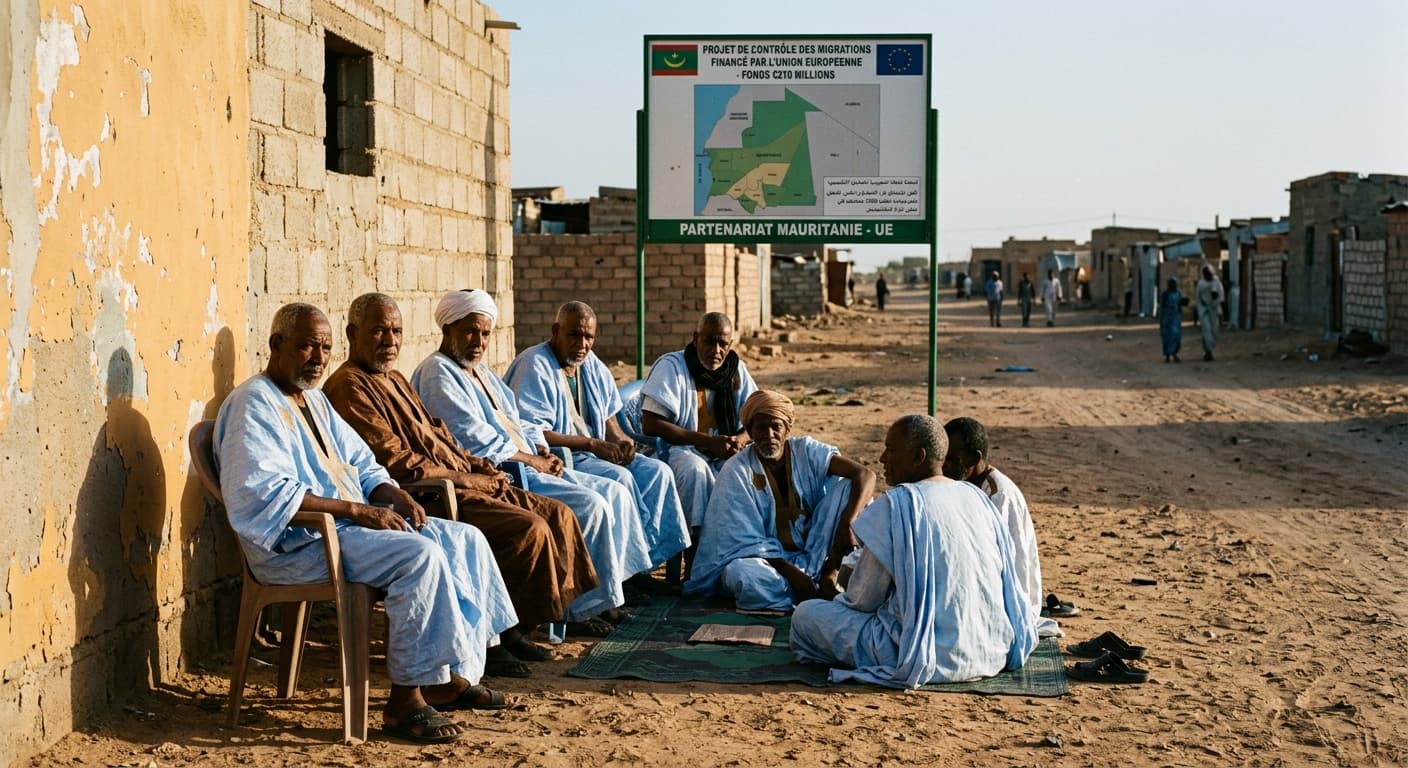
Mauritania's Gatekeeper Premium — Why Europe Is Paying for Nouakchott's Stability
Ghazouani has consolidated power, locked in a €210 million EU migration deal, and begun exporting gas — but the social math beneath the stability is deteriorating.
President Mohamed Ould Cheikh El Ghazouani has accomplished what few Sahelian leaders can claim: a second elected term, zero jihadist attacks on soil since 2011, and a country now exporting liquefied natural gas. Yet Mauritania entered 2026 as a state whose stability is being bought, not built — and the bill is coming due.
Ghazouani won reelection on 29 June 2024 with 56.12% of the vote, comfortably ahead of anti-slavery activist Biram Dah Abeid at 22.10% and Islamist candidate Hamadi Ould Sidi El Mokhtar at 12.78%, according to the Agence Ivoirienne de Presse. No appeals were filed with the Constitutional Council, and he took office on 2 August 2024. The result ratified what was already clear: Ghazouani's El Insaf party, built from the remnants of the former ruling UPR, controls the political terrain with little effective opposition.
The EU bargain: €210 million for a buffer
The defining geopolitical transaction of Ghazouani's second term was the March 2025 migration cooperation framework with Brussels. The EU committed €210 million under its Global Gateway Strategy, and the IEMed Mediterranean Yearbook 2026 notes the deal is "a clear move by the EU to make Mauritania a buffer against migration to the Canary Islands" (IEMed).
The arrangement is fragile. Afrobarometer data from May 2025 shows that while roughly 3 in 10 Mauritanians see emigration as their only path forward, 6 in 10 are vehemently opposed to the free movement of people within West Africa. Immigrants already make up 9% of the workforce, competing for scarce jobs in an economy where youth unemployment hovers around 32%. The government's narrative about the benefits of the EU deal is colliding with a ground-level reality of latent xenophobia and strained public services.
Gas, diplomacy, and the regional chessboard
The Greater Tortue Ahmeyim (GTA) gas project — operated by BP, Kosmos Energy, and the national hydrocarbons companies of both Mauritania and Senegal — began production in January 2025, with the first LNG cargo exported in April. Phase 1 will deliver roughly 2.4 million tonnes per year to international markets, the Agence Congolaise de Presse reported after a joint visit by Presidents Ghazouani and Bassirou Diakhar Faye to the offshore platform in May 2025. The project positions Mauritania — alongside Senegal — as a strategic energy supplier for a Europe still reconfiguring away from Russian gas.
On diplomacy, Ghazouani has been energetic. He chaired the African Union through February 2025, handing over to Angola's João Lourenço at the Addis Ababa summit, where he pressed for increased international climate finance and institutional reform (Ethiopian News Agency). In December 2024, King Mohammed VI received him at the Royal Palace in Casablanca, where the two leaders discussed the Afro-Atlantic gas pipeline and Morocco's initiative to grant Sahel states Atlantic access (
Ghana News Agency). Meanwhile, Nouakchott is maintaining its "active neutrality" on Western Sahara while quietly deepening economic ties with Algeria — the 20th Algerian-Mauritanian Grand Joint Commission convened in Algiers in April 2026, with energy cooperation at the top of the agenda (
Algérie Presse Service).
Most telling was the June 2026 diplomatic burst: ECOWAS chair Julius Maada Bio flew to Nouakchott on 15-16 June to deepen security coordination, with Ghazouani proposing a special regional summit on emerging threats (Agence Ivoirienne de Presse). Simultaneously, Ghazouani dispatched his defense minister to Ouagadougou with a personal message for Burkina Faso's Captain Ibrahim Traoré, reaffirming "friendship, cooperation, and solidarity" (
Agence d'Information du Burkina). Nouakchott is positioning itself as the indispensable diplomatic bridge between the junta-led Sahel and the Western-aligned coastal states.
What to watch
The IEMed analysis is direct: Mauritania entered 2026 with "extreme social fragility" beneath the macroeconomic success. The Haratin and Black African populations remain structurally excluded. The education system "falls well short of minimum quality standards." GDP growth driven by extractives is not reaching the inland regions.
The pressure point is whether gas revenues translate into visible public goods — or whether the EU's €210 million migration cheque simply reinforces a model where Europe outsources its border security to an increasingly brittle gatekeeper. Ghazouani has the leverage. The question is whether he uses it to buy himself another five years of calm, or to address the social fractures that the calm is masking.
Discover more
India
Romanian Coalition Party Demands PM Resign
Romania's Social Democrats withdrew from coalition, joining far-right AUR to topple PM Bolojan, risking €10 billion in EU funds by August 2026.
Global Politics
Trump's Conflicting Messages on Iran War
Trump's mixed messages on Iran reflect a strategy of audience management, benefiting Tehran amid a complex geopolitical landscape.
International Relations
Economist Impact Sustainability Week 2026
Economist Impact Sustainability Week 2026 spotlights the energy transition, AI in clean technology, and supply chain resilience as themes for global leaders.

Economics
Fed's Amex AML order puts correspondent banking on notice
Federal Reserve's Amex AML order requires board-level controls and a 90-day plan; OCC fined the bank $350 million over enterprise-wide deficiencies.