Mozambique's LNG Restart: A Foreign Policy of
Examining Mozambique's LNG project and foreign policy priorities
Model Diplomat4 min readafrica
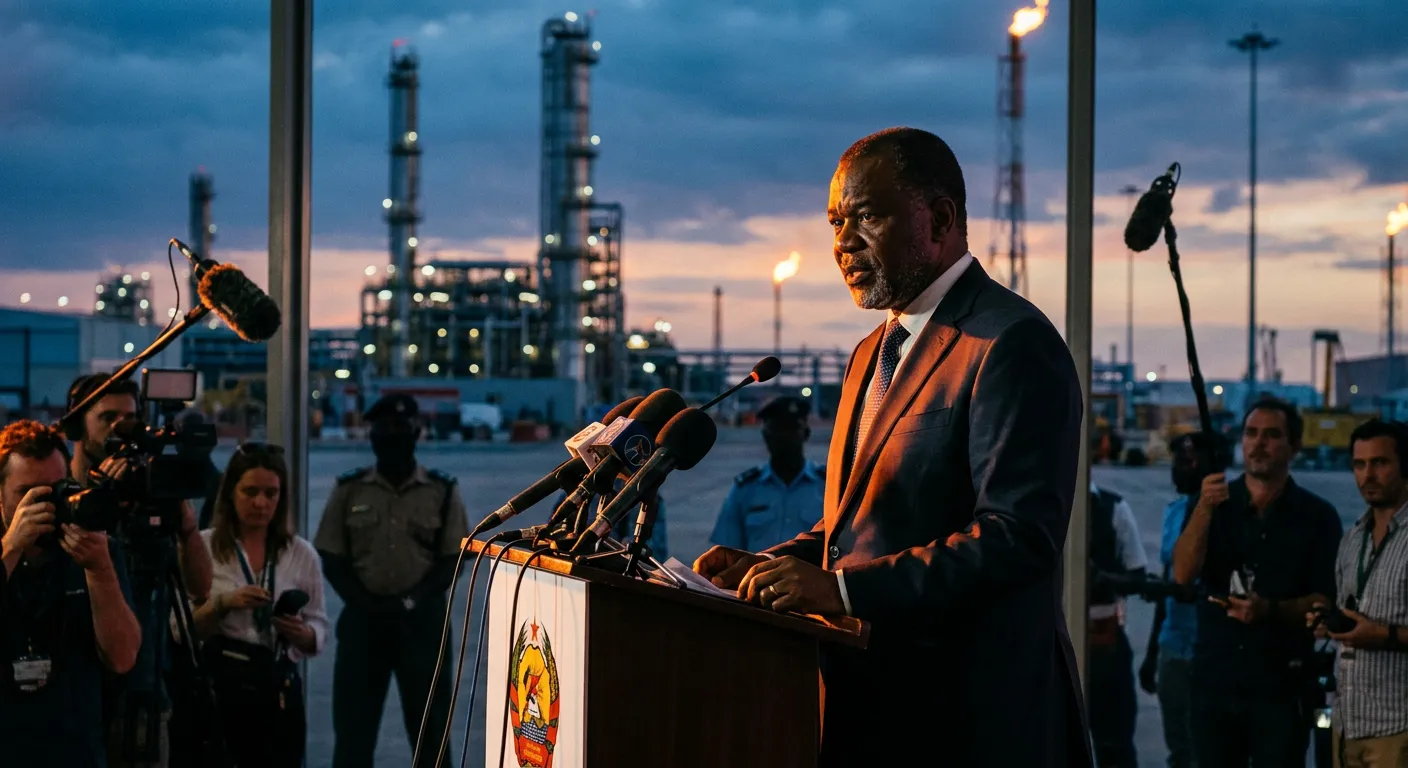
Mozambique's LNG Restart Reveals the Real Foreign Policy: Regime Survival, Whatever It Takes
The January 2026 TotalEnergies project relaunch in Cabo Delgado crystallizes a foreign policy built on a single hierarchy — security first, gas revenue second, ideology a distant third.
The ceremonial restart of TotalEnergies' $20 billion liquefied natural gas project at Afungi on January 29, 2026, was more than a business milestone. President Daniel Chapo stood beside CEO Patrick Pouyanné to announce that after a five-year freeze, Mozambique was back in business — and with it, the operational logic of Mozambican foreign policy snapped into focus. Every major diplomatic move Chapo has made since his disputed January 2025 inauguration serves the same chain of priorities: stabilize Cabo Delgado, unlock LNG revenue, and convert that revenue into regime durability. Ideology is whatever works.
The project, designed to produce over 13 million tonnes of LNG annually and generate an estimated $35 billion for government coffers over its lifetime, had been suspended since 2021 when ISIL-linked insurgents struck Palma, killing dozens and forcing TotalEnergies to declare force majeure. Al Jazeera Its return signals that Maputo — with critical external backing — has contained the threat sufficiently for capital to return.
The Security-LNG Nexus: Rwanda Delivers What SADC Couldn't
The enabling condition is straightforward: foreign troops. Mozambique's stated commitment to non-interference and sovereignty never survived contact with the Cabo Delgado insurgency. When the state's grip on gas-rich territory faltered, Maputo invited in Rwandan forces in July 2021 — well ahead of the SADC mission — and the contrast in outcomes has shaped everything since.
Rwandan troops, now reportedly reinforced beyond their initial deployment, secured the Afungi peninsula and the critical districts of Palma and Mocímboa da Praia. The SADC Mission in Mozambique (SAMIM), by contrast, withdrew in July 2024 after a three-year mandate marked by financial constraints and limited operational impact. BBC News Botswana and Lesotho pulled out early; South Africa kept troops in country but outside the SADC framework. Rwanda emerged as the indispensable security guarantor — a non-SADC actor with a professional, battle-tested army, and one that answers directly to bilateral understandings with Maputo rather than multilateral consensus.
The result is a security architecture built around investor confidence, not regional solidarity. TotalEnergies' return has now triggered a cascade: ExxonMobil lifted its own force majeure declaration in November 2025 for the $30 billion Rovuma LNG project, and the two majors are jointly tendering maritime services for a projected 400 LNG tankers per year. Chapo has said he expects ExxonMobil's Final Investment Decision by mid-2026. ANGOP
Chapo's Diplomatic Offensive: The President as Chief Investment Officer
Since taking office, Chapo has used the presidency as a roving investment platform. In April 2026, he visited Ethiopia and signed multiple MOUs with Prime Minister Abiy Ahmed. ENA In June, he traveled to Luanda for the Angola Investment Summit, where he and João Lourenço discussed bilateral cooperation and Cabo Delgado stabilization.
ANGOP He addressed the World Bank's Fragility Forum 2026 in Washington with a blunt message: "It is better to invest before conflicts break out than after."
ANGOP
Europe is listening. The EU's Africa director, Patricia Llombart, stated explicitly in 2026 that Mozambique's gas is "clearly in the common interest of both Europe and Mozambique," framing it within Europe's post-Ukraine energy diversification strategy. Structured EU-Mozambique security consultations on Cabo Delgado were launched, co-chaired by Defense Minister Cristóvão Chume. ANGOP
This is the foreign policy in practice: bilateral, transactional, security-guaranteeing-investment. Chapo is selling stability to anyone who can help deliver it — Rwanda, the EU, the US, regional neighbors — while keeping all doors open.
UN Voting as Cover: Non-Aligned Enough to Keep Everyone Talking
Mozambique's multilateral behavior provides the necessary political cover. During its 2023–2024 UN Security Council term, Maputo voted consistently with African and Global South consensus on Gaza — backing ceasefire resolutions, supporting Palestinian membership, and breaking with the US where the broader non-aligned bloc did. Al Jazeera On Ukraine, Mozambique abstained on the February 2025 UNGA resolution condemning Russian aggression — a position that frustrates Western capitals but preserves Maputo's relationships with Moscow and Beijing.
Al Jazeera
This is not ideological conviction; it is positioning. Mozambique's UN voting record keeps it legible as a non-aligned developing state, which is precisely the status that allows it to accept security assistance from Rwanda, investment from TotalEnergies, development finance from the IMF, and political engagement from China — without being locked into any single camp. The rhetoric of South-South solidarity and sovereignty is the public face; the private reality is a government willing to host foreign troops on its own soil because the alternative is losing control of territory that holds the bulk of future state revenue.
What to Watch
The ExxonMobil FID, expected by June–July 2026, is the next decision point that matters. If it lands, Mozambique's LNG trajectory locks in, and the competition for security and commercial access to Cabo Delgado intensifies. The EU's structured security consultations with Maputo will test whether Brussels can translate energy interest into sustained security cooperation — or whether Rwanda remains the indispensable partner. And underneath it all, the insurgency is contained but not defeated; displacement numbers remain high, and any major attack on Afungi would reset the clock. Chapo's foreign policy has bought time. Whether it has bought stability is the question the next 12 months will answer.
Discover more
Global Politics
Trump's Conflicting Messages on Iran War
Trump's mixed messages on Iran reflect a strategy of audience management, benefiting Tehran amid a complex geopolitical landscape.
India
Women’s Reservation in India
India's 33% women's reservation law is enacted but won't take effect until after 2029 due to political setbacks and census delays.

Global Politics
US Seizes Iranian Ship, Tensions Surge
The US seizure of the Iranian ship Touska highlights a shift in control over the Strait of Hormuz, favoring Iran's strategic position.

Economics
Fed's Amex AML order puts correspondent banking on notice
Federal Reserve's Amex AML order requires board-level controls and a 90-day plan; OCC fined the bank $350 million over enterprise-wide deficiencies.