Modi's Women's Reservation Bill Fails
A historic defeat for Modi's government in Lok Sabha
Model Diplomat9 min readIndia

Modi's Women's Reservation Bill Fails: The Vote That Broke a Streak
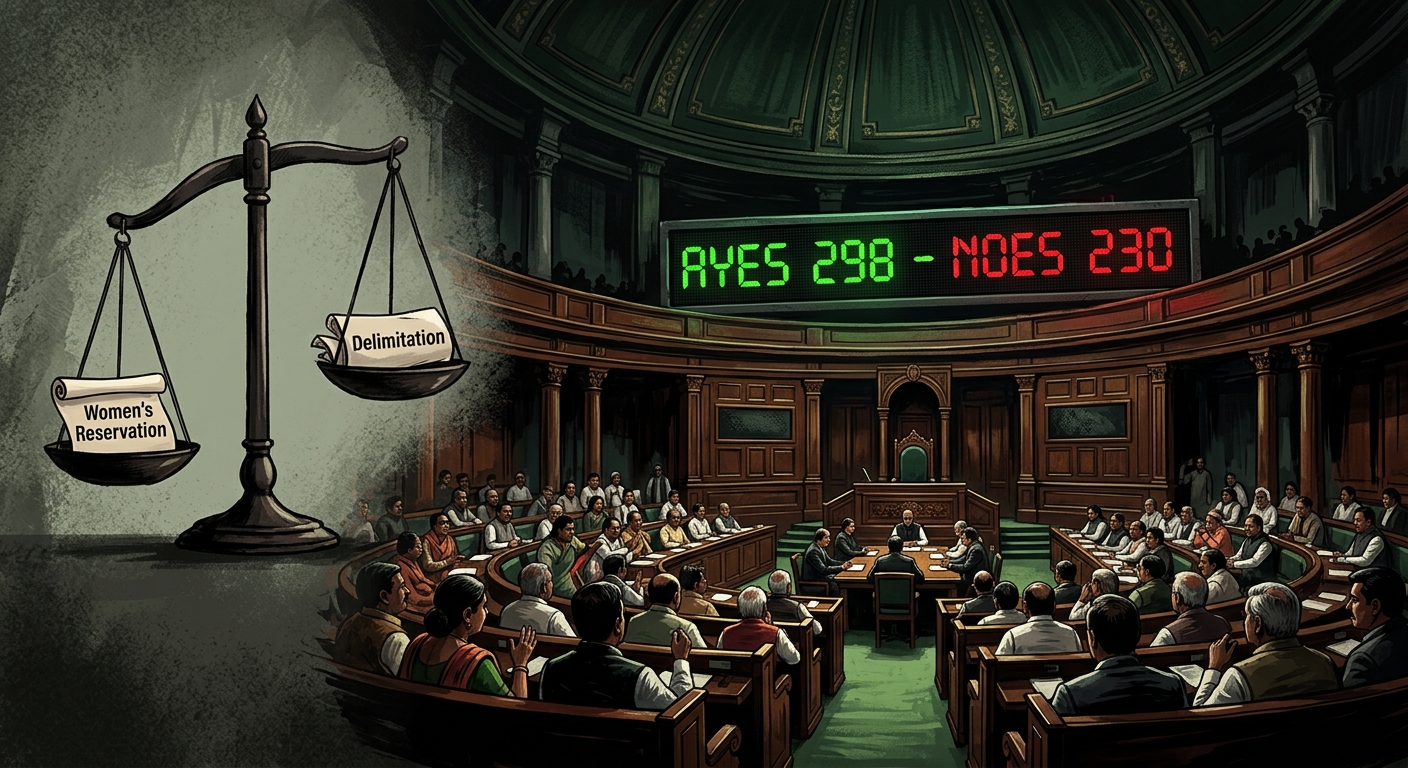
India's Lok Sabha voted 298–230 to reject the Constitution (131st Amendment) Bill on April 17, 2026 — the first constitutional amendment defeat of Modi's premiership, and a fight that was never really about women.
Prime Minister Narendra Modi lost his first constitutional amendment on the floor of the Lok Sabha on April 17, 2026, when the Constitution (131st Amendment) Bill secured only 298 of the 360 votes needed for a two-thirds majority — a defeat formally concerning a 33% quota for women in parliament but, in substance, an opposition veto over the government's plan to redraw India's political map before the 2029 general election. According to the NUS Institute of South Asian Studies, 230 members voted against — a united INDIA bloc plus southern regional parties — after two days of debate the government refused to postpone until after Tamil Nadu and West Bengal went to the polls. The bill's failure did not kill women's reservation, which is already law. It killed Modi's shortcut to expanding the Lok Sabha from 543 to 850 seats on 2011 census data — a shortcut that would have shifted political weight decisively toward the BJP-dominated north.
What actually happened on the floor
The government convened a special session of the 18th Lok Sabha from April 16 to 18, 2026 to move three linked pieces of legislation: the Constitution (131st Amendment) Bill, 2026; the Delimitation Bill, 2026; and the Union Territories Laws (Amendment) Bill, 2026. In his end-of-session summary, Lok Sabha Speaker Om Birla confirmed that the three bills were debated for 21 hours and 27 minutes across the two days, with 131 members participating — including 56 women — and that "the Constitution Amendment Bill was not passed by the House."
The arithmetic was punishing from the start. Al Jazeera reported that Modi's National Democratic Alliance holds 293 seats in the lower house — 67 short of the 360 needed for a constitutional amendment at full strength. The BJP had bet that the political toxicity of voting against a women's quota would peel off enough Congress, DMK and TMC MPs to bridge the gap. It didn't. Home Minister Amit Shah's
closing intervention offered a last-minute concession — a uniform 50% pro-rata seat expansion, so that the five southern states' share of the chamber would rise from 23.76% to 23.87% under an enlarged 816-seat Lok Sabha — but by the time Shah spoke, the whip lines had hardened. The Business Standard
reported that ministers spent the previous evening trying to persuade smaller opposition parties one-on-one; the effort failed, and the government still called the division rather than adjourn.
The Indian Express noted this was the first time in 12 years a Modi-government constitutional amendment had fallen on the floor of the House — the end of a streak that began with the 101st (GST) in 2016 and ran uninterrupted through the 103rd (EWS reservation), the 105th (state OBC lists) and the 106th (women's reservation) amendments.
The Trojan horse the opposition wouldn't accept
The 33% women's quota itself is not contested. The Constitution (106th Amendment) Act, 2023 — the Nari Shakti Vandan Adhiniyam — was notified on 28 September 2023 after passing the Lok Sabha 454–2 and the Rajya Sabha unanimously. What that statute did not do was implement itself: Articles 330A and 332A tie the quota's activation to the completion of a fresh census and a subsequent delimitation exercise.
That sequencing is the whole game. The Carnegie Endowment's May 2026 analysis put it bluntly: the 131st Amendment package sought to operationalise the women's quota "for a distinctly political purpose. The quota for women functioned as a vehicle to push through a broader reengineering of India's electoral design." The 131st Amendment would have raised the Lok Sabha cap to 850 seats, allocating a maximum of 815 to states and 35 to union territories, while stripping out the constitutional requirement that seats be reapportioned after every census — letting Parliament pick which census to use. The Delimitation Bill named that census as "the latest census figures published as on the date of the constitution of the Commission" — meaning the 2011 count, not the ongoing 2026 census whose first phase
began on April 1, 2026.
Rahul Gandhi, in a statement quoted by Al Jazeera, called it what the opposition believed it was: "It is merely an attempt to seize power through delimitation and gerrymandering." Congress parliamentarian Gaurav Gogoi told the House the government was smuggling delimitation "through the backdoor." The Samajwadi Party's Akhilesh Yadav pushed a different fault line, asking whether Muslims would be given any reservation within the women's quota — an argument that echoed the 1998–2010 debates, when OBC-based parties killed successive women's reservation bills on precisely this ground. CPI(M) MP John Brittas summarised the technical objection to the BBC: "We support reserving 33% seats for women based on the current strength of parliament. We also want a further freeze on expanding overall seats in the parliament until population trends stabilise."
Why the south held the line
India has not redrawn parliamentary boundaries between states since the 1971 census. The 42nd Amendment in 1976, enacted during the Emergency by Indira Gandhi, froze reapportionment out of concern that population-based redistribution would penalise states with reduced fertility rates. The 84th Amendment in 2002 extended the freeze until after the first census taken post-2026. The unstated bargain protected states — mostly southern — that had cut fertility rates faster than the north. Population growth since 1971 has been wildly uneven, and unfreezing seats on a purely proportional basis would strip Tamil Nadu, Kerala, Karnataka, Andhra Pradesh and Telangana of parliamentary weight they have held for half a century.
The BBC's Delhi bureau cited estimates that Tamil Nadu alone could lose up to eight seats under a straight 2026-based delimitation, while Uttar Pradesh and Bihar would each gain roughly a dozen seats to close their gap with population share. By 2031, the same reporting notes, Tamil Nadu will likely hold 11 seats more than its population proportion, and UP a dozen fewer — a distortion that makes some form of realignment unavoidable, and makes the fight over which census is used a proxy fight over how much power the south permanently loses.
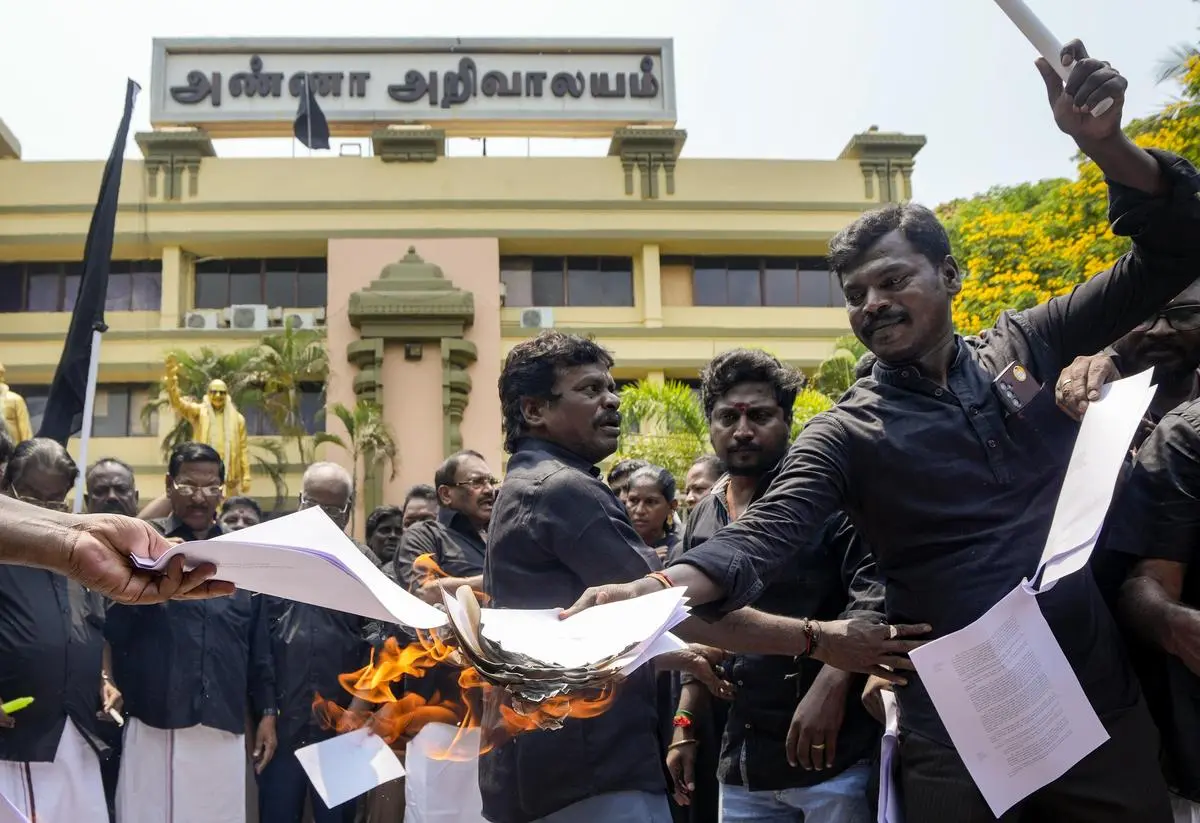
Tamil Nadu Chief Minister M.K. Stalin burned a copy of the bill outside the state secretariat on the day of introduction, calling the plan a "massive historic injustice" and telling supporters to fly black flags. His party, the DMK, faced a state election within weeks. So did Mamata Banerjee's Trinamool Congress in West Bengal. For both, voting for the government's package would have been political suicide; voting against a women's reservation bill, framed that way by Modi, was a manageable cost. Vidhi Centre for Legal Policy's Arghya Sengupta had already told the BBC that the 850-seat cap was arbitrary — "the basis for this number is unclear and does not appear to be proportionate to population growth recorded in the 1971 and 2011 census" — and that the bill created a "mismatch: fast-growing states could gain more MPs without a corresponding rise in MLAs" because state assemblies were not being expanded in parallel.
The BJP's own southern flank was cornered. The party's Karnataka and Andhra Pradesh MPs whipped in favour, but coalition partners with southern exposure had to be leaned on hard. Even with all NDA allies delivering, 298 votes was still 62 shy of the two-thirds threshold — evidence that either a slice of NDA-adjacent MPs quietly abstained, or that the government's floor management, as NUS-ISAS observed, was compromised by "the way the legislation was introduced… without any prior consultation with opposition parties or floor management."
The morning after: 'foeticide' and a wager on 2029
Modi's response the following day set the political frame. In a televised address on April 18, 2026, he "apologised to the women of the country" for the bill's defeat and, Business Standard reported said Congress had "repeated its history of not supporting the Bill." The Independent reported that Modi went further,
likening the vote to "female foeticide" and declaring that the opposition had "committed a sin… they will be surely punished for this."
The gambit worked in one of the two election states. Mamata Banerjee's Trinamool lost West Bengal to the BJP weeks later, ending 15 years in power; the BBC's post-election profile framed the defeat as part of a wider shift toward single-party dominance in Indian politics. Tamil Nadu, though, held. The DMK-led alliance survived a campaign in which Modi personally accused the opposition of killing women's reservation. That split verdict tells you what the bill was actually litigating: not gender representation but federal power — and the answer voters gave was regional, not national.
Two truths that will outlive this vote
The first is that the women's quota is now stranded. As the Carnegie analysis notes, the 2023 amendment "explicitly ties the implementation of a one-third reservation for women to the completion of a fresh census and the subsequent delimitation exercise. As a result, women's reservation — despite being formally enacted — cannot take effect until after the 2027 census is completed and a new delimitation is carried out." Women currently hold roughly 14% of Lok Sabha seats. Without either a fresh amendment or the completion of the current census cycle, that number will not move before the 2029 general election — meaning the practical beneficiaries of the 2023 law will be women elected sometime in the 2030s, not the ones the government spent the past three years crediting itself with empowering. The
Takshashila Institution's post-vote assessment concluded that the bills, coming against the backdrop of state polls, "were seen as an affront to federalism and were defeated."
The second is that Modi's post-2024 arithmetic is now structural. The 2024 general election cost the BJP more than 50 seats, leaving it below the 272 majority mark on its own and dependent on the Telugu Desam Party's Chandrababu Naidu and Janata Dal (United)'s Nitish Kumar for a governing majority. In his first two terms, Modi's constitutional amendments passed with room to spare because the opposition either supported them (the 106th passed 454–2) or was too fragmented to organise a two-thirds veto. The 131st is the first that didn't clear, and the reason is structural: allies with southern and Bihar voter bases will not co-sign a delimitation formula that shrinks their own political geography, and a united INDIA bloc no longer needs their defection to block him — it needs only their abstention.
The historical parallel worth noting is 1989, when V.P. Singh's government fell partly on Mandal-era caste politics that also weaponised representation as a proxy for regional power. What broke on April 17, 2026 is not Modi's authority — his government continues and won West Bengal three weeks later — but the presumption that constitutional revision is his to write.
Diplomat View
The 131st Amendment's defeat is being read in Delhi as a Modi loss. It is more usefully read as the moment the 2024 election result acquired constitutional teeth. For a decade, Modi enjoyed a working two-thirds coalition on any amendment he cared to move; on 17 April 2026, he did not. The specific issue was delimitation, but the deeper signal is that the BJP can no longer treat constitutional revision as a majoritarian instrument — allies now have a veto, and they will use it whenever a redraw of federal power is at stake. Expect the government to unbundle the package: a "clean" women's reservation activation bill offered in the monsoon session, decoupled from seat expansion, to force the opposition either to concede or wear the "anti-women" charge in 2029. The forecast changes if the 2026 census phase concludes ahead of schedule and Shah brokers a written no-seat-loss guarantee with the southern chief ministers — in which case the delimitation fight moves from the floor to the Supreme Court, where population equity and federal balance will be litigated as constitutional first principles under India's basic structure doctrine.
What to watch:
- Monsoon Session 2026 (July–August): whether the government tables a decoupled women's reservation activation bill, or lets the issue sit until after the census.
- Second phase of the 2026 census: phase-two enumeration is expected in early 2027 and is the legal trigger for any lawful delimitation. Any acceleration signals a renewed push.
- Supreme Court delimitation petitions: southern states and civil-society plaintiffs are expected to challenge whether 2011-based delimitation violates the one-person-one-vote principle. First hearings could set the terms of the next round.
Discover more

India
Modi's Nari Shakti Gambit
Modi's Varanasi speech redefines women's empowerment as a Nari Shakti gambit, blending appeals for women's votes with the contentious delimitation debate.
India
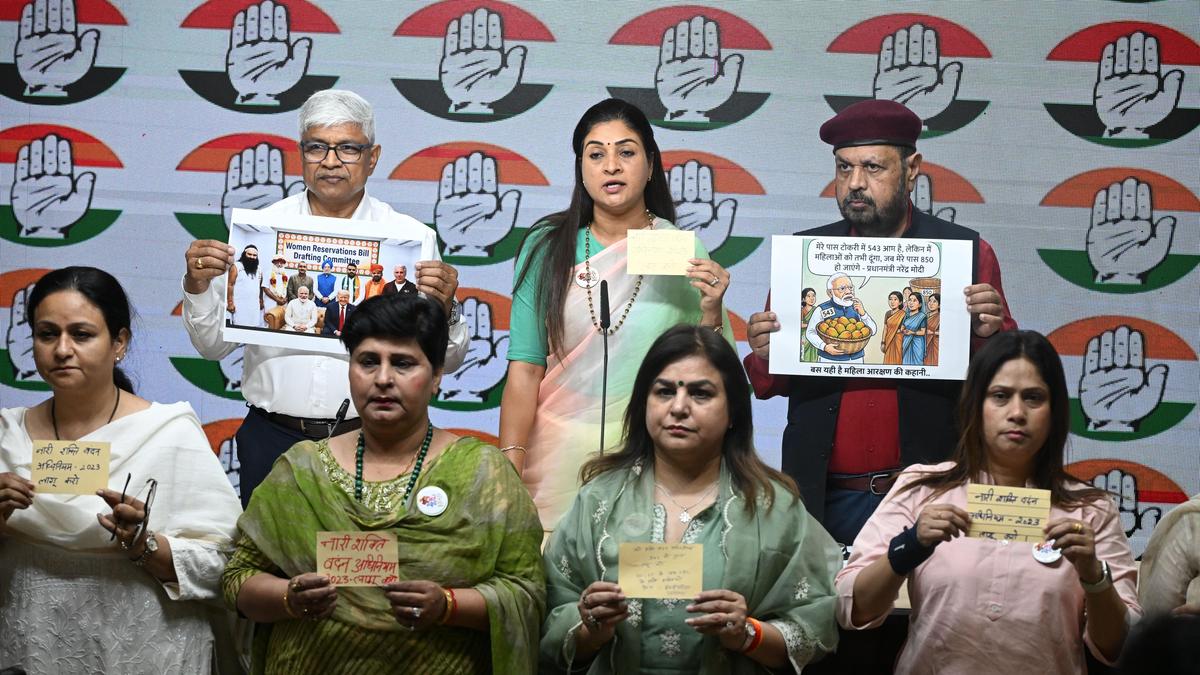
Mahila Congress Postcard Push for Women's Quo
The Mahila Congress launches a postcard campaign to demand immediate implementation of the 33% women's reservation in India's Lok Sabha, targeting PM Modi.
India
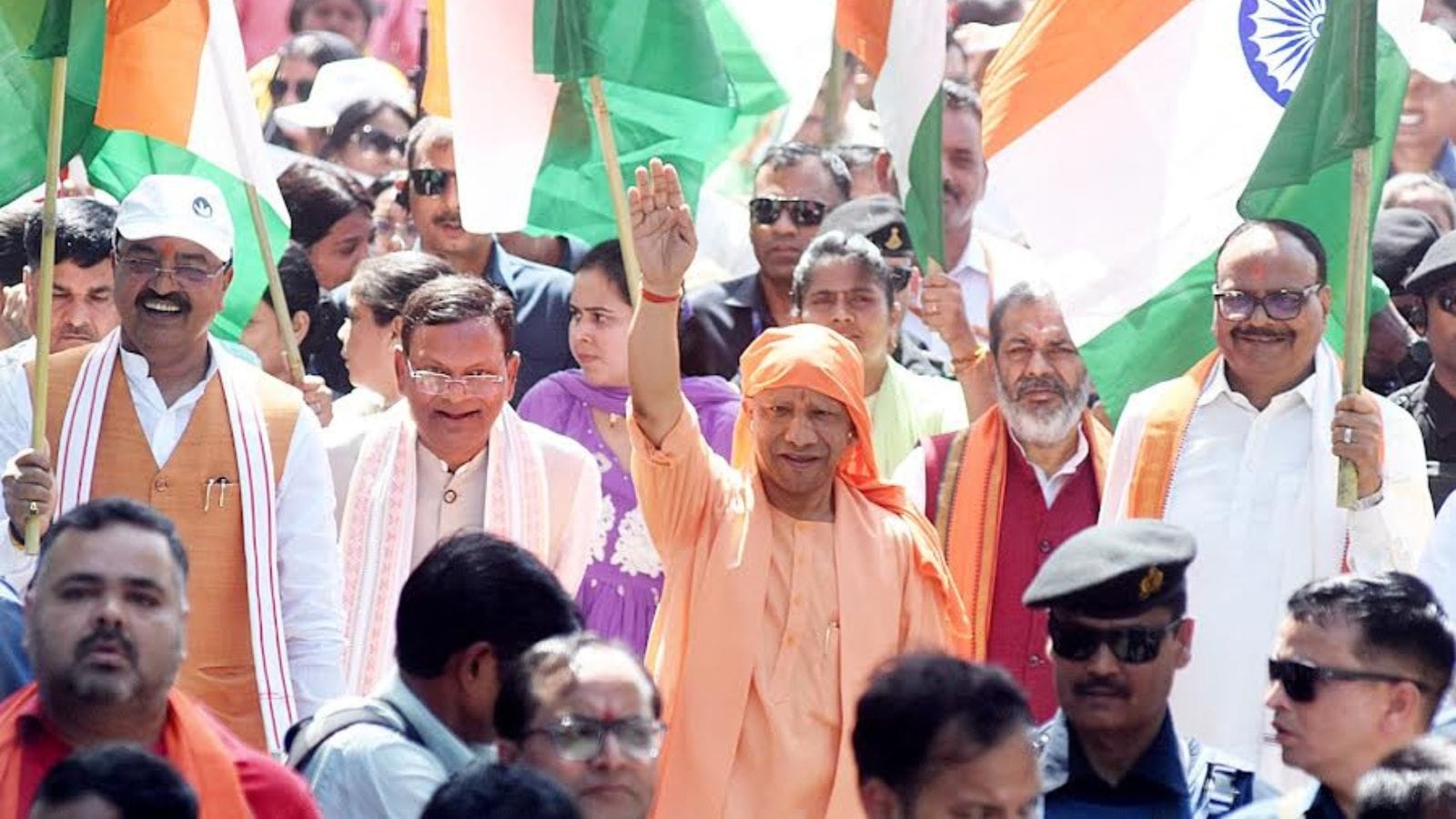
Yogi Adityanath's BJP March on Women's Bill
Yogi Adityanath's padyatra after the women's bill defeat aims to reshape UP's 2027 elections, targeting women's votes against the SP.
India
Women’s Reservation Bill 2026
The Constitution (131st Amendment) Bill, 2026 was defeated in Lok Sabha, revealing deeper political conflicts over women's reservation and delimitation.