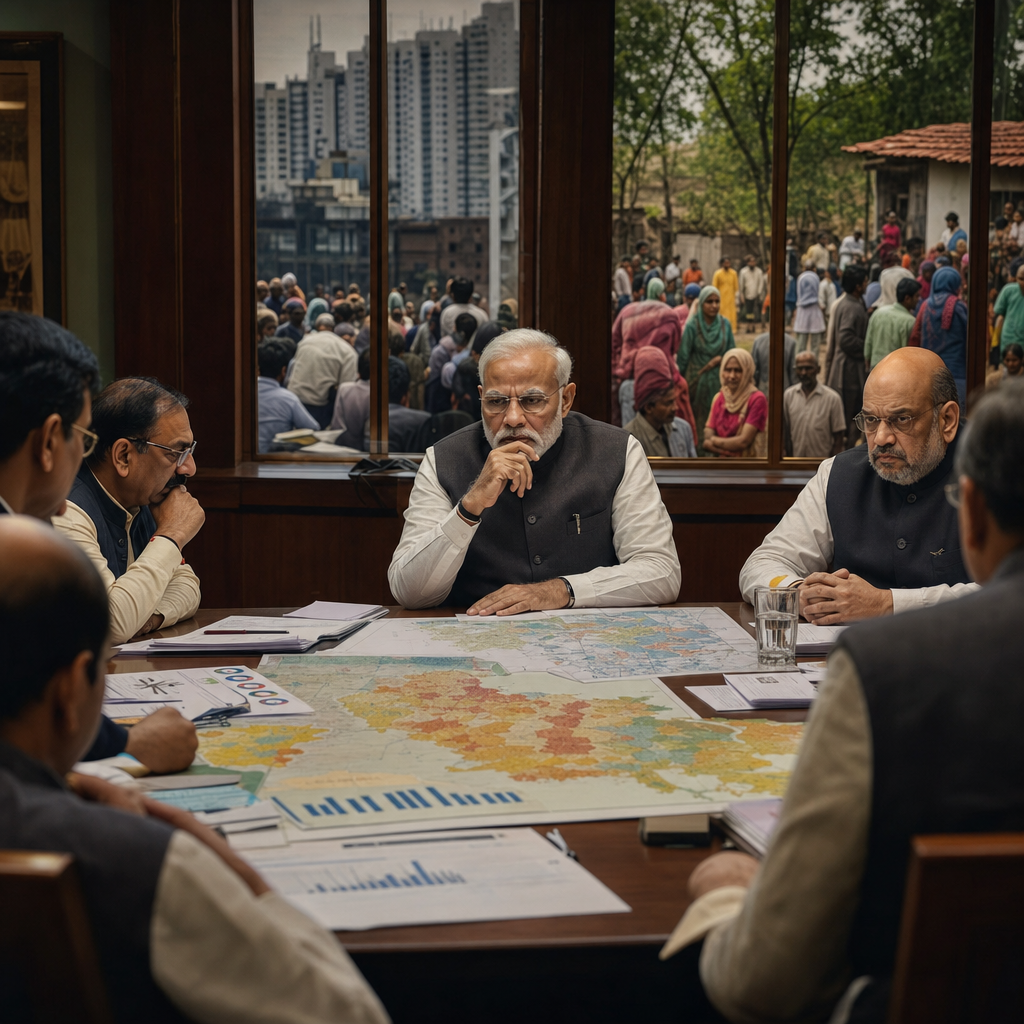
Modi Turns “Demography” Into a State Project
The Centre’s new panel gives Amit Shah a formal vehicle to turn infiltration rhetoric into policy, but the real battle is political: measurement, messaging and border-state control.
Union Home Minister Amit Shah said the Centre has constituted a high-level committee under retired Supreme Court judge Justice P.P. Naolekar to assess demographic changes across India caused by “illegal immigration and other unnatural causes,” with the census commissioner and senior former officials among its members, according to  NDTV. Shah said the panel will study “abnormal population shifts” across religious and social communities and produce a “planned and time-bound solution,” framing the issue as one of sovereignty, law and order, and tribal security, NDTV.
Why this matters
The power dynamic is straightforward: the Centre is institutionalising a political claim that has already become a core BJP talking point. By putting the issue in committee form, Shah gives the government an administrative handle on a narrative that Prime Minister Narendra Modi elevated in his 15 August speech, where he warned of a “pre-meditated conspiracy” to alter India’s demography through infiltration, NDTV. That matters because a panel can do more than study data; it can justify tighter border enforcement, deeper scrutiny of documents, and a political campaign against migrants and minorities.
But the government is also moving into a data vacuum.  The Hindu reported that a similar committee announced in the 2024 interim budget never took off, and noted that India’s last Census was in 2011, with the next population count expected in 2027. That means the Centre is trying to address a supposed nationwide demographic shift without a fresh national baseline. In practice, that weakens the statistical credibility of any finding and increases the likelihood that the panel becomes a political instrument first and a research body second.
Who benefits, who loses
The immediate beneficiary is the BJP’s security-and-identity agenda, especially in border states where migration, land, and citizenship are already heavily politicised. The panel also helps Shah centralise the file inside the Home Ministry, where border control, foreigners policy, and internal security sit together. For the party, it creates a formal bridge between campaign rhetoric and executive action.
The losers are likely to be local administrations and vulnerable communities in contested border belts, who may face more aggressive documentation drives and surveillance without clear evidence standards. The larger risk is that “demographic change” becomes a catch-all label for everything from migration to fertility trends to local population movement. That would blur the line between security policy and social engineering, and make the eventual policy response harder to challenge.
What to watch next
The next real test is the panel’s terms of reference: whether it is limited to border infiltration, or broadens into religion-wise population analysis and state-level intervention. Watch for who gets access to Census data, whether the Home Ministry shares intelligence inputs, and whether the committee produces recommendations before the 2027 Census cycle. If it moves quickly, the Centre is not just assessing demographic change; it is building the case for a more aggressive internal security doctrine. For a wider read on the political stakes, see  India and Global Politics.