Middle East's Compute Corridor Development
Rail and pipelines support digital ambitions
Model Diplomat4 min readMiddle East
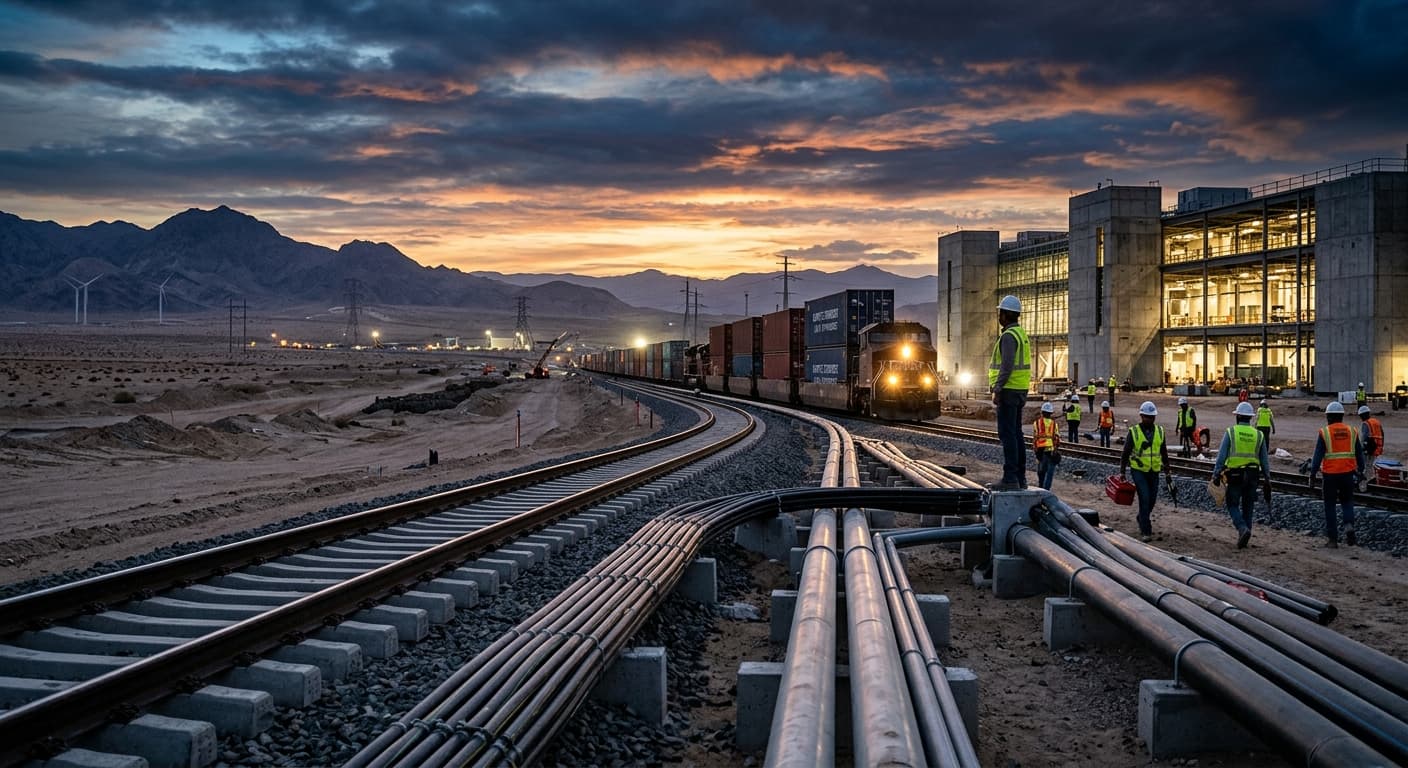
The Middle East is building a compute corridor. The rail and pipelines are the cover story. Etihad Rail's link to Oman is nearing completion; a Saudi–Qatar high-speed line signed in December 2025 will run at 300 km/h between Riyadh and Doha, Al Jazeera reports. The GCC's April 28, 2026 leaders' summit in Jeddah, the first in-person gathering since the Iran war began, put the six-country, 2,117-kilometre GCC Railway back on the front burner, aiming for a Kuwait-to-Muscat spine by 2030.
The harder corridor is the one everyone wants. The World Bank on March 31, 2026 approved a $2 billion loan — anchoring $6.75 billion in multilateral co-financing — for Türkiye's Istanbul North Rail Crossing, which will lift Bosphorus rail freight capacity from 3 million to up to 50 million tonnes a year and explicitly connect the "Middle Corridor" from Central Asia to Iraq's "Development Road." Two months later the Bank added $900 million for
Iraq's Transport Economic Corridors — rehabilitating the east–west E1 to Syria and Jordan and building the north–south E2 to Türkiye. These are the primary documents that turn corridor-speak into disbursements.
The angle: this is a compute corridor with pipelines attached
Read the 2023 IMEC MOU closely and one clause jumps out:
"Along the railway route, Participants intend to enable the laying of cable for electricity and digital connectivity, as well as pipe for clean hydrogen export."
That sentence is the strategic hinge: the steel and asphalt are cover for what the Gulf states actually want to export in the 2030s — electrons, hydrogen, and cloud compute.
The Middle East Institute's December 2025 study "From Crude to Compute" argues the GCC bloc is trying to convert hydrocarbon wealth into an "AI stack": Saudi Arabia, the UAE and Qatar are planning 8–10 gigawatts of AI-related compute capacity across shared grids. Carnegie's Middle East Program is starker, describing GCC data centres as
"the Gulf's new aluminum" — fossil fuels re-exported as digital services, with the carbon booked in the Gulf but the value captured worldwide.
The Iran war intersects this trajectory in two ways. First, it damaged the "island of stability" narrative: the Gulf International Forum notes data centres in the UAE and Bahrain were struck directly, and the IISS calculates the
GCC data-centre market — projected to hit $9.5 billion by 2030 — now sits inside a demonstrated missile envelope. Second, and more important: the war made corridor-based redundancy essential. Four Bab al-Mandeb submarine cables were severed in 2024, disrupting a quarter of Asia–Europe internet traffic (IISS), and the compute economy now needs terrestrial fibre that missiles cannot reach. IMEC's route through the UAE, Saudi Arabia, Jordan and Israel is precisely that alternative — a "compute corridor" the Atlantic Council names explicitly.
The Atlantic Council's own in-depth report is candid that the "economic potential and feasibility" of the trans-Arabian gas pipeline and hydrogen line "remains unclear," but flags "high-potential projects" in deeper electricity grid integration and new subsea and terrestrial fibre-optic cables linking emerging data centres in the Middle East with Europe and India.
Who gains, who loses
The clearest winner is the UAE. Its pipeline can absorb the demand shock now, its Stargate UAE campus — a 5 GW site inside a 10-square-mile masterplan — anchors regional compute, and Emirati capital (MGX, G42) is buying stakes across the AI supply chain. Abu Dhabi is the one Gulf capital simultaneously moving oil, electrons and data outside the strait.
Saudi Arabia is close behind, betting that NEOM, HUMAIN's gigawatt-scale data centres, and the Petroline can convert Vision 2030 into a physical corridor. The BBC notes Riyadh's rivalry with Abu Dhabi is intensifying, and IISS warns the two capitals are "building parallel infrastructure in competition, fragmenting regional leverage."
Jordan and Syria are the sleeper beneficiaries. The post-Assad government in Damascus has re-opened Syrian rail arteries, Al Jazeera reported in May 2026, and Emirati port investments plus World Bank financing are creating the first serious case for a Gulf-to-Mediterranean overland route since the Trans-Arabian Pipeline was abandoned. Jordan finally gets Aqaba built into a regional oil outlet.
The losers are more interesting than the winners. Iran loses long-term: the strait remains its leverage instrument — Tehran even stood up a "Persian Gulf Strait Authority" to charge tolls, per Brookings — but every kilometre of bypass pipeline degrades that leverage's future value. Egypt loses too: Suez transit fees, already hit by the Houthi campaign, face structural erosion if IMEC-style rail-sea combinations mature. And China's Belt and Road faces its first credible Middle East counterweight, backed not just by American rhetoric but by IFI balance sheets.
The climate paradox
Here is the second-order effect the wire misses. These corridors were sold at COP and G20 stages as green infrastructure — hydrogen pipelines, electricity interconnectors, clean supply chains. In practice, the 2026 rush is being driven by oil-crisis logic and financed by hydrocarbon rents. Carnegie's analysis argues Gulf states are on track to weaponise this dual role, "combining their traditional role as hydrocarbon producers with growing control over critical computing infrastructure" as climate negotiations return to the region for COP31 in Antalya in November 2026.
Translation: the same corridors that will one day move green hydrogen to Rotterdam are, this decade, locking in fossil-fuelled data centres and pipeline expansions that make Gulf carbon exports more, not less, resilient. The Gulf states know this. COP31 in Antalya in November 2026 will be the first major climate summit where the hosts are also the world's largest compute-corridor builders — and that is not a coincidence.
Discover more
Global Politics
Xi Jinping Calls China-Russia Ties 'Precious'
Xi Jinping's description of China-Russia ties as 'precious' reflects a strategic imbalance, with Beijing dictating terms in the partnership.
India
Congress Accuses Modi of Stalling Women's Law
Congress accuses Modi of stalling women's reservation law by linking it to delimitation, revealing a deeper electoral strategy.

US Politics
Virginia's Redistricting Referendum
Virginia's redistricting referendum is drawing a flood of dark money, shaping future elections and the fight for congressional control amid party stakes.

Economics
Fed's Amex AML order puts correspondent banking on notice
Federal Reserve's Amex AML order requires board-level controls and a 90-day plan; OCC fined the bank $350 million over enterprise-wide deficiencies.