Middle East Crisis Rewrites Energy Security
Renewables emerge as key to national security post-2026 war.
Model Diplomat7 min readMiddle East
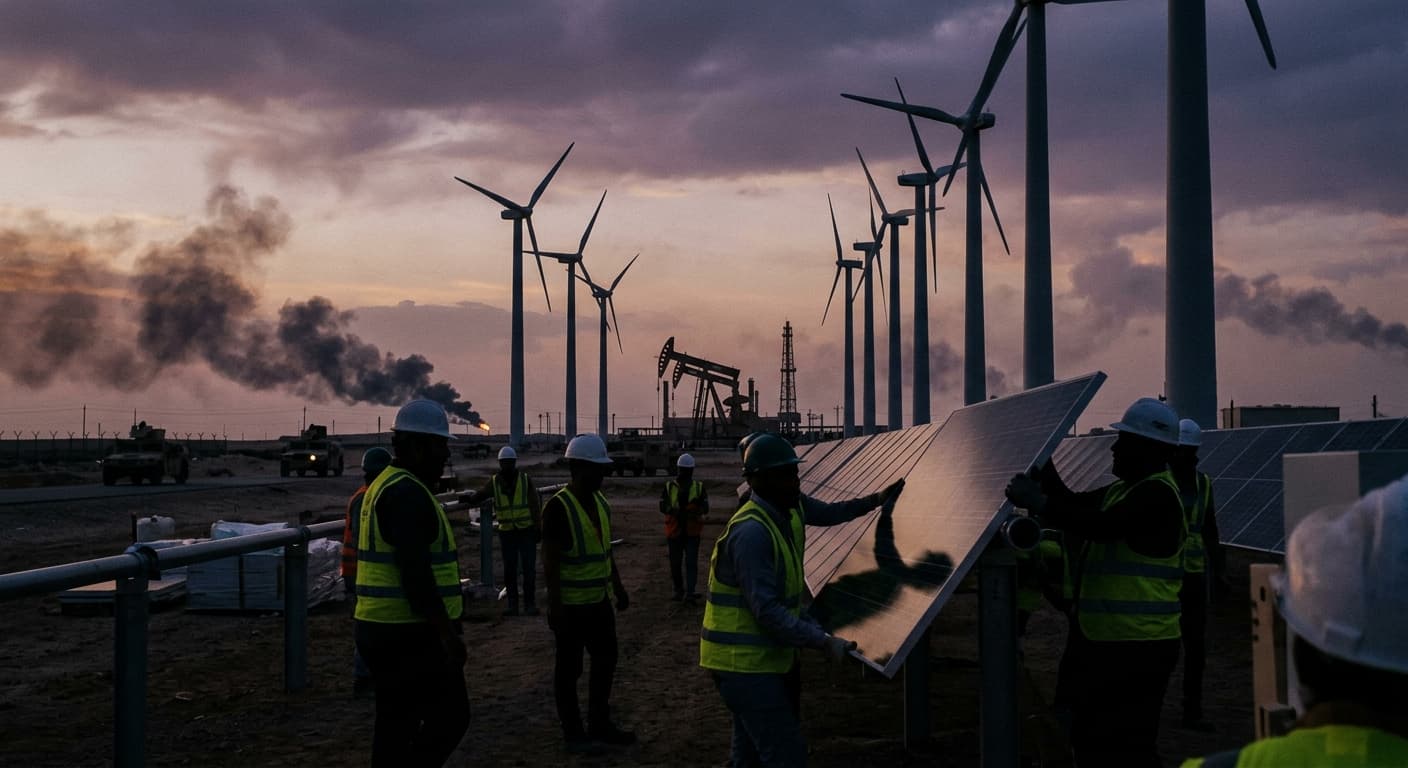
Middle East Crisis Rewrites Energy Security Playbook
The 2026 Iran war made fossil-fuel imports a national-security liability. IEEFA's five lessons show why the durable response is renewables, grids and electrification — not another LNG cargo.
The 2026 Middle East war has done what a decade of climate diplomacy could not: it has moved renewable energy from an environmental preference to a first-order national-security investment. In a July 8 analysis titled "Deal or no deal: Five energy market lessons from the Middle East crisis," the Institute for Energy Economics and Financial Analysis argues that switching cargoes, contracts or suppliers cannot fix a system built on a 29-mile chokepoint — and that the only durable answer is to shrink the exposure itself. The data behind that claim is now blunt: global clean-energy investment will hit roughly $2.2 trillion in 2026, nearly double the $1.2 trillion flowing to oil, gas and coal, according to the IEA's World Energy Investment report referenced by the
UK government. Security, not climate, is now the strongest bid in the market.
The shock that reset the rules
On February 28, 2026, the United States and Israel struck Iran. Within days Tehran had effectively closed the Strait of Hormuz, cutting off roughly a fifth of global seaborne oil and LNG. The International Energy Agency called it "the largest supply disruption in the history of the global oil market," with Gulf producers shutting in at least 10 million barrels per day. Brent, trading below $70 before the war, peaked near $120. Iranian drones then hit QatarEnergy's Ras Laffan complex on March 2, forcing a force majeure that pushed benchmark Asian LNG prices up almost 39% in a single session,
Al Jazeera reported.
The response was equally unprecedented. On March 11 the IEA coordinated a 400-million-barrel emergency reserve release — the largest in the agency's history — adding an estimated 2.5–3 million barrels a day to the market, according to a Brookings analysis by Kari Heerman and David Wessel. A US-Iran 14-point memorandum in June briefly pulled Brent back to $83.55, per the
BBC. By July 8, fresh US strikes on Iranian fast boats had reversed most of that relief — the backdrop against which IEEFA published its lessons.
Lesson one: imports are a fiscal weapon pointed at the importer
The clearest test of an energy-security strategy is how it performs when the price doubles. IEEFA's answer is that import-heavy economies fail the test in weeks, not years. Pakistan, Japan and the Philippines each source more than 90% of their crude from the Persian Gulf; India imports about 90% of its oil, with roughly half moving through Hormuz, BBC reporting confirms. Every $10 rise in Brent pushes Indian inflation up by 0.2–0.25 points if passed through, or forces an equivalent fiscal hit if it isn't.
The bill is landing on state balance sheets. Japan spent more than $77 billion on fuel subsidies between 2022 and 2024, IEEFA calculates. Bangladesh, which imports 95% of its oil and LNG, has requested a new IMF programme; on May 15, 2026 the World Bank approved an additional $350 million payment-guarantee facility to keep Petrobangla's LNG cargoes moving. India's state oil marketing companies are absorbing more than $4 billion of losses on cooking fuel alone.
Lesson two: LNG failed its transition-fuel audition
Europe's post-2022 pivot from Russian pipeline gas to seaborne LNG was sold as diversification. The 2026 crisis showed it was substitution — one geopolitical dependency for another. Between March and May 2026, the United States supplied 60% of EU LNG imports even as Russian volumes rose 25% year on year, and combined EU-UK imports still fell 3% because demand had to be crushed to fit available supply, IEEFA notes. Projects in China and Vietnam have already been cancelled. Australia, one of the world's largest LNG exporters, remains exposed to global price spikes because most of its gas leaves the country.
The Peterson Institute modelled two scenarios in June: a one-year spike to $120 oil, and a three-year plateau. In both, emerging economies took the deepest GDP hits because fertiliser costs — the Strait of Hormuz carries roughly a third of global seaborne fertiliser trade — hit agriculture disproportionately. Even China, with vast domestic reserves, saw a projected 1.8% GDP loss for 2026 because slowing global demand hit its exports. There is no LNG portfolio big enough to hedge a chokepoint.
Lesson three: the shock jumps out of the energy sector
IEEFA's third insight is that fossil-fuel volatility no longer stays in the pipeline. The Strait carries 7–8% of global fertiliser supply, a large share of world helium — essential for semiconductor manufacturing — and significant polyethylene, polypropylene and aluminium flows. In India, petrochemical shutdowns put roughly 5 million jobs across 30,000 plastics MSMEs at risk. In Bangladesh, the garment sector is squeezed simultaneously by high spot LNG and rising freight insurance. The Policy Center for the New South argues that the crisis has exposed a "structural vulnerability" that "cannot be offset by marginal increases in production or strategic reserves."
That structural framing matters. It reclassifies imported hydrocarbons from a commodity-market risk (hedgeable) to a sovereign-security risk (not hedgeable through markets). Central banks, finance ministries and defence planners now share a common problem set — and the same solution set.
Lesson four: the money has already moved
The most important number in the debate is not the oil price but the capital-allocation ratio. The World Bank's Global Economic Prospects, June 2026 puts it plainly: clean energy accounts for two-thirds of all global energy investment, and "over the past five years, most of the increase in clean-energy spending — as much as 70 percent — has been attributable to net importers of fossil fuels aiming to bolster energy security." That is the mechanism IEEFA is describing, written in the language of capital flows rather than climate policy.
The IEA's Fatih Birol told an Atlantic Council event that after the 2022 Russia shock, European annual solar and wind installations tripled — "not driven by climate change" but by security. He expects a similar effect from 2026, boosted by faster nuclear deployment, small modular reactors, and an "additional boost" to electric vehicles across developing Asia. COP31, meeting in Antalya later this year under a Turkey-Australia shared presidency, has already been handed a draft target from President-designate Murat Kurum: raise the share of electricity in final energy demand from around 20% today to 35% by 2035, per the
World Resources Institute.
The COP30 outcome in Belém set the surrounding framework: mobilise $1.3 trillion per year by 2035 for climate action, triple adaptation finance by 2035, and operationalise the loss and damage fund, UN News reported. The absence of a fossil-fuel phase-out roadmap in the Belém text — struck out in the final hours despite 80-country support — now looks less like a defeat than a lag: the war has done the political work the negotiators refused to do.
Lesson five: the new dependency is critical minerals
The transition IEEFA prescribes is not dependency-free. It shifts exposure from Hormuz to Chinese processing plants. China refines roughly 70–75% of global lithium and cobalt, and controls over 90% of rare-earth refining and battery-grade graphite processing, per the Hellenic Foundation for European and Foreign Policy ELIAMEP. In April 2025 Beijing imposed export controls on seven medium and heavy rare earths, and in October 2025
MOFCOM extended the regime with what RUSI called "the strongest controls that China has ever placed on its rare earth exports," including a first attempt at extraterritorial licensing.
The strategic implication is that the post-Hormuz energy order swaps one geographic chokepoint for one industrial one. The Atlantic Council argues the answer is demand-side innovation — substitution, efficiency, redesign — not just more mines. Otherwise "more supply from more places" simply reproduces the vulnerability at higher cost. Watch the EU's Critical Raw Materials Centre, scheduled for the second half of 2026, and the US price floor for neodymium-praseodymium oxide as the first live tests of that thesis.
Diplomat View
The 2026 Middle East crisis is the second energy shock in five years to punish importers who bet on suppliers over structure. That is a pattern, not an accident. The IEEFA lessons converge on a falsifiable forecast: countries whose 2026 fiscal response is more LNG contracts will underperform on growth and inflation over 2027–2029 relative to those redirecting the same capital into grids, storage and electrification.
The catalysts that would revise this call are specific. If the Strait-administration talks between Iran and Oman collapse before year-end, oil prices reset higher and the security-driven investment thesis strengthens. If they hold and Brent settles below $75, the political urgency softens and marginal LNG projects revive — testing whether the underlying strategic logic can survive cheap gas. And if China implements the October 2025 extraterritorial rare-earth licensing regime in force, the "clean energy equals security" narrative fractures fast, because the alternative to Hormuz becomes a Chinese licence application. Watch that decision more closely than the next OPEC+ meeting.
What to watch next:
- August 2026: IEA stock release exhaustion point — Birol has flagged reserves could be drawn down by July or August, forcing a second round of demand-side rationing.
- November 2026: COP31 in Antalya — decision on the 35%-electrification-by-2035 goal and any binding language on fossil-fuel phase-down.
- H2 2026: Launch of the EU Critical Raw Materials Centre and first joint-purchasing pilots, the first real stress test of a "diversify away from China" strategy.
The Bottom Line
The Middle East crisis has converted energy security from a fossil-fuel procurement problem into a domestic industrial-policy problem — and the capital markets have already voted, at two dollars of clean-energy investment for every one dollar of oil, gas and coal. The importers that treat 2026 as a supply shock to be waited out will pay for a third shock; the ones that treat it as the end of the import-security model will not. The next chokepoint is not in the Gulf. It is in a rare-earth refinery in Inner Mongolia — and that is now the strategic conversation.
Discover more
India
700 Activists Accuse PM Modi of MCC Breach
Over 700 activists allege PM Modi breached election code with a televised address attacking opposition parties just before state elections.
US Politics
House Ethics Committee Pushes Sexual Miscond.
The House Ethics Committee has shifted responsibility for sexual harassment settlement records to the Office of Congressional Workplace Rights, complicating disclosure efforts.

India
Delhi CM Rekha Gupta Blasts Opposition's Delm
Delhi CM Rekha Gupta's remarks on women's quota defeat reveal BJP's strategy for the 2029 Lok Sabha elections, focusing on delimitation.

Conflict & Security
Drone Warfare Killing Aid Workers at Unprec
Over 1,000 humanitarian workers killed in three years as cheap armed drones collapse legal protections. Gaza, Sudan, Ukraine, and DRC see deliberate targeting of aid convoys and hospitals with zero prosecutions.