Met Police Investigate Iranian Proxy Arson in
New law gives UK ministers counter-terror powers over Iran.
Model Diplomat8 min readEurope
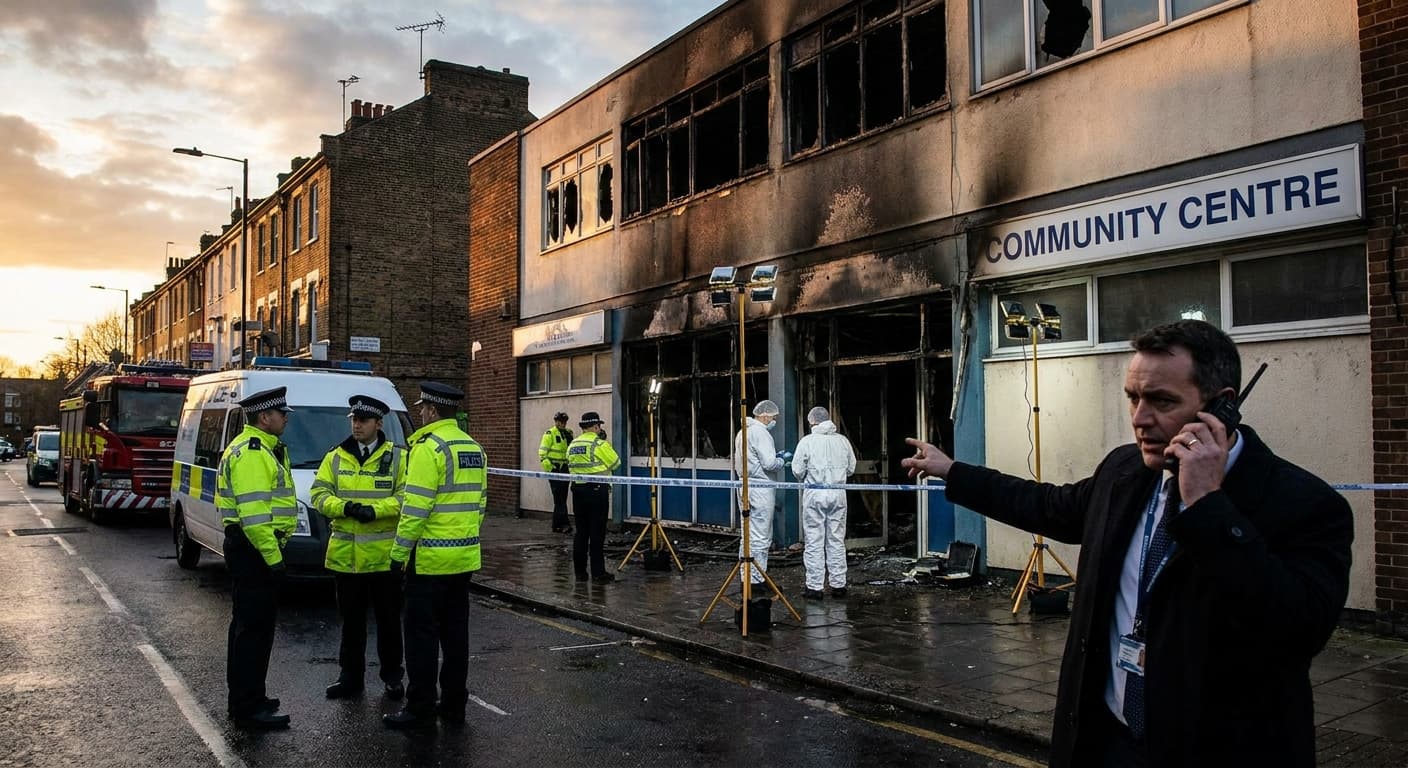
Met Police Iran Proxy Arson Probe Reshapes UK Law
The Met's Iranian-proxy arson investigation in north London has forced a fast-tracked national security law giving ministers counter-terror-style powers over Tehran's networks.
On June 9, 2026, Home Secretary Shabana Mahmood introduced the National Security (State Threats) Bill to the House of Commons, a fast-tracked measure that will let her designate the Islamic Revolutionary Guard Corps and its proxies with counter-terrorism-style powers carrying up to 14 years in prison. The bill is the direct legislative payload of a Metropolitan Police investigation opened weeks earlier into whether a wave of arson attacks on London's Jewish community and Iranian dissident sites was commissioned by Tehran through criminal proxies. The arson wave itself caused no deaths — but it has done something harder: it has moved the UK from crisis management to a permanent, terrorism-grade legal regime for Iranian state activity on British soil.
That is the argument of this feature. The Kenton, Finchley and Golders Green fires were operationally minor. Politically, they were decisive. Iran's cheapest form of coercion — hiring teenagers to throw petrol bombs — has produced the most consequential upgrade to UK national security law in three years, and it is arriving on the statute book this month.
The wave, in precise sequence
The pattern began on March 23, 2026, when four ambulances belonging to the volunteer Jewish medical charity Hatzola were set alight in Golders Green, triggering gas-canister explosions and roughly £1 million in damage, according to the BBC. Metropolitan Police Commissioner Sir Mark Rowley told the Community Security Trust annual dinner that same evening that officers were examining a claim of responsibility from a group with "potential Iranian state links," while cautioning it was "too early" to attribute the attack to Tehran,
BBC News reported.
Between April 15 and April 18 the tempo escalated. Petrol bombs hit Finchley Reform Synagogue; an "ignited container" was thrown at the Park Royal offices of Volant Media, parent of the Persian-language broadcaster Iran International; a bag of accelerant was lit outside the former premises of the Jewish Futures charity in Hendon; and a bottle was thrown through a window at Kenton United Synagogue in Harrow. Al Jazeera reported Deputy Assistant Commissioner Vicki Evans confirming that most incidents had been claimed by Harakat Ashab al-Yamin al-Islamiya (HAYI), a previously unknown "Islamic Movement of the Companions of the Right" that had also claimed synagogue attacks in Rotterdam, Amsterdam and Liège.
By April 21, seven further arrests had been made over a separate planned arson attack against the Jewish community, bringing the running total to 23 individuals detained since Hatzola. A 17-year-old British national from Brent pleaded guilty within days — the first conviction of the wave,
the BBC reported. None of the suspects publicly charged has an Iranian nationality or an obvious ideological profile. Two are from Watford, one from Ilford, one from Walthamstow, one from Brent. This is precisely the point.
"Violence as a service"
"This is recruiting violence as a service," Evans told reporters outside Kenton on April 19, "and the people who conduct that violence often have little or no allegiance to the cause and are taking quick cash for their crimes." The phrase, reproduced by BBC News, is the operational thesis of the entire investigation. What connects Watford teenagers to a north-London synagogue is money and a Telegram handler — not theology.
That thesis is not new. In October 2024, MI5 Director General Sir Ken McCallum revealed that since January 2022 the service had responded to 20 potentially lethal Iran-backed plots on UK soil, a figure now embedded in the government's impact assessment for the State Threats Bill. MI5 state-threat investigations, the same factsheet notes, rose 35% year-on-year. In September 2025 the government placed the Iranian state — including the IRGC and Ministry of Intelligence and Security — on the
enhanced tier of the Foreign Influence Registration Scheme, meaning anyone directed by Iran in the UK must register or face five years in prison.
What the arson wave delivered was corroboration under public gaze. In an oral statement to the Commons on April 20, Security Minister Dan Jarvis told MPs that Whitehall was "actively protecting Persian-language media organisations at risk" and that Iran would be "held to account for its hostile acts" — while pointedly declining, on live-investigation grounds, to attribute the specific incidents. That statement is on GOV.UK and matters because it is the moment the government pinned its legislative timetable to the investigation.
The bill the fires produced
The Bill introduced on June 9 does something the Terrorism Act 2000 could not. Independent Reviewer of State Threats Legislation Jonathan Hall KC concluded in his May 2025 report that terrorism proscription was ill-fitted to state-linked bodies like the IRGC, and that the National Security Act 2023 was "less effective at disrupting proxies than foreign intelligence services." His fix — a state-threats designation power "equivalent to proscription" — is now the operative clause of the new law, per the GOV.UK factsheet.
The bill creates three new offences: supporting a designated organisation, assisting one, and accepting material benefit from one. Penalties reach 14 years. The government's own impact assessment projects that "10 or fewer organisations will be designated as state threats in the first year." Whitehall will not say which — but the IRGC has been the referenced example in every ministerial appearance since April, and the Prime Minister has publicly committed to bringing it forward,
BBC News reported after his April 20 visit to Kenton synagogue.
The parliamentary handling is unusually fast. The bill cleared the Commons and was in Lords committee stage by June 26, 2026, with ministers signalling it could come into force "as early as next month" — meaning July. That schedule was set explicitly against the arson wave. In its own
press release, the Home Office said Mahmood "confirmed the legislation would be fast-tracked after the recent wave of antisemitic attacks."
Who benefits — and who quietly loses
The obvious beneficiary is the security state. Counter Terrorism Policing gains a proscription-like hammer for exactly the operational reality Matt Jukes, the Met's Deputy Commissioner, described on BBC Radio 4: "part of the modern hybrid war fought by proxies." The less obvious beneficiary is the Foreign Office. Ministers had long resisted proscribing the IRGC under the Terrorism Act 2000 in part because it would sever diplomatic relations with Tehran, a concern flagged by the Intelligence and Security Committee in its 2025 Iran report. The new bill allows designation without invoking terrorism law, giving King Charles Street a way to punish the IRGC while keeping an embassy open in Kensington.
The loser is Tehran's plausible deniability. The 24-country joint statement issued on June 10, 2026 — signed by every major Western capital — publicly names the IRGC-Intelligence Organisation, Quds Force and MOIS as the drivers of "lethal plotting and other malign actions in Europe, North America and Australia," and links HAYI-claimed attacks to Iranian intermediaries. It is the sharpest multilateral attribution to date. That the UK convened it while its own criminal investigations were still open is not coincidence; it is diplomatic cover for the bill.
Iran's ambassador, Seyed Ali Mousavi, was summoned to the Foreign Office over what the government called "reckless and destabilising actions." Yvette Cooper's May 11 sanctions package targeted the Zindashti Network — long identified in BBC Eye's investigation as an Iran-linked assassination broker — plus two currency-exchange fronts, per
GOV.UK. The UK now has more than 550 Iran-related sanctions on the books.
The attribution problem
There is still a live intellectual dispute about HAYI itself. Some security researchers argue the group is essentially a "flag of convenience" — a synthetic Shia-Islamist brand overlaying attacks Tehran wants claimed but not owned. NPR cited experts making exactly that case. The Jerusalem Institute for Strategy and Security's own
analysis went further, describing HAYI as "invented attribution" — a digital footprint tied to pro-IRGC channels producing a Shia-sounding claimant on demand. The International Centre for Counter-Terrorism, cited in the same analysis, was more cautious: no unequivocal proof, several possible scenarios, including autonomous local cells or a genuine independent group.
That ambiguity is what the new bill's designation power is engineered to bypass. Ministers do not need a courtroom finding that HAYI is an IRGC front. They need only a reasonable belief that the group is engaged in "foreign power threat activity." That is a materially lower evidentiary bar than criminal terrorism prosecution, and it applies to bodies as well as individuals.
What to watch
The next 90 days determine whether this becomes a template for the rest of Europe — Germany, France and Sweden have all confronted similar Iran-linked proxy operations, per the European Commission's own briefing — or whether the London prosecutions collapse into ordinary hate-crime cases and the political urgency fades.
- July 2026 — Royal Assent and first designations. The bill is on track to become law this month. Watch whether the Home Secretary designates the IRGC on day one, or holds fire pending an operational trigger.
- August 2026 — Old Bailey pre-trial hearings. The Volant Media suspects (McGuinness, Dunn and a 16-year-old) and the Hatzola defendants are due back in court over the summer, per
BBC reporting. Any plea, cooperation deal or evidence of overseas handling instructions could push the investigation from "suspected" to "attributed."
- Autumn 2026 — MI5 annual threat address. Sir Ken McCallum's next public speech will refresh the plot count. A number above 25 would confirm the trajectory and pressure the new designation regime into visible use.
Diplomat View
The London arson wave is the first case in which a Western democracy has upgraded its permanent national security architecture in response to what was, at street level, low-consequence violence. That is the story. Iran's calculation — that cash-for-arson through teenage subcontractors offers deniability at negligible cost — has been publicly reversed. The 14-year sentences and designation regime attached to the State Threats Bill are engineered specifically to make the proxy layer as legally exposed as a direct IRGC officer.
Our forecast: the IRGC will be designated under the new law within six months of Royal Assent, and the UK-led 24-country coalition will move to synchronised proscription-equivalents by the first quarter of 2027. What would revise that call: a diplomatic re-opening with Tehran — most plausibly around the stalled JCPOA-successor talks — that gives the Foreign Office political reason to delay designation. Absent that, the trajectory is set. The fires in Kenton were minor. The law they produced is not.
Discover more
Global Politics
London Synagogue Arson
Two men charged with arson at a former synagogue in London amid a counter-terrorism investigation into Iranian-linked violence.

Conflict & Security
Drone Warfare Killing Aid Workers at Unprec
Over 1,000 humanitarian workers killed in three years as cheap armed drones collapse legal protections. Gaza, Sudan, Ukraine, and DRC see deliberate targeting of aid convoys and hospitals with zero prosecutions.

Global
World Normalises Taliban as Afghan Women Eras
UN data shows Afghan women erased from public life as Russia recognises the Taliban, EU hosts officials in Brussels, and ICC warrants for gender persecution go unenforced.
Conflict & Security
West Africa Food Crisis: Three Shocks in 2026
Conflict, climate extremes, and the Strait of Hormuz closure drive a severe food crisis in West and Central Africa, with fertilizer prices surging 80% and millions displaced.