London Synagogue Arson
Arson case tests UK's theory on Iranian proxies
Model Diplomat8 min readEurope
Whitechapel Synagogue Arson: A Test Case for Britain's Iran-Proxy Theory
Two men deny torching a former East London synagogue mid-sale to a Muslim charity. The case sits at the centre of a UK counter-terror inquiry into Iranian "violence as a service."
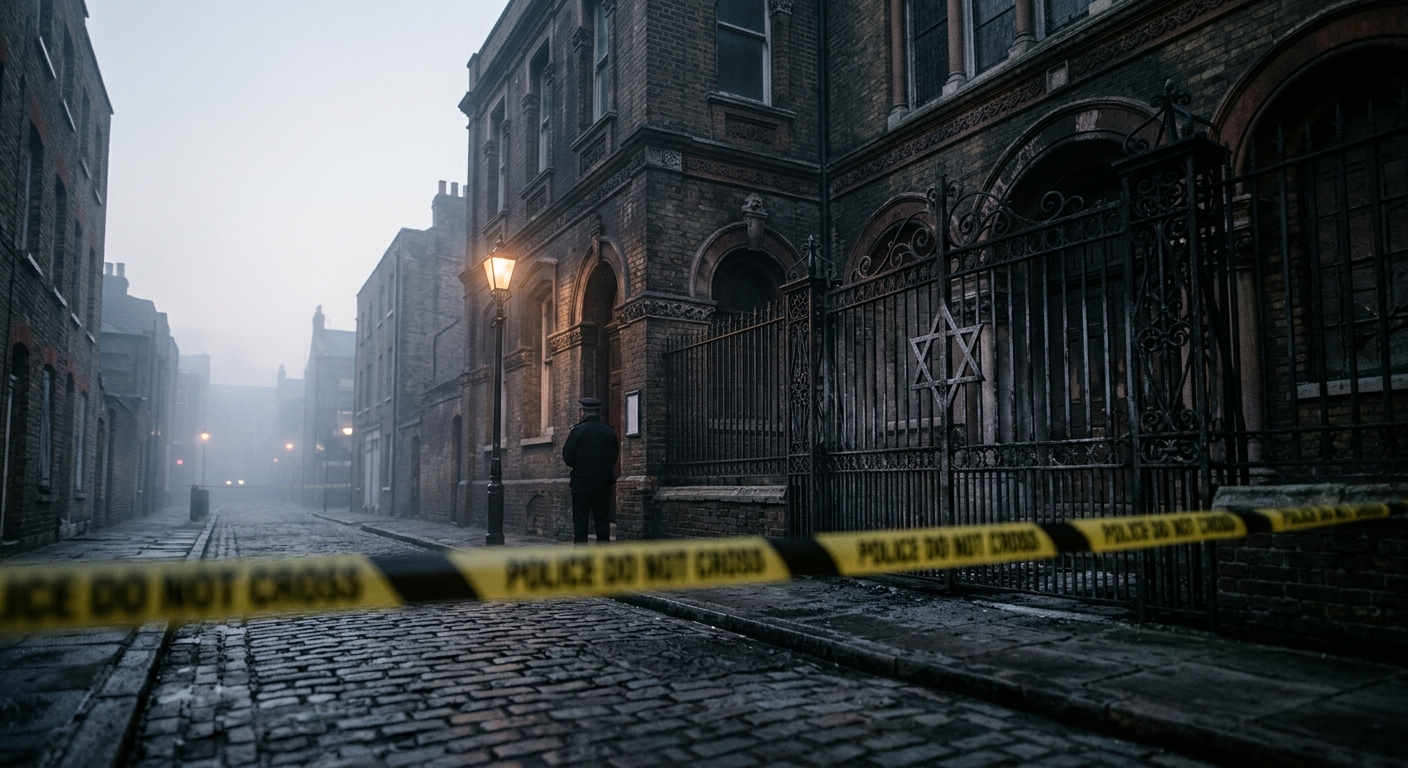
At 05:16 on May 5, 2026, two small explosions and a fire scorched the gates of the former East London Central Synagogue on Nelson Street, Whitechapel — a building already sold, in principle, to a Somali Muslim charity that planned to turn it into a mosque. Two men now stand charged with arson with intent to endanger life and plead not guilty; the Metropolitan Police's Counter Terrorism Command runs the case. The specific fact that matters is not the damage — a scorched lock and gate — but the file it sits in: British counter-terror leadership is treating the London arson wave as a state-linked "violence as a service" operation, not a run of local hate crimes, and the Whitechapel case is the one that most tests that theory.
What happened on Nelson Street
The former synagogue closed to worship in 2020 but still displayed Jewish symbols and, at the time of the fire, was in the process of being bought by the Ashaadibi Education and Cultural Centre, a local Somali Muslim organisation. According to the Metropolitan Police, the London Fire Brigade was called by neighbours; damage was confined to the front gates and lock, and no one was injured.
Moses Edwards, 45, of Wanstead, was charged with arson with intent to endanger life and remanded in custody, the Metropolitan Police confirmed. A second defendant, Dominic Charles-Turner, 31, from Leyton, was charged a fortnight later. At a preliminary Old Bailey hearing on June 5, 2026, both indicated not-guilty pleas; a plea hearing has been set for September 18,
the BBC reported. A 52-year-old woman arrested on suspicion of conspiracy to commit arson was released on bail until August.
The court heard there were two explosions at around 05:00 BST before the fire took hold at the entrance — a detail that matters legally, because it distinguishes the charge (arson with intent to endanger life) from the lesser reckless variant applied in some parallel London cases.
Why counter-terror runs this case
An arson at a disused building would normally sit with local CID. It doesn't here for one reason: pattern. Since late March 2026, the Met's Counter Terrorism Command has been running a single investigation covering at least six incidents — the burning of four Hatzola charity ambulances in Golders Green, firebomb attacks on Finchley Reform and Kenton United synagogues, an ignited container thrown at the Volant Media offices that host the Persian-language broadcaster Iran International, an incident at a former Jewish Futures charity building in Hendon, and now Nelson Street.
Deputy Assistant Commissioner Vicki Evans, the national coordinator for counter-terrorism policing, told reporters outside Kenton synagogue on April 20 that most of the incidents had been claimed online by Harakat Ashab al-Yamin al-Islamia, a group that surfaced in March 2026 and has claimed prior attacks on a synagogue in Liège, a synagogue in Rotterdam and a Jewish school in Amsterdam. Speaking to NPR, Evans said the force was "considering whether this tactic" — Iranian recruitment of criminal proxies — "is being used here in London." The claim is attributed; the evidence behind it has not been made public. Deputy Commissioner Matt Jukes was blunter: those doing it for cash, he said, would find it "a mug's game."
The theory rests on two prior public claims. First, that MI5 disrupted more than 20 Iran-backed plots in the UK in the year to October 2024, a figure Sir Ken McCallum has repeated in annual threat updates. Second, that Britain summoned Iran's ambassador, Seyed Ali Mousavi, on March 24 over what the Foreign Office called Tehran's "reckless and destabilising actions." Iran's London embassy has "categorically rejected" any role in what it calls "baseless" accusations, per the BBC.
Nothing in the Whitechapel charge sheet publicly attributes the Nelson Street fire to Iran, and both defendants deny the charge. But the case is inside the same file because the tradecraft — a small hours strike, minimal damage, high symbolic value, a target already flagged by online chatter — fits a template the Met has now catalogued.
The Whitechapel wrinkle
The Nelson Street building is not a straightforward Jewish target. It sits in a borough — Tower Hamlets — that is roughly two-fifths Muslim, and the buyer was a Somali Muslim charity that publicly condemned the attack. Detective Superintendent Oliver Richter, who leads policing in Hackney and Tower Hamlets, told the BBC the fire had left "those of all faiths in the local area" feeling targeted.
Two readings are on the table. If the prosecution's timeline holds, the attackers hit a building still marked as a synagogue in signage and memory but about to pass into Muslim ownership — a target that broadcasts antisemitic intent while also disrupting an interfaith property transfer in the East End, where Bengali, Somali and orthodox Jewish histories are physically layered on the same streets. If the Iran-proxy theory extends to this case, it is precisely the kind of asymmetric strike that serves Tehran's interest in fracturing British social cohesion without committing state assets — a cost of a few hundred pounds in accelerant.
The counter-reading is more prosaic: both defendants are British, from east London, and their alleged targeting of a building that has not held services since 2020 is compatible with a hate crime driven by symbol rather than intelligence. The Old Bailey trial will test which reading survives disclosure.
The wider ledger: what the numbers show
The context that puts a single scorched gate on the counter-terror grid is the Community Security Trust's annual data, released in February 2026: 3,700 antisemitic incidents in 2025, the second-highest annual total on record, exceeded only by the 4,298 logged in 2023 after the October 7 Hamas attacks. Assaults rose 38% year-on-year to 217. The CST logged more than 200 incidents in every calendar month of 2025 — a first in its 40-year archive.
Home Office statistics for the year ending March 2025, published on October 9, 2025, recorded 10,065 religiously motivated hate crimes across England and Wales. The Jewish-targeted subset fell 18% year on year to 1,715 offences excluding the Metropolitan Police Service — excluded because of a recording-system change — though the Home Office notes the Met accounted for 40% of all such offences the prior year. The true national figure is materially higher than 1,715.
That statistical picture, and the operational one — the Manchester synagogue attack on Yom Kippur 2025 that killed Adrian Daulby, 53, and Melvin Cravitz, 66, and the Golders Green double stabbing on April 29, 2026 — pushed the Joint Terrorism Analysis Centre to lift the UK national threat level from substantial to severe on April 30, 2026, the first such move since the Liverpool Women's Hospital bombing of November 2021,
per Home Office records. The independent reviewer of terrorism legislation told the BBC that attacks on Jews in Britain now amount to "the biggest national security emergency" since 2017.
Who is paying — and who is not
Money follows threat. On June 5, 2026, the UK Home Office announced a record £73.4 million for protective security at faith sites in 2026–27, of which £28.4 million is ring-fenced for the Jewish Community Protective Security Grant administered by the CST. That is on top of the £25 million emergency uplift for Jewish community patrols and hardware announced within hours of the Golders Green stabbing.
The politics have followed the money. Home Secretary Shabana Mahmood, who replaced Yvette Cooper in the autumn 2025 reshuffle, has committed to expanded police powers on "intimidating protests" — language the Community Security Trust welcomes and civil-liberties groups oppose. Reform UK's Nigel Farage described Britain as "open season on Jewish people"; Chief Rabbi Sir Ephraim Mirvis warned the campaign was "gathering momentum" before lives were lost.
What has not happened is a public attribution. The Metropolitan Police has not named Iran as directing the London arson wave. It has publicly linked the online claim of responsibility to a group with "potential Iranian state links" and moved the cases into counter-terror — a legal step that unlocks National Security Act 2023 charging options should evidence emerge. Any such upgrade would carry sentences up to life imprisonment and, more importantly, would set a British precedent for treating diaspora-directed arson as state-sponsored terrorism.
Diplomat View
The Whitechapel case is smaller than Manchester, quieter than Golders Green — and, for that reason, the most instructive of the three. If the Crown Prosecution Service upgrades either defendant's charge under the National Security Act 2023, the Nelson Street fire becomes the first British court test of the "violence as a service" doctrine that Deputy Assistant Commissioner Evans and Deputy Commissioner Jukes have publicly floated. If it does not — if the case is disposed of as a domestic hate crime — the Met will have signalled, without saying so, that the evidentiary threshold for state-linked prosecution remains out of reach even where the pattern strongly suggests it.
The forecast: the CPS proceeds under the existing Criminal Damage Act charge, secures a conviction on straight arson, and leaves the Iran attribution to intelligence channels and sanctions. What would revise that call is a single item of disclosure at the September 18 plea hearing showing tasking, payment, or contact with a proscribed foreign network. Absent that, the political message — record funding, severe threat level, tougher protest laws — will do the work the courtroom cannot.
What to watch
- September 18, 2026: Old Bailey plea hearing for Edwards and Charles-Turner. Any change of charging authority signals a National Security Act pivot.
- October 2026: Home Office release of hate crime statistics for the year ending March 2026 — the first data set that will fully absorb the Manchester attack.
- March 1, 2027: Trial of Essa Suleiman at the Old Bailey over the Golders Green stabbings. The disclosure phase may test how far the "criminal proxies" theory holds outside the arson file.
The Bottom Line
The London synagogue arson wave is not a spate of hate crimes running in parallel — it is a single investigation the Metropolitan Police treats as state-adjacent, and the Whitechapel case is the one that will show whether Britain's counter-terror architecture can prosecute Iranian "thugs for hire" as such, or only as ordinary arsonists. Either outcome will tell European democracies whether their counter-terror statutes can reach the handler, not just the hand.
Discover more

Global Politics
US Seizes Iranian Ship, Tensions Surge
The US seizure of the Iranian ship Touska highlights a shift in control over the Strait of Hormuz, favoring Iran's strategic position.
US Politics
Congress Targets AI Chatbot Access for Terror
The House passed the Generative AI Terrorism Risk Assessment Act, focusing on AI's role in terrorism and potential surveillance implications.

US Politics
House Ethics Committee Pushes Sexual Miscond.
The House Ethics Committee has shifted responsibility for sexual harassment settlement records to the Office of Congressional Workplace Rights, complicating disclosure efforts.

Conflict & Security
Drone Warfare Killing Aid Workers at Unprec
Over 1,000 humanitarian workers killed in three years as cheap armed drones collapse legal protections. Gaza, Sudan, Ukraine, and DRC see deliberate targeting of aid convoys and hospitals with zero prosecutions.