Meituan's 1.6T AI Model on Chinese Chips
US export controls reshape China's AI landscape
Model Diplomat10 min readAsia
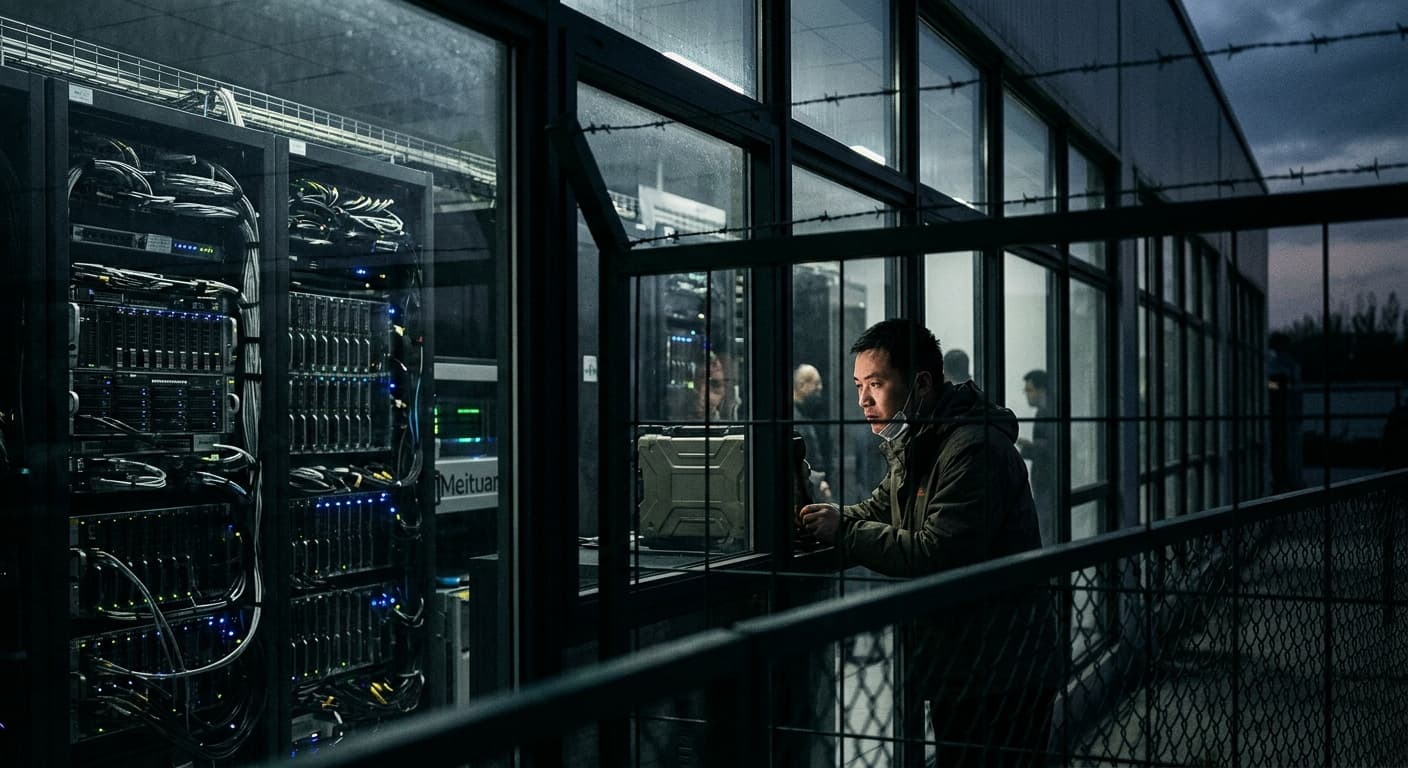
Meituan's 1.6T AI Model on Chinese Chips: Export Controls Backfire
Meituan's LongCat-2.0, a 1.6-trillion-parameter open-source AI model trained entirely on Chinese chips, is the empirical proof that US semiconductor export controls have flipped from containment to industrial policy for Huawei and Cambricon.
On July 7, 2026, Meituan released the weights of LongCat-2.0, a 1.6-trillion-parameter Mixture-of-Experts language model trained on roughly 50,000 domestic accelerators from Huawei, Moore Threads and MetaX — no Nvidia silicon in the training loop — according to Caixin Global. The specific fact matters more than the round number: for the first time, a frontier-scale model matching Western open-weights competitors in parameter count has been trained end-to-end on a purely Chinese hardware stack and released for free commercial use. That closes the last plausible argument for US chip export controls as a containment tool. Washington's restrictions have not slowed the frontier so much as forcibly constructed a parallel one, and the beneficiaries are Huawei, Cambricon, Moore Threads and MetaX — whose valuations now depend on Beijing's CAC-enforced Nvidia ban, not on the US Bureau of Industry and Security.
The release lands inside a policy environment reshaped in three quarters. In August 2025, Chinese regulators summoned Tencent and ByteDance to justify their H20 purchases and froze new orders, Al Jazeera reported. By September 17, the Cyberspace Administration of China had ordered ByteDance and Alibaba to end testing of Nvidia's RTX Pro 6000D — a chip Nvidia had built specifically for China after prior controls — according to
Al Jazeera. By November, Beijing had barred ByteDance from deploying any Nvidia chips in new data centers and had issued guidance requiring that state-funded data-center projects run exclusively on domestic AI silicon,
Al Jazeera reported. Washington's counter-move — a December 2025 rule permitting Nvidia H200 exports — was neutered almost immediately: Chinese customs officials informed brokers in January 2026 that H200s were "not permitted" to enter the country despite valid US licenses, according to
CSIS. Meituan's model is what that decoupling produces in code.
What LongCat-2.0 actually is
The engineering is not exotic. LongCat-2.0 is a sparse MoE: 1.6 trillion total parameters, roughly 48 billion activated per token, a native one-million-token context window and a "LongCat Sparse Attention" scheme adapted from Meituan's earlier LongCat-Flash line. The company's technical report on arXiv for the 560-billion-parameter predecessor describes zero-computation experts and shortcut-connected MoE layers that push inference throughput above 100 tokens per second at roughly $0.70 per million output tokens on prior-generation Nvidia hardware. The 2.0 release replicates that architectural template — the same "Meituan LongCat Team" byline — on domestic accelerators, and open-sources the Chinese-chip inference code alongside the weights.
Meituan is targeting agentic coding — code understanding, generation and execution inside agent workflows — which is where domestic Chinese models have already displaced OpenAI and Anthropic among enterprise buyers in China. The company is not claiming benchmark parity with GPT-5.4 or Gemini 3.1-Pro; independent evaluations have not been published. But parity is not the point of the release. The point is that Meituan can ship a model at this scale without a single Nvidia GPU in the training rack, and can prove it by shipping open code for Huawei Ascend, Moore Threads MTT and MetaX C-series cards.
The policy verdict export controls were meant to prevent
The Biden-era October 2022 export controls were built on a testable hypothesis: deny China access to the chips that train frontier models, and China's frontier stalls. Three-and-a-half years later, the hypothesis has been falsified twice — once by DeepSeek's V4 Pro, itself a 1.6-trillion-parameter model that the Council on Foreign Relations noted is optimized for inference on Huawei Ascend chips "reportedly at Beijing's direction," and now on the training side by LongCat-2.0. CFR conceded the strategic upshot: V4 is "open source, large in scale…and priced for mass deployment at least four times cheaper than American competitors." The same description now applies to Meituan.
The Brookings verdict was blunter still. Writing in June 2026, John Villasenor argued that US chipmakers have reached "exactly zero market share of the AI chip market in China" with no prospect of recovery — the "ball game is over." Chinese AI companies, Brookings observed, "do not need U.S. chips" because they can innovate at different levels of the stack: DeepSeek redesigned its model to run on Huawei Ascend chips; Meituan has now redesigned the training pipeline. And Chinese open-source pricing runs roughly one-sixth per token of US frontier APIs, which is why enterprise buyers globally are already price-shopping the Chinese stack.
What the controls did accomplish, however, was to construct a Chinese chip industry with government-guaranteed demand. Cambricon's Shanghai-listed shares had risen roughly 350% in the year to May 2025, The Economist reported, and traders were joking that the stock had become "a substitute for Nvidia's processors, and for its stock, too." On June 30, 2026 — the day Meituan first previewed LongCat-2.0 — Cambricon's intraday market cap crossed one trillion yuan, roughly $147 billion, making it the first trillion-yuan stock on the STAR Market, according to
BiggoFinance. Huawei released its own open-source model the same day. Coordination is the correct word.
Who benefits, who loses
The obvious loser is Nvidia. Jensen Huang has spent 18 months lobbying Washington to loosen controls precisely because the alternative — a Chinese customer base learning to live without CUDA — is worse than any discounted export line. The BBC reported that Huang met Donald Trump to reaffirm the case; he got the H200 license, but he does not have the customers. CSIS notes Nvidia does "not expect any meaningful shipments in the near term." RAND
documented that Chinese firms bought roughly one million Nvidia H20 units in 2024 against 450,000 Huawei Ascend 910Bs — a ratio that has now been inverted by regulatory fiat, with the CAC pushing companies onto homegrown silicon and Huawei's CloudMatrix 384 system, per SemiAnalysis, outperforming Nvidia's GB200 NVL72 on compute and memory bandwidth at the system level.
The obvious winners are the Huawei–Cambricon–Moore Threads–MetaX bloc, whose valuations are underwritten by two forces: US restrictions on the supply side, and CAC restrictions on the demand side. RAND also flags that "other Chinese AI chipmakers besides Huawei are making progress" — including Cambricon, Biren, Moore Threads, Enflame and Hygon — and that Cambricon's revenue was forecast by Goldman Sachs to grow 3.7 times to 5.5 billion yuan in 2025. Nvidia's own CEO has said the company's China market share fell from 95% to 50%; by late 2025 the CAC pushed that further.
The less obvious winner is Meituan itself. Until 2024, Meituan was a food-delivery company. Chief executive Wang Xing brought co-founder Wang Huiwen back to run a new generative-AI unit, GN06, and staffed it partly out of California, the Financial Times reported. Meituan has now shipped the largest open-source model of any Chinese platform company — a claim to a seat at the top table of AI industrial policy that no delivery moat could have earned. It is also a hedge: after the CAC's algorithm-registration regime, food-delivery platform monopolies are politically vulnerable in a way that open-source national AI champions are not.
The subtler loser is the American open-source ecosystem. Meta's Llama and Mistral defined "open" for two years. In 2026, "open" increasingly means Chinese: DeepSeek V4, Alibaba's Qwen, Moonshot's Kimi K2, Huawei's Pangu family and now LongCat-2.0. If enterprise buyers in the Global South choose good-enough Chinese open weights running on Huawei clouds, the second-order consequence of US export controls is a Chinese cloud footprint outside China that Washington cannot police.
The regulatory scaffolding
Meituan's release is not a spontaneous market outcome; it sits on top of an explicit state framework. The State Council's "AI+ Action" guidance of August 26, 2025 — Guofa (2025) No. 11 — directs support for open-source AI communities, calls for open-sourcing of models, tools and datasets as national priority, and encourages "international cooperation on compute, data and talent." China's
Interim Measures for Generative AI Services, in force since August 15, 2023, require providers to file algorithm registrations with the CAC and explicitly encourage "independent innovation in algorithms, frameworks, chips and supporting software platforms."
The Cyberspace Administration disclosed on January 9, 2026 that 748 generative-AI services had completed filings by end of 2025, with 446 new services added in the year — an administrative trail that ties every open-source Chinese frontier model to a licensing regime the state can throttle at will. Layered on top is the March 2025 AI-generated content labeling rule, in force since September 1, 2025, which requires both visible and embedded metadata watermarks. Meituan complies with all three regimes. That is the deal: Beijing will underwrite domestic compute and shield you from Nvidia's competition; in return, the CAC keeps the algorithm register, the watermarks and — as ByteDance discovered in November — a veto over your data-center procurement.
Washington's response is already stuck
Congressional patience with the Trump administration's chip diplomacy has curdled into legislation. Representative Brian Mast's AI OVERWATCH Act, H.R. 6875, advanced 42–2 out of the House Foreign Affairs Committee on January 21, 2026. The bill would strip the executive of unilateral authority to license advanced-chip exports to China, prohibit any general license, and give Congress a 30-day joint-resolution veto over individual export licenses. Section 2 mandates that the Director of National Intelligence produce a "quantitative analysis examining the artificial intelligence capabilities of countries of concern if such countries relied solely on indigenous production of covered integrated circuits using indigenously produced manufacturing equipment and related subcomponents."
LongCat-2.0 is that analysis, delivered a year early — by Meituan, in open source. The bill's premise, that Chinese labs still need US silicon to reach frontier scale, is being retired in real time. A Senate companion, S. 4456, was introduced April 30, 2026 and remains in committee. Meanwhile the White House knows the ground has shifted: the
Bureau of Industry and Security's revised H200 rule, published January 13, 2026, permits chips 13 times more powerful than the prior threshold, capped at 50% of US shipments — a policy CFR judged "strategically incoherent and unenforceable." The market has judged it moot.
The compute-gap caveat
None of this means China has won the AI race. CSIS's analysis of the compute gap projects US labs will command 14.3 million AI accelerators by year-end 2025, against 4.6 million in China — a threefold gap that widens on a performance-adjusted basis, since US chips are more performant. CSIS also notes that of China's 4.6 million, roughly 2.69 million are modified Nvidia chips still permitted under the (now-shifting) rules and only 1.9 million are truly domestic. The decisive question, CSIS argues, is whether China can centralize enough compute for at least one lab to match a frontier US training run — and it estimates that China can already assemble clusters matching xAI's Colossus (roughly 100,000 GPUs). Meituan's 50,000-accelerator cluster is half of that, on entirely domestic hardware.
The counter-case comes from CFR's AI Chip Deficit brief, which argues Huawei's own public roadmap shows the Ascend 950PR/DT — both due in 2026 — will actually have lower total processing performance than the current 910C, and that Huawei will not ship a chip more powerful than the H200 until Q4 2027. The plausible read: Huawei's silicon roadmap is TSMC-dependent legacy — the 910B/C dies were manufactured in Taiwan before controls bit, with CSIS estimating
more than 2 million Ascend 910B logic dies reached Huawei via shell-company orders. SMIC's 7nm yields, still around 20%, cannot backfill that stockpile at frontier scale. LongCat-2.0 was trained on a 50,000-accelerator cluster, roughly half the size of Colossus; the model is sparse, activating perhaps 48 billion parameters dense-equivalent, not a GPT-5-class dense frontier run. The engineering achievement is real; the frontier-parity claim is not being made by Meituan.
Diplomat View
The controlling reality after Meituan's release is that US export controls have flipped from containment tool to industrial-policy accelerant for Beijing's chip champions, and the reversal is durable. The two conditions that would have kept controls effective — Nvidia dominance of Chinese demand, and Chinese inability to train frontier-scale models on domestic silicon — have both been retired inside twelve months, the first by CAC directive, the second by LongCat-2.0. Expect the following: (1) H.R. 6875 clears the House but stalls in the Senate this fall as Nvidia's lobbying and administration opposition prevail; (2) Beijing formalizes domestic-chip procurement mandates for state-linked cloud and AI deployments into a full ministry rule by end-2026, extending November's data-center guidance; (3) at least one G20 non-aligned government — likely Indonesia, Brazil or Saudi Arabia — hosts a sovereign LLM deployment built on LongCat- or DeepSeek-family weights running on Huawei CloudMatrix racks before Q3 2027. The forecast would be revised if SMIC's advanced-node yield collapses below 15% or Huawei misses its 950-series 2026 ship window — in which case Meituan's 2027 successor model will quietly reappear on smuggled Nvidia Blackwells and the "domestic-only" narrative unwinds.
What to watch
- Independent benchmarks (4–6 weeks). Meituan has not published third-party evaluations of LongCat-2.0. Watch Hugging Face leaderboard entries, the SuperCLUE Chinese benchmark, and coding evaluations (SWE-Bench, TerminalBench) — the domain Meituan targets.
- AI OVERWATCH Act floor vote. House Rules Committee has not yet scheduled H.R. 6875. A floor vote before the August recess would signal Congress is prepared to override the White House on chip policy.
- Cambricon and Huawei Q3 shipment guidance (late October 2026). Whether domestic-chip demand is sustaining without further US-side tightening.
- CAC's next semi-annual filings publication. Whether LongCat-2.0's open-source deployments are being registered by downstream integrators — the test of whether "open source" and "algorithm register" are compatible at scale in
China.
The Bottom Line
Meituan's 1.6-trillion-parameter LongCat-2.0, trained on 50,000 domestic accelerators without a single Nvidia GPU, is the empirical proof that US chip export controls now function as industrial policy for Huawei, Cambricon, Moore Threads and MetaX rather than as a lid on Chinese AI. The winners are the Chinese chip-and-model duopoly Beijing has quietly consolidated through CAC procurement bans; the losers are Nvidia's China revenue and the American claim to define what "open source" means in AI. Every subsequent frontier model out of China will be judged not on whether it matches GPT-5, but on whether it needed Western silicon to get there — and after July 7, 2026, the answer is no.
Discover more
Global Politics
Xi Jinping Calls China-Russia Ties 'Precious'
Xi Jinping's description of China-Russia ties as 'precious' reflects a strategic imbalance, with Beijing dictating terms in the partnership.

US Politics
Virginia's Redistricting Referendum
Virginia's redistricting referendum is drawing a flood of dark money, shaping future elections and the fight for congressional control amid party stakes.

US Politics
SNAP Food Assistance Faces Legal Challenges
In 2026, SNAP faces stricter eligibility rules and mounting legal challenges, threatening food assistance for the millions of Americans who rely on the program.

Economics
Fed's Amex AML order puts correspondent banking on notice
Federal Reserve's Amex AML order requires board-level controls and a 90-day plan; OCC fined the bank $350 million over enterprise-wide deficiencies.