MATCH Act's 44-0 Vote on Chip Exports
Congress pushes for allied chip export controls with MATCH Act.
Model Diplomat9 min readNorth America
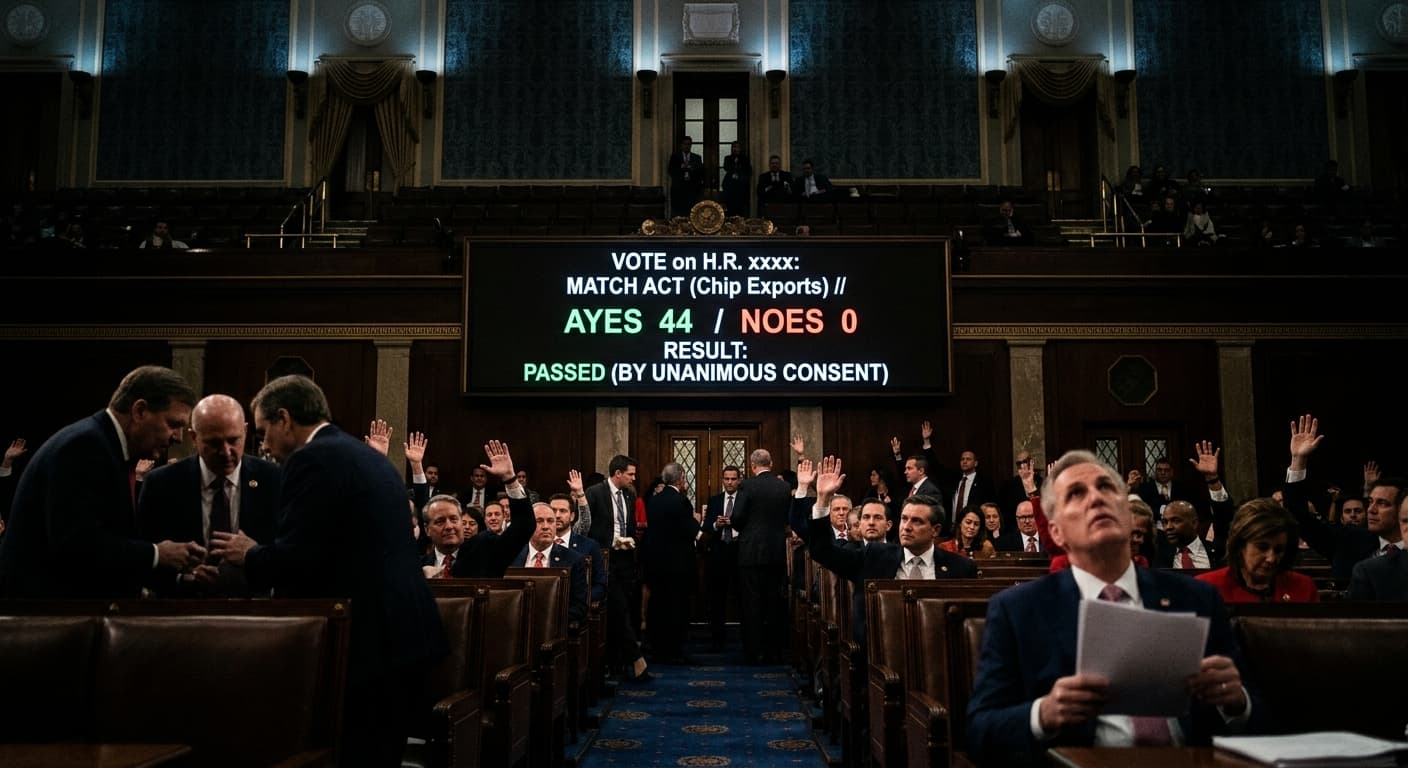
The MATCH Act's 44–0 Vote Redraws Allied Chip Export Controls
Congress's plurilateral chip export-control push, the MATCH and STRIDE Acts, is one House floor vote from forcing the Netherlands and Japan into a binding chokepoint regime — even as Trump loosens AI chip flows.
A 44–0 committee vote on April 22, 2026, sent the Multilateral Alignment of Technology Controls on Hardware Act to the House floor — and with it, a legislated ultimatum to the Netherlands and Japan. That unanimous margin — on legislation that would give Washington statutory authority to seize jurisdiction over Dutch and Japanese lithography exports if allies drag their feet — is the most important fact in tech policy this year. The MATCH Act reframes semiconductor export controls from a shifting BIS rulemaking to a hard multilateral deadline, and it does so precisely as the Trump administration is loosening controls on the other end of the pipeline by licensing Nvidia H200 sales into China. The two moves point in opposite directions. One of them is going to give.
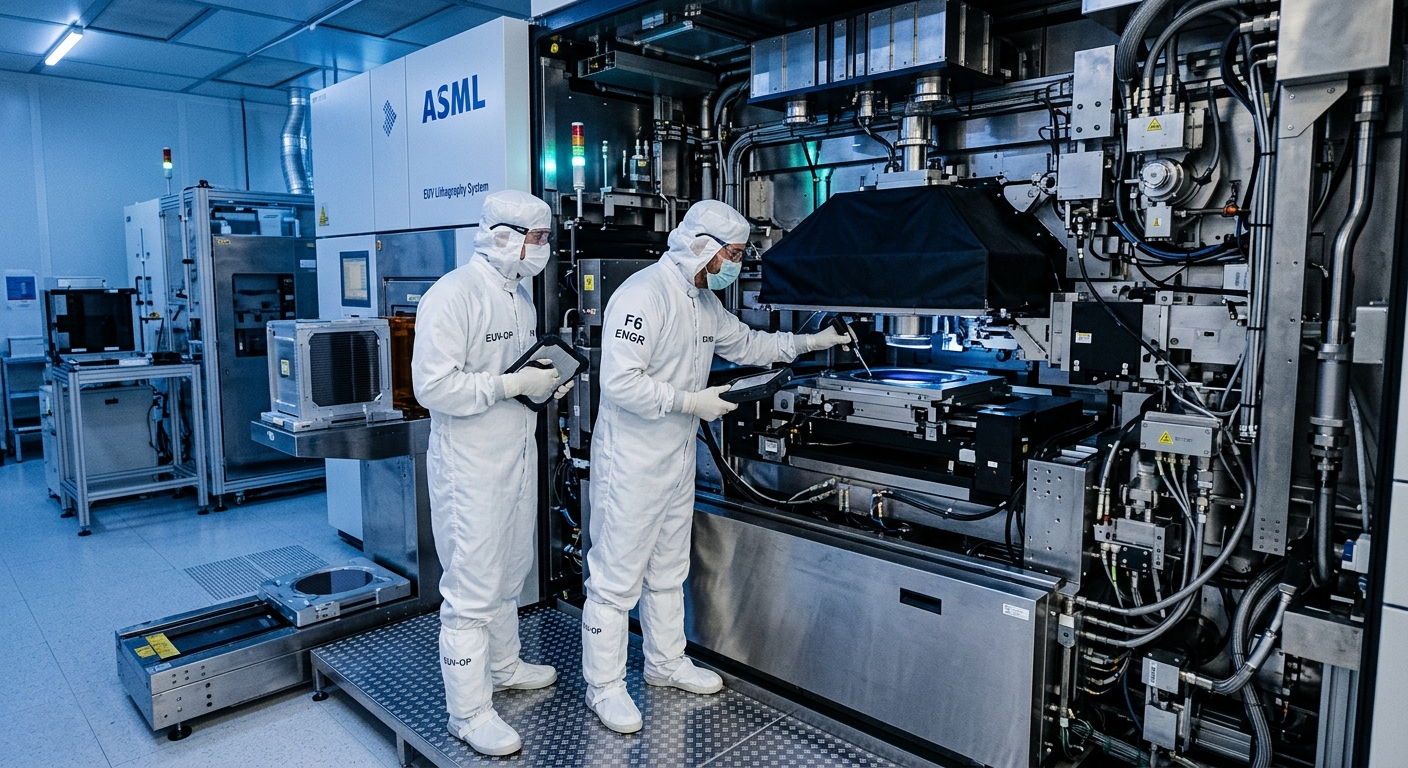
The immediate consequence is that ASML, Tokyo Electron, Nikon and Canon now face a legislated 150-day clock: either allied capitals adopt country-wide denial on advanced deep-ultraviolet immersion (DUVi) tools and their servicing, or the U.S. Commerce Department is directed to reach across the Atlantic and impose the Foreign Direct Product Rule on their exports directly. That is not diplomacy. That is a scheduled ultimatum. Beijing understands it more clearly than The Hague does.
The regime as it stands: effective, leaky, contradicted
The evidence that current controls bite is now overwhelming — and so is the evidence that they leak. The Council on Foreign Relations concluded in its June assessment that Semiconductor Manufacturing International Corporation "cannot currently produce chips at nodes more advanced than 7nm" because of allied equipment restrictions, and that Huawei's own public roadmap shows its 2026 flagship AI chip will actually be less powerful than its 2025 offering, according to a CFR analysis by Chris Miller and colleagues. Denmark's DIIS reached the same conclusion, judging that the "sanctions have been effective at imposing costs on China's path to technological advancement," per
DIIS research.
But the same body of evidence shows the ceiling is porous. The Center for Strategic and International Studies reports that Chinese-made SME's share of the domestic market surged from 25% to 35% between 2024 and 2025, exceeding the "Made in China 2025" target of 30%, and that in etching and thin-film deposition domestic firms now supply 40% of demand, according to a CSIS assessment. SMIC's SN2 fab, meanwhile, is on a trajectory toward roughly 35,000 wafers per month of 7nm output using DUV multipatterning — a workaround the October 2022 rules were designed to prevent, as
CSIS documented in its Huawei Mate60 postmortem.
The gap runs through The Hague. Chinese entities absorbed 70% of ASML's 2024 DUVi tool shipments — nearly $12 billion in Chinese revenue, more than a third of the company's total — during the two-year window before Dutch controls were expanded in September 2024, according to a detailed AEI analysis by Ryan Fedasiuk and Julia Torres. The House Select Committee on the CCP found in its "Selling the Forges of the Future" investigation that ASML sold a majority of its DUV immersion systems to China in 2024 and that 69% of 2024 China revenue for the four leading equipment makers came from Chinese state-owned enterprises, according to the
committee's report.
What MATCH and STRIDE actually do
Read the statutory text and the mechanism is unusually explicit. The MATCH Act, introduced April 2, 2026, defines "covered semiconductor manufacturing equipment" to include "all deep ultraviolet immersion photolithography machines, through silicon via deposition and etch tools, cryogenic etch equipment, and cobalt deposition equipment," and directs Commerce, within 150 days, either to certify that allied supplier countries have imposed matching country-wide controls or to name them and extend U.S. jurisdiction unilaterally, according to the bill text on Congress.gov. The Senate companion, S. 4281, introduced by Sens. Pete Ricketts (R-Neb.), Andy Kim (D-N.J.), Jim Risch (R-Idaho) and Chuck Schumer (D-N.Y.), designates as covered facilities every fab operated by SMIC, ChangXin Memory Technologies, Yangtze Memory Technologies Corporation, Hua Hong and Huawei — including subsidiaries — and applies Entity-List-equivalent restrictions to all servicing and technical support, per the
Senate Foreign Relations Committee release.
The STRIDE Act, H.R. 6058, is the softer diplomatic instrument. It directs the Secretary of State to seek allied "alignment of export control policies regarding semiconductor technology manufacturing equipment, including lithography systems, deposition equipment, etching tools, thermocompression bonding equipment, resist processing tools, chemical mechanical planarization tools, cleaning tools, handling tools, assembly, packaging, and test tools, and inspection systems and the critical subcomponents needed to produce such equipment," and to convene the Export Advisory Review Board within 21 days when a country is found non-compliant, according to the bill's introduced text.
"The MATCH Act ensures that controls will apply uniformly to U.S. and allied countries, in the interests of our collective national security. If allies cannot demonstrate progress within the 150-day deadline, the Act directs the Department of Commerce to implement controls unilaterally."
— Senate Foreign Relations Committee, April 8, 2026
Read together, the pair executes what the Just Security legal team called the "plurilateral turn" — abandoning the 42-member Wassenaar Arrangement, whose consensus rule gives Russia a veto over technology-list updates, and replacing it with a small like-minded regime under U.S. statutory pressure, per a Just Security analysis of the bills.
The contradiction at the top
The problem for the coalition is that the White House is moving the other way on the demand side. On January 13, 2026, BIS issued a rule permitting sales of Nvidia H200 and AMD MI325X chips to China; the next day President Trump signed a Section 232 proclamation imposing a 25% tariff on those same chips, effectively creating an export fee mechanism, according to a White House fact sheet. The Center for a New American Security estimates that policy authorizes up to roughly 900,000 H200-equivalent chips to China at the current cap, and up to 2.3 million if the administration extends the formula, per
CNAS's H200 breakdown.
CFR's assessment is blunt: shipments of one million H200s would "increase the total amount of AI compute installed in China in 2026 by 250% relative to if China relied solely on domestic AI chips." A parallel BBC report confirmed Commerce's approval "granted that there is sufficient supply of the processors in the US," conditioned on end-users showing "sufficient security procedures," according to BBC News. BIS subsequently clarified on June 1, 2026, that licensing requirements apply to Chinese-headquartered firms operating outside China, closing what former State Department official Chris McGuire told
Al Jazeera had become an active loophole.
The Congressional Research Service, in its updated report R48642, notes that some members of Congress "have raised concerns about President Trump's negotiation of U.S. export control terms with China and approval of Nvidia's H20 and AMD's MI308 for sale in China" — and flags a constitutional question: Article I, Section 9, Clause 5 prohibits federal export taxes, and 50 U.S.C. §4815(c) bars BIS from collecting fees for export licenses, according to the CRS report. That legal exposure is now embedded in the H200 revenue-share arrangement.
Where the leverage actually sits
The commercial arithmetic explains why the MATCH Act's coercive design is the plan, not diplomacy. ASML derived 27% of its revenue from China in 2025 versus roughly 16% from the United States, according to a CSIS transatlantic analysis. The Netherlands cannot impose extraterritorial controls; the European Union has no BIS-equivalent enforcement body; and Dutch officials view single-member-state controls as inconsistent with the single market. Japan faces analogous domestic legislative barriers.
The 2019–2023 record shows persuasion took four years to yield the January 2023 trilateral, and another 20 months for the Netherlands to expand DUVi coverage in September 2024. During that window, Chinese firms stockpiled. AEI's Fedasiuk estimates that "China already has a large installed base of DUVi tools, and these machines require specialized maintenance approximately every six months — maintenance that ASML itself often provides on-site in China," meaning the servicing pipeline, not new sales, is now the binding constraint on China's frontier production.
That is the specific loophole MATCH targets. The Ricketts–Kim provisions prohibit "the sale or servicing of the most essential chipmaking tools to any destination inside a country of concern, except U.S.- or allied-controlled chipmaking facilities," and expand FDPR jurisdiction over foreign-produced items that use U.S. software, technology or components. In plain English: if the Dutch government does not act, U.S. law will reach into ASML's Chinese service depots.
China's counter-move is already law
Beijing is not waiting. On April 30, 2026, the State Council promulgated "Regulations on Industrial Chain and Supply Chain Security," consolidating export controls, unreliable-entity listings and anti-sanctions provisions into a single framework: a mirror of the U.S. statutory architecture MATCH extends, according to the CSIS transatlantic assessment. China controls roughly 85% of global rare-earth processing capacity, giving it a symmetric chokehold on the inputs allied fabs and defense systems require, a point
Art of Truth sets against the 90% Western dominance of SME.
The Government Accountability Office, meanwhile, concluded in its January 2025 review that BIS "took steps to help address" compliance concerns after the 2022 and 2023 rules but that industry still reports significant challenges, per GAO-25-107386. Enforcement capacity is the quiet variable — NPR reported in April 2025 that the H20 rulemaking was delayed in part "because of a lack of staff at the Bureau of Industry and Security," according to
NPR reporting. A statute that adds 150-day deadlines to an under-resourced agency is a statute that will slip.
What to watch
- House floor vote on H.R. 8170 (MATCH Act) and H.R. 6058 (STRIDE Act). Both were reported 44–0 out of Foreign Affairs on April 22, 2026, and remain on the calendar. A summer package vote would start the 150-day clock on allied certification by early 2027.
- Senate Banking markup of S. 4281. Referred April 13, 2026; no markup scheduled. Schumer's co-sponsorship signals leadership intent, but chip-industry lobbying against FDPR expansion is intense.
- ASML Q3 2026 earnings and Dutch government response. ASML's China revenue trajectory will dictate whether The Hague pre-emptively tightens servicing rules to blunt the MATCH Act's extraterritorial trigger.
- BIS enforcement of the June 1, 2026 extraterritorial clarification. Whether Commerce actually pursues Chinese-headquartered subsidiary shipments will indicate the administration's willingness to be pushed by Congress.
- First H200 license approvals under the 25% fee. The constitutional challenge to the fee under Article I, Section 9 and 50 U.S.C. §4815(c) is one lawsuit away.
Diplomat View
The MATCH Act will pass the House this year. It will not become law in the 119th Congress. Senate Banking is hostile terrain and the administration wants transaction-based leverage, not statutory constraints. But the 44–0 committee vote has already done the work: it credibly threatens Dutch and Japanese firms with extraterritorial FDPR expansion, which is the negotiating position U.S. diplomats have privately wanted since 2022. Expect the Netherlands to quietly tighten servicing rules on installed DUVi tools before the end of 2026, and Japan to expand controls on subcomponents in parallel — pre-emptive alignment to avoid the bill actually taking effect. The forecast changes if: (1) the Trump administration formally opposes MATCH, killing floor time; (2) Nvidia and AMD secure a broader Blackwell licensing carve-out that gives Beijing enough compute to make chokepoint tools moot; or (3) China's rare-earth export controls escalate to a formal embargo, forcing Washington to trade SME leverage for materials access. The strategic logic is coherent only if paired with the demand-side controls the White House is dismantling. It is not paired. That is the story.
The bottom line: The MATCH Act's 44–0 committee vote is the moment U.S. semiconductor export controls stopped being an executive rulemaking and started becoming a statutory alliance. Its enforcement mechanism — extraterritorial FDPR over Dutch and Japanese tools — will change allied behavior before it ever passes. But the same Congress advancing chokepoint controls on manufacturing equipment is watching the White House license H200 shipments that could triple China's 2026 AI compute base. Coherent export-control strategy requires both ends of the pipeline. Washington controls one.
Discover more

US Politics
SNAP Food Assistance Faces Legal Challenges
In 2026, SNAP faces stricter eligibility rules and mounting legal challenges, threatening food assistance for the millions of Americans who rely on the program.

US Politics
House Ethics Committee Pushes Sexual Miscond.
The House Ethics Committee has shifted responsibility for sexual harassment settlement records to the Office of Congressional Workplace Rights, complicating disclosure efforts.

International Relations
Pakistan's Key Role in US-Israel-Iran Meddle
Pakistan is seeking to mediate the US-Israel-Iran conflict, balancing high-stakes diplomacy against severe economic pressures and steep regional challenges.

Economics
Fed's Amex AML order puts correspondent banking on notice
Federal Reserve's Amex AML order requires board-level controls and a 90-day plan; OCC fined the bank $350 million over enterprise-wide deficiencies.