Saint Martin's Border Agreement Explained
France and the Netherlands formalize their Caribbean boundary.
Model Diplomat4 min readamericas
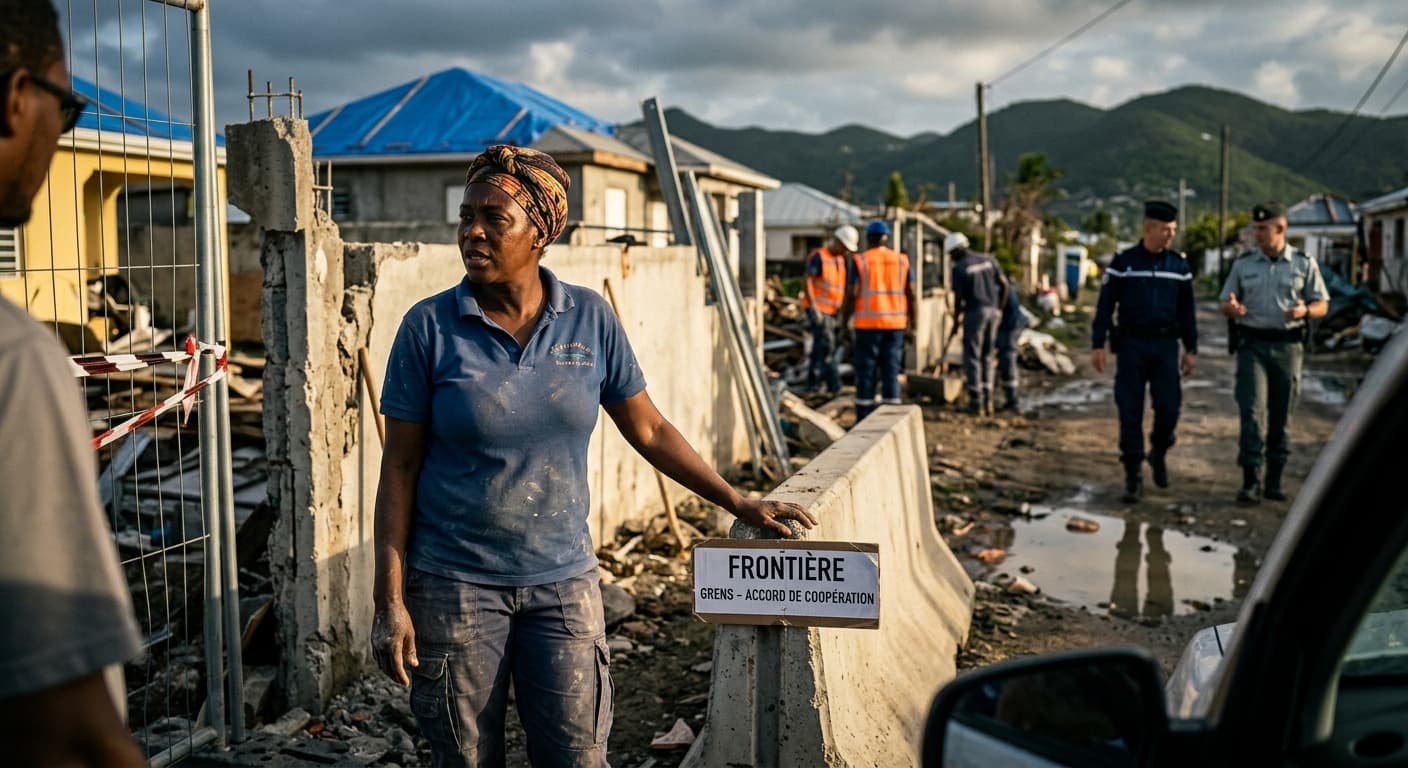
Saint Martin's Invisible Border Gets a Legal Spine — Why Paris and The Hague Just Acted
France and the Netherlands formalized their 378-year-old Caribbean boundary in April 2026. The real story isn't cartography — it's who pays for the next hurricane.
The French National Assembly received a bill on April 16, 2026, authorizing ratification of a border agreement with the Netherlands that formally delimits the frontier between Saint Martin and Sint Maarten — the two jurisdictions that share an 87 km² island in the Lesser Antilles. The text had cleared the Senate the day before under an accelerated procedure, and the government had triggered urgency as early as February 25, according to the Assemblée Nationale legislative dossier.
The agreement itself isn't breaking news — the two sides settled their border dispute in 2023 after nine years of negotiation, as BBC News reported. What's new is the speed. Paris wanted this done before hurricane season.
The French Senate published a detailed report in April 2026 titled "Saint-Martin: une île, deux logiques, une frontière à maîtriser" — one island, two logics, a border to manage — which lays out why a territory most French citizens couldn't find on a map suddenly commands attention in the Palais du Luxembourg. The island operates as a de facto integrated economic space: workers cross the border daily, tourists treat it as seamless, and the airport on the Dutch side serves both populations. But the institutional asymmetry is widening, and that asymmetry has a price tag.
Two Sovereignties, One Hurricane Zone
Saint Martin, the French northern half (53 km², ~32,000 people), is an overseas collectivity governed under Article 74 of the French Constitution and is the only French overseas collectivity that is part of the European Union, as confirmed by CIA World Factbook data. Its external relations, defense, and international engagement run entirely through Paris and Brussels. It has no independent diplomatic apparatus.
Sint Maarten, the Dutch southern half (34 km², ~41,000 people), became an autonomous constituent country within the Kingdom of the Netherlands in 2010. The Kingdom retains defense and foreign affairs, but Sint Maarten runs its own internal governance — and negotiates its own reconstruction financing.
When Hurricane Irma struck in 2017, this divergence became material. The World Bank documents that the Netherlands established a €470 million Recovery, Reconstruction and Resilience Trust Fund, managed by the World Bank, with Sint Maarten implementing projects directly. The fund has financed airport reconstruction, hospital resilience, digital government, wastewater management, and small-business grants — including $20 million disbursed to 321 MSMEs as of late 2025, 43% of them women-owned, per the
World Bank's June 2026 feature.
The French side gets no equivalent. Saint Martin's reconstruction flows through centralized French budgetary mechanisms and EU frameworks. There is no dedicated trust fund, no tripartite governance model. The French Senate report identifies this gap explicitly, noting that the island "functions as an integrated economic space" but lacks "adapted institutional mechanisms" — which "limits its effectiveness."
Why the Border Agreement Matters Now
The Senate report warns that regulatory divergence between the two sides creates "unfair competition" and "social tensions," with differing tax, labor, and immigration regimes on a single island. The formalized border isn't about checkpoints — the 87 km frontier remains open. It's about clarifying jurisdiction for disaster response, infrastructure investment, and fiscal claims.
The timing isn't accidental. The Sint Maarten Trust Fund was extended to 2028. The Princess Juliana International Airport terminal reopened in November 2024 after a seven-year, blended-finance reconstruction — passenger traffic hit 1.8 million in 2025, per the World Bank. A new St. Maarten General Hospital topped out in March 2026 with Category-5 resilience, 108 seismic base isolators, and independent power and water. The Dutch side is visibly building back better.
The French side remains dependent on Parisian budgetary cycles and EU cohesion funds — instruments not designed for rapid post-disaster deployment on a micro-territory.
What to Watch
The National Assembly is expected to adopt the border agreement before the summer recess. That clears the way for ratification, but the operational question is whether Paris uses the treaty as a lever to negotiate a joint French-Dutch resilience framework — something the Senate report explicitly recommends.
The 2026 Atlantic hurricane season has begun. If a storm hits, the asymmetry in reconstruction capacity will be tested in real time. Watch whether France proposes a Saint Martin-specific recovery vehicle — or whether the Dutch model, backed by World Bank technical capacity and €470 million in committed funding, becomes the benchmark that Paris is forced to match.
Discover more
Global Politics
Xi Jinping Calls China-Russia Ties 'Precious'
Xi Jinping's description of China-Russia ties as 'precious' reflects a strategic imbalance, with Beijing dictating terms in the partnership.

US Politics
SNAP Food Assistance Faces Legal Challenges
In 2026, SNAP faces stricter eligibility rules and mounting legal challenges, threatening food assistance for the millions of Americans who rely on the program.

India
Yamini Aiyar on Modi's Federalism Shift
Yamini Aiyar critiques Modi's shift from equity-based to performance-based federalism, highlighting implications for India's political landscape.

Conflict & Security
Drone Warfare Killing Aid Workers at Unprec
Over 1,000 humanitarian workers killed in three years as cheap armed drones collapse legal protections. Gaza, Sudan, Ukraine, and DRC see deliberate targeting of aid convoys and hospitals with zero prosecutions.