Macron's Visit to Syria Amid Bombings
Explosions in Damascus highlight Gulf-French dynamics
Model Diplomat7 min readMiddle East
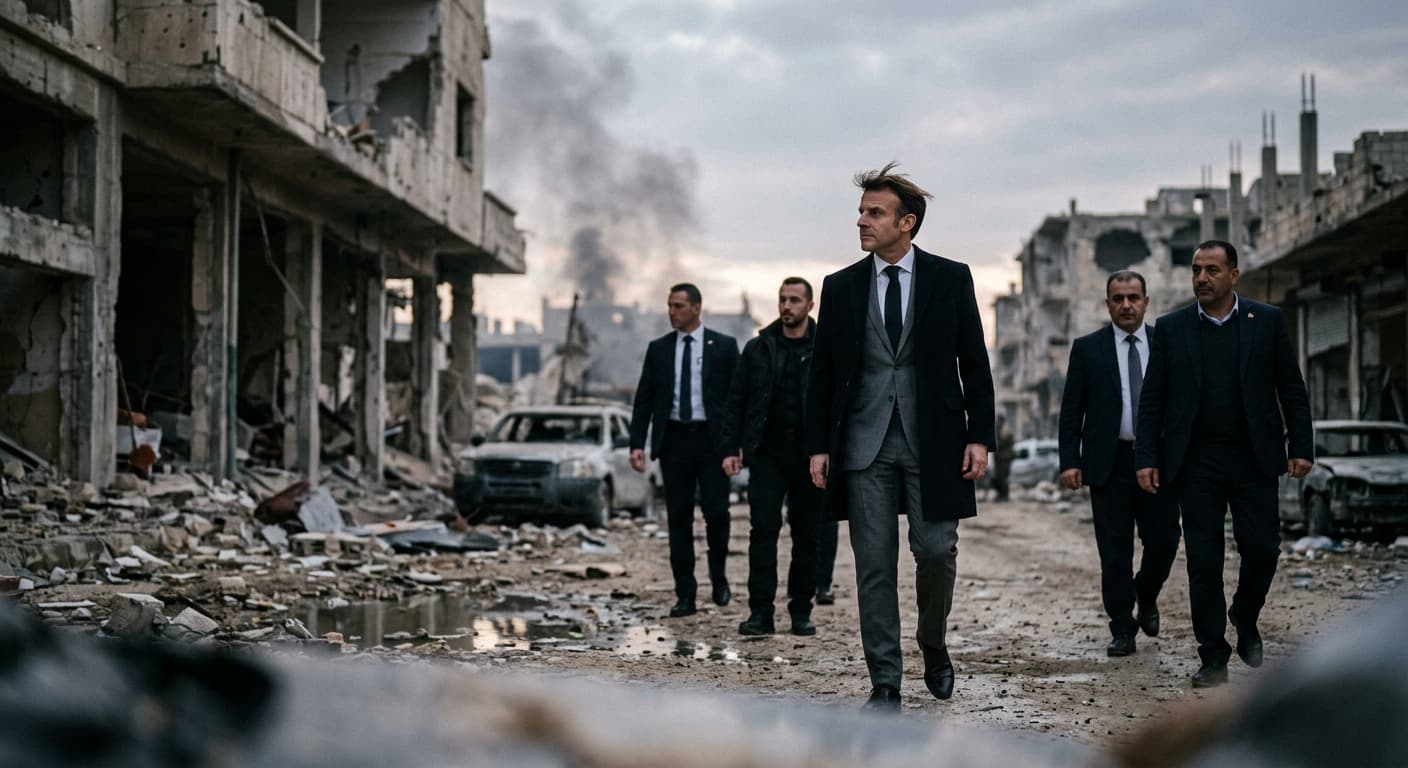
Damascus bombs greet Macron as Gulf money meets French leverage
Two explosions rocked Damascus on July 7 as Emmanuel Macron met Ahmed al-Sharaa — a security jolt that reframes who controls Syria's $400bn reconstruction and Gulf-state calculations after the Iran war.
Eighteen people were wounded on July 7, 2026 when two improvised devices detonated roughly 125 metres from the Four Seasons hotel where French President Emmanuel Macron was staying, minutes before his motorcade reached the presidential palace to meet Syrian President Ahmed al-Sharaa. The blasts — the second bombing in central Damascus in a week — did not derail the visit, but they did something more consequential: they exposed the transaction Macron came to close. France is trying to buy its way back into a Levant that Saudi Arabia, Qatar and the UAE have already paid to shape — and the spoilers targeting Sharaa's government are betting the Gulf calculus is about to shift after the US-Israel war on Iran.
That is the story worth watching, not the smoke.
The visit was never really about the bombs
Macron arrived on July 6 as the first EU leader to enter Syria since Bashar al-Assad fell in December 2024, en route to a NATO summit in Türkiye, Al Jazeera reported. He brought a delegation of French chief executives — CMA CGM's Rodolphe Saadé and TotalEnergies' Patrick Pouyanné among them — and, according to
BBC News, signed 15 bilateral accords in civil aviation, health and banking at a "reconstruction and strategic corridors" forum. A firm Syrian order for eight Airbus aircraft was flagged in Elysée briefings picked up by
BBC Arabic.
When the devices went off — Syria's interior ministry said security forces spotted them in a parked car and a bin, and one detonated as specialists began defusing it — Macron did not cancel. He recorded a message from the palace: "Nothing can smother the aspiration of Syrian women and men to live in a fully sovereign, safe, pluralistic, and united Syria." At the joint press conference, he warned against being "destabilised." Sharaa praised his "courage." The choreography was tight because the stakes were high: Paris cannot afford to look repelled from a market Riyadh and Doha have already booked.
The Gulf built this. France wants a lane.
The scale of Gulf commitment is what makes Macron's late arrival awkward. Saudi Arabia pledged a $6.4bn investment package in July 2025 and, in February 2026, added a further multibillion-dollar tranche covering aviation, energy and telecoms, Al Jazeera reported. Qatar's UCC Holding took a $4bn Damascus airport rebuild; the UAE's national investment corporation signed a $2bn Damascus metro; DP World took the
$800m Tartous port concession. Saudi Arabia and Qatar jointly cleared Syria's $15m World Bank arrears and are co-funding public-sector salaries — the everyday plumbing of state legitimacy.
Against a UN reconstruction bill above $400bn, France's marker is smaller but strategic: CMA CGM already holds a 30-year concession to operate Latakia port — Syria's other Mediterranean gateway, alongside Emirati-run Tartous. That pairing is the deal-within-the-deal. Paris is positioning itself as the European counterweight inside a Gulf-financed Syria, giving Damascus a European anchor for sanctions clearance, technical standards and diplomatic cover it cannot get from Riyadh alone. The European Council
terminated the suspension of the EU-Syria cooperation agreement on May 11, 2026, restoring full trade ties — a decision Macron pushed since hosting Sharaa at the Élysée on
May 7, 2025.
The Élysée readout from that meeting is worth quoting because it is the operative doctrine now being tested on Damascus streets:
France's support for the establishment of a new Syria — free, stable, pluralistic, sovereign, and respectful of all components of Syrian society... The fight against terrorism, a security priority for Syrians, the wider region, and the French people.
Fourteen months later, in a January 22, 2026 communiqué, Macron endorsed the January 18 Damascus–SDF ceasefire integrating Kurdish-led forces into the Syrian army — the political precondition for the Airbus order and the Latakia concession to look investable rather than reckless.
Why the bombs matter more than the wounds
Nobody has claimed the July 7 blasts. Syria's interior ministry spokesman Nour al-Din al-Baba said the devices were planted "minutes before" the blasts and just outside Macron's security perimeter, BBC News reported. The pattern points to two candidate spoilers, and both are political.
The first is the Islamic State, which the Atlantic Council's Daniel Hojnacki documented in March 2026 is exploiting the security vacuum left by the SDF's withdrawal from northeastern camps — where US intelligence estimates as many as 20,000 ISIS-linked individuals broke out in January 2026. ISIS has publicly declared jihad against Sharaa, casting him as a US puppet insufficiently committed to Sunni Islam. ISPI analyst Sultan al-Kanj
assesses that IS today "seeks to undermine stability through surprise attacks that may target influential figures or international interests, in order to destabilize the government and strike at its legitimacy." A bomb 125 metres from a visiting Western head of state is the definitional example.
The second is the Assad-loyalist infrastructure. Al Jazeera documented in February 2026 that "Saraya al-Jawad," a shadowy militia formed in August 2025 and reportedly loyal to former Tiger Forces commander Suheil al-Hassan, has run "assassinations, bombings, and targeting public celebrations" from the Alawite coast. Amman-based analyst Munir al-Hariri told the network that external actors "who lost influence in Syria — specifically pointing to Iran — may be mobilising dormant cells" to portray the new state as "weak and incapable of controlling security." That is a hypothesis, not a finding — but it is the framing that will shape how Gulf capitals price Syrian risk in Q3 2026.
The Iran-war overhang
The tell is that the bombs went off on the same morning a Qatari LNG tanker was struck in the Strait of Hormuz. The Financial Times and Al Jazeera's live coverage both identified the vessel as the Al Rekayyat, struck near Limah, Oman. Two tankers were hit; the US-Israel-Iran memorandum of understanding signed on June 17 is under strain.
CSIS Middle East analysis warned in March that Sharaa's investment-led recovery "assumes that Arab Gulf states will devote political and financial resources to stabilizing the Levant. But if the war leaves Iran weakened yet more radicalized, Gulf governments are likely to prioritize their own defense spending and economic recovery instead." That warning is now operational. Every rocket into Gulf shipping lanes raises the domestic-security bid on Riyadh's and Doha's budgets — money that was pencilled in for Damascus metros and Aleppo airports.
This is the opening Macron is exploiting. French capital and European sanctions clearance become more valuable to Sharaa precisely as Gulf reconstruction pledges become more conditional. It is also the opening the bombers are trying to close: if Damascus looks ungovernable to a French CEO on July 7, the Airbus board room recalculates on July 8.
Who wins, who loses
The immediate winner is Sharaa, on points. He kept the visit on the rails, extracted 15 French agreements, and got Macron to condemn the attacks from Syrian soil — a legitimacy transfusion no Gulf donor can provide. The Élysée's insistence on a "sovereign, united and peaceful Syria" is also a diplomatic shield against Israeli demilitarisation demands south of Damascus, where the IDF has struck repeatedly since March 2026 in the name of protecting the Druze.
The medium-term loser is the assumption that Gulf money alone can stabilise Sharaa. Carnegie's Sada scholars argued in July that a "new patrimonialism" is corroding the transition — Idlibi loyalists running ministries without institutional accountability. CSIS's
one-year post-Assad review noted that although the government has "touted securing $28 billion in foreign investment in just six months, most of these deals have yet to materialize." Announcements outrun execution; bombs close that gap in the wrong direction.
The quiet loser is Israel. Every French flag in Damascus makes Netanyahu's preferred outcome — a weak, fragmented Syrian centre with autonomous Druze and Kurdish enclaves, as former Israeli consul-general Alon Pinkas described it — harder to sustain diplomatically. Macron's on-camera framing of Syria's unity turns Israeli strikes on Syrian territory into a Western problem, not merely an Arab one.
Diplomat View
The Damascus bombs are not the story. The story is that France just physically inserted itself into a reconstruction market Gulf capitals had treated as their exclusive sphere, on the same 24 hours that Iranian-aligned actors reminded Gulf capitals that shipping lanes are not secure. Sharaa is diversifying his patron base in real time, and Macron is buying a European foothold at Levantine pricing before Berlin, Rome or a returning US corporate class enters the auction.
The forecast: expect France to convert the July 7 accords into signed contracts by Q4 2026, with Airbus and TotalEnergies leading. Expect one more high-visibility spoiler attack in Damascus before year-end — the target set (foreign delegations, courts, minority sites) is where ISIS and Assad remnants overlap. Expect Gulf disbursement rates to slip 15–25% below 2025 announcement pace as Hormuz insurance premia rise. The forecast breaks if Sharaa loses control of Suwayda to Israel-backed Druze factions, or if a second successful attack lands inside a foreign leader's security perimeter — either would trigger a European re-freeze that undoes the June–July gains.
What to watch
- NATO summit in Türkiye (this week): whether Macron secures Erdoğan's tacit acceptance of a French-led European track on Syria alongside Ankara's northern zone of influence.
- Q3 2026 Gulf disbursement data: the gap between the $28bn announced and the money actually wired to Damascus is the truest thermometer of Sharaa's runway.
- The next Damascus bombing: claim of responsibility will identify which spoiler — ISIS, Assad remnants, or an Iranian proxy — has decided France is the target worth deterring.
The Bottom Line
The July 7 explosions were an attempt to price France out of a Syrian reconstruction market the Gulf can no longer afford to fund alone after the Iran war — and Macron's decision to stay on the palace floor, sign the accords and fly to NATO the next morning is the clearest signal yet that Europe is treating Sharaa's Syria as an asset, not a risk. The next twelve months will decide whether that bet earns France a permanent lane in the Levant or a very expensive lesson in why Gulf money got there first. Either way, Syria is no longer a proxy theatre — it is a market with prices, and the auction has begun.
Discover more

US Politics
SNAP Food Assistance Faces Legal Challenges
In 2026, SNAP faces stricter eligibility rules and mounting legal challenges, threatening food assistance for the millions of Americans who rely on the program.
US Politics
House Ethics Committee Pushes Sexual Miscond.
The House Ethics Committee has shifted responsibility for sexual harassment settlement records to the Office of Congressional Workplace Rights, complicating disclosure efforts.
India
Romanian Coalition Party Demands PM Resign
Romania's Social Democrats withdrew from coalition, joining far-right AUR to topple PM Bolojan, risking €10 billion in EU funds by August 2026.

Conflict & Security
Drone Warfare Killing Aid Workers at Unprec
Over 1,000 humanitarian workers killed in three years as cheap armed drones collapse legal protections. Gaza, Sudan, Ukraine, and DRC see deliberate targeting of aid convoys and hospitals with zero prosecutions.