Macron's Musical Diplomacy
How Macron uses music for soft power in diplomacy.
Model Diplomat7 min readCaucasus
Macron's Musical Diplomacy: Aznavour in Yerevan, Playlists in Évian
How Emmanuel Macron turned pop songs into a soft-power instrument — from a viral duet with Armenia's PM to a curated G7 arrival playlist for Trump, Modi and Meloni.
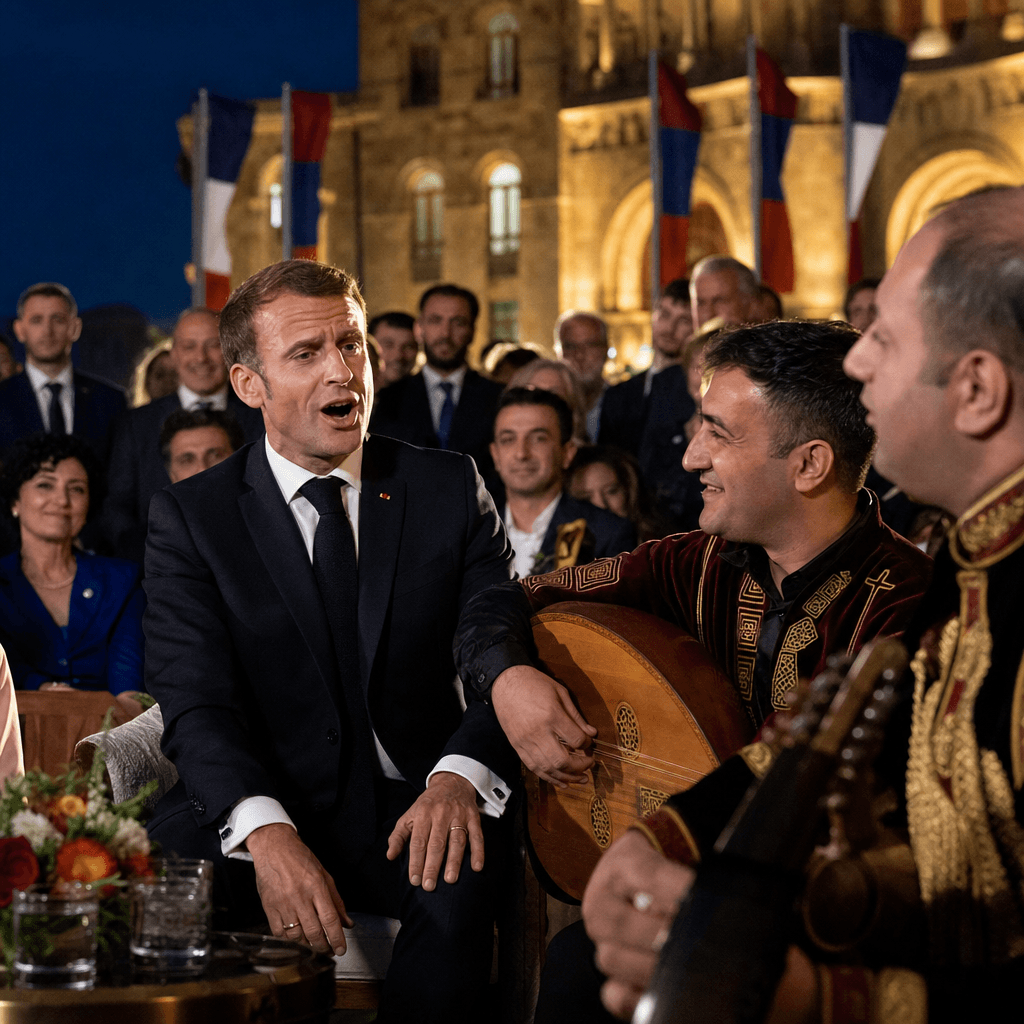
Emmanuel Macron sang Charles Aznavour's "La Bohème" at a state dinner in Yerevan on May 4, 2026, while Armenian Prime Minister Nikol Pashinyan played drums — and 24 hours later signed a France–Armenia Strategic Partnership that hardwires Paris into the defence, cyber and connectivity architecture of a country still legally inside Vladimir Putin's Eurasian Economic Union. The performance was not a whim. It was the opening bar of a deliberate communications doctrine that reached its next crescendo six weeks later, when the Élysée's Instagram account greeted every G7 leader arriving in Évian with a personalised song. Macron is treating music as a low-cost, high-virality substitute for the hard commitments — EU candidacy, defence guarantees, gas replacement — that France cannot actually deliver.
That is the argument of the piece. What follows is the evidence.
The Yerevan performance was a signing bonus
The viral clip — Macron seated beside a pianist, microphone in hand, Pashinyan on the kit behind him — was filmed at the state dinner on the evening of May 4, and shared globally within hours by Al Jazeera,
Euronews and
France 24. Aznavour, born in Paris to Armenian survivors of the 1915 genocide, is the one cultural figure both nations claim as theirs — the perfect symbolic collateral.
The transactional payload arrived the next morning. According to the Élysée's official record of the May 4–5 state visit, Macron told the French community in Yerevan that "never since Armenia's independence have relations between our two countries been so intense, so trusting" — and used the address to defend French arms deliveries in the face of regional criticism: "we have often been alone among Europeans in doing so… but we have always assumed it." That is the President of France telling his diaspora, on the record, that Paris is arming a CSTO member and does not care who notices.
The strategic partnership document signed on May 5 institutionalises regular political and security dialogue and extends cooperation into artificial intelligence, cybersecurity, semiconductors and the North–South transport corridor through Armenia's Syunik region, according to a detailed reading of the text by Institut Montaigne. France is now, in the think-tank's phrasing, "Armenia's key bilateral partner and a principal driver of its integration with Europe."
The material base: France has already replaced Russia in Armenia's arsenal
The song only lands because the arms have already shipped. Russia supplied 96% of Armenia's armaments in 2011–2020; by 2024 that figure had collapsed to under 10%, according to the German Marshall Fund. Moscow also failed to deliver an estimated €250 million of weapons Yerevan had pre-paid for.
France and India filled the gap. Since October 2023, Paris has sold Yerevan three Thales GM-200 ground-based radars, 50 Bastion armoured personnel carriers, 36 CAESAR self-propelled howitzers and a Mistral short-range air-defence package — with a bilateral defence cooperation programme for 2025 signed in December 2024, per the Institute for Defence Studies and Analyses. France became the first EU and NATO member to arm a CSTO state. The
Clingendael Institute's July 2025 policy brief documents the shift in supply and warns Europe has not yet decided how far it will follow France's lead.
That is the ledger behind the song. When Macron sings in Yerevan, he is not softening a demand — he is decorating a delivery.
The Kremlin is losing the meme war, and it knows it
The clearest sign that the Aznavour clip worked is Moscow's reaction. According to Al Jazeera, the video "provoked sharp criticism from the Kremlin." Within three weeks, Putin phoned Pashinyan ostensibly to wish him a happy birthday and demanded an immediate referendum on quitting the Eurasian Economic Union — a demand Pashinyan publicly rejected on June 1. Russia then banned Armenian mineral water, flowers, brandy, fresh fruit and vegetables in the fortnight before Armenia's June 7 parliamentary election, per
BBC News.
The pressure backfired. Pashinyan's Civil Contract party took 49.8% against 23.2% for the pro-Russian Strong Armenia Alliance led by billionaire Samvel Karapetyan, BBC News reported. Macron congratulated Pashinyan the same day, saying the result would shift Armenia's "momentum toward closer ties with Europe." Yerevan then signed a strategic partnership with the United States on May 26, with US Vice President JD Vance pledging up to $9 billion in potential investment, per
Al Jazeera reporting.
Music, in other words, was the softest edge of a hard geopolitical squeeze that Moscow could not counter without looking like it was punishing a small neighbour for laughing at a viral clip. Which is exactly what it then did.
Évian: the same technique, aimed at seven audiences at once
Macron re-used the format on June 15 as G7 host. As leaders arrived at Évian-les-Bains, the Élysée's Instagram account posted personalised welcome videos scored to a song tied to each visitor's national culture — Al Bano and Romina Power's "Felicità" for Giorgia Meloni, Tom Petty's "Love Is a Long Road" for Donald Trump, a BTS track for Japan's Sanae Takaichi, Hussain Al Jassmi for the UAE's Mohammed bin Zayed, and — during Modi's bilateral visit to Nice on the summit's sidelines — the Bollywood track "Aari Aari" from the film Dhurandhar, per The National,
Agenzia Nova and
The Statesman.
The playlist reads as flattery — and reads more usefully as a targeting map. Meloni, whose government is drifting rightward on migration and Ukraine; Trump, arriving fresh from a US-brokered Iran ceasefire and threatening 10–12.5% tariffs on 60 partners including the EU, according to Al Jazeera's G7 preview; Modi, whom Macron is courting on defence and critical minerals; Takaichi, Japan's new Prime Minister; MBZ, whose UAE is central to any post-Strait-of-Hormuz maritime security mission the French navy will help lead. Each song was a small gift wrapped around a hard conversation the President intended to have.
The pianist theory of Macron
The musical instinct is not new. Macron trained for a decade at the conservatory in Amiens, won a third prize in piano, was nicknamed "the Mozart of the Élysée" as economy minister, and told ClassiqueNews he still returns to Schumann and Liszt when he can, per NPR. It has also gone wrong:
BBC News documented a 2023 misfire when Macron joined a Paris street choir mid-pension crisis and the video ricocheted onto far-right pages. At the 2025 AI Action Summit in Paris, he leaned into a deepfake montage of himself inserted into disco hits and MacGyver,
BBC News reported — testing how far a French President could ride internet virality without losing gravitas.
Yerevan and Évian are the first cases where the technique has been fully welded to a hard geopolitical objective. The pattern: pick a cultural artefact the counterparty already loves, perform it on camera, and let the clip do the diplomatic explanation your press release cannot.
Who benefits, who does not
Macron benefits at home: a domestically unpopular president, presiding over a minority government, gets three days of positive foreign coverage from a nine-minute concert. Pashinyan benefits abroad: the clip made Armenia's Western pivot legible to a global audience that will never read a strategic partnership annex. French defence exporters — Thales, Nexter/KNDS on CAESAR, MBDA on Mistral — benefit because political cover for further Armenia deals just got easier to sustain.
The losers are named. Azerbaijan, whose government has accused Paris of "stoking a new war" by arming Yerevan, per the Institute for Defence Studies and Analyses. Russia, whose customs-bloc leverage is being publicly ridiculed. And the harder-nosed critics inside Europe — Germany and the Nordics have not matched French arms deliveries to Yerevan — who now look flat-footed next to a president who arrived with a song and left with a strategic partnership.
The Council on Foreign Relations argued before the G7 that Macron's real task in Évian was less about advancing his own agenda than "managing" Trump. The playlist was part of the management: it flattered Trump's cultural register (a Petty rock ballad, not a French chansonnier) while giving Macron a low-stakes way to also flatter the six other leaders whose cooperation he needed to keep the summit from being hijacked. The G7 communiqué, released on June 17,
pledged tighter sanctions on Russian oil and gas, more Ukrainian air defence, and a Franco-British-led mission to help reopen the Strait of Hormuz. Macron got most of what France went in wanting.
What to watch
- October 2026, Yerevan: first scheduled meeting of the France–Armenia Strategic Partnership's high-level political and security dialogue. Watch for a new arms package — a follow-on to Mistral, or a Franco-Indian trilateral element — announced under that framework.
- Late 2026: the EU's decision on whether to open formal candidacy talks with Armenia. Macron has publicly staked France on that outcome; anything short of candidate status will expose the gap between the symbolism and the deliverables.
- The next state visit: if Macron repeats the technique — sings, or curates, in a capital where France is trying to displace a rival — the doctrine becomes explicit. If he does not, Yerevan will look like a one-off. Prabowo Subianto's incoming state visit to Paris, listed on the
Élysée's May 2026 agenda, is the near-term test.
The Bottom Line
Macron's musical diplomacy is not eccentricity — it is a deliberate substitute for the hard commitments France cannot give: EU membership on demand for Armenia, a defence guarantee against Azerbaijan, cheap gas to replace Russia's, tariff relief from Trump. A viral duet with Pashinyan and a playlist for the G7 buy Paris the appearance of strategic intimacy at a fraction of the cost of the real thing. It works — until the moment a partner needs France to actually deliver.
Discover more

International Relations
Pakistan's Key Role in US-Israel-Iran Meddle
Pakistan is seeking to mediate the US-Israel-Iran conflict, balancing high-stakes diplomacy against severe economic pressures and steep regional challenges.
India
Modi's Women’s Convention in Varanasi
Modi's Varanasi rally frames women's reservation as a national mission, targeting the 2027 Uttar Pradesh elections with a strategic narrative.

Conflict & Security
Drone Warfare Killing Aid Workers at Unprec
Over 1,000 humanitarian workers killed in three years as cheap armed drones collapse legal protections. Gaza, Sudan, Ukraine, and DRC see deliberate targeting of aid convoys and hospitals with zero prosecutions.

Global
World Normalises Taliban as Afghan Women Eras
UN data shows Afghan women erased from public life as Russia recognises the Taliban, EU hosts officials in Brussels, and ICC warrants for gender persecution go unenforced.