Macron's Historic Visit to Syria
France aims to reclaim influence in post-war Syria
Model Diplomat8 min readMiddle East
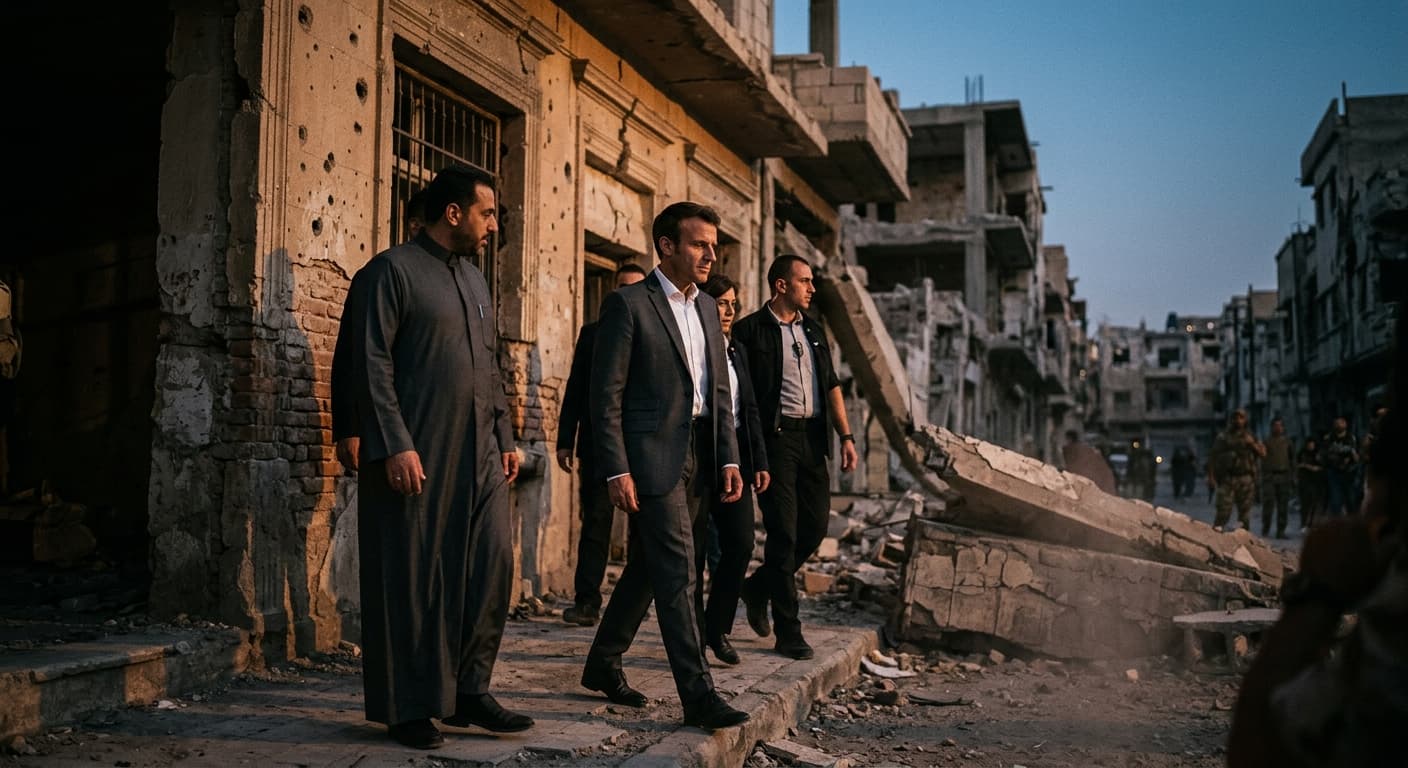
Macron in Damascus: Paris crashes the Gulf's Syria party
France's July 7 Damascus trip — bookended by IED blasts and a Riyadh-dominated reconstruction race — is Europe's bid to buy back into a Levant now run out of Gulf capitals.
Emmanuel Macron's motorcade rolled into central Damascus on July 7, 2026, roughly an hour before two improvised bombs wounded 18 people near the Four Seasons hotel where he had just slept — and the choreography of the day mattered more than the explosions. Macron became the first European head of state to enter Syria since Bashar al-Assad's fall in December 2024, arriving with 15 signed agreements, TotalEnergies' CEO in tow, and an implicit message to Riyadh, Doha and Abu Dhabi: France intends to be a shareholder in the New Syria, not a spectator to a Gulf-run reconstruction. The angle worth watching is not whether Macron survived a possible assassination attempt. It is whether Paris can convert diplomatic capital — UN Security Council leverage, sanctions expertise, colonial-era networks — into contracts in a country where Saudi Arabia has already committed roughly ten times what France has offered.
The blasts, and what they were meant to signal
Two IEDs — one hidden in a parked vehicle, one in a trash container — detonated as French security teams tried to defuse them, according to Syria's Interior Ministry statement to state agency SANA. Syrian authorities insist the devices sat outside the presidential security perimeter and posed no direct threat. French officials said Macron did not hear the blasts. The Élysée nonetheless framed the visit as a defiance: "Nothing can smother the aspiration of Syrian women and men to live in a fully sovereign, safe, pluralistic, and united Syria," Macron wrote after the meeting with President Ahmed al-Sharaa, according to the
BBC.
No group has claimed responsibility. But the sequencing is telling: five days earlier, on July 2, a bomb planted under a table in a cafe near Damascus's Palace of Justice killed at least nine people, six of them lawyers handling Assad-era prosecutions. That attack itself followed a June 2025 church bombing that killed 25, claimed by a shadowy group called Saraya Ansar al-Sunnah but attributed by authorities to the Islamic State, according to BBC reporting. The pattern — courthouse targets, symbolic Western milestones, sectarian venues — points to a jihadist rejectionist current rather than Assad-loyalist remnants.
CBS News reported the French presidential palace confirmed Macron was safe after what "may have been an attempted assassination," per the network's Damascus dispatch. Al Jazeera's correspondent on the ground put it more cautiously: "unprecedented" security had been in place, and analysts could not confirm the convoy was the target, per the
live report from Damascus. What is unambiguous is the political payload of the day — visible European legitimation of a former al-Qaeda commander now running the Syrian state.
The number that reframes everything: $216 billion
The World Bank's October 2025 Syrian Conflict Physical Damage and Reconstruction Assessment put the "best estimate" cost of rebuilding Syria's physical assets at $216 billion, with a range of $141–$343 billion. Nominal Syrian GDP in 2024 was $21.4 billion. Reconstruction therefore costs roughly ten times the country's entire annual output — a gap no single sponsor can close, and one that turns Damascus into an auction house.
France arrived with a modest opening bid. According to Al Jazeera's readout of the visit, the two governments launched a process to return €51 million ($58.3 million) in assets seized from Assad's uncle Rifaat al-Assad, sentenced in France for money laundering; CMA CGM signed to handle air freight at Damascus International Airport, extending a May contract to operate two dry ports; and TotalEnergies chief Patrick Pouyanné met Syrian counterparts to discuss an exploration contract. France also pledged support for rebuilding water and electricity infrastructure in Homs and for banking-sector reform.
Set that against the Gulf ledger. Saudi Arabia's Investment Minister Khalid al-Falih announced $6.4 billion in deals in Damascus in July 2025, including $2.9 billion in real estate and infrastructure, according to Al Jazeera. In February 2026, Riyadh's Elaf fund committed $2 billion to build two new airports in Aleppo, alongside a Saudi–Syrian budget airline and a "SilkLink" telecoms corridor, per
Al Jazeera's coverage of the Damascus ceremony. DP World's $800 million Tartous port deal was signed in July 2025. Qatar and Saudi Arabia have jointly funded Syrian public-sector salaries since May 2025.
France is not entering an empty market. It is entering a market where Riyadh sets the price.
Why Macron came anyway — and what he brought that the Gulf cannot
The Élysée has been Sharaa's most persistent Western advocate. Macron hosted him at the Élysée on May 7, 2025 — his first visit to any European capital — and chaired the Paris Conference on Syria on February 13, 2025, according to official Élysée transcripts. Paris then coordinated an Eastern Mediterranean "Quint" with Lebanon, Cyprus and Greece around Syria's transition roadmap, per the
March 2025 Élysée statement. In January 2026, Macron issued a communiqué reasserting French demands on Kurdish integration and counter-Daesh coordination, published on the
Élysée site.
That accumulated diplomatic inventory is what France is monetising. Three assets in particular:
UN Security Council leverage. France is the P5 member most invested in Syria's political process. Any lifting of remaining UN-level restrictions, chemical-weapons file management with the OPCW, or Chapter VII protection for the transition runs through Paris as much as Washington. The Gulf pays; France legitimises.
Sanctions and asset-recovery machinery. The €51 million Rifaat al-Assad asset return is symbolic but replicable. French courts hold the case law — from the 2020 Rifaat conviction onward — that could unlock frozen Assad-family assets across Europe. Sharaa's finance ministry cannot access that machinery in Riyadh.
Corporate depth in the right sectors. TotalEnergies operated in Syria until 2011 and knows the geology. CMA CGM is the world's third-largest container line. AFD (French Development Agency) has been on the ground since early 2025. In banking-sector reform — a chronic Syrian weakness identified in the World Bank's Spring 2025 Syria Economic Monitor, which flagged $27 billion in total public debt and heavily constrained fiscal capacity — French expertise is genuinely differentiated.
The Gulf International Forum's analysis captures the underlying dynamic: Riyadh, Abu Dhabi and Doha "cooperate selectively on financing and regional coordination while competing over contracts, infrastructure projects, and trade routes," according to Gulf International Forum's mapping of Syrian energy deals. Macron is inserting France into that competition — not as a rival financier, but as the sanctioner-of-last-resort whose blessing the Gulf still wants.
The Hormuz subtext no one is stating out loud
Sharaa's press conference contained the tell. He told Macron, per Al Jazeera's Damascus reporting, that Syria could play "an important role in global transit following the disruptions in the Strait of Hormuz." That is not throwaway rhetoric.
Since the US–Israel war on Iran began on February 28, 2026, roughly 20% of global oil and LNG traffic through Hormuz has been intermittent. Even after the June 17 US–Iran memorandum of understanding, Tehran has continued to assert control over the strait, with fresh tanker attacks on Saudi and Qatari vessels on July 7 prompting overnight US strikes on Sirik, Qeshm and Bandar Abbas, according to the BBC. Al Jazeera's July 1 assessment concluded that shipping-industry investment appetite in the Gulf will remain suppressed "while the current Iranian regime remains in place," citing RUSI's Dan Marks in its
energy analysis.
Syria — with a Mediterranean coastline, functional pipeline connections to Turkey and Iraq, and Tartous now under DP World management — is being marketed as an east–west bypass. TotalEnergies' offshore Block 3 exploration near Latakia, in a technical review agreement signed May 12, 2026 with QatarEnergy and ConocoPhillips per Gulf International Forum, sits on the same geoeconomic map. France, which co-chaired the April 2026 international summit on the Strait of Hormuz alongside the UK per the Élysée agenda, has an obvious interest in Levantine alternatives to Hormuz-dependent supply.
Read this way, Macron's Damascus trip is not primarily a Syria story. It is a Mediterranean-energy-corridor story dressed as post-war diplomacy.
Who loses
Two actors lose ground this week. Iran, obviously — Sharaa's welcome of a Western leader on the same day Iranian assets on the Hormuz seaboard are being struck by US aircraft closes the "Shia crescent" that connected Tehran to Beirut for two decades. Carnegie's Middle East program has argued for months that Sharaa's economic model, however imperfect, structurally excludes Iranian re-entry, in analysis published by the Carnegie Endowment.
Israel is the quieter loser. As the SETA Foundation observed in its February 2026 analysis, Saudi Arabia and Qatar view Israeli military operations in southern Syria and its outreach to Druze separatists as the principal external threat to a unified Syrian state, per SETA's assessment. Every European legitimation of Sharaa — and Macron's visit is the largest yet — narrows Israel's room to argue that the Damascus government is a jihadist regime with which no accommodation is possible. That constraint tightened on July 7.
The UAE occupies an uncomfortable middle. Abu Dhabi has quietly aligned with Israel on questions of Syrian fragmentation while investing heavily in Tartous. Whether it drifts toward Riyadh's unitary-state model or Israel's fragmentation model is, per SETA, the single most important sub-plot to watch in the Gulf's Syria policy through late 2026.
Diplomat View
Macron's Damascus visit is being read as a security story because of the bombs. It is not. It is Paris announcing that Europe will not let the Gulf and Turkey — with American acquiescence — carve up post-Assad Syria without a French seat at the table. The forecast: France converts diplomatic capital into 5–10% of major Syrian reconstruction and energy contracts by end-2027, concentrated in banking reform, water/power in Homs, aviation, and offshore hydrocarbons alongside TotalEnergies. That share sounds modest against Saudi Arabia's headline pledges — but Gulf commitments have a documented gap between MOU and disbursement, flagged by Karam Shaar advisory in Al Jazeera's coverage, and Paris only needs to execute to over-index.
What would revise this call downward: a second, larger attack that forces European insurers to blacklist Syrian projects; a Sharaa consolidation of power that alarms Paris on rule-of-law grounds; or a US–Iran collapse that reactivates Hormuz risk to the point Gulf capital pulls home. What would revise it upward: formal EU sanctions termination, a French-led Paris Club debt restructuring, and Homs pilot projects on time.
What to watch
- Ankara, July 8–9, 2026 — Sharaa's bilateral with Trump on the NATO summit sidelines; watch whether Washington endorses a French-led banking-reform package or steers Damascus back toward Gulf financiers.
- UN Security Council, September 2026 — expected French push to formally close the Syria chemical-weapons file, unlocking further sanctions relief.
- Riyadh Future Investment Initiative, October 2026 — the venue where Saudi disbursement (as opposed to pledges) becomes measurable, per Gulf International Forum tracking.
The bottom line: Macron flew to Damascus under IED fire not to rescue Syria's transition but to price France into it. If the July 7 agreements convert to executed contracts, Europe will have bought its way back into the Levant using the one currency the Gulf cannot print — Security Council legitimacy — and the post-Assad order will finish being written in three languages: Arabic, English, and, quietly, French.
Discover more

US Politics
SNAP Food Assistance Faces Legal Challenges
In 2026, SNAP faces stricter eligibility rules and mounting legal challenges, threatening food assistance for the millions of Americans who rely on the program.
US Politics
Virginia's Redistricting Referendum
Virginia's redistricting referendum is drawing a flood of dark money, shaping future elections and the fight for congressional control amid party stakes.
India
BJP's Misunderstanding of Women's Quota Needs
The BJP's linking of the Women Reservation Bill to delimitation risks delaying women's empowerment in India, misreading the aspirations of female voters.

Conflict & Security
Drone Warfare Killing Aid Workers at Unprec
Over 1,000 humanitarian workers killed in three years as cheap armed drones collapse legal protections. Gaza, Sudan, Ukraine, and DRC see deliberate targeting of aid convoys and hospitals with zero prosecutions.