Machado sidelined as US picks Venezuela negot
US bypasses Machado, anoints Figuera for Venezuela talks
Model Diplomat7 min readLatin America
Machado's Dilemma: Washington Picked Venezuela's Negotiator, and It Wasn't Her
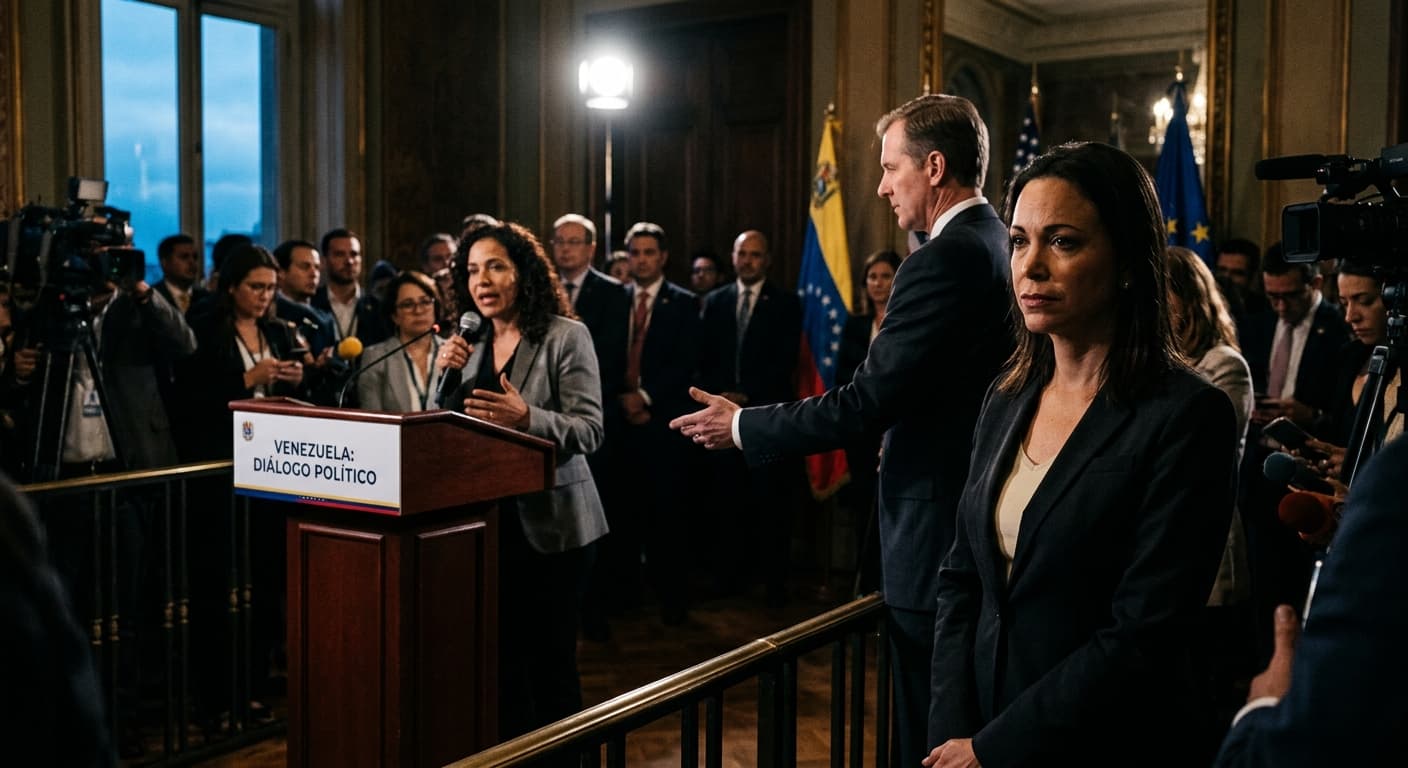
María Corina Machado convened her coalition on July 16, 2026, to assess a chavismo–opposition dialogue she neither called nor controls — a US-anointed rival will lead the August 1 talks that could decide whether Venezuela holds elections or the regime survives intact.
On July 16, 2026, María Corina Machado and Edmundo González Urrutia convened the Plataforma Unitaria Democrática (PUD), Venezuela's largest opposition coalition, to evaluate a dialogue track with chavismo that begins formally on August 1 — a process designed in Washington and Caracas without Machado at the table. A source close to the PUD told EFE the meeting was held to gather information on the newly announced agenda and "define a public position," but offered no details on whether any agreement was reached, according to Noticias SIN. The real story is not the meeting itself. It is that the woman leading the August 1 talks is not Machado, but Dinorah Figuera — an exiled ex-lawmaker the US State Department designated in June to run the negotiation, overriding the PUD's own May mandate naming Machado its chief negotiator.
The meeting exposes the central political fact of post-Maduro Venezuela: the opposition that won the 2024 election in a landslide has been reduced to reacting to a transition scripted by Donald Trump's administration and executed by the remnants of the regime it spent a decade fighting.
How the dialogue was built — and who built it
The August 1 process has two authors, and neither is the PUD. On one side sits Jorge Rodríguez, the chavista National Assembly president and brother of interim President Delcy Rodríguez — the regime's chief operator and, per Crisis Group, the man who "controls the levers of negotiation." On the other sits Dinorah Figuera, president of the opposition's parallel 2015 legislature, who returned to Caracas on June 18 telling reporters she traveled "on invitation from the [US] State Department" to push for renewal of the electoral council, per BBC News Mundo. That same day she met Jorge Rodríguez; the resulting communiqué announced a "mesa técnica y política paritaria" to draft "una hoja de ruta para la construcción de un escenario democrático, plural e institucional."
The timing is the tell. Figuera's designation came less than a month after the PUD met in Panama and formally designated Machado to lead the negotiations. Washington did not wait for that mandate to play out. On April 22, Figuera had already met in Washington with Michael Kozac, the State Department's top Western Hemisphere official, to discuss "vías hacia una transición democrática," as Kozak publicly framed it. Secretary of State Marco Rubio, in a CBS interview, explained the logic bluntly: "María Corina Machado es fantástica... pero estamos lidiando con realidades inmediatas," adding that "la mayoría de la oposición ya no está presente dentro de Venezuela," per BBC News Mundo. In other words: Machado is in exile in the United States, barred from re-entering Venezuelan airspace; Figuera is in Caracas. The US chose the negotiator who could physically sit across from chavismo.
That choice sidelined the opposition's most popular figure. Machado, who won the 2025 Nobel Peace Prize for her democracy work and handed the medal to Trump at a January White House meeting, has been unable to return home. The regime briefly closed Venezuelan airspace to her plane after the June 24 earthquakes, and US officials told reporters her return attempt was "potentially disruptive" to rescue operations, per BBC News. She remains in exile, issuing statements; Figuera runs the talks.
The three-phase plan and the missing timeline
The August 1 agenda is the product of a US strategy unveiled by Rubio on January 8: a three-phase plan of "estabilización, reconstrucción y transición." The third phase — actual political transition and elections — remains deliberately vague. Rubio's Senate testimony in January offered the Franco-era Spanish transition as a model but "provided few details," and Trump told NBC that elections were not "on the horizon," per BBC News. The State Department did not respond to a request for comment.
The chavismo side has been explicit about what the talks are not. Jorge Rodríguez told Newsmax on February 10 that "there will not be an election in this immediate period of time where the stabilisation has to be achieved," framing the priority as "re-institutionalisation," per Al Jazeera. The joint agenda announced July 14 lists "fortalecimiento de las instituciones democráticas, del sistema electoral, y el restablecimiento de las garantías para la participación política" — institutional reforms that, as analyst Javier Corrales noted in Foreign Affairs, mirror the conditions that preceded Spain's post-Franco democratization, but "lack any detail on timelines," per
Foreign Affairs.
The chavismo calculation, as Crisis Group documents from interviews with regime insiders, is survival through delay. Delcy Rodríguez has three stated priorities, per a gathering of regime media: "preservación de la paz," "rescate de Maduro," and "preservación del poder político por parte de la revolución bolivariana." Analyst David Smilde summarized the strategy: "They are playing to survive, not to reform," per BBC News Mundo.
The earthquake as political cover
The June 24 twin earthquakes — magnitudes 7.2 and 7.5, centered in Yaracuy state — killed at least 1,719 people, injured roughly 5,000, and displaced 12,000, according to UN News. The disaster handed the Rodríguez government a state of emergency that, critics argue, has been used to defer political commitments. The joint dialogue communiqué explicitly references "enfrentar todos juntos las consecuencias del doblete sísmico," per
Noticias SIN. The opposition faction's own statement stressed the US support lent "since the quakes" showed "Venezuela is not alone," per
BBC News.
The earthquake also reinforced the geographic logic of sidelining Machado. She tried and failed to re-enter Venezuela shortly after the disaster; the regime cited the emergency. NPR quoted pro-Machado activist José Rolón in La Guaira — the hardest-hit state — saying "the regime always comes up with new excuses to delay things... it will never be the right time to talk about elections," per NPR. The dialogue's framing around "reconstruction" gives both chavismo and Washington a reason to defer the electoral question the opposition exists to push.
The leverage gap
What makes the July 16 meeting politically fraught is not just that Machado was bypassed — it is that the US holds the only credible leverage and is spending it on oil, not elections. The January operation and subsequent oil quarantine put Venezuelan crude sales under US supervision; by January 8, Washington had completed its first sale of Venezuelan oil, valued at $500 million, per BBC News. A hydrocarbons law reform pushed by Delcy Rodríguez reversed much of Chávez-era nationalization, opening the sector to private investment, per
BBC News Mundo. Rubio told the Senate that Rodríguez "has pledged to end Venezuela's oil lifeline to the Cuban regime," per
BBC News.
The House Foreign Affairs Committee Democrats, in a June 8 letter to Rubio, put the transactional character of US policy bluntly: "Four months into the administration's engagement with Maduro's hand-picked Vice President, the Delcy regime is still stacked with the same Maduro regime officials, the regime has yet to outline an electoral timeline, and 473 political prisoners continue to languish in prison," per the committee's letter. Amnesty International, citing Foro Penal, counted 485 arbitrary detainees as of April 6, 2026 — down from over 1,000 pre-raid but plateauing, per
Amnesty International.
For Machado and González, the calculation is defensive. Their Manifiesto de Panamá, signed May 22, demanded the release of all political prisoners, safe return for exiles, and "desmantelamiento del aparato represivo" as preconditions, per BBC News Mundo. The August 1 agenda mentions "garantías para todos los actores políticos" but sets no deadlines. The PUD's July 16 statement insisted "el centro de cualquier acuerdo y decisión debe ser la urgencia de la gente" and "abogará por el respeto del mandato popular" — a reference to the 2024 vote the opposition says González won, per
Noticias SIN.
Diplomat View
The July 16 meeting is not the opposition choosing to engage — it is the opposition being forced to respond to a process it did not design. Washington's bet is that a compliant chavismo under Delcy Rodríguez can deliver oil, counter-narcotics cooperation, and distance from Cuba, China, and Iran without holding elections, and that a Figuera-led technical track on electoral institutions will satisfy the democracy demand without forcing an actual vote. Chavismo's bet is that it can run out the clock — absorbing US economic demands while preserving the coercive apparatus that keeps it in power, betting Trump loses interest or loses office. Machado's bet, that popular legitimacy and the Nobel halo would make her indispensable, has not held against the reality that she cannot get home.
The forecast: the August 1 talks will produce incremental institutional commitments — electoral council reform language, prisoner releases in the low dozens, liberalization of party registration — but no election date. Rodríguez's government has every incentive to stretch the "stabilization" phase through 2026 and into 2027. Machado's coalition, lacking US backing for an electoral timeline and lacking physical access to Venezuela, will struggle to convert its popular mandate into leverage. The scenario that would change this forecast: a specific, US-enforced election date tied to sanctions relief or oil revenue disbursement, or a split within chavismo that forces Delcy Rodríguez to seek electoral legitimacy she cannot manufacture. Neither is currently on the table.
What to watch:
- August 1, 2026 — Formal launch of the "hoja de trabajo conjunta" between Jorge Rodríguez and Dinorah Figuera's faction; first test of whether the agenda produces benchmarks or open-ended process.
- September 2026 — The 90-day interim presidency window granted by the Supreme Court expires; whether the National Assembly extends it or Rodríguez seeks a new constitutional basis will signal regime durability.
- Foro Penal's next detainee count — A figure stuck near 485 would confirm that the amnesty law's reach has plateaued, narrowing the good-faith case for the dialogue.
The bottom line: Venezuela's transition is being negotiated between chavismo and a US-anointed faction of the opposition, with the coalition that won the 2024 election relegated to issuing communiqués from abroad. Unless Washington ties its oil leverage to an electoral deadline, the August 1 dialogue will stabilize the regime more than it democratizes the country.
Discover more

US Politics
SNAP Food Assistance Faces Legal Challenges
In 2026, SNAP faces stricter eligibility rules and mounting legal challenges, threatening food assistance for the millions of Americans who rely on the program.

US Politics
House Ethics Committee Pushes Sexual Miscond.
The House Ethics Committee has shifted responsibility for sexual harassment settlement records to the Office of Congressional Workplace Rights, complicating disclosure efforts.
India
Modi's Women’s Convention in Varanasi
Modi's Varanasi rally frames women's reservation as a national mission, targeting the 2027 Uttar Pradesh elections with a strategic narrative.

Economics
Fed's Amex AML order puts correspondent banking on notice
Federal Reserve's Amex AML order requires board-level controls and a 90-day plan; OCC fined the bank $350 million over enterprise-wide deficiencies.