Lynas Invests $50M in Malaysia Magnet Plant
Lynas Rare Earths challenges China's magnet dominance.
Model Diplomat8 min readSoutheast Asia
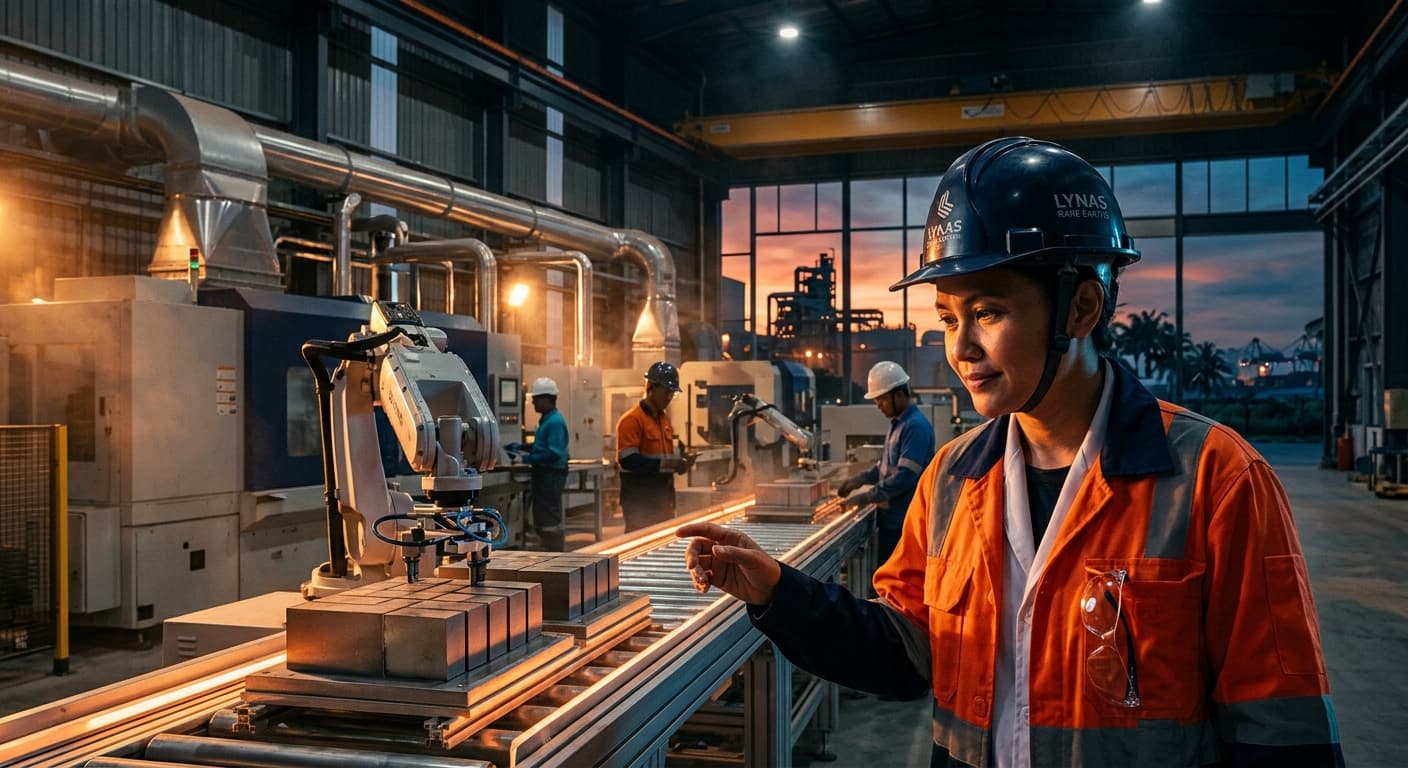
Lynas puts $50m into Malaysia magnets as China tightens screws
Australian miner Lynas Rare Earths will take a 4.58% stake in South Korea's JS Link to build a 3,000-tonne NdFeB magnet plant in Kuantan — the first serious downstream challenge to Beijing's 94% grip on permanent magnets from Southeast Asia.
Lynas Rare Earths announced on July 7, 2026 that it will invest about US$50 million in South Korean magnet maker JS Link to bankroll a 3,000-tonne-per-year neodymium-iron-boron (NdFeB) magnet plant next to its Kuantan refinery, locking in exclusive rare-earth supply to both Kuantan and JS Link's Yesan factory in South Korea through January 2038. The deal, reported by Australian Mining, is the first magnet-manufacturing investment of any scale in Southeast Asia by a Western-aligned rare-earth producer — and it lands eight months after China's Ministry of Commerce weaponised the very step in the value chain the plant is designed to serve. That timing is the story: this is not a commercial diversification, it is a supply-chain move enabled by a specific policy shock, and its geopolitical value will be tested against Beijing's willingness to escalate rather than against the plant's economics.
What the deal actually does
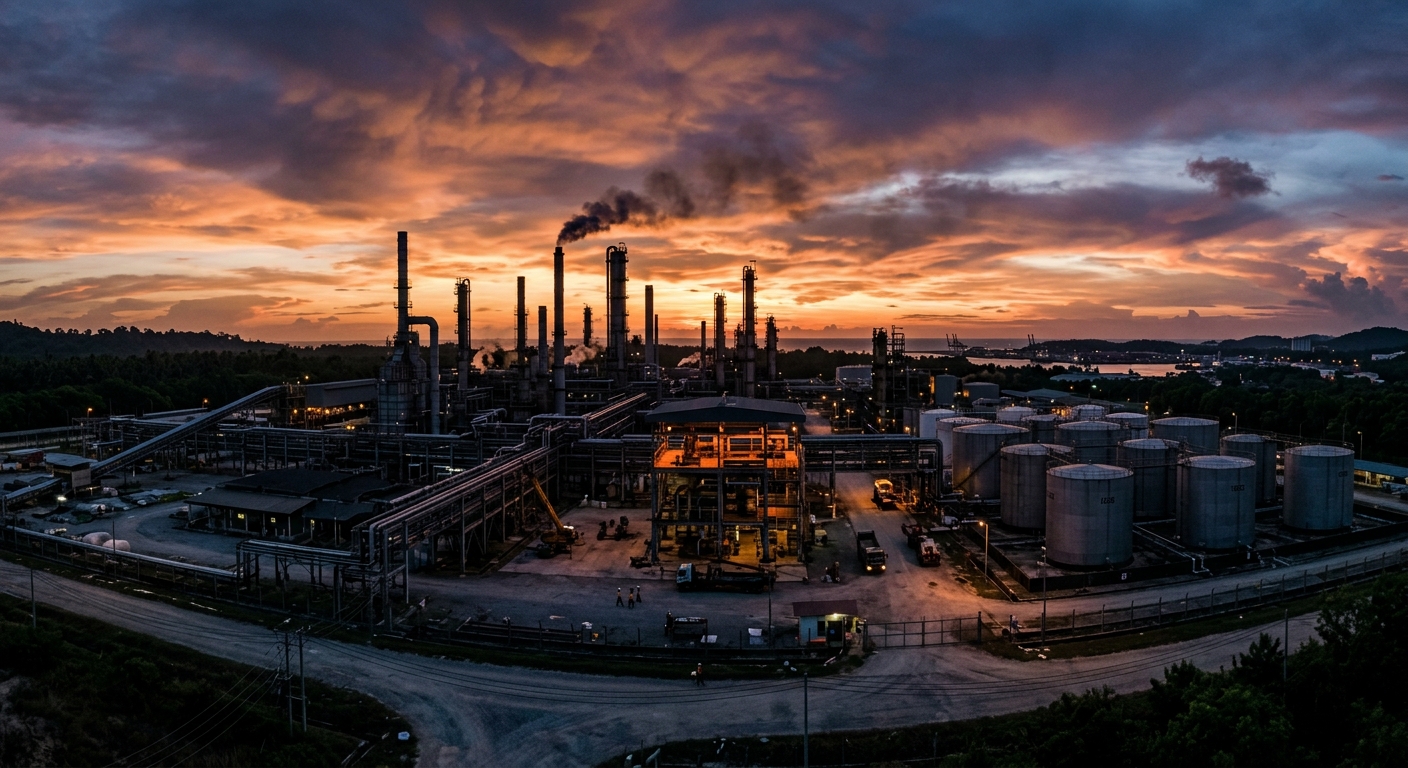
Under the transaction, Lynas takes roughly a 4.58% fully-diluted equity position in KOSDAQ-listed JS Link via an ordinary equity subscription, and JS Link uses the cash to build a plant near the Lynas Advanced Materials Plant (LAMP) in Kuantan producing sintered NdFeB magnets for automotive traction motors, wind turbines and electronics. Lynas becomes the exclusive rare-earth feedstock supplier to both the new Malaysian line and JS Link's existing 1,000-tonne Yesan facility until January 2038, with materials sold at commercial prices, according to the ASX filing lodged for the original MoU and reporting from
The Edge Malaysia. Up to 400 jobs are expected on the Kuantan site.
Interim chief executive Pol Le Roux framed it in the company's own transition language:
"This is an exciting project for the development of a sustainable rare earths industry in Malaysia and delivers on our Towards 2030 growth objective of expanding into the outside China metal and magnet supply chain."
The figure to hold onto is 3,000 tonnes. That is what the combined Kuantan-plus-Yesan footprint would produce at nameplate. In a global magnet market where China produced roughly 300,000 tonnes of NdFeB magnets in 2024, it is 1%. But scale is not what this project is buying. What it is buying is a certified non-Chinese pathway — a document trail from mine to magnet that never touches Chinese oxides, Chinese solvent-extraction technology, or Chinese sintering equipment. Under Beijing's new licensing regime, that document trail is the product.
Why now: Beijing set the trap, then closed it
Between April and October 2025, China moved from tactical restriction to structural chokehold. On April 4, 2025, the Ministry of Commerce placed licence controls on seven medium and heavy rare-earth elements — samarium, gadolinium, terbium, dysprosium, lutetium, scandium and yttrium — the specific dopants that give NdFeB magnets the temperature performance required for EV motors and missiles, according to CSIS analysis. On October 9, 2025, Beijing published Announcement No. 61, extending controls to five additional elements and, critically, to any foreign-produced magnet containing at least 0.1% Chinese-origin heavy rare earths or made using Chinese process technology, as the
BBC reported. Foreign military end-users are effectively barred.
That last clause is the pivot. It converts China's dominance in mining and separation into extraterritorial control over the magnet buyer's factory floor. The US Congressional Research Service puts China at 60% of global mining, 90% of processing and 94% of magnet manufacturing; a magnet plant that touches Chinese oxides, alloys or equipment is now — as a matter of Chinese law — subject to Beijing's licensing regime wherever it sits. What Lynas and JS Link are building in Kuantan is one of a very small number of plants that can plausibly document a fully non-Chinese input stack: Mount Weld ore, LAMP separation, JS Link metallisation and sintering. That is the compliance value proposition, and it did not exist as a market until October 2025.
The Malaysia pivot
The location matters as much as the chemistry. On October 26, 2025, in Kuala Lumpur, President Donald Trump and Prime Minister Anwar Ibrahim signed a Memorandum of Understanding on critical minerals cooperation, alongside a broader reciprocal trade pact in which Malaysia "committed to refrain from banning, or imposing quotas on, exports to the United States of critical minerals or rare earth elements," according to the
White House joint statement. That treaty language is the diplomatic scaffolding underneath the Lynas–JS Link deal: Malaysian oxides moving into a Korean-owned magnet plant on Malaysian soil now sit inside a US-guaranteed export corridor.
Malaysia has spent a decade uneasy about Lynas — the LAMP plant generates lightly radioactive residue, and successive governments extracted concessions on waste management. In March 2026, Kuala Lumpur renewed the operating licence for another 10 years but demanded that by the five-year review the plant produce no new radioactive waste and treat existing residues, according to the Asia Pacific Foundation of Canada. The Anwar government's calculation has changed: Malaysia's Special Task Force projects that a full rare-earth cluster could contribute RM91.9 billion in GDP and 96,900 jobs by 2050, per
ISIS Malaysia. Downstream magnet manufacturing is what unlocks those numbers, because refined-oxide export at 1,500 tonnes a year — LAMP's heavy rare-earth capacity — will not.
The awkward corollary, flagged by ISEAS in Singapore, is that Malaysia's other significant rare-earth operator, MCRE, uses ionic-leach extraction technology sourced from state-owned Chinalco and ships ore directly to China. Anwar's "neutrality by sector" doctrine means Kuala Lumpur will host the Lynas–JS Link line while continuing to let Chinese-linked capacity operate in parallel. The bet is that Malaysia can be indispensable to both blocs. It is a bet Malaysia can hold only as long as neither Washington nor Beijing forces a choice.
The winners and losers
The unambiguous winner is JS Link, a mid-sized Korean firm that until this deal had 1,000 tonnes of capacity, no independent feedstock, and no listing story. It now has the world's only Western-aligned integrated rare-earth-to-magnet supply chain visible to institutional buyers, and a US$50 million equity anchor from the only major non-Chinese oxide producer. Its Yesan plant is already sampling to global customers ahead of commercial ramp.
The second-order winner is Japan. Lynas' Mount Weld feedstock has been contractually tied to Japan since a 2011 JOGMEC–Sojitz investment triggered by China's 2010 embargo. In March 2026, Lynas extended that arrangement, agreeing to supply Japan Australia Rare Earths (JARE) with 7,200 tonnes of neodymium-praseodymium annually until 2038, with 5,000 tonnes protected by a US$110/kg floor price — a mechanism first crafted by the US Department of War for MP Materials in July 2025, as detailed by the Lowy Institute. The Kuantan magnet line does not compete with that JARE flow; it monetises the residual heavy rare-earth output that Japanese buyers do not take. Japan gets a diversified downstream customer for the same upstream it already owns.
The loser is Chinese magnet exporters — but only marginally, and only over time. China exported 58,000 tonnes of NdFeB magnets in 2024, worth US$2.9 billion, with the US and EU together absorbing more than 40%, according to a Vivekananda International Foundation analysis. A 2,000-tonne Kuantan line does not dent that. What it does is establish the template — feedstock, permitting, Korean magnet IP, government-backed offtake — that other projects can copy. Europe's first magnet plant opened in Narva, Estonia in September 2025; India approved an US$800 million magnet subsidy scheme in November 2025 aiming at 6,000 tonnes by the early 2030s, per the
BBC. Kuantan is one node in a network that will take a decade to matter. Adamas Intelligence's Ryan Castilloux, quoted by
Al Jazeera, estimates US magnet imports from China alone at 10,000 tonnes annually and European imports above 25,000 tonnes — figures set to "grow by multiples" over the coming decade.
The quiet loser is South Korea's own onshore magnet ambition. By anchoring JS Link's growth capacity in Malaysia rather than Yesan, the deal implicitly concedes that Korean permitting, land costs and labour cannot compete with a Kuantan site that sits next door to its feedstock supplier and inside a US-treatied export corridor. Seoul will need to justify why the next 3,000 tonnes of Korean magnet capacity is being built abroad. As the Korea Institute for International Economic Policy has warned, the rare-earth cycle punishes cost-uncompetitive downstream investment; the plant that survives is the one nearest the oxide.
The historical parallel that should worry Beijing
China has been here before. In September 2010, Beijing halted rare-earth shipments to Japan during the Senkaku islands dispute. Tokyo's response — the JOGMEC–Sojitz investment in Lynas the following year — is the reason a non-Chinese rare-earth industry exists at all. According to the United States Studies Centre, Lynas supplies roughly 90% of Japan's neodymium-praseodymium requirement today. Each Chinese escalation has produced a durable, adversarial counter-capacity.
Announcement No. 61 is that dynamic on a wider canvas. Chatham House argues the controls should "galvanize the West to build resilience"; the
Atlantic Council documents how China accounts for 89% of separation, 90% of refining and 92% of NdFeB magnet production — a monopoly built over 30 years that is now generating the political conditions for its own erosion. Lynas–JS Link is the small, concrete instance of that erosion.
The counter-argument is scale and time. Rahman Daiyan of UNSW told Al Jazeera that Western economies "hold 35–40% of global reserves but only 10–15% of refining and processing capacity"; post-2030, if planned projects deliver, the balance could tilt. Kuantan is one such planned project. It will not tilt anything alone.
Diplomat View
The Lynas–JS Link deal is a small transaction with a large signalling function. On its own commercial merits, US$50 million for 4.58% of a mid-cap Korean magnet maker is an unremarkable capital allocation. As a policy artefact, it is the first test of whether Beijing's extraterritorial magnet controls will produce the diversification they nominally punish or successfully deter it. Our call: Kuantan will get built, will produce below nameplate, and will trade at a premium to Chinese magnets sustained by defence procurement, EU Critical Raw Materials Act compliance quotas, and Korean OEM buyers seeking Announcement No. 61 exemption. The forecast changes if (a) Beijing tightens dysprosium and terbium licences to the point Lynas's Kalgoorlie cracking-and-leaching cannot substitute for lost Chinese heavy-REE inputs, or (b) neodymium-praseodymium prices break through the US$110/kg floor for a sustained period and Lynas needs to draw on Australian or Japanese price support to keep Kuantan viable. Either would signal that non-Chinese magnet manufacturing still needs a subsidy floor to survive Chinese price discipline — and that private capital, even with treaty cover, cannot yet do the work alone.
What to watch next
- December 1, 2025 licensing regime maturation: Beijing's implementation record on Announcement No. 61 export licences — approvals for civilian magnet buyers, denials for defence users — sets the demand ceiling for Kuantan's output.
- March 2031 LAMP licence review: Malaysia's five-year checkpoint on the Kuantan operating licence will decide whether the magnet plant's feedstock stays local or migrates to Kalgoorlie.
- JS Link mass-production milestone: Yesan is currently sampling; commercial ramp there is the leading indicator for Kuantan's construction timeline and 2028 first-magnet target.
The Bottom Line
Lynas's US$50 million into JS Link is not a bet on magnet economics — it is a bet that Beijing's October 2025 export controls have created a permanent premium market for certified non-Chinese magnets, and that Malaysia, under a US critical-minerals treaty, is the cheapest place to serve it. The plant will be small, late, and strategically decisive: it turns Kuantan from a refinery town into the first fully integrated non-Chinese mine-to-magnet node, and it forces Beijing to choose between escalating controls that accelerate diversification or relaxing them and losing leverage.
Discover more

India
Women’s Reservation Bill
Parliament weighs the Women's Reservation Bill to reserve 33% of seats for women in the Lok Sabha and state assemblies, a landmark gender-equality test.

US Politics
U.S. House Passes Alert Act for Aviation
The House passed the ALERT Act 396–10, replacing the ROTOR Act after Pentagon intervention, impacting aviation safety regulations.

US Politics
House Ethics Committee Pushes Sexual Miscond.
The House Ethics Committee has shifted responsibility for sexual harassment settlement records to the Office of Congressional Workplace Rights, complicating disclosure efforts.

Economics
Fed's Amex AML order puts correspondent banking on notice
Federal Reserve's Amex AML order requires board-level controls and a 90-day plan; OCC fined the bank $350 million over enterprise-wide deficiencies.