Lynas $50m Malaysia Magnet Deal Cracks China
Lynas invests in magnet plant to counter China's dominance.
Model Diplomat8 min readSoutheast Asia
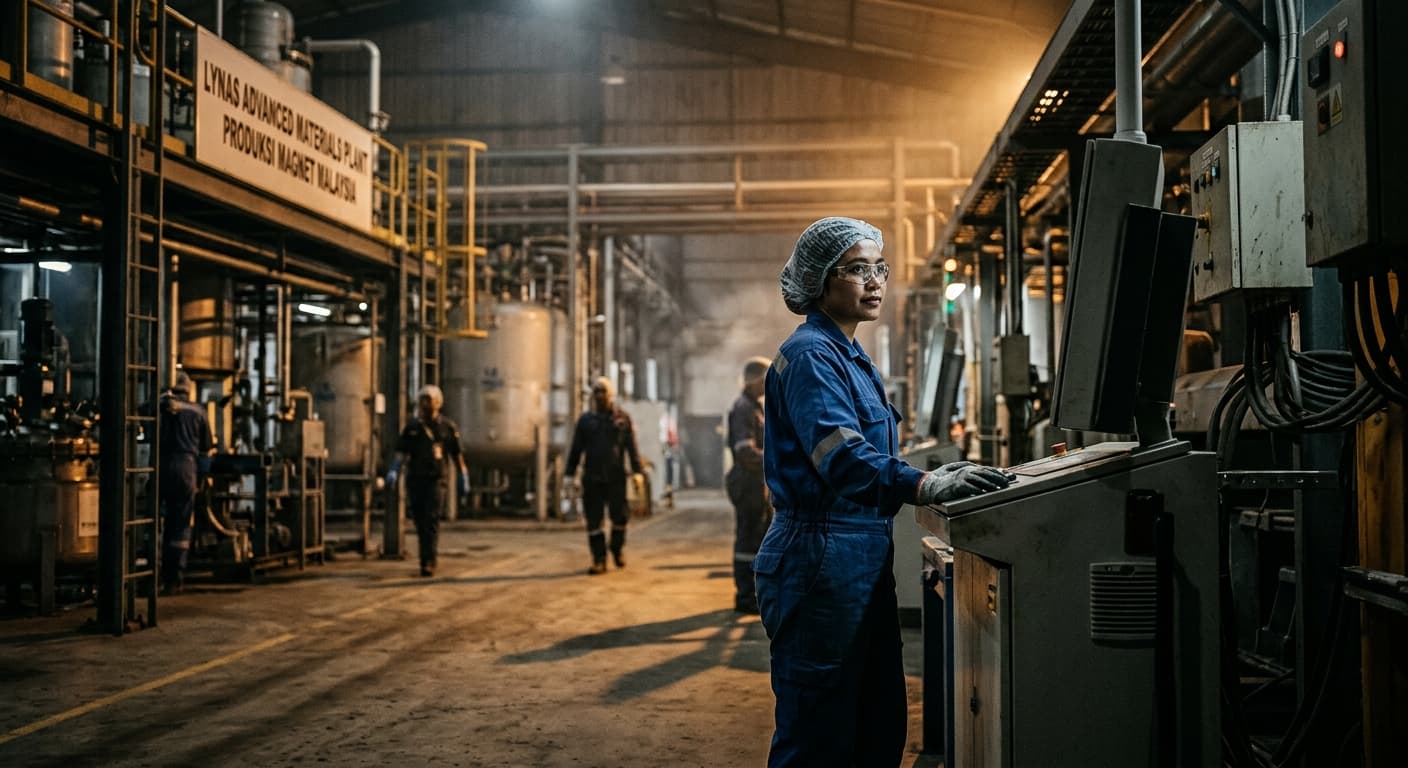
Lynas $50m Malaysia Magnet Deal Cracks China's Grip
Lynas's US$50m investment in a 3,000-tpa NdFeB magnet plant in Kuantan is the first Western-anchored magnet capacity in Southeast Asia — and Beijing's export-control regime is why it exists.
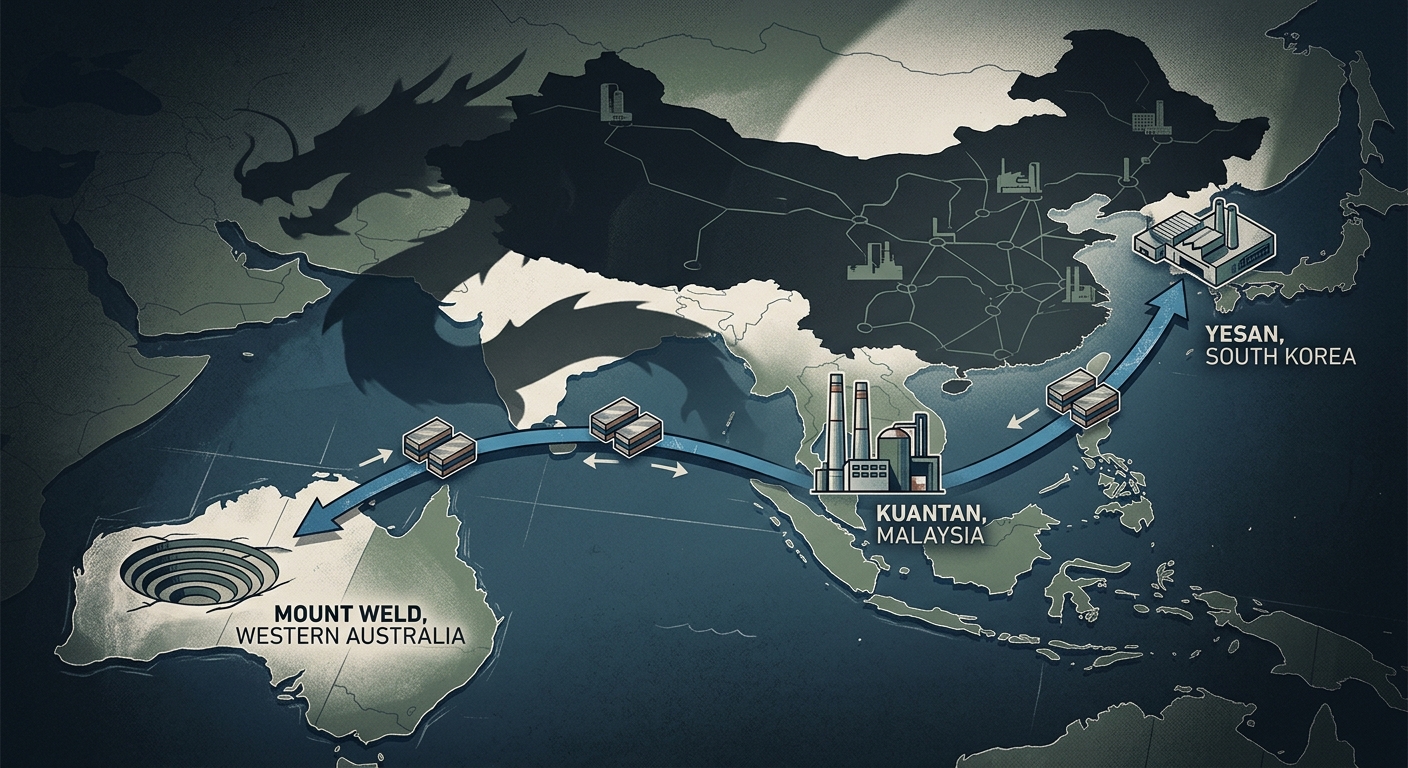
Lynas Rare Earths will spend roughly US$50 million to take a 4.58% fully diluted stake in South Korea's JS Link and anchor a 3,000-tonne-per-year neodymium-iron-boron (NdFeB) magnet plant in Kuantan, Malaysia, the Australian miner confirmed on July 7, 2026. The deal — reported by Australian Mining and building on a July 2025 memorandum of understanding — is small in dollar terms but structurally large: it welds together the only major non-Chinese heavy rare-earth refinery, a listed Korean magnet manufacturer, and a Southeast Asian government now bound by an October 2025 critical-minerals pact with Washington. The deal only makes commercial sense because China has spent 18 months making its own magnets politically radioactive to buy.
The transaction, in specifics
Under the agreement disclosed to the Australian Securities Exchange on July 24, 2025, Lynas will supply NdPr and heavy rare-earth feed exclusively to two JS Link plants — the existing 1,000-tpa Yesan facility in South Korea and the new Kuantan factory — at commercial prices through January 2038. JS Link, listed on Korea's KOSDAQ, has secured a site adjacent to the Lynas Advanced Materials Plant (LAMP) in Pahang state. Interim Lynas chief executive Pol Le Roux framed the tie-up as delivering the company's "Towards 2030" objective of "expanding into the outside China metal and magnet supply chain," according to the Australian Mining report.
The plant is expected to generate up to 400 jobs and feed automotive, wind and electronics customers primarily in South Korea and Malaysia, per company statements carried by The Edge Malaysia. Malaysia's strategic task force projects that domestic super-magnet output will generate US$3 billion in revenue by 2030,
Malaysia's ISIS think tank reported, and an ISIS working paper values a fully integrated national rare-earth chain at RM91.9 billion of GDP and 96,900 jobs by 2050, per its November 2025 study "
From mine to magnet."
Two features of the deal matter more than the headline dollar figure. First, exclusivity: for the next 12 years, JS Link's magnet output will be traceable end-to-end to non-Chinese ore mined at Mount Weld in Western Australia, refined in Pahang, and metallised inside Malaysia. Second, equity: a 4.58% stake gives Lynas a downstream option in the highest-margin segment of the value chain, where China currently produces roughly 92% of global NdFeB magnets, according to the Atlantic Council's June 2025 report on rare-earth dominance.
Why the deal exists now: Announcement No. 61
The market gap Lynas is filling was engineered in Beijing. On April 4, 2025, China's Ministry of Commerce introduced licensing for seven medium and heavy rare earths — samarium, gadolinium, terbium, dysprosium, lutetium, scandium and yttrium — plus related permanent magnets. The IMF's April 2026 World Economic Outlook documents what followed: global permanent-magnet exports collapsed roughly 70% year-on-year by May 2025 in what it calls a "system-wide disruption" extending beyond formally controlled products. Ford and Suzuki suspended production lines; India's carmakers were "at the back of the queue," according to
The Economist.
Then came the escalation. On October 9, 2025, MOFCOM's Announcement No. 61 built an extraterritorial control regime modelled on the US Foreign Direct Product Rule. Any foreign-made magnet containing 0.1% or more of Chinese-origin heavy rare earths — or produced using Chinese processing technology — now requires a Chinese licence. Applications from foreign militaries are automatically rejected from December 1. Berlin-based think tank MERICS called it a system "much like US controls, but on a radically larger scale," in an
October 15 analysis.
The truce brokered in London and suspended in November 2025 has not repealed the framework — it has paused enforcement. Beijing has already invoked the tool once since: the IMF notes that "in January 2026, China restricted HREE exports to Japan." That is the operating context in which JS Link, whose Yesan plant needs terbium and dysprosium to make traction-motor and wind-turbine magnets, chose to lock itself to Lynas ore for 12 years.
Malaysia's neutrality-by-sector bet
The second variable is Malaysian politics. On October 26, 2025, Prime Minister Anwar Ibrahim's government signed a Memorandum of Understanding with the United States on critical minerals cooperation. In a parallel
joint trade statement, Kuala Lumpur committed to "refrain from banning, or imposing quotas on, exports to the United States of critical minerals or rare earth elements." That language directly imports the US–Australia–Japan playbook into Southeast Asia's largest rare-earth processing jurisdiction.
Anwar's cabinet has also renewed Lynas's LAMP operating licence for a decade from March 2026, with a five-year formal review and tighter waste conditions, according to the Asia Pacific Foundation of Canada. The message is coherent: Lynas stays, magnet capacity expands, and Malaysian state agencies collect royalties and jobs on top of Australian ore.
The strategic reading is subtler. ISEAS analyst Amalina Anuar describes Kuala Lumpur's approach as "neutrality by sector": the government keeps ionic-clay operator MCRE tied to state-owned Chinalco even as it hands Lynas–JS Link the flagship magnet plant. That balancing act is deliberate. Malaysia lacks domestic separation technology, and Chinese know-how remains, in Anuar's phrase, the only viable option for scaling ionic-clay processing "for the foreseeable future." The Lynas deal buys Malaysia a Western hedge without foreclosing the Chinese one.
Who benefits, who loses
The clearest winner is South Korea's automotive-industrial complex. Hyundai Motor Group and its battery-adjacent suppliers have watched the licensing regime disrupt Japanese and European competitors while Korea's own magnet base — dominated by two or three mid-sized firms including JS Link — remained too small to serve domestic EV demand. The Korea Institute for International Economic Policy calls the permanent-magnet chain "one of the principal fronts in strategic competition between the United States and China." A Korean-owned, Malaysia-anchored, Australian-fed magnet stream lets Seoul plug the gap without provoking Beijing the way a Texas plant would.
The second winner is Lynas itself. The 4.58% JS Link stake gives the miner an equity claim on magnet-margin economics, which have historically been captured by Chinese producers and Japanese trading houses. Lynas has been squeezed between Australian cracking-and-leaching cost overruns at Kalgoorlie and Japanese offtake contracts that lock most of its output to priority buyers, per the ISIS report. Malaysia is the vehicle for value-chain descent.
The loser is not China's mining and refining base — that remains untouched — but the argument that decoupling from Chinese magnets is impossibly slow. As CSIS analysts wrote in an April 2026 review marking one year since the April 2025 controls, "magnet exports surged 13 percent" once Beijing eased restrictions in November 2025 — but "shipments to Europe jumped 60 percent year" on year, an implicit reallocation away from US-aligned buyers that gives Kuala Lumpur and Seoul political cover to build alternatives.
The scale problem nobody is solving fast
Set against Chinese incumbency, the Kuantan plant is a rounding error. China produced roughly 138,000 tonnes of NdFeB magnets as early as 2018, per CSIS's July 2025 processing-hub analysis. MP Materials, the DoD-backed US champion, is scaling from 1,000 tpa in 2025 toward 10,000 tpa by the mid-2030s under a July 2025 public-private partnership that includes a $400 million equity purchase, a $110/kg neodymium-praseodymium price floor, and a Pentagon commitment to buy 100% of its output. Add Kuantan's 3,000 tpa, Noveon's Texas capacity, and pilot lines in Europe, and non-Chinese sintered-magnet capacity will still be well under 10% of Chinese output by 2028.
That gap is the case for the deal, not against it. The point of Kuantan is not to substitute for China; it is to give Korean and Malaysian OEMs one certified, Chinese-input-free line of supply that survives Announcement No. 61's foreign-direct-product logic. A carmaker that can point to a Kuantan-sourced traction motor is a carmaker that no longer needs a Chinese export licence to ship EVs to the United States.
Two second-order effects deserve attention. First, Japan — Lynas's original strategic backer through the Japan Organization for Metals and Energy Security — is being quietly relegated to a co-anchor role as Korean and American capital take equity positions Tokyo declined. The January 2026 Chinese cut-off to Japanese buyers has not accelerated Japanese investment upstream; it has accelerated everyone else's.
Second, the deal exposes an unresolved question about primary supply. Malaysia's own ionic-clay reserves remain locked to Chinese processing technology, per ISEAS. Lynas can feed Kuantan for at least a decade from Mount Weld, but a genuinely Malaysian rare-earth chain — mine, refine, magnetise — still runs through Beijing at the extraction stage. Anwar's neutrality-by-sector strategy works only as long as both patrons keep tolerating it.
What to watch — the next catalysts
- August–October 2026: Lynas's FY26 results and definitive JS Link joint-venture agreement (the July 7 announcement was equity-plus-supply, not the final JV structure). Watch for the Chinese-content certification protocol Kuantan will use to reassure US buyers.
- December 1, 2026: One-year anniversary of the effective date for the deferred elements of Announcement No. 61. Any renewed US–China friction risks reactivating the extraterritorial licensing rules that make Kuantan valuable.
- March 2031: Five-year review of Lynas's Malaysian operating licence under conditions set by Putrajaya in
March 2026. A political shift in Kuala Lumpur before then is the single largest execution risk to the plant.
- Q4 2026 – Q1 2027: MP Materials' Independence facility ramp milestones. If Fort Worth delivers on schedule, US buyers will have less reason to underwrite Kuantan capacity via offtake — squeezing JS Link's addressable market.
Diplomat View
Lynas's $50 million cheque is not, as the trade press has framed it, a diversification story. It is a wager that Beijing's October 2025 rare-earth regime is permanent architecture, not a bargaining chip — and that the market-clearing price for "Chinese-input-free" magnets is now high enough to sustain sub-scale plants in jurisdictions like Pahang. That thesis is defensible: even after the November 2025 truce, China restricted heavy rare-earth exports to Japan within eight weeks, per the IMF, and Announcement No. 61's Chinese-persons and foreign-direct-product provisions remain on the books. The forecast we would revise is this: Kuantan proceeds to steel-cutting by mid-2027, adds 3,000 tpa of certified non-Chinese magnet capacity by 2028, and helps push Korean auto OEMs' Chinese magnet dependence below 50% by 2030. What would falsify it: a US–China grand bargain that dismantles Announcement No. 61 in exchange for tariff relief, a fresh Malaysian environmental challenge to LAMP at the 2031 review, or an MP Materials cost curve that makes Kuantan's magnets uncompetitive on a landed basis into North America. On present evidence, the Chinese leverage is likelier to harden than dissolve — and Lynas has just bought a decade of downstream optionality at a bargain price.
Related coverage: Global Politics.
Discover more
US Politics
U.S. House Passes Alert Act for Aviation
The House passed the ALERT Act 396–10, replacing the ROTOR Act after Pentagon intervention, impacting aviation safety regulations.

India
Women’s Reservation Bill
Parliament weighs the Women's Reservation Bill to reserve 33% of seats for women in the Lok Sabha and state assemblies, a landmark gender-equality test.

India
Women's Reservation Bill 2026: A Political Sh
India's Lok Sabha rejected the Women's Reservation Bill, exposing a political maneuver to redraw electoral maps favoring the north over the south.

Conflict & Security
Drone Warfare Killing Aid Workers at Unprec
Over 1,000 humanitarian workers killed in three years as cheap armed drones collapse legal protections. Gaza, Sudan, Ukraine, and DRC see deliberate targeting of aid convoys and hospitals with zero prosecutions.