Live Nation Antitrust Trial 2026 Verdict
Ticketmaster declared illegal monopoly; remedies pending.
Model Diplomat9 min readNorth America
Live Nation Antitrust Trial 2026: Verdict, Remedies, and Fallout
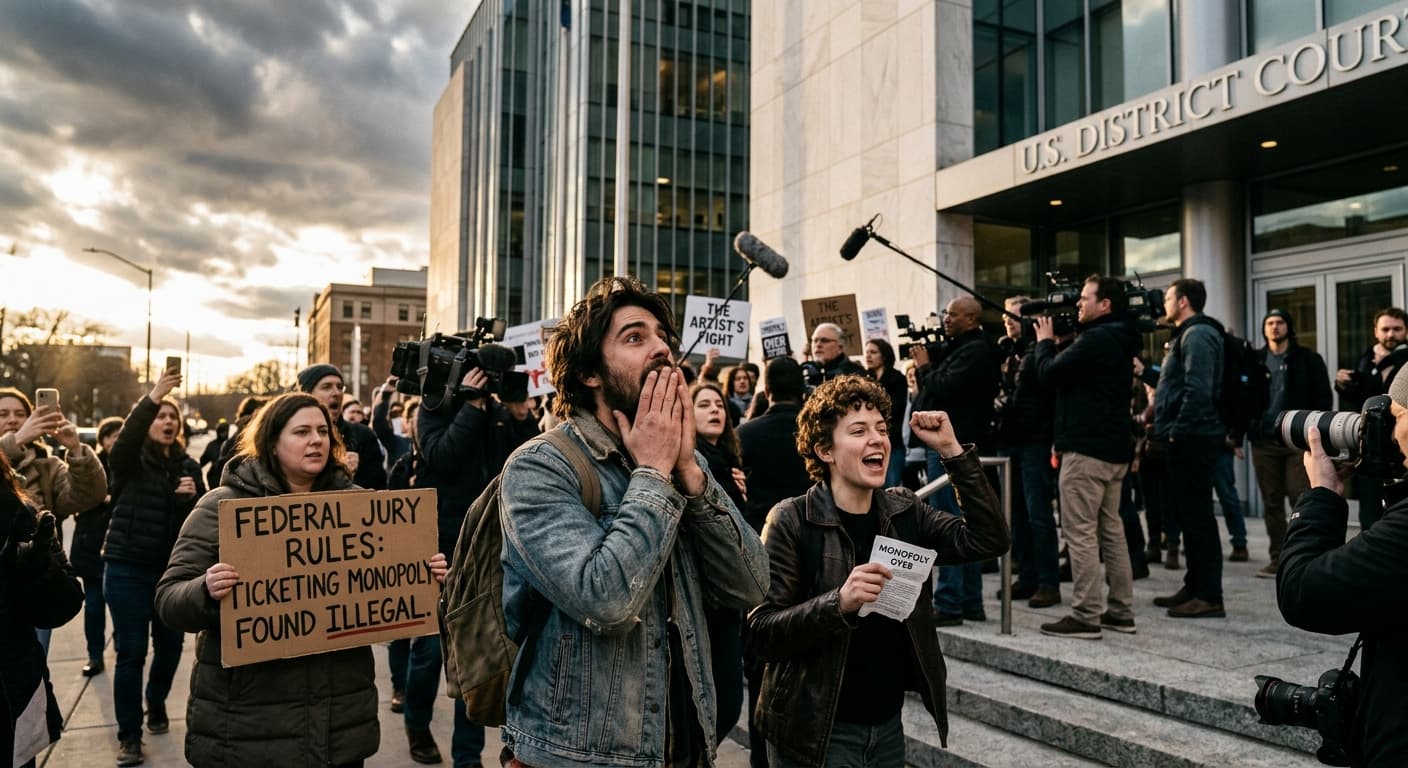
Federal jury on April 15, 2026 declared Ticketmaster an illegal monopoly. Now Judge Arun Subramanian decides whether to break it up or bless a $280M deal.
On April 15, 2026, a Manhattan federal jury spent four days working through an 11-page verdict form and answered "yes" to every question the plaintiffs put to it: Live Nation Entertainment and its Ticketmaster subsidiary had wielded illegal monopoly power over the U.S. concert business, and had overcharged fans $1.72 per ticket across 22 states. The finding, reported by NPR and
Al Jazeera, is the largest antitrust liability verdict against a live-entertainment firm in U.S. history. But the real fight — over whether Live Nation is broken up or ring-fenced by a soft consent decree the Trump Justice Department negotiated five weeks earlier — has not started yet, and the leverage in that fight has quietly shifted from the executive branch to a single federal judge and a coalition of 33 state attorneys general the White House could not control.
What the jury actually decided
The case, United States et al. v. Live Nation Entertainment, Inc., No. 1:24-cv-03973-AS, was filed on May 23, 2024 by then-Attorney General Merrick Garland alongside 30 states and the District of Columbia, per the S.D.N.Y. docket on CourtListener. The complaint alleged monopolization across six related markets — primary ticketing to major concert venues, large amphitheater booking, artist management, concert promotion, and secondary ticketing — tied together with allegations of retaliation against venues that dared to use Ticketmaster's rivals SeatGeek or AXS. The first plaintiff witness, former Barclays Center executive John Abbamondi, testified that CEO Michael Rapino warned him on a recorded call it would "be a tough time to deliver tickets or concerts" after Barclays defected to SeatGeek — a call the
BBC reported that Live Nation insists was not a threat.
At trial, plaintiffs' lead counsel Jeffrey Kessler argued that Ticketmaster controls 86% of the primary market for concerts and 73% of primary ticketing when sports are included, Al Jazeera reported. Bloomberg's Leah Nylen,
interviewed by NPR from the courthouse, put the figure at "something like 87% of venues across the U.S." The economics of the case ran through those numbers into a $1.72 per-ticket overcharge — a per-unit figure that sounds small until it is multiplied by the 159 million fans Live Nation drew to more than 55,000 concerts in 2025, as disclosed in the
company's earnings coverage by the BBC. Multiply through and the exposure runs into hundreds of millions before the Clayton Act trebling — Live Nation's own trial estimate,
per NPR, pegged damages "below $150 million" pre-treble, while states in the
proposed joint pretrial order referenced their own 2017-2025 damages calculations at multiple billions before trebling.
Live Nation's defense, laid out in its answer to the amended complaint, was that plaintiffs had "gerrymandered" markets by inventing a "major concert venues" category, that promoter margins are single digits, and that "artists are not 'forced' to hire Live Nation." Its post-verdict
Rule 50(b) motion argues that after 25 days of trial and 50 witnesses, plaintiffs produced "no venue" and "no artist" testifying to being overcharged, and that fan-facing fees are "legally irrelevant" because fans do not book venues or buy primary ticketing services. The jury did not agree. It did not have to: the credibility problem for Live Nation was compounded when internal Slack messages surfaced during trial in which its head of ticketing, Benjamin Baker, told a colleague the company was "robbing them blind, baby" and called customers "so stupid," per the
Associated Press account via Al Jazeera.
The plot twist: the DOJ walked away five weeks before the verdict
The verdict is not the strangest thing about this case. The strangest thing is that when it was handed down, the U.S. Department of Justice — the lead plaintiff — was no longer in the courtroom.
On March 9, 2026, six days into trial, the Trump administration's DOJ Antitrust Division and Live Nation announced they had signed a term sheet ending the federal case. The signed term sheet, filed publicly on March 13, commits Live Nation to establish a $280,388,297 settlement fund for state consumer claims and to accept an eight-year consent decree with anti-retaliation, non-interference and non-circumvention provisions enforced by a monitor and a $5 million penalty per violation. On primary ticketing, the term sheet allows major venues an "option to exempt from exclusivity up to 20% of primary tickets," subject to an economic adjustment. Live Nation's own
narrative of the negotiations is telling: the company says the Biden DOJ refused to talk before litigation, and the Trump DOJ "chose not to respond with a counterproposal until January 29" — meaning a deal materialized only after new political leadership.
That is not a breakup. It is not close to a breakup. Judge Arun Subramanian, according to NPR's contemporaneous reporting, was informed at 8 p.m. the night before, jurors were already seated, and 33 of the state plaintiffs refused to sign. Arizona Attorney General Kris Mayes said the deal "does not adequately remedy the harm done," per
NPR's settlement story. New York Attorney General Letitia James called it a monopoly-preserving giveaway. Democratic Senators Amy Klobuchar, Elizabeth Warren and Richard Blumenthal urged Judge Subramanian in a joint letter to "closely scrutinize this settlement." The historical parallel is exact: as the
Center for American Progress documented, the DOJ approved the 2010 Live Nation-Ticketmaster merger with a behavioral consent decree that "since 2012, Defendants' executives have retaliated against or threatened venues throughout the United States in violation of" — a decree the department itself amended in 2020 after finding those violations. Behavioral remedies against this company have already failed once. The states are betting the Tunney Act judge sees the pattern.
Understand the leverage here. The DOJ believed a settlement was defensible; the states did not, and they had independent Section 4 and parens patriae standing to keep going. On April 15, they won on every question. The bipartisan coalition — California AG Rob Bonta told NPR that "red and blue states don't always work together on everything" but did here — extracted a verdict the federal executive branch could not have delivered even if it had wanted to.
Two deals, one company, one judge
Judge Subramanian now has two documents on his desk that describe the same defendant. One is the DOJ term sheet, a behavioral-remedies package that keeps the merged company intact. The other is a jury verdict finding illegal monopolization on which the states will demand structural relief — separating Ticketmaster from Live Nation, divesting amphitheaters, and paying trebled damages under 15 U.S.C. § 15. Bonta was explicit on-air that California and its co-plaintiffs "have asked" the court to "separate them."
The two paths cannot easily coexist. On April 6, 2026, the joint parties told the court that a proposed final judgment plus a Tunney Act filing would be ready in "approximately two months," triggering a mandatory 60-day public comment period under 15 U.S.C. § 16(b)–(h) before the DOJ deal can become final. That clock points to public comment closing in late summer 2026 and a Tunney Act "public interest" determination — the judge's actual sign-off — likely in the fall. Live Nation's own statement, quoted by
NPR, tries to fuse the two tracks: it is "confident that the ultimate outcome of the States' case will not be materially different than what is envisioned by the DOJ settlement." That confidence is doing a lot of work. Rebecca Haw Allensworth, a Vanderbilt antitrust scholar visiting at Harvard Law School, told NPR that a jury verdict is "generally harder to fight successfully than one from a judge," but that any structural remedy would be paused during appeal — meaning "certainly not in 2026" will Live Nation actually be severed from Ticketmaster. Allensworth expects the states to argue the DOJ deal is "a slap on the wrist."
Who wins, who loses
The winners. Independent promoters and ticketing rivals SeatGeek and AXS gain immediate leverage in every renegotiation, because venues can now credibly threaten to open — the DOJ term sheet's 20% carve-out is a floor, not a ceiling, once the states extract more. The 13 amphitheaters whose exclusive booking arrangements Live Nation agreed to relinquish, per the BBC, become the first competitive test-beds in a decade. Independent artists gain a signal — the National Independent Venue Association study cited by
NPR's artist coverage found 64% of independent venues, promoters and festivals were unprofitable in 2024 — that the ecosystem they operate in has legal cover it did not have on April 14. State AGs, particularly the bipartisan bloc Bonta highlighted, walk away with a template for state-led antitrust enforcement when the federal executive branch is reluctant.
The losers. Live Nation shareholders lost more than 6% on the day of the verdict, per the BBC, on top of legal exposure the company itself estimates at up to $450 million after trebling, and potentially far more if the states' damages models prevail. The 2010
Center for American Progress testimony warning the merger would "foreclose competition in both markets" has now been validated by a federal jury. The DOJ Antitrust Division itself is a loser in institutional terms — the states won a verdict on the same evidence the department was willing to trade away, exposing a settlement-by-political-cycle problem that will haunt future merger decrees. And fans hoping for cheaper tickets in 2026 will not get them:
NPR notes that ticket prices "won't drop just yet" and that even a structural remedy would be stayed pending appeal — a process Allensworth cautioned could stretch years.
The second-order effect is legislative. The Congressional Research Service's ticketing report (R48179) catalogs at least four pending bills — the TICKET Act, BOSS and SWIFT Act, Fans First Act, and Junk Fee Prevention Act — that would impose all-in pricing, ban speculative tickets, and mandate refunds. The verdict removes the industry's strongest lobbying argument, namely that concentration is not a problem. Klobuchar's
Fans First Act and Pallone's
TICKET Act now have a jury finding behind them. The
American Enterprise Institute — not a natural ally of aggressive antitrust — has argued that Congress must "pick up where DOJ left off." Bipartisan cover exists for a bill that would have been dead on arrival in 2019.
What to watch next
- Summer 2026 — Tunney Act filing. The proposed final judgment and Explanation are due roughly two months after the April 6 joint letter, opening a 60-day public comment window. Watch which state AGs file objections and whether the American Economic Liberties Project — whose Morgan Harper called the verdict a "historic victory,"
per the BBC — files a formal Tunney Act comment.
- Fall 2026 — Rule 50(b) ruling and remedies schedule. Judge Subramanian must rule on Live Nation's renewed motion for judgment as a matter of law before scheduling the states' remedies phase; Kessler has declined comment because that trial "has not been scheduled."
- Live Nation's Second Circuit appeal. Any structural relief will be stayed during appeal, and the company has told the court it "can and will appeal any unfavorable rulings," per its post-verdict statement to NPR.
Diplomat View
The forecast: Judge Subramanian will not order a breakup in 2026, and a Second Circuit appeal will consume 2027. But the DOJ term sheet, as drafted, will not survive Tunney Act review intact — the 20% ticketing carve-out is too narrow, the 15% fee cap covers too few venues, and the record now includes a jury finding of monopolization the settlement was designed to preempt. Expect Subramanian to demand amendments before he certifies the DOJ deal is "in the public interest," and expect the states' remedies phase to force at least partial amphitheater divestiture even if the ticketing subsidiary stays inside the corporate parent. The revision condition: if Live Nation wins its Rule 50(b) motion in whole or in part — an outcome legal scholars view as unlikely for a jury verdict but not impossible given the "gerrymandered market" defense the Fourth Circuit accepted in It's My Party, Inc. v. Live Nation — the states lose leverage and the DOJ deal becomes the ceiling. Absent that, this case is the moment the behavioral-remedy playbook that governed U.S. antitrust from 2010 to 2024 finally exhausted its credibility in tech and media markets. The next merger review that cites "conduct remedies over structural remedies" will do so against a jury verdict that says the last one didn't work.
Discover more

US Politics
SNAP Food Assistance Faces Legal Challenges
In 2026, SNAP faces stricter eligibility rules and mounting legal challenges, threatening food assistance for the millions of Americans who rely on the program.
India
Congress Advocates 33% Women’s Quota
Congress calls for a 33% women's reservation in the existing 543 Lok Sabha seats, countering Modi's plan to expand the house to 850 seats.
India
700 Activists Accuse PM Modi of MCC Breach
Over 700 activists allege PM Modi breached election code with a televised address attacking opposition parties just before state elections.

Economics
Fed's Amex AML order puts correspondent banking on notice
Federal Reserve's Amex AML order requires board-level controls and a 90-day plan; OCC fined the bank $350 million over enterprise-wide deficiencies.