Lebanon's Ultimatum: Pilot Zones or No Talks
Beirut threatens to skip Rome talks unless Israel withdraws.
Model Diplomat8 min readMiddle East
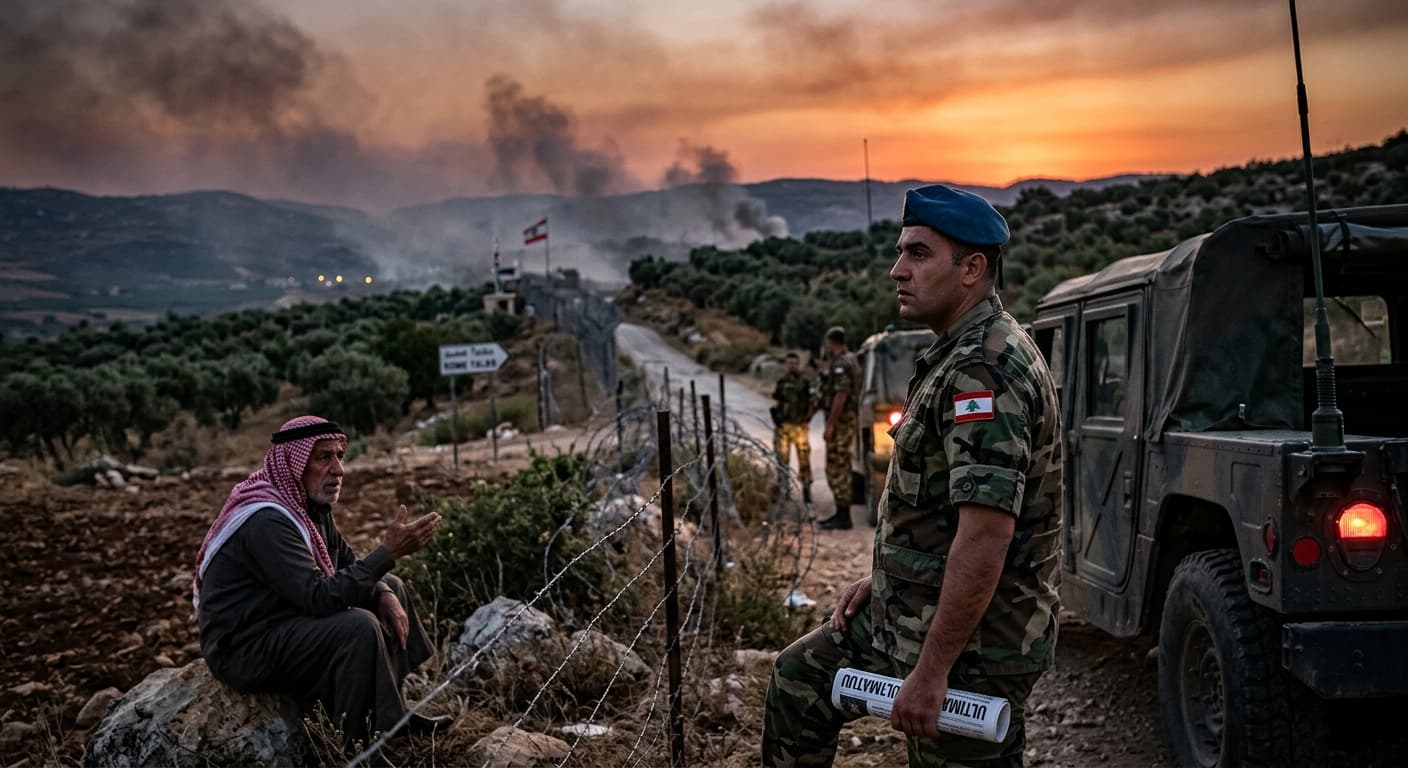
Lebanon's Rome ultimatum: pilot zones or no talks with Israel
Beirut is threatening to skip the July 15 Rome round unless Israel starts pulling out of two southern "pilot zones" — a Gulf-backed test of the Washington framework.
Lebanon told Washington on July 8, 2026 that it will not send a delegation to the July 15-16 Rome round of direct talks with Israel unless the Israel Defense Forces first begin withdrawing from two "pilot zones" it agreed to vacate in the trilateral framework signed at the State Department on June 26. The ultimatum is not really about the two patches of ground — it is Beirut's first attempt to convert Gulf reconstruction leverage into a hard withdrawal timetable before Iran, Hezbollah or Israeli domestic politics collapse the sequence. According to The Times of Israel, a Lebanese diplomatic source told AFP that Beirut wants confirmation from Washington that "engagement and policies in Rome will remain consistent" — code for the fixed drawdown calendar the Washington text pointedly omitted.
The pilot-zone trap
The framework Secretary of State Marco Rubio unveiled on June 26 does not contain the word "withdrawal." According to the U.S. Department of State's trilateral text, Israel "shall progressively redeploy" from two designated pilot zones as the Lebanese Armed Forces (LAF) "gradually assume full and effective security responsibility" — a sequenced process explicitly tied to "verified disarmament of non-state armed groups." Rubio himself called it "the beginning of the beginning" at the signing ceremony, according to
Al Jazeera.
Prime Minister Benjamin Netanyahu identified the zones on a map on June 27: one south of the Litani River but outside the Israeli security zone, and a small area north of the Litani in the expanded zone the IDF seized in the closing weeks of the war, according to Al Jazeera's explainer. Both sit in Nabatieh governorate — the same governorate the World Bank identified as the most damaged in the country. The IDF has told Israeli media the areas are ready for handover; no cabinet instruction has followed.
That gap is the leverage point Beirut is exploiting. Israel accepted the pilot-zone concept in principle at the fourth round in Washington on June 2-3, according to a State Department joint statement, then reaffirmed the concept on paper three weeks later. Lebanese officials read the June 26 text as a binding, near-term pledge; Israeli officials read it as conditional on Hezbollah disarmament progress they say has not happened. As INSS analyst Orna Mizrahi wrote in a
post-signing assessment, Israel walked away with "recognition that Israel's withdrawal from Lebanon will be gradual, beginning with pilot areas, and conditioned on progress in achieving its targets vis-à-vis Hezbollah" — plus implicit agreement that the IDF may continue holding its buffer zone up to the Yellow Line.
Why Beirut is picking this fight now
President Joseph Aoun's government has three windows closing simultaneously, and Rome is the last public forum where it holds procedural leverage.
The first window is Gulf money. Aoun's spring tour of Riyadh, Abu Dhabi and Doha yielded almost nothing. The Atlantic Council reported that Mohammed bin Salman sent him home without a financial commitment, that Abu Dhabi lifted its travel ban but refused to announce an investment package or LAF financing, and that only Qatar renewed a $60 million grant covering Lebanese army salaries. The
World Bank estimates reconstruction needs at $11 billion against a Lebanese state budget of roughly $3 billion, with Nabatieh and South governorates the worst hit. Its own Lebanon Emergency Assistance Project provides an initial $250 million and admits, in a
February 2026 factsheet, to a $750 million financing gap inside its own scalable framework. Riyadh and Abu Dhabi will not close that gap until they see Hezbollah's arsenal shrinking — but Hezbollah will not shrink it while Israeli troops sit inside Lebanon. A visible IDF pullback from the pilot zones is the only sequence that unlocks Gulf checkbooks without asking Hezbollah to disarm first.
The second window is the UNIFIL clock. Under Security Council Resolution 2790, the peacekeeping mandate was extended "for a final time" and expires on December 31, 2026, with an orderly drawdown to follow within a year. The resolution "calls on the Government of Israel to withdraw its forces north of the Blue Line, including from the five positions held in Lebanese territory," and asked the Secretary-General to present options by June 1, 2026 for what replaces UNIFIL. Guterres has since floated three scenarios ranging from 2,000 to more than 5,500 UN personnel to monitor any ceasefire,
UN News reported. Every month of delay narrows the multilateral cover Lebanon can invoke against a permanent Israeli redeployment.
The third window is Iran. Tehran's National Security Council has publicly insisted that the June 17 US-Iran memorandum of understanding signed in Islamabad requires an end to fighting "on all fronts, including Lebanon," and Iranian officials have made clear they will not sign a broader nuclear deal until Israel withdraws from Lebanese territory, according to Al Jazeera. That gives Beirut an interest alignment with Tehran a Lebanese government has not enjoyed in a decade — a Lebanese win here is also an Iranian one — which is precisely why Aoun needs the withdrawal to look Lebanese, not Iranian, in origin.
What Israel actually signed — and what its ministers are saying
The gap between the framework text and the Israeli political line is now the story.
On June 30, Defence Minister Israel Katz told reporters the IDF would not withdraw "a millimetre" until Hezbollah is disarmed. The next day Netanyahu, visiting troops in southern Lebanon, said the army "will not leave" the area while Hezbollah remains a threat, per Al Jazeera. Israeli elections are expected around October, and analysts quoted in that reporting argue that a hasty pullback risks looking like capitulation to Donald Trump — an admission that Netanyahu fell into line under American pressure rather than victorious over Hezbollah. Netanyahu's earlier declaration, reported by
Al Jazeera, that "Israel remains in the security zone in southern Lebanon … as long as Hezbollah has not disarmed" gave his coalition partners a permission slip to slow-walk the pilot zones indefinitely.
Hezbollah, excluded from the talks, has rejected the framework outright. Secretary-General Naim Qassem called it "humiliating, shameful and a surrender of sovereignty" in a June 27 statement reported by Al Jazeera, and rejected any link between an Israeli withdrawal and the group's disarmament. Israeli air raids continued into southern Lebanon the same weekend, killing one person near Nabatieh al-Fawqa according to the Lebanese Ministry of Public Health.
The result is a document three parties read three different ways: Rubio treats it as a "clear and structured process" leading to Hezbollah disarmament; Netanyahu treats it as a licence to stay; Hezbollah treats it as a surrender document Beirut cannot enforce. Aoun's ultimatum is designed to force a decision — a physical, verifiable withdrawal from two small zones that would confirm the Lebanese reading and puncture the Israeli one.
The Gulf reads the room
Aoun's leverage in Rome is borrowed from Riyadh and Abu Dhabi more than it is generated in Beirut.
Gulf capitals do not want a return to the pre-2023 arrangement in which Hezbollah operated unchecked south of the Litani. But they also do not want a permanent Israeli occupation feeding Iranian propaganda about Arab weakness. Their preferred outcome — a demonstrable LAF takeover of pilot zones, funded by Gulf money, framed as an Arab, not American, victory — requires Israel to move first. Al Jazeera reported after the US-Iran deal that Gulf states have shifted toward "hard-headed pragmatism," welcoming the Islamabad MoU as a war they never wanted ending on terms they can live with, but still wary of Iranian entrenchment via Hezbollah. That pragmatism cuts both ways: it makes Riyadh unwilling to bankroll Aoun before Hezbollah moves, and unwilling to be seen bankrolling an Israeli occupation.
The Al Jazeera Centre for Studies argued in a July 6 policy brief that divergent readings of the text will define its implementation phase — and that without a concrete withdrawal move, the framework will replicate the fate of the November 2024 ceasefire that was violated daily. Ronnie Chatah, quoted by Al Jazeera, drew the sharper historical parallel: a 1983 tripartite Lebanon-Israel-US agreement collapsed within a year, followed by attacks on peacekeepers and the US embassy in Beirut, and the emergence of Hezbollah as the dominant security actor. That precedent is the one Gulf capitals are watching, and it is the one Aoun is invoking — implicitly — when he says Rome cannot become a photo-op that outruns the ground truth.
What to watch
- July 10-14: Whether the Israeli security cabinet issues a formal instruction to the IDF to begin the pilot-zone pullback. Without it, Beirut has signalled it will not board the plane to Rome.
- July 15-16: Whether the Rome round happens at all, and — if it does — whether the joint statement contains a dated withdrawal calendar or repeats the "sequenced process" formula.
- October (approx.): Israeli elections. Any Netanyahu concession on Lebanon before the vote will be read domestically as a Trump-imposed retreat.
- December 31, 2026: UNIFIL's mandate ends. From that date, the LAF must be able to hold the pilot zones on its own — or the framework's premise fails.
Diplomat View
The most likely outcome in the next 10 days is a face-saving compromise: a limited, symbolic IDF move on one of the two zones — probably the smaller area north of the Litani that the IDF has publicly said it does not need — in exchange for Lebanon showing up in Rome. That would keep the process alive without giving Aoun the fixed timetable he wants or forcing Netanyahu into an election-year climbdown. The forecast changes if either (a) Trump personally intervenes to pressure Israel, as he did to secure the April 16 ceasefire; (b) Hezbollah conducts a demonstrative attack that lets Netanyahu freeze the framework entirely; or (c) Iran links slower nuclear talks to the Lebanon file, giving Gulf states cause to withhold reconstruction pledges Beirut is counting on. The deeper bet worth making: the Washington framework is engineered to fail slowly rather than collapse quickly. Its ambiguity is not a bug — it is what allowed three incompatible readings to sign the same page. Rome is where that ambiguity gets tested, and where Lebanon, for the first time since 1983, is trying to price it.
The Bottom Line
Lebanon's threat to skip Rome is a bid to turn one line of the June 26 framework — the pilot-zone pledge — into the enforceable core of the whole agreement, before Israeli elections, UNIFIL's expiry and Gulf donor fatigue close the window. If Aoun gets even a partial IDF move before July 15, he unlocks Gulf reconstruction money and hands Iran a face-saving reason to keep nuclear talks going; if he does not, the framework begins its slow slide toward the fate of the 1983 accord.
Discover more

US Politics
House Ethics Committee Pushes Sexual Miscond.
The House Ethics Committee has shifted responsibility for sexual harassment settlement records to the Office of Congressional Workplace Rights, complicating disclosure efforts.
India
Congress Accuses Modi of Stalling Women's Law
Congress accuses Modi of stalling women's reservation law by linking it to delimitation, revealing a deeper electoral strategy.

US Politics
SNAP Food Assistance Faces Legal Challenges
In 2026, SNAP faces stricter eligibility rules and mounting legal challenges, threatening food assistance for the millions of Americans who rely on the program.

Conflict & Security
Drone Warfare Killing Aid Workers at Unprec
Over 1,000 humanitarian workers killed in three years as cheap armed drones collapse legal protections. Gaza, Sudan, Ukraine, and DRC see deliberate targeting of aid convoys and hospitals with zero prosecutions.