Lebanon's Returnees Face Devastation
Returnees confront destruction and funding gaps.
Model Diplomat8 min readMiddle East
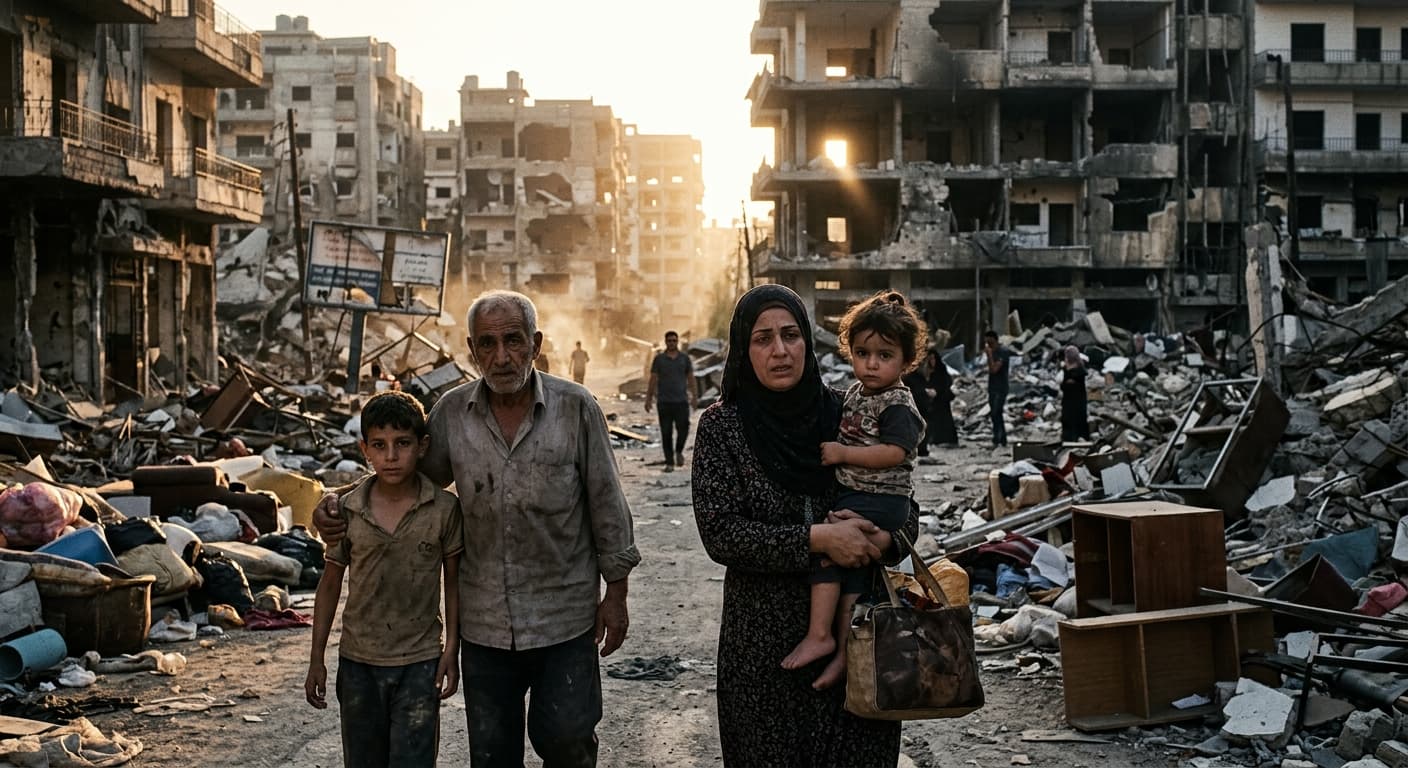
Grim homecoming: devastation greets Lebanon's returnees
Lebanon's 646,000 returnees are walking back into rubble, unexploded ordnance and a $11 billion reconstruction bill no one has agreed to pay.
Since the June 21 ceasefire took hold, 646,107 displaced Lebanese have gone home — walking into villages where Israeli demolitions have flattened more than 70% of some neighbourhoods and where the money to rebuild does not exist. That is the story of this homecoming: not liberation, but a slow-motion political trap. Because the US-brokered framework agreement signed in Washington on June 26 conditions Israeli withdrawal on Hezbollah's disarmament — and links reconstruction financing to the same test — Lebanon's socio-economic recovery is now hostage to a security bargain the country cannot deliver on its own. If the deal freezes, so does the money. And if the money freezes, the returnees become the pool from which Hezbollah rebuilds its political base.
The homecoming, in numbers
The International Organization for Migration's Displacement Tracking Matrix put the number of returnees at 646,107 as of July 2, with roughly half a million still stranded. Nearly one million Lebanese were displaced at the peak, according to
IOM's revised Flash Appeal, which now seeks $42.37 million to sustain operations through August 2026.
The physical picture is worse than the count suggests. Lebanese officials told NPR that some 62,000 homes have been damaged or destroyed since the war reignited on March 2, 2026 — on top of the roughly 163,000 units damaged in the 2023-24 round. In Bint Jbeil, Mayor Mohammad Bazzi told
Al Jazeera that more than 70% of the city has been levelled and another 20% partially damaged; roughly 3,000 housing units, the 400-year-old Great Mosque and the historic Ain al-Saghira quarter are gone. Israel's 98th Division has conducted televised controlled demolitions across 55 border villages it now occupies, framing the destruction as counter-Hezbollah infrastructure work. Legal experts cited in the same report call it the "emptying of residential geography" — a permanent buffer zone at the border edge.
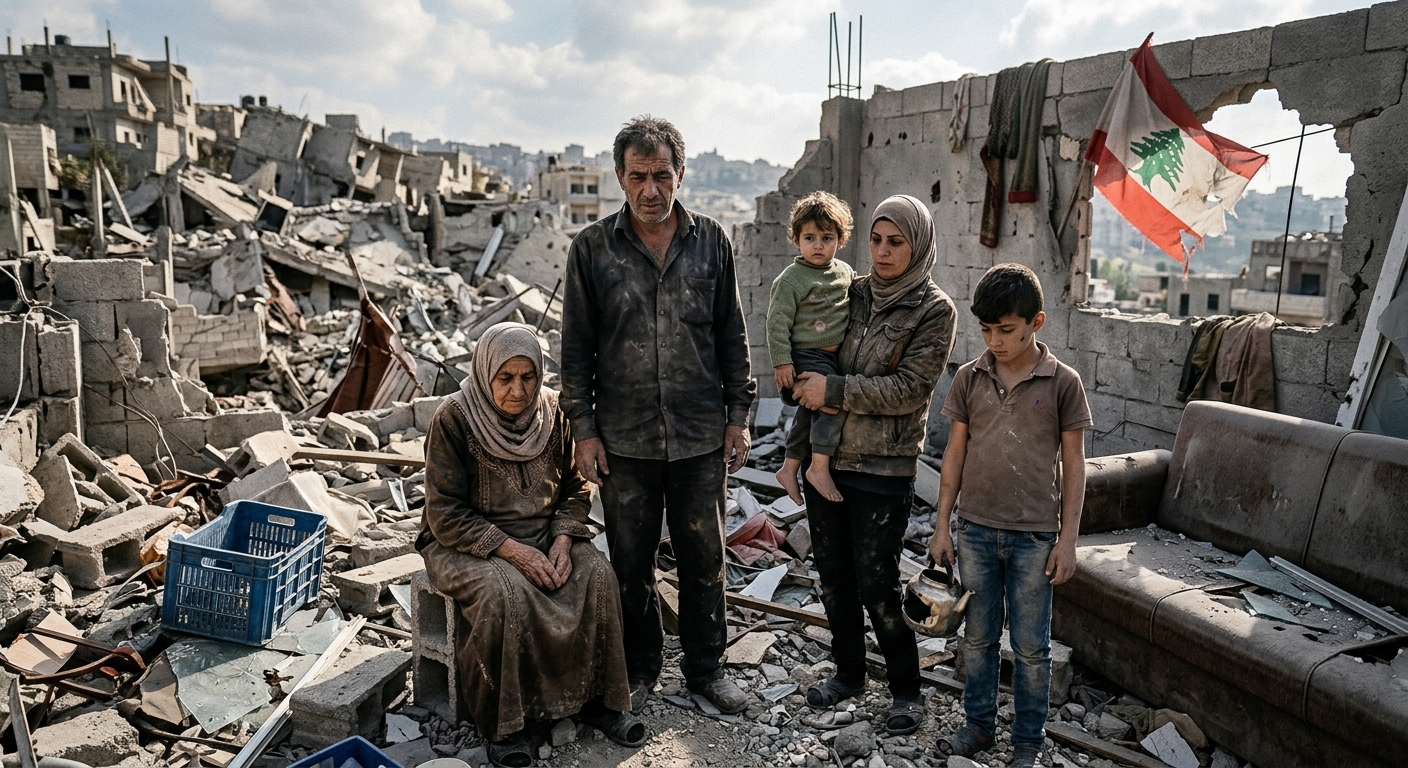
The reconstruction gap: an $11 billion bill and $250 million on the table
The gulf between damage and financing is the story's load-bearing fact. The World Bank's Rapid Damage and Needs Assessment, released in March 2025, pegged the economic cost of the 2023-24 conflict alone at $14 billion, with reconstruction and recovery needs of $11 billion. Housing accounted for $4.6 billion. That estimate stopped on December 20, 2024 — before the 2026 war. The Bank's country page now
warns that the 2026 fighting and higher oil prices will push the 2026 budget, which had targeted balance, "under pressure."
Against that ledger, the only committed vehicle is the Lebanon Emergency Assistance Project (LEAP). It is structured as a $1 billion scalable framework — but only $250 million has been approved, leaving a $750 million financing gap even before 2026 damages are counted. LEAP is not a housing programme; it funds rubble management, water, power, transport and public buildings. It does not rebuild the 62,000 homes.
The private-financing shortfall is worse. The RDNA assumed $6–8 billion of the $11 billion would come from private sources — mostly for housing, commerce and tourism. Lebanon has been in what the World Bank has called one of the three worst financial crises worldwide since the mid-19th century. The lira has lost more than 90% of its value; bank deposits remain frozen; and the cabinet's draft "gap law,"
reported in December 2025 by Al Jazeera, quantifies the banking-sector shortfall at roughly $70 billion. An
IMF staff visit in February 2026 welcomed the Financial Stabilization and Depositor Recovery draft law as a "first step" — but the Fund made clear that a full programme, and the reforms it would unlock, remain unfinished. The IMF's May 2026
governance diagnostic makes explicit what donors already assume: corruption and institutional weakness are the binding constraints on disbursement.
The framework agreement as a financing lever
The Israel-Lebanon Framework Agreement, signed at the State Department on June 26 by Israeli Ambassador Yechiel Leiter and Lebanese Ambassador Nada Hamadeh under Marco Rubio's mediation, is the pivot. It contains 14 clauses. The
BBC reported that both states "affirm" mutual right to peace and pledge a "cessation of all hostile or adverse actions in international political or legal fora." But two clauses do the work.
Clause 3 conditions the safe return of Lebanese civilians in border zones on the "successful disarmament of non-state armed groups and dismantlement of their infrastructure." Clause 13 bars both parties from recourse to international courts, including the ICC and ICJ. Six leading rights groups — Amnesty International, Human Rights Watch, the Lebanese Center for Human Rights, Legal Agenda, RSF and the Union of Journalists in Lebanon — warned in a July 3 joint statement that the agreement "threatens to betray the victims of war crimes" by converting displacement into a bargaining chip and closing legal avenues for accountability.
Under international humanitarian law, people must be allowed to return once hostilities have ended or the reasons for their displacement cease to exist.
— Joint statement of six rights groups, July 3, 2026
The framework offers two "pilot zones" — one south of the Litani, one north — where the Lebanese Armed Forces will progressively assume security responsibility, at which point "internationally supported reconstruction efforts will begin." That linkage is the lever. Reconstruction financing follows disarmament; disarmament requires Hezbollah's acquiescence; Hezbollah, having rejected the deal as "null and void," is not offering it.
Who benefits, who loses
The Aoun-Salam government inherits the loss. Elected in January 2025 on a technocratic reform platform, President Joseph Aoun and Prime Minister Nawaf Salam have moved further and faster against Hezbollah than any predecessor — banning the group's military activities on March 2, 2026, expelling IRGC personnel and asserting the state's monopoly on arms. Yet the framework they signed hands Israel a veto over when their citizens can go home and when donors can write cheques. As Karim Bitar and other analysts argued to Al Jazeera, connecting reconstruction to disarmament risks "reinforcing Hezbollah's narrative that only armed resistance can liberate Lebanese territory."
Hezbollah loses militarily but gains politically among a Shia population that watched the state fail to deliver. The Clingendael Institute's March 2026 assessment concluded that the party is "weakened" but has "transformed into a more resilient and opaque force." Brookings' William Galston
wrote in June that Iran will not trade Hezbollah at the negotiating table and will "race to transfer resources to Hezbollah to outperform and undermine the government" if sanctions relief materialises. Every month the LEAP gap goes unfilled is a month Hezbollah's parallel welfare network out-delivers Beirut. In its February 2025
reporting, Al Jazeera found that families received a one-time state payment of 30 million Lebanese pounds — about $330 — while Hezbollah engineers surveyed damage and paid rent, funded by roughly $77 million the group had disbursed by December 2024.
Israel gains a durable buffer. Prime Minister Benjamin Netanyahu declared on July 1 that Israeli forces "will not leave" until Hezbollah disarms, per Al Jazeera. Defence Minister Israel Katz said not "a millimetre." That posture squarely contradicts the first clause of the June 17 US-Iran Islamabad MoU, which mandated an immediate halt on "all fronts." The Atlantic Council's
analysis treats the buffer as one of two core issues; INSS' Orna Mizrahi
argues implementation will be "slow, prolonged, and fraught."
Iran, by insisting Lebanon be on the US-Iran table, kept Hezbollah's survival wired to Tehran's nuclear diplomacy. The Carnegie Endowment's Diwan argues Lebanon should insert an Egypt-Saudi "phased settlement" framework into those talks. INSS' Raz Zimmt
assessed that "the linkage between Iran and Hezbollah cannot be severed at this stage" — even after Ayatollah Ali Khamenei's killing on February 28.
Regional spillover: the divide-and-conquer temptation
Netanyahu's July 7 comments implying Lebanese Christian villages had requested Israeli annexation — swiftly refuted by the villages themselves — reflect the second-order risk. A June 2026 poll by Lebanese American University's Jad Melki found 87% of Lebanese view Israel as an enemy; only 34% support a peace agreement. The regional coalition of Egypt, Saudi Arabia, Türkiye, Qatar and Pakistan that helped broker the Islamabad MoU is now working, per Carnegie, precisely to prevent Lebanese sectarian collapse. Their alarm is well-founded: a Lebanon that fragments becomes Syria 2013, not Syria 2024.
For the returnees, the immediate danger is more prosaic. Unexploded ordnance killed a boy in Majdal Selem within hours of the April 17 truce, Al Jazeera reported. An Israeli drone strike on July 6 killed a school principal, her mother, a domestic worker and a Syrian passenger returning from checking their home in Nabatieh al-Fawqa,
per NNA. Human Rights Watch's Ramzi Kaiss
documented in December 2025 that Israeli forces have "unlawfully target[ed] reconstruction-related equipment and facilities" — bulldozers, crushers, cement plants — inside the ceasefire zone. That pattern converts damage into permanent depopulation.
What to watch next
- Pilot-zone handover (H2 2026). The first LAF assumption of security in the two framework "pilot zones" — one south of the Litani, one north — is the concrete test of whether disarmament-first sequencing produces any Israeli redeployment. Netanyahu faces elections around October; a visible withdrawal before then is politically unlikely.
- IMF programme decision. The Fund's engagement,
publicly ongoing since February 2026, depends on parliament passing the FSDR bank-restructuring law and amendments to the Bank Resolution Law. Without an IMF anchor, the $750 million LEAP gap will not be filled by Gulf donors.
- US-Iran nuclear talks. The Islamabad MoU is a ceiling on Israeli escalation only while Trump wants to keep the Iran track alive. If those talks collapse, Netanyahu's freedom of action in Lebanon widens.
Diplomat View
The June 26 framework is not a peace deal; it is a financing filter. By making Israeli withdrawal, safe return and international reconstruction cash conditional on verified Hezbollah disarmament — a condition Hezbollah has publicly rejected and the LAF cannot enforce — Washington has effectively locked Lebanon's recovery inside a security bargain the Lebanese state cannot deliver. The prediction: reconstruction disbursements beyond LEAP's initial $250 million will remain frozen through end-2026, southern homecomings will proceed under intermittent Israeli fire, and Hezbollah's post-war political recovery will outpace Beirut's, funded by whatever channels Tehran preserves after any nuclear deal. This forecast changes if three things happen together: an IMF Staff-Level Agreement by Q1 2027, a credible pilot-zone handover south of the Litani, and Saudi-Egyptian sponsorship of the "phased settlement" plan Carnegie describes. Absent all three, the returnees pictured today waving flags atop their rubble will, within eighteen months, become the demographic base from which the next war is recruited. *
Discover more
US Politics
SNAP Food Assistance Faces Legal Challenges
In 2026, SNAP faces stricter eligibility rules and mounting legal challenges, threatening food assistance for the millions of Americans who rely on the program.

Global Politics
US Seizes Iranian Ship, Tensions Surge
The US seizure of the Iranian ship Touska highlights a shift in control over the Strait of Hormuz, favoring Iran's strategic position.
US Politics
House Ethics Committee Pushes Sexual Miscond.
The House Ethics Committee has shifted responsibility for sexual harassment settlement records to the Office of Congressional Workplace Rights, complicating disclosure efforts.

Conflict & Security
Drone Warfare Killing Aid Workers at Unprec
Over 1,000 humanitarian workers killed in three years as cheap armed drones collapse legal protections. Gaza, Sudan, Ukraine, and DRC see deliberate targeting of aid convoys and hospitals with zero prosecutions.