Lavrov's Moscow Summit: A Losing Bet
Russia's ties with Sahel juntas deepen amid rising violence.
Model Diplomat8 min readAfrica
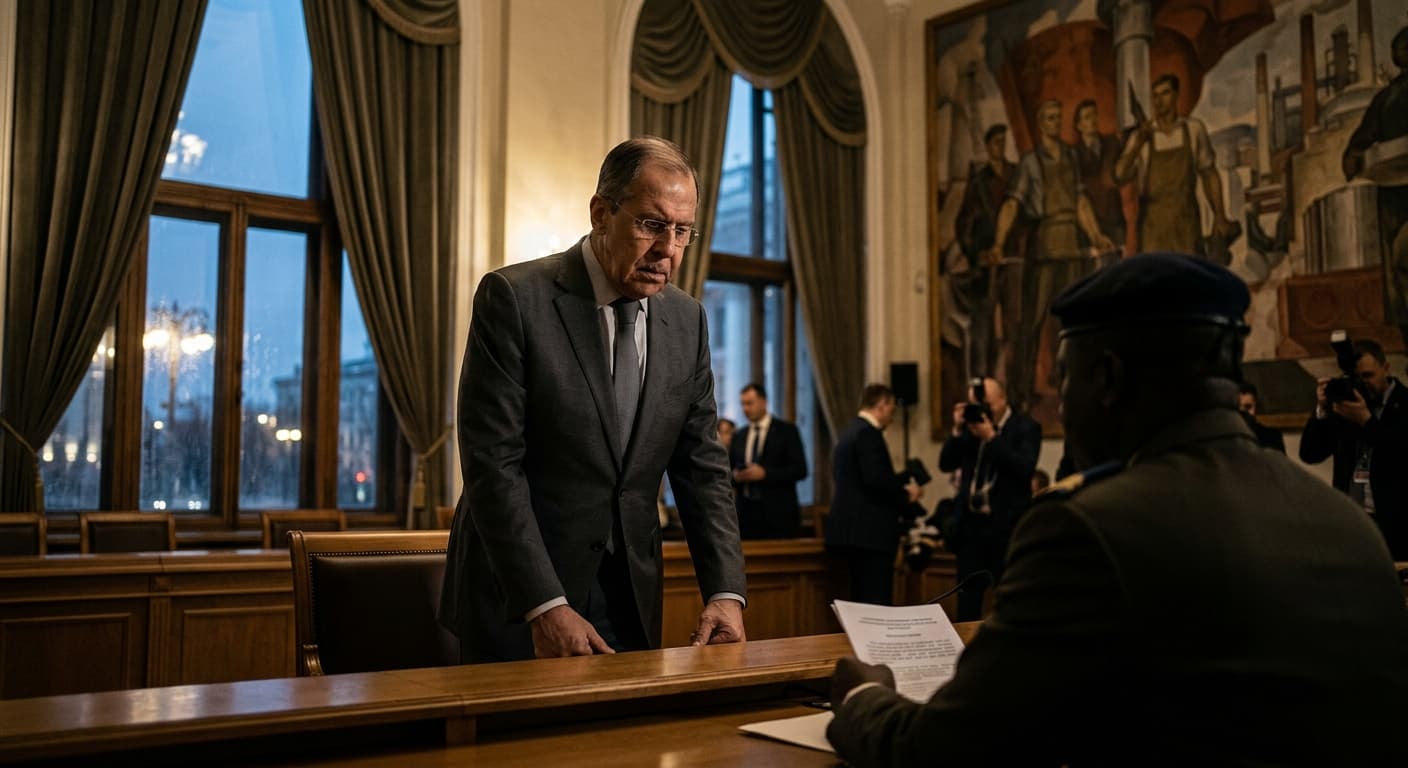
Lavrov in the Sahel: Moscow locks in a losing partner
Russia's foreign minister invited Mali, Burkina Faso and Niger's juntas to the October Moscow summit — days after Africa Corps abandoned Kidal and Bamako sits under jihadist blockade.
Sergey Lavrov's July 8 stop in Niamey — the second Russia–Alliance of Sahel States ministerial, per Il Sole 24 ORE — was designed to look like counter-terrorism diplomacy. It is not. Ten weeks after Russian Africa Corps forces retreated from Kidal and Mali's defence minister was killed in Bamako, Moscow is using the third Russia-Africa summit in October to politically lock in three juntas whose partnership with Russia has coincided with record Sahelian violence, not its containment. The offer on the table is regime survival in exchange for uranium, gold and a permanent Russian foothold on Europe's southern flank — a trade the juntas are taking because no one else is bidding.
The invitation, and what it papers over
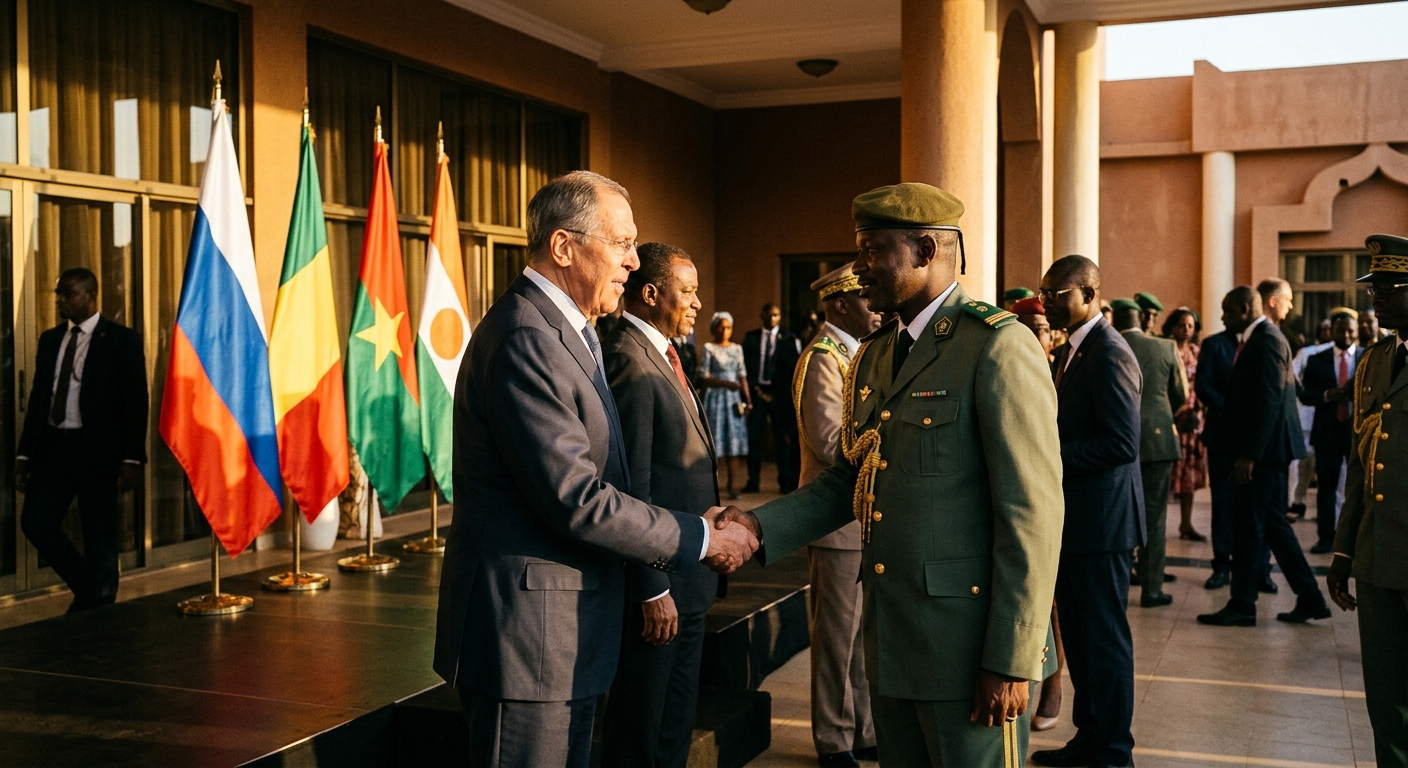
Lavrov arrived in Niamey after Addis Ababa, on his first-ever visit to Niger. At a formal ministerial with the foreign ministers of Mali, Burkina Faso and Niger, he delivered what TASS described as Vladimir Putin's personal invitation to the three heads of state — Assimi Goïta, Ibrahim Traoré and Abdourahamane Tchiani — to attend the Russia-Africa summit in Moscow in October, Independent reported. The Russian Foreign Ministry, in its own
readout of the format, calls the three states the "Confederation of Sahel States" — a naming choice that treats the bloc as a de facto peer of ECOWAS, from which it withdrew in January 2025.
The optics were carefully staged. The substance is that Lavrov flew into the capital of a country whose main airport was overrun by Islamic State Sahel Province fighters in January 2026, an assault Russia's own Ministry of Foreign Affairs confirmed Africa Corps had helped repel — reminding everyone that the security partner is now also a defensive necessity for the terminal itself.
What Kidal broke
The single most important fact hovering over Niamey was Kidal. On April 25–26, 2026, an al-Qaeda-linked JNIM and the Tuareg-dominated Azawad Liberation Front (FLA) launched coordinated attacks across Mali, killed Defence Minister Sadio Camara in an apparent suicide truck bombing near Bamako, and retook Kidal — the northern city Wagner had helped the Malian army seize in late 2023.
Russian Africa Corps confirmed its withdrawal via Telegram, saying the pullout was a "joint decision" with Bamako. FLA spokesman Mohamed Elmaouloud Ramadane told the BBC an "agreement" had been reached with the Russian elements "with a view to ensuring their secure withdrawal." Analyst Ulf Laessing told Al Jazeera that Moscow "will struggle to attract new clients for the Africa Corps because they just didn't do their job — it's reputational damage, what has happened."
The Elcano Royal Institute's July 2026 assessment went further: Kidal, it argued, "exposed the fragility of the Malian junta's gains" and showed that Africa Corps' guarantees of stability "are constrained." Rebels reportedly used FPV drones — Ukraine-war technology arriving on the Niger–Mali frontier — against combined Russian-Malian units.
Then came the siege. JNIM tightened its fuel blockade of Bamako in May, burned more than 100 tankers on highways from Senegal and Côte d'Ivoire, and by June was closing entry roads for hours at a time, the BBC reported. A Policy Center for the New South study using
ACLED's dataset of roughly 3,000 JNIM activities in twelve months describes a group that has shifted from insurgency to "economic warfare" — throttling a landlocked capital by seizing chokepoints rather than territory.
The scoreboard: Russia in, violence up
The strategic case that pulled the three juntas toward Moscow in 2022–24 was security. That case has collapsed on the numbers.
The Egmont Institute's April 2025 policy brief documents that Sahel violent-extremism fatalities tripled from 2021 to reach 11,200 deaths in 2024, with an additional 2,430 civilian deaths attributed to national security forces and their Russian partners. The
West Africa Security Tracker recorded 12,964 conflict-related deaths in West Africa in the first half of 2025 alone — with Burkina Faso losing 3,539 people and Mali 2,157. In Burkina Faso, JNIM was responsible for roughly 2,370 fatalities in six months.
The Council on Foreign Relations noted in its March 2026 analysis that jihadist groups are "increasingly spreading south and infiltrating countries such as Benin, Côte d'Ivoire, Ghana, and Togo." The Sahel has, in the words of ORF's
tracker, become the epicentre of global jihadist terrorism, accounting for 51% of world terrorism fatalities in 2024.
Africa Corps arrived to fight that fire. Two years in, according to RAND's June 2025 assessment, Moscow's transition from Wagner to a Defence Ministry-controlled force has cost it plausible deniability without buying results: "the security situation in its client countries has deteriorated since it replaced U.N. and West African forces."
What Moscow is actually buying
If the counter-terrorism story has fallen apart, the resource story has not. That is the deal Lavrov came to consolidate.
In Niger, the junta nationalised Somaïr — the country's principal uranium mine — in June 2025, expropriating the 63% stake held by French state-owned Orano. Orano has since filed multiple arbitrations at the World Bank's International Centre for Settlement of Investment Disputes, including
Orano Mining SAS v. Republic of Niger, ICSID Case No. ARB/25/8. Niger is the world's seventh-largest uranium producer; Russian and Chinese firms are already positioning to acquire Orano's stranded assets, and Rosatom has proposed a nuclear power plant. As the Valdai Club — a Kremlin-adjacent think tank —
candidly wrote in October 2025, "the recent regime change in the country allows Nigerien authorities to be more flexible in issuing licenses traditionally sought by Western companies, opening the field to alternative players, including Russia."
Mali, cut off from IMF financing until it "irons out its relations with France" — as its own finance minister conceded off-camera to Al Jazeera's Nicolas Haque — has restructured gold concessions in Russia's favour. The Australian Institute of International Affairs
describes Moscow's Africa play as an explicit "security-for-resources exchange model," with Rosatom holding nuclear and mineral cooperation agreements across more than 20 African states.
The Kremlin's payoff, in other words, is not battlefield victory. It is uranium concessions, gold flows outside the Western banking system, and a supply of hard-currency-earning African contracts at a moment when Russia's Ukraine war has soaked up its own manpower and cash.
Who loses
Europe loses first. The Elcano paper is blunt: Africa Corps is "reshaping the security order in the central Sahel by institutionalising Russia's regime-protection model and sidelining European actors." France has now been evicted from Mali, Burkina Faso, Niger, Chad and Senegal. The EU's border-management architecture — which since 2015 depended on Nigerien cooperation to throttle Sahel-to-Libya migration routes — no longer exists in the same form.
The OSW warned in April 2024 that Africa Corps' arrival in Niger would give Moscow leverage over migration flows toward Europe — a warning that has aged well. Nearly 3.1 million people were internally displaced across Burkina Faso, Niger, Mali and Chad by March 2025, per Egmont.
ECOWAS loses second. The regional bloc's activation of a 2,000-troop standby force by end-2026, reported by Al Jazeera in March, was as much a response to the AES's own 6,000-strong joint battalion as to jihadist expansion. The AES has moved faster institutionally — a Sahel Investment and Development Bank, a common television channel, a mooted currency — than ECOWAS did in fifty years.
The juntas themselves are the third loser, though they don't know it yet. They have traded a Western partnership that came with human-rights conditions for a Russian one that came with combat support that has visibly failed at the moment it was most needed. Traoré's Burkina Faso has lost control of roughly 60% of national territory, per Egmont. Bamako sits under a blockade. Niamey's airport was stormed. The regime-protection Moscow offers keeps Goïta, Traoré and Tchiani in their palaces — it does not keep JNIM out of the countryside.
The counter-move that isn't coming
Washington under Donald Trump has signalled a wary re-engagement. State Department Africa chief Nick Checker travelled to Bamako in early 2026 to reset relations, and AFRICOM has floated "targeted, limited intelligence sharing" with all three AES capitals, the CFR notes. But the Trump administration has been unwilling to make releasing deposed Nigerien president Mohamed Bazoum — held in the presidential palace since July 2023 — a condition of dialogue. The result is a U.S. approach that competes with Russia on Russia's terms: transactional, elite-facing, indifferent to governance.
France is out. The EU has no operational leverage. Turkey sells drones and courts Bamako. China quietly buys mineral offtake. The Gulf pays for hostage releases — the UAE reportedly paid $50–70 million in October 2025 to secure the release of two Emirati hostages from JNIM, per the Policy Center analysis, correlating with a 40-day pause in fuel-corridor attacks.
Into that vacuum, Lavrov walks with an invitation card.
Diplomat View
The October Moscow summit will be Putin's ceremony of consolidation, not counter-terrorism cooperation. Expect three heads of state to attend, expect Rosatom and Rosgeologia contracts for Nigerien uranium and Malian lithium/gold to be signalled or signed, and expect a joint statement recognising the AES Confederation as a bloc — the diplomatic upgrade the juntas cannot get from the African Union, which has kept their memberships suspended since the coups.
The forecast: Moscow's presence in the Sahel is now structural, not contingent on Ukraine. Even a ceasefire in Europe would not free enough Africa Corps manpower to reverse the security trajectory; the model has shifted from combat to elite protection plus resource extraction, and that model does not require battlefield victories. The juntas will stay in power through 2026–27 because no successor coalition is coherent — but the territory they govern will keep shrinking.
What would change this call: a JNIM–FLA push into Gao or Timbuktu that forces a second junta reshuffle in Bamako; a Trump-brokered Bazoum release in Niamey that opens the door to a partial Western re-entry; or a public split within the AES over Mali's disproportionate exposure to insurgent pressure, which would give ECOWAS its opening. Absent one of those, the Moscow summit will be remembered as the moment Russia's Sahel project graduated from opportunism to an institution.
What to watch
- October 2026, Moscow: third Russia-Africa summit. Attendance by all three AES heads of state, and any Rosatom-Niger uranium deal, will confirm the security-for-resources model is now formalised.
- ICSID rulings on Orano v. Niger (ARB/25/8) and parallel Somaïr cases: an adverse award would test whether Niamey's nationalisation survives contact with Western capital markets, or whether Moscow underwrites the fallout.
- ECOWAS standby force deployment, end-2026: the 2,000-troop initial mobilisation is the first real regional counter-jihadist instrument since MINUSMA's departure. If it deconflicts with the AES joint battalion, the region has a chance. If it collides, expect a proxy contest inside West Africa's own security architecture.
The bottom line: Lavrov did not fly to Niamey to help the juntas win a war they are losing. He flew to make sure they cannot afford to lose Russia — and Putin's October summit is the ceremony where that dependency becomes permanent. The Sahel is no longer contested ground between Paris and Moscow; it is a Russian security order that Europe will now have to live next to.
Discover more
US Politics
SNAP Food Assistance Faces Legal Challenges
In 2026, SNAP faces stricter eligibility rules and mounting legal challenges, threatening food assistance for the millions of Americans who rely on the program.
US Politics
House Ethics Committee Pushes Sexual Miscond.
The House Ethics Committee has shifted responsibility for sexual harassment settlement records to the Office of Congressional Workplace Rights, complicating disclosure efforts.
Global Politics
Trump's Conflicting Messages on Iran War
Trump's mixed messages on Iran reflect a strategy of audience management, benefiting Tehran amid a complex geopolitical landscape.

Conflict & Security
Drone Warfare Killing Aid Workers at Unprec
Over 1,000 humanitarian workers killed in three years as cheap armed drones collapse legal protections. Gaza, Sudan, Ukraine, and DRC see deliberate targeting of aid convoys and hospitals with zero prosecutions.