Lavrov Secures AU Deal Ahead of Summit
Russia and AU commit to annual consultations and UNSC alignment.
Model Diplomat7 min readAfrica
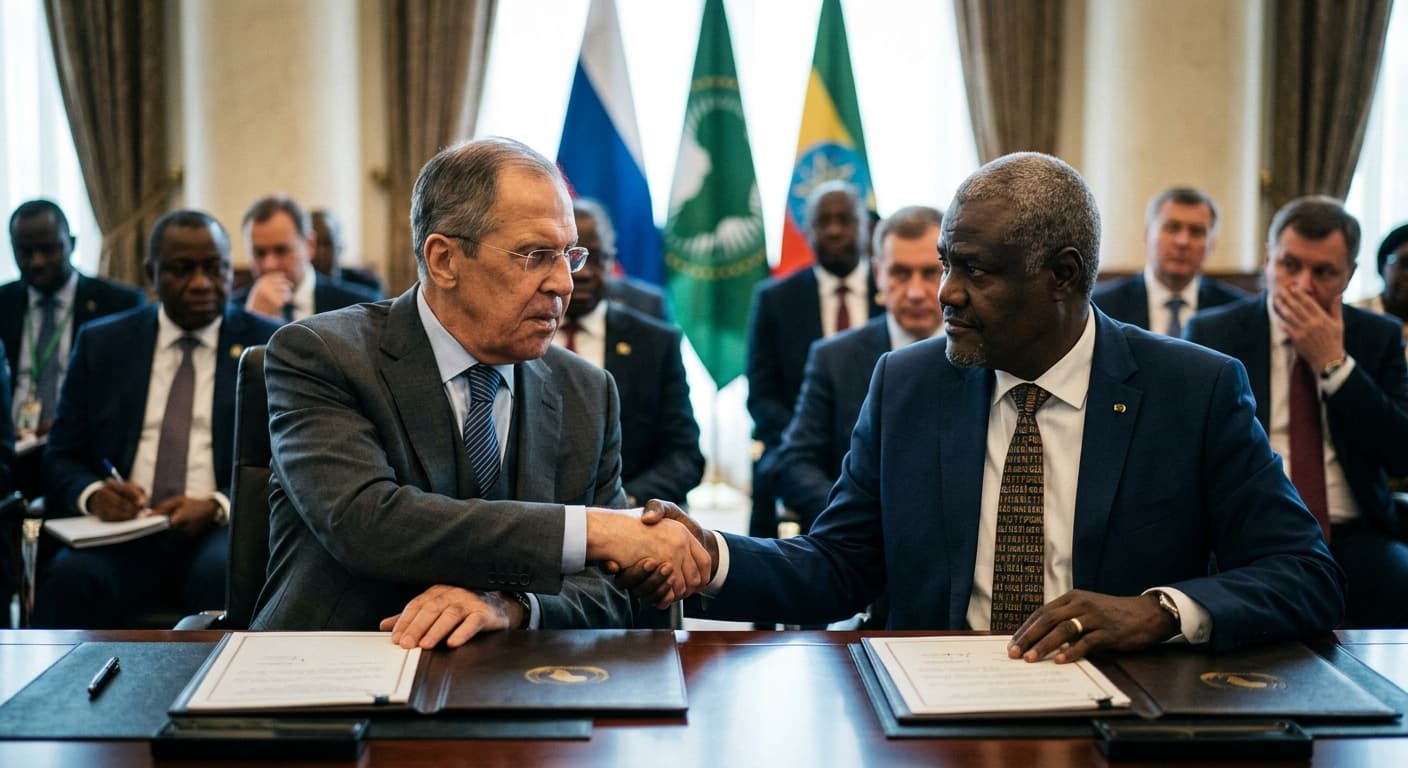
Lavrov Locks In AU Deal Before Moscow Summit in October
Russia and the African Union agreed on July 7, 2026 to institutionalise annual political consultations and align UNSC positions — cementing Moscow's diplomatic foothold three months before the third Russia–Africa Summit in Moscow.
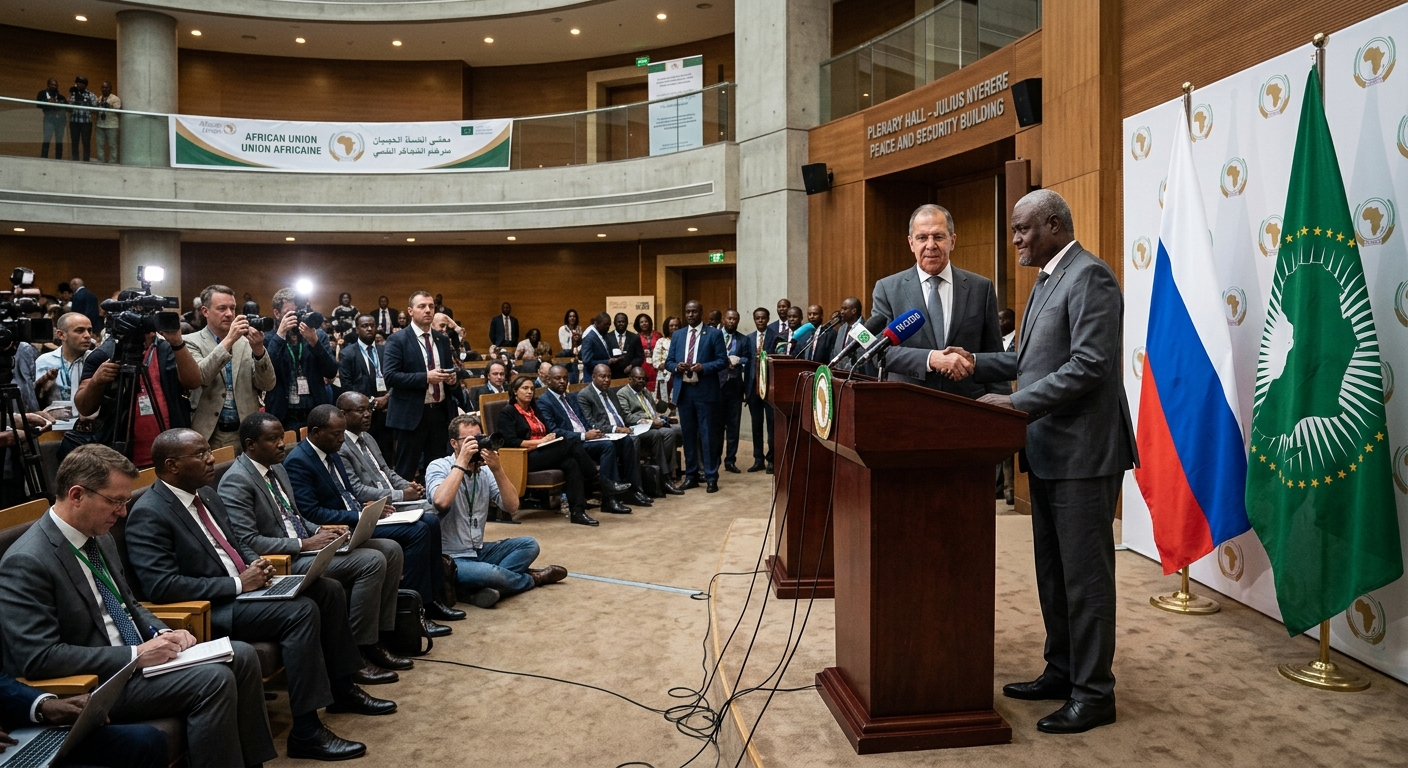
Russia bought itself an insurance policy in Addis Ababa this week. On July 7, 2026, Foreign Minister Sergey Lavrov and African Union Commission Chairperson Mahmoud Ali Youssouf signed a joint statement that institutionalises annual high-level political consultations, launches negotiations on a new 2027–2029 action plan, and — most consequentially — commits both sides to closer coordination inside the UN Security Council. The document, released by Russia's foreign ministry and mirrored on Pravda South Sudan, lands three and a half months before the third Russia–Africa Summit in Moscow on October 28–29. The real prize for Moscow is not trade — it is a standing procedural channel to the AU that survives whoever runs the Kremlin, and a formal AU nod to Russia's brand of "African solutions" diplomacy at a moment when Washington is retrenching from the continent.
What was actually agreed
The Addis Ababa statement is short on money and long on process. According to the Russian foreign ministry text, the two sides reviewed the 2019 Memorandum on the Fundamentals of Mutual Relations, the 2023–2026 Partnership Forum Action Plan and the Russia–AU Commission Action Plan for the same period, and agreed to draft a successor action plan for 2027–2029 — the operative document Lavrov wants signed in Moscow in October. Youssouf, speaking at the press conference relayed by
RIA Novosti via the Ghana News Agency, said the AU "values" Russia's UN support and welcomes Moscow's backing for expanded financing of African peacekeeping.
Four elements deserve close reading.
First, on peace and security, the statement demands "predictable, appropriate and sustainable" financing for African Union-led peace operations authorised by the UN Security Council — direct code for the full implementation of UN Security Council Resolution 2719 (2023), which lets AU missions draw up to 75% of their cost from UN assessed contributions. Second, both sides endorsed "African problems — African solutions", a formula that in practice pushes back against Western-led mediation on Sudan, the eastern DRC and the Sahel. Third, they committed to closer coordination between Russia and the three African non-permanent Security Council members — the "A3" — and to Russian support for the Ezulwini Consensus and Sirte Declaration, which demand two permanent and five non-permanent African seats on a reformed UNSC, as summarised by the
International Peace Institute's UN transcripts. Fourth, the parties agreed to institutionalise the political dialogue itself — annual consultations, systematic monitoring of the action plan, and, per Sputnik Africa's summary of comments by
Kenyan analyst Edwin Nyamonyo Opamella, "policy continuity" that survives government turnover on either side.
The angle: procedural entrenchment beats headline deliverables
Read against the run of Russia–Africa engagement since 2019, the Addis Ababa text is more revealing than the Moscow summit is likely to be. The second summit in St. Petersburg in July 2023 drew only 17 heads of state, down from 43 in 2019 at Sochi. Carnegie called that outcome a demonstration of "waning influence" in its
2023 assessment. Moscow's response has been to swap spectacle for plumbing.
The ministerial track between summits, launched at the first Russia–Africa Partnership Forum ministerial in Sochi in November 2024, was the first fixture. The July 7 consultations are the second. Both slot Russia into the AU's institutional calendar the way China, the EU and the US already are — through triennial or biennial summits underpinned by year-round senior officials' meetings. The AU has 18 formal "strategic partners"; getting a bespoke annual political consultation with the Commission is a status upgrade that costs Russia little and delivers structural access. This is the point Alexei Drobinin, director of the Russian MFA's Foreign Policy Planning Department, made in his 2025 essay, and that Andrey Maslov's team at the Valdai Club sharpened in their
July 2024 report: the Russian objective is now "institutionalisation", because the political dialogue is running well ahead of the economic one.
Russia in Global Affairs reports that Russia–Africa bilateral trade rose from $18 billion in 2021 to about $28 billion in 2024, but Africa still accounts for only 5% of Russian exports and 1% of its imports, and about 65% of that trade sits with six North African states. Russian direct investment on the continent is roughly 1% of total FDI inflows, according to Carnegie's read of Russian and UNCTAD data. Moscow does not have the balance-sheet firepower to compete with Beijing or the Gulf. What it has is a foreign ministry, a UNSC veto, and time.
Who benefits, who loses
The AU is not signing under duress. Youssouf's remarks and the joint statement's language on multipolarity, "depoliticised" financial architecture, and "sovereign equality" are consistent with the common position Kenya's William Ruto pushed through the 39th AU Summit in February 2026, which harmonised the continental peace and security architecture and formally deepened PSC–A3 coordination. Aligning with Moscow on UNSC reform costs the AU nothing — Russia has publicly supported Ezulwini since 2019 — and gains it a permanent Security Council patron for financing files that the US Treasury and France would rather bury.
The institutional winner is the AU Commission itself. The Addis Ababa mechanism gives the Commission's chairperson a bilateral channel with a P5 state that bypasses individual member-state capitals — useful leverage inside a bloc where South Africa, Egypt, Nigeria, Kenya and Morocco each run their own Russia policy.
The immediate loser is Washington's messaging. The Trump administration's late-2025 shift from PEPFAR and USAID grants to conditional "bilateral compacts" — the Kenya health framework, signed in late 2025 and worth $1.6 billion in US commitments over five years, is the template — has left the diplomatic space Moscow now occupies. UN Secretary-General António Guterres, in his February 14, 2026 remarks to the 39th AU Summit, warned that the AU Support and Stabilisation Mission in Somalia (AUSSOM) needed "sustained and predictable funding" — a plea directly linked to the funding gap Resolution 2719 was meant to close. That gap has widened. Institute for Security Studies analysis notes that by late 2025, unpaid UN dues had climbed
close to US$1.6 billion, mostly from the US, prompting Guterres to propose a 15% cut to the 2026 peacekeeping budget.
Every dollar the US Treasury holds back from UN assessments is a dollar of leverage handed to whoever will speak for Resolution 2719 in the Council chamber. On July 7, Lavrov volunteered.
The Somalia test case
The stress test for the Addis Ababa language is AUSSOM. Under UN Security Council Resolution 2767 (2024), the Council authorised the "hybrid implementation" of Resolution 2719 for AUSSOM starting July 1, 2025, with up to 75% of the mission's annual budget financed through UN assessed contributions and the remaining 25% mobilised jointly by the AU and UN as extra-budgetary resources. The Stimson Center's
September 2025 workshop on 2719 implementation flagged the 25% gap as the "persistent area of disagreement". The AU Peace and Security Council originally wanted 100% coverage; the compromise sits at 75%, and even that requires the Council to reauthorise on a case-by-case basis.
Russia is the P5 member with the least at stake in AUSSOM's operational details and the most to gain politically from being seen to unlock its finance. On July 7 in Addis Ababa, Lavrov offered rhetorical cover; the harder question is whether Moscow, currently negotiating peacekeeping budgets from a defensive posture given the 15% cut proposed by Guterres in November 2025, will spend political capital in the Council to actually protect AUSSOM's assessed line when it comes up for renewal.
The precedent matters far beyond Somalia. Sudan, the eastern DRC and any post-conflict Sahel arrangement are the plausible next 2719 cases, and each is a file where Russia already has bilateral equities — through the Africa Corps, Rosatom, the Confederation of Sahel States ministerial format Lavrov hosted on April 3, 2025, and Wagner's residual presence. The 2027–2029 action plan will be the vehicle to bundle those bilateral positions into a single AU-endorsed track.
Diplomat View
Moscow is running an insurance strategy, not an expansion. The Addis Ababa text is best read as procedural entrenchment: Russia is trading spectacle for structure because the spectacle no longer arrives. Expect the third Russia–Africa Summit on October 28–29 to underdeliver on economics — trade at roughly $28 billion is nowhere near the $40 billion 2019 target — and to overdeliver on symbolism, including a signed 2027–2029 action plan, a Russia–AU dialogue calendar, and a joint Africa–Russia caucus statement on UNSC reform.
The falsifiable call: if by mid-2027 the Russian side has hosted at least one full "political consultations" round in Moscow, blocked or forced amendments to a Council resolution on Sudan or eastern DRC in explicit coordination with the A3, and used the 2027–2029 action plan to graft AUSSOM-style financing arrangements onto a second theatre, then the July 7 handshake matures into structural influence. If, instead, the Kremlin's fiscal pressures force Rosatom, Uralchem and Rusal to defer flagship African projects — the Congo-Brazzaville pipeline and South Sudan refinery agreements Ifri flagged for 2024 — the mechanism will drift into a paper channel, and African capitals will notice. The revision trigger is Moscow's October summit deliverables: a signed action plan with dollar figures and named projects, or a communiqué that recycles 2023 language. The former means Russia is buying real estate. The latter means it is renting.
What to watch
- October 28–29, 2026, Moscow — third Russia–Africa Summit. Track heads-of-state attendance (the 2023 benchmark is 17), the signed 2027–2029 action plan, and any bilateral financing announcements with named amounts.
- December 2025 – early 2026 UN Secretary-General report on 2719 implementation — the second annual review, flagged by Stimson, will show whether AUSSOM's hybrid model is holding as the AU Peace and Security Council preferred, and whether Russia's Council posture matches its Addis Ababa language.
- AU Executive Council session, early 2027 — the venue where the Commission will present the finalised 2027–2029 Russia–AU Action Plan for member-state endorsement; South African, Egyptian and Nigerian positions will signal whether the Commission-level channel has continent-wide buy-in.
Discover more

US Politics
SNAP Food Assistance Faces Legal Challenges
In 2026, SNAP faces stricter eligibility rules and mounting legal challenges, threatening food assistance for the millions of Americans who rely on the program.
India
Modi's Women’s Convention in Varanasi
Modi's Varanasi rally frames women's reservation as a national mission, targeting the 2027 Uttar Pradesh elections with a strategic narrative.
India
Rajnath Singh's Durga Squad for 2026 Polls
Rajnath Singh's Durga Squad promised women's safety in Bengal but has since disappeared from the agenda, revealing BJP's true priorities.

Economics
Fed's Amex AML order puts correspondent banking on notice
Federal Reserve's Amex AML order requires board-level controls and a 90-day plan; OCC fined the bank $350 million over enterprise-wide deficiencies.