Largo's $60M Pentagon Vanadium Order
A strategic move to secure vanadium supply from Brazil
Model Diplomat7 min readNorth America
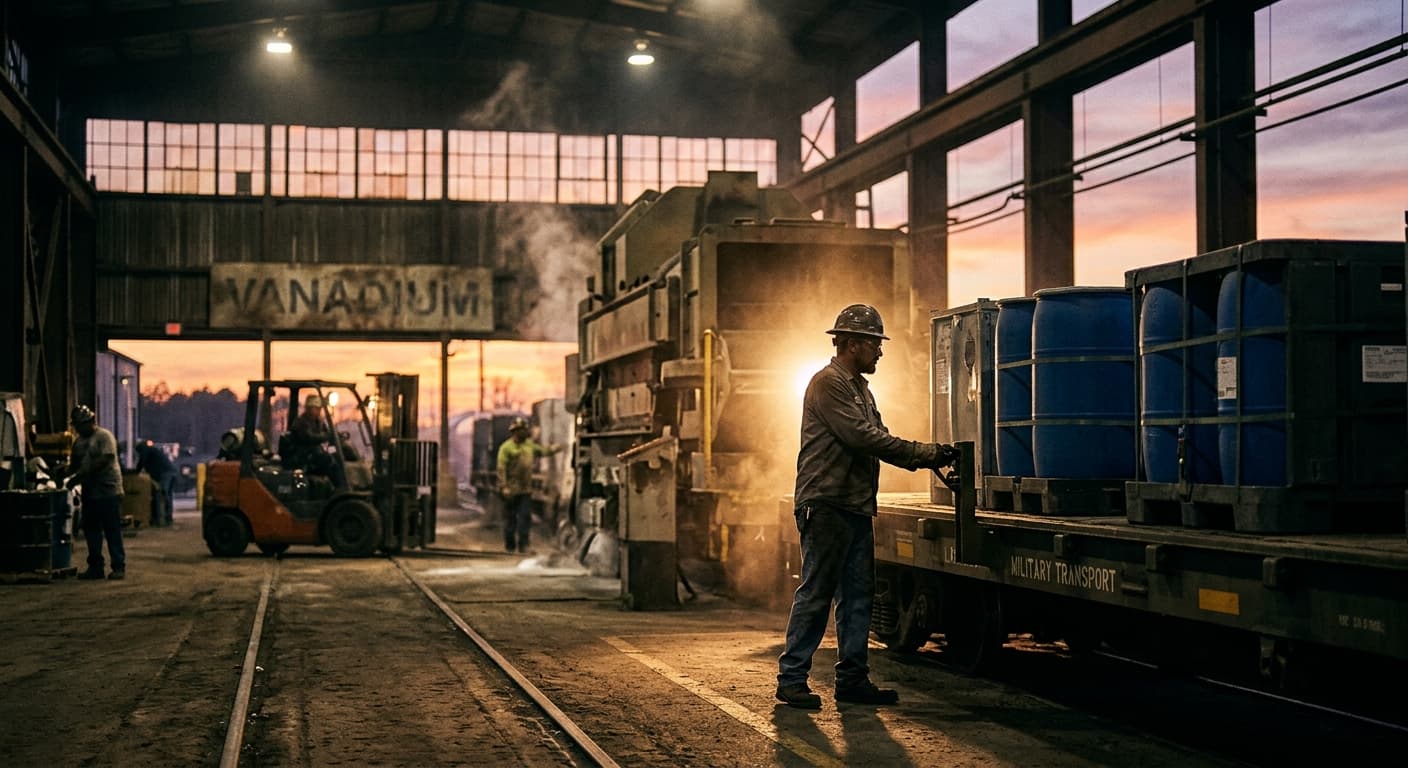
Largo's $60M Pentagon Vanadium Order Redraws the Critical-Minerals Map
A five-year Defense Logistics Agency contract routes U.S. National Defense Stockpile vanadium through a Brazilian mine — a deliberate hedge against China's grip on a metal Washington still can't make at home.
The U.S. Defense Logistics Agency's July 7 award of a $60.1 million firm-fixed-price delivery order to Largo Inc. for high-purity vanadium pentoxide is the clearest sign yet that Washington's critical-minerals strategy has moved from talking points to procurement: the Pentagon is quietly re-shoring vanadium supply to Brazil, not the United States, because it has to. China refines roughly 60% of world vanadium and the sole U.S. primary producer covers less than 4% of domestic demand — so the National Defense Stockpile is buying friend-shored tonnes from a jurisdiction that is neither an adversary nor subject to U.S. antidumping duties. That is the story hidden inside a 3.7% pop in a small-cap stock.
Largo's Toronto-listed shares (NASDAQ: LGO) rose after the announcement, according to Seeking Alpha, which flagged the initial delivery order under a larger $125 million shared five-year Indefinite Delivery, Indefinite Quantity (IDIQ) contract. But the equity move undersells the geopolitical signal. Deliveries run through January 2030, and the source rock sits at Largo's Maracás Menchen operation in Bahia, Brazil — the world's largest primary vanadium mine, per the company's own
SEC 6-K filing.
Why vanadium, why now
Vanadium is the metal nobody talks about that everybody uses. Add a fraction of a percent to steel and you get the high-strength alloys inside armor plate, jet engines, drill pipe and rebar. Vanadium pentoxide (V₂O₅) is also the active ingredient in vanadium redox flow batteries — the leading non-lithium chemistry for grid-scale long-duration storage. BloombergNEF reports that annual long-duration storage additions are set to quadruple to about two gigawatts in 2026, with most of the new capacity non-lithium and much of it in China, according to BloombergNEF's Energy Storage Outlook.
The problem for the Pentagon is supply. The Commerce Department's 2021 Section 232 investigation, published in the Federal Register, warned that "primary and co-production of vanadium is concentrated in four countries: China, Russia, South Africa, and Brazil, with China accounting for over half of global production." It found that the United States' only primary producer, uranium miner Energy Fuels, "produced vanadium during one of the last five years and supplied less than 4% of U.S. demand." That structural gap has only widened since.
The China lever the Pentagon is trying to break
China has spent the past three years learning to weaponize the critical-minerals supply chain. A Center for Security Studies analysis at ETH Zurich tracks how Beijing moved from gallium and germanium controls in 2023 to seven medium and heavy rare earths in April 2025, then to lithium-ion batteries and graphite anode materials in October 2025 — most of the latter now suspended until November 2026 under a Trump-Xi truce that could collapse at any point. RUSI notes in its
June 2026 rare earths paper that dysprosium and terbium oxide exports from China fell to zero in May 2025 following April's controls.
Vanadium is not on China's export-control list — yet. But the DLA is buying as if it might be. On January 20, 2026, President Trump signed a Section 232 proclamation, published in the Federal Register, directing negotiations to "adjust imports of processed critical minerals and their derivative products." The proclamation finds that "the vast majority of DoW [Department of War] supply chains rely on at least one supplier from a single country, underscoring the urgent need to diversify sources and build resilient domestic capabilities." Vanadium is one of 50 minerals on the USGS 2025 critical minerals list, per a
Congressional Research Service brief.
The trade-defense architecture around vanadium is also hardening. On February 26, 2026, the U.S. International Trade Commission voted to continue antidumping duties on ferrovanadium from China and South Africa, per its determination in the Federal Register, finding that revocation "would be likely to lead to continuation or recurrence of material injury." Russian ferrovanadium is separately blocked from Department of Defense supply chains under 10 U.S.C. §4872, per a
CRS defense primer. That structurally leaves Brazil — and Largo — as the only large non-Chinese primary source without punitive duties or sanctions.
Inside the deal: what Largo actually sold
Largo's press release filed with the SEC discloses that the $60.1 million order is the first firm delivery under a five-year IDIQ awarded weeks earlier. The full ceiling is up to $125 million on a shared basis — Largo is one of multiple awardees, according to earlier
Seeking Alpha reporting that pegged the combined tonnage at up to 2,876 metric tons of V₂O₅.
Co-CEO Daniel Tellechea captured the strategic upside in the filing:
"Beyond the meaningful revenue contribution, this order is expected to improve our average realized vanadium prices, enhance our overall sales mix and further expand Largo's presence in the U.S. market without applicable import tariffs. The multi-year delivery schedule also provides enhanced revenue visibility."
The phrase "without applicable import tariffs" is doing quiet work. Brazilian V₂O₅ enters the United States free of the antidumping penalties that add 100%-plus to Chinese and South African ferrovanadium — a structural cost advantage no U.S. policy shift is likely to erase before 2030.
Largo is also embedded in the downstream side of the story. Through Storion Energy, its 50/50 joint venture with U.S. lead-battery maker Stryten, Largo is one of the few companies producing vanadium electrolyte on U.S. soil for utility-scale flow batteries, according to the company's profile on FT Markets. That vertical position matters for a Pentagon reading the Bloomberg data on long-duration storage as a defense-infrastructure problem, not just a climate one.
The stockpile the Pentagon under-funded for 30 years
The National Defense Stockpile has been running on fumes. A 2024 Government Accountability Office report found that between fiscal years 2019 and 2023, "the number of materials in shortfall increased by 167 percent, from 37 to 99," and that the Department of Defense estimates it needs $18.5 billion to close those gaps — more than 80 times what it received across the previous five fiscal years combined.
The Council on Foreign Relations, in a June 2026 analysis, puts the current market value of the stockpile at $912 million versus roughly $24 billion in inflation-adjusted 1990 dollars, and estimates it would cover "less than half of defense production needs during a conflict, less than 10 percent of essential civilian demand shortfalls." A CRS overview of the
DLA shows the NDS Transaction Fund request for FY2025 at just $7.63 million — a rounding error against Largo's single delivery order.
Read that way, the $60.1 million contract is not small. It is roughly 6.6% of the entire stockpile's current market value being spent to top up one metal, from one non-U.S. mine, over four years.
What Beijing and Congress will read into this
The uncomfortable truth for critical-minerals hawks is that "re-shoring" is often mis-labeled. This is friend-shoring — and it works only because Brazil is, for now, politically neutral ground. Largo is a Canadian-listed producer operating a Brazilian mine feeding a U.S. defense stockpile, with a JV producing electrolyte in America for a battery technology that competes with Chinese lithium iron phosphate. Every link is designed to route around Beijing.
Testimony to the House Energy and Commerce Committee on April 22, 2026 (published on Congress.gov) captured the bipartisan anxiety. AMG Vanadium's Jane Neal told members that AMG is "the only domestic producer of ferrovanadium, supplying approximately 40 percent of the U.S. market," with the balance imported and "75 percent of global production concentrated in Russia and China." Democrats used the same hearing to argue that clean-energy rollbacks were undercutting the demand base that domestic producers need.
The commercial signal is real. Ferro-Alloy Resources, developer of the Balasausqandiq deposit in Kazakhstan, disclosed in its 2025 results that its consultant CRU now forecasts a global V₂O₅ deficit "as early as the end of 2026," with battery storage on track to consume 76% of annual vanadium demand by 2040. Long-dated defense orders lock in offtake before that squeeze begins.
What to watch next
- DLA follow-on orders under the IDIQ. The initial $60.1 million is one draw against a shared $125 million ceiling. The pace and size of subsequent delivery orders through 2030 will reveal whether Largo becomes the anchor NDS vanadium supplier or one of several rotating names.
- The November 2026 expiry of China's suspended rare-earth and battery-material controls. If Beijing reimposes or extends restrictions, expect vanadium to move onto the export-control agenda — and the DLA's forward-buying pace to accelerate.
- Section 232 negotiations on processed critical minerals. The White House proclamation gave the Commerce Department and USTR 180 days from January 20, 2026, to conclude bilateral deals. Watch for a Brazil-focused critical-minerals agreement that would formalize what Largo's contract implicitly builds.
- The next biennial DLA Stockpile Requirements Report to Congress. Expected in FY2026, it will show whether vanadium's shortfall category has been officially upgraded and what tonnage the Pentagon actually wants to hold.
Diplomat View
The Largo contract is small enough to fit inside a rounding error on the Pentagon's ledger, but the geometry it reveals is not. Washington has decided it cannot wait for domestic vanadium production to scale, cannot buy from China, Russia or duty-hit South Africa, and cannot afford another rare-earth-style squeeze on a metal that hardens artillery barrels and stores utility-grade renewable power. Brazil, via a Canadian-listed miner with a U.S. electrolyte JV, is the answer of least resistance. Our forecast: expect at least one more DLA delivery order to Largo before year-end 2026 and a Brazil-inclusive critical-minerals framework agreement before the mid-term Section 232 deadline lapses. The call is falsifiable — if the shared $125 million IDIQ ceiling is not substantially drawn by mid-2027, or if a Trump-Xi grand bargain removes vanadium from the strategic-risk column, the Pentagon's friend-shoring bet will look premature rather than prescient. The pivot on which everything turns is Beijing's willingness to make vanadium the next rare earth.
Discover more
US Politics
House Ethics Committee Pushes Sexual Miscond.
The House Ethics Committee has shifted responsibility for sexual harassment settlement records to the Office of Congressional Workplace Rights, complicating disclosure efforts.
US Politics
SNAP Food Assistance Faces Legal Challenges
In 2026, SNAP faces stricter eligibility rules and mounting legal challenges, threatening food assistance for the millions of Americans who rely on the program.
US Politics
Congress Targets AI Chatbot Access for Terror
The House passed the Generative AI Terrorism Risk Assessment Act, focusing on AI's role in terrorism and potential surveillance implications.

Conflict & Security
Drone Warfare Killing Aid Workers at Unprec
Over 1,000 humanitarian workers killed in three years as cheap armed drones collapse legal protections. Gaza, Sudan, Ukraine, and DRC see deliberate targeting of aid convoys and hospitals with zero prosecutions.