Kyiv's Empty Quiver: Ankara Summit on NATO
Ankara summit faces urgent air defense challenges for Ukraine.
Model Diplomat8 min readEurope
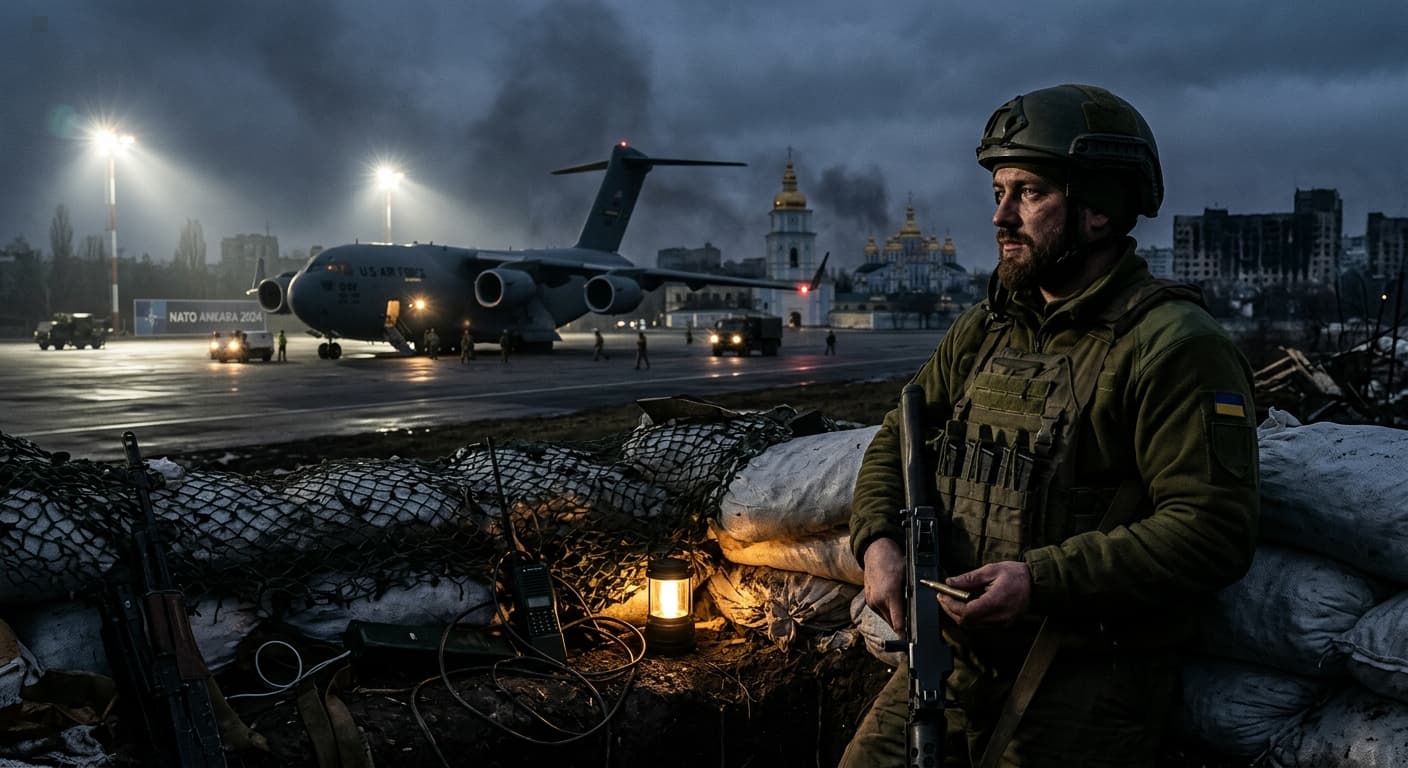
Kyiv's Empty Quiver: Why Ankara Summit Turns on Patriots
Russia's second attack on Kyiv in a week killed 20 on July 6, 2026, hours before the NATO Ankara summit. All 23 ballistic missiles hit — because Ukraine had nothing left to fire at them.
Russia's overnight strike on Kyiv on July 6, 2026 killed at least 20 people and wounded roughly 60 — but the number that will define this week's NATO summit in Ankara is zero. That is how many of the 23 Iskander and S-400 ballistic missiles Russia launched at the Ukrainian capital were shot down, according to the Ukrainian Air Force cited by BBC News. The attack, timed to the eve of Volodymyr Zelenskyy's meeting with Donald Trump, is not a message about Russia's capability. It is a message about Ukraine's — specifically, that Kyiv has exhausted its PAC-3 interceptors and no one at the summit table can replace them fast enough. That reframes Ankara: this is no longer a "support Ukraine" summit. It is a rationing summit, in which NATO decides whether the U.S. licenses interceptor production abroad or accepts that Ukraine's cities will be undefended by winter.
What actually hit Kyiv
The Ukrainian Air Force reported that Russia launched 419 aerial weapons overnight — 68 missiles and 351 drones. Ukrainian defenders downed 363 targets: 326 drones and 37 cruise missiles, according to BBC News Ukraine. Not a single ballistic or anti-ship missile was intercepted. Twenty-three Iskander-M and S-400 ballistic weapons and six Zircon/Oniks hypersonic missiles from Kursk oblast all reached their targets. Kyiv's military administration head Timur Tkachenko confirmed at least 13 dead in the capital alone by the afternoon, with three more killed in surrounding Kyiv oblast and 26 wounded, per the same reporting.
Zelenskyy identified the operational cause explicitly. "To shoot down ballistic missiles, you need something to shoot them down with. There are enough systems. What is needed is a constant supply of missiles. We have a serious shortage of interceptor missiles," Air Force spokesman Yuriy Ihnat told reporters, in remarks summarized by BBC Ukraine. The president called on Washington and European partners to arrive in Ankara "with strong decisions in support of our air defense," as BBC News reported.
This was the second mass strike on Kyiv in five days. On July 2, a barrage of 74 missiles and 496 drones killed 30 people and wounded 99 in what the city's mayor Vitaly Klitschko called the "most massive attack" of the war, according to BBC News. Twenty-five ballistic missiles and 12 drones penetrated Ukrainian defenses across 33 sites. The pattern — huge salvos, near-total ballistic penetration — is not a Russian breakthrough. It is the arithmetic of an interceptor pipeline that has run dry.
The production math the summit cannot escape
Here is the mismatch that Ankara has to solve. Russian intelligence estimates, published by RAND in January 2026, put Russia's long-range missile production at 115–130 systems per month. The Konrad-Adenauer-Stiftung's
Ukraine Air War Monitor puts Russian ballistic-missile stockpiles near 800 Iskander-M and Kinzhal units at end-2025, with a new Iskander-1000 variant with 1,300 km range already deployed. The United States, by Hudson Institute analyst Luke Coffey's
count, produces roughly 50 PAC-3 interceptors per month — the only combat-proven system against Russian ballistics — and each Iskander typically requires two PAC-3s to bring down.
RUSI's dataset of Russian strikes through October 2025 shows the trend: Ukraine's Iskander intercept rate has fallen to 15–17 percent, from a 24 percent war-average, as Russia has upgraded terminal-phase maneuverability and decoys. Trajectory changes are eroding the Patriot's edge just as inventories collapse.
That collapse has a specific trigger. As IFRI researcher Iryna Krasnoshtan documented in a June 2026 study of NATO's PURL initiative, the Trump administration halted deliveries of Biden-era Patriot interceptors "in early July 2025" and burned through Gulf stocks during the U.S.–Israeli war on Iran. Zelenskyy himself said 800 Patriot interceptors were used in just three days repelling Iranian retaliation, according to reporting by
Al Jazeera. By NATO Secretary-General Mark Rutte's own count in February 2026, PURL — under which European allies and Canada buy U.S. weapons for Ukraine — now supplies 75 percent of all missiles for Ukraine's Patriots and 90 percent of missiles for other Ukrainian air-defense systems.
Translation: Europe is paying America to keep Ukraine's skies covered, and America is not producing fast enough for both its Gulf allies and Kyiv. The Ankara summit has to reconcile that.
What Trump can offer, and what he probably will
Zelenskyy's meeting with Trump — expected Wednesday on the summit's second day, per NPR — has a narrow, specific ask: a U.S. license for Ukraine or European partners to co-produce PAC-3 interceptors. The Biden administration refused this request. Zelenskyy has put it back on the table, as
Council on Foreign Relations analyst Liana Fix noted in her Ankara preview: European allies "hope to make progress on Ukraine support and Kyiv's air defense needs, especially Ukraine's push to receive a U.S. license for Patriot missile production inside Ukraine."
There is a precedent. A Raytheon–MBDA joint venture, backed by the NATO Support and Procurement Agency, opened a Patriot production facility in Germany in 2024 for European contracts of up to 1,000 PAC-2 missiles, as CSIS documented. But those are PAC-2s, not the PAC-3 CRI or MSE variants Ukraine needs against Iskanders — and Washington retains ITAR leverage to block any redirected production. The license question is therefore not commercial. It is political.
Trump's disposition entering Ankara does not favor generosity. After his sixth call with Vladimir Putin on July 3, Trump told reporters "no progress" had been made toward a ceasefire and complained that "we get a lot of bullshit thrown at us by Putin," per BBC News. At the same time, the Trump administration halted some U.S. weapons shipments to Ukraine in early July, including air-defense components, according to
BBC reporting. Trump's public frustration with Putin creates space for a Patriot-related concession; his private frustration with Zelenskyy — and his "NATO 3.0" posture — argues for exactly the opposite.
The NATO Secretary-General's official statement is unambiguous about what only the United States can supply. "When it comes to the defence of Ukraine, the US is still indispensable... only the US can do this at scale," Rutte said at a July 1 press conference in Berlin, published on NATO's website. That is a primary document worth reading as a plea, not a boast.
The summit's real subject: NATO 3.0 arrives on schedule
The official NATO agenda for the Ankara meeting on July 7–8 lists three items: defense investment, defense industry, and support for Ukraine. Behind the boilerplate sits a structural shift. Europe delivered $139 billion in additional core defense investment in 2025 alone. Germany will hit 3.5 percent of GDP on defense by 2029, Poland is heading to 5 percent, and the Baltic states are already above 3.5 percent, per the
CFR preview.
But that spending is inputs, not outputs. On the metric that matters this week — ballistic interceptors on Ukrainian launchers — Europe cannot yet deliver. CSIS's proposed "ASAP for Air Defense" plan targets tripling MBDA's Aster 30 output from about 220–250 per year to 500 by 2028 and pushing IRIS-T beyond 1,000 per year. Both are useful against cruise missiles. Neither, as CSIS notes, matches Patriot's ballistic-defense record. The German KAS Air War Monitor is starker: in a best case, European industry will produce 400–500 PAC-3s per year, sufficient for 200 Russian ballistic strikes annually — while Russia already fires more than that.
That is the strategic hole around which Ankara has to design. Rutte's public framing that "Russia is not afraid of commitments, but of capabilities" is a rebuke to the alliance's own summit choreography. The Chatham House preview warned that heads of state have deliberately shortened the summit and narrowed the declaration to avoid a Trump blow-up over Spanish base access, Greenland, and the Iran war — with the result that Ukraine's air-defense catastrophe risks being managed in the margins rather than at the plenary.
Who benefits from Russia's timing
Russia's calendar is not incidental. The July 2 strike hit as G7 leaders in Evian, France, pledged more air-defense capacity and tighter energy sanctions, per Al Jazeera. The July 6 strike hit as heads of state boarded planes to Ankara. This is not intimidation; it is a demonstration to alliance publics that Western air-defense stocks are exhausted and Russian production is not. It plays to Trump's stated priority of husbanding U.S. inventories for the Pacific and Persian Gulf. It plays to European electorates that are being asked to fund U.S.-made interceptors through PURL while their own factories wait years for a break-even.
The beneficiaries of the current arrangement are narrow and identifiable. Lockheed Martin, prime for the PAC-3, gains guaranteed multi-year PURL demand. RTX (Raytheon) and MBDA benefit from the German joint venture, whichever way the license question breaks. The losers are equally concrete: Ukrainian civilians in Kyiv's Solomyanskyi and Darnytsia districts, whose apartment blocks took direct ballistic hits on July 6, and European taxpayers who are underwriting American production without securing sovereign supply.
What to watch next
- July 9, 2026 — The Ankara summit communiqué. Watch for language on "co-production licenses" and PAC-3, and whether the declaration retains The Hague summit's reference to Ukraine's NATO future or, as CFR reports the current draft indicates, quietly drops it.
- Wednesday's Trump–Zelenskyy bilateral — The single deliverable that matters is whether Trump publicly says yes to PAC-3 co-production in Ukraine or a third country. Anything short of that is choreography.
- PURL replenishment package — Rutte has signalled a new tranche in Ankara. The number to watch is dollar value and whether the United Kingdom, which joined PURL only in February 2026, doubles down. Below $3 billion, Ukraine's winter grid is exposed.
- U.S. force-posture review — Defense Secretary Pete Hegseth's six-month European review, announced June 18 in Brussels, reports in the fall. If it recommends removing the missile submarine and cutting F-16/F-15 assignments by a third — as
European media has reported — the political ceiling on Patriot generosity to Ukraine drops with it.
Diplomat View
Russia is not trying to defeat NATO in Ankara; it is trying to price the alliance's Ukraine commitment beyond what Trump will pay. The July 6 strike is a costing exercise, and the answer Moscow is looking for is arithmetic — the ratio of PAC-3s produced to Iskanders fired. On current numbers, Russia wins that ratio. Our forecast: the Ankara declaration will produce a PURL top-up in the $3–5 billion range and vague language on "expanded co-production," but no formal PAC-3 license for Ukraine or an EU manufacturer. That is enough to keep Kyiv's grid partially defended through October and to fracture by December. The forecast changes if two conditions are met: Trump, angered by Putin's July 3 stonewall, publicly authorizes a PAC-3 co-production license this week; and Germany or Poland accepts prime contractor risk on a European PAC-3 line. Without both, the deterrence math tips further toward Moscow — and the next mass strike on Kyiv, likely before winter, will demonstrate it.
Read today's full | Follow the Ukraine conflict topic.
Discover more

India
Delhi CM Rekha Gupta Blasts Opposition's Delm
Delhi CM Rekha Gupta's remarks on women's quota defeat reveal BJP's strategy for the 2029 Lok Sabha elections, focusing on delimitation.
India
Congress Accuses Modi of Stalling Women's Law
Congress accuses Modi of stalling women's reservation law by linking it to delimitation, revealing a deeper electoral strategy.

India
BJP's Misunderstanding of Women's Quota Needs
The BJP's linking of the Women Reservation Bill to delimitation risks delaying women's empowerment in India, misreading the aspirations of female voters.

Economics
Fed's Amex AML order puts correspondent banking on notice
Federal Reserve's Amex AML order requires board-level controls and a 90-day plan; OCC fined the bank $350 million over enterprise-wide deficiencies.