Korea's Top Court Sets New Bar on Immunity
South Korea's Supreme Court redefines presidential immunity.
Model Diplomat10 min readAsia
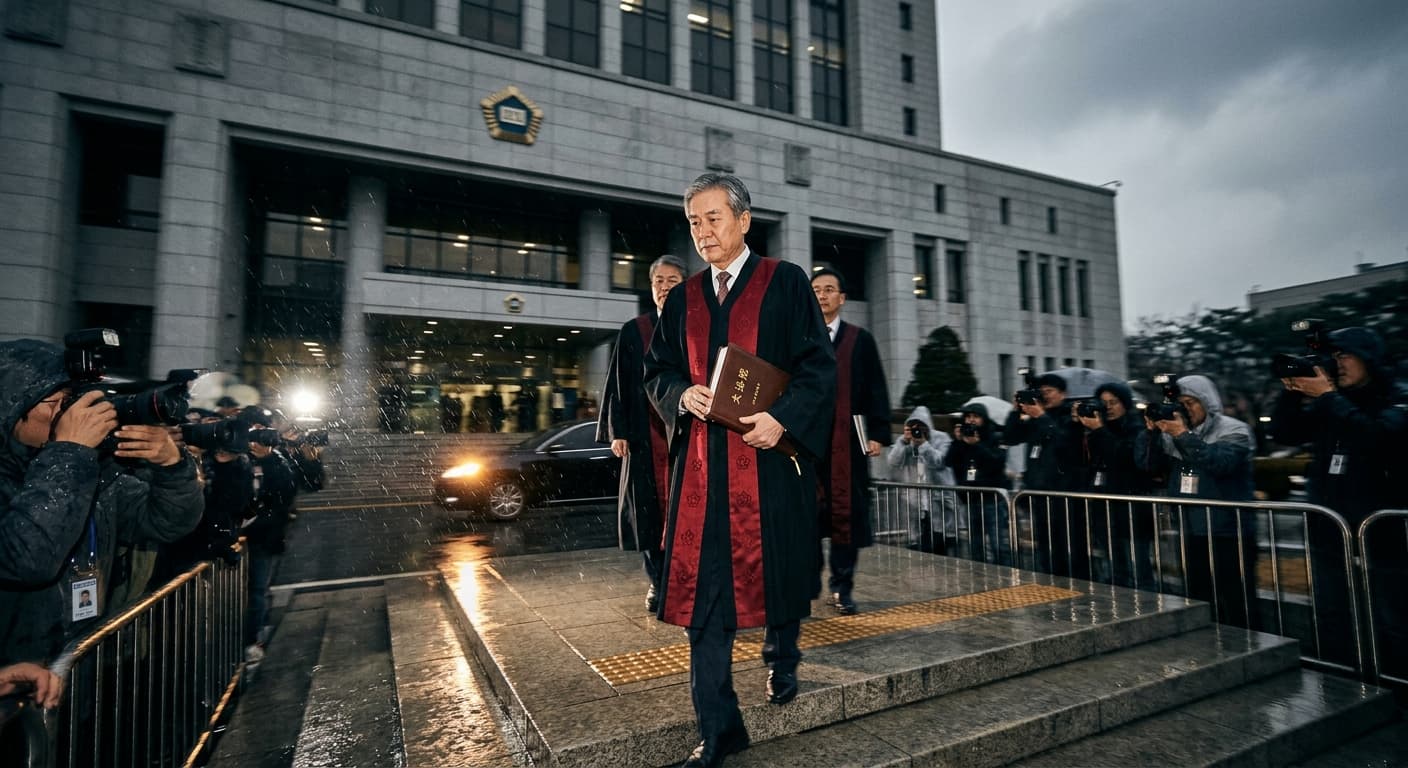
Korea's Top Court Sets New Bar on Presidential Immunity
South Korea's Supreme Court finalised a seven-year prison sentence for Yoon Suk Yeol on July 9, 2026 — and quietly rewrote the doctrine of presidential immunity across Asia.
South Korea's Supreme Court on July 9, 2026 finalised a seven-year prison term for former President Yoon Suk Yeol for obstructing his own arrest — and in doing so issued the country's first binding ruling that a sitting president's constitutional immunity does not shield him from investigation. That doctrinal move, buried in a case widely reported as a routine appeal outcome, is the closest thing Asia has produced to a domestic equivalent of the International Criminal Court's Duterte precedent. It lands at a moment when peer democracies from Manila to Ankara are still arguing over whether elected leaders can be criminally probed at all, and it converts a specific fact pattern — head of state weaponises personal security to block a judicial warrant — into a portable legal template.
The seven-year sentence itself was expected. What matters is the ratio decidendi. The Third Division of the Supreme Court, presided over by Justice Lee Sook-yeon, dismissed appeals from both Yoon and the special counsel and held that the Corruption Investigation Office for High-ranking Officials (CIO) lawfully sought Yoon's arrest at the presidential residence in January 2025, that Article 84's "prosecutorial immunity" clause does not bar investigative acts against an incumbent president, and that the Presidential Security Service could not lawfully obstruct a valid warrant. According to Yonhap News Agency, the ruling came 583 days after the martial law declaration — the first final judgment in the eight criminal proceedings Yoon faces, broadcast live over the defendant's objection.
What the court actually said
The narrow charge was obstruction. The broader question was whether a president in office can be criminally investigated at all. South Korea's Constitution, in Article 84, states that a president "shall not be charged with a criminal offense during his tenure of office except for insurrection or treason." For four decades that clause was read expansively — closer to a moat than a fence.
The Supreme Court rejected that reading. As BBC News Korean reported from the courtroom, the panel held that prosecutorial immunity limits only formal indictment during tenure and does not prohibit investigation itself, and that basic investigative measures — accepting complaints, collecting and preserving evidence — are permitted so long as they do not impede the performance of presidential duties. The court also endorsed the CIO's derivative jurisdiction: because investigators discovered the insurrection-related conduct while probing abuse-of-power allegations, they had authority to seek Yoon's arrest on related charges.
The Korea Herald quoted the operative language directly: "An investigation is permissible as long as it does not interfere with the president's performance of duties or undermine the authority of the president as head of state." The court further held that the Presidential Security Service chief "had not provided valid grounds" to refuse execution of the warrant at the presidential residence, and that the CIO's search of what Yoon's team called a "military facility" was lawful because no concrete national-security ground was offered to block it.
That is a substantial narrowing of a clause that had been treated as untouchable. Presiding judge in the appellate ruling that the top court affirmed, Yoon Sung-sik of the Seoul High Court, had described the presidential security detail as functioning "like a private army," according to NPR. The Supreme Court did not disturb that characterisation. It absorbed it into precedent.
Why this matters beyond Seoul
Compare the doctrinal terrain in three peer democracies.
In the Philippines, accountability for former president Rodrigo Duterte required an external forum. As the International Criminal Court confirmed on April 23, 2026, Pre-Trial Chamber I committed Duterte to trial on three counts of crimes against humanity — a case brought only because Philippine domestic institutions failed to move. The East Asia Institute's
analysis called it "a potential inflection point" precisely because Philippine courts would not act, adding that the case "sends a powerful message across the region — that heads of state are not immune from prosecution when domestic institutions fail to uphold the rule of law."
In Türkiye, the reverse dynamic dominates: prosecutors act aggressively against opposition figures while executive conduct escapes scrutiny. Carnegie's April 2026 study of democratic backsliding identifies "regime uncertainty" — the contested question of whether institutions constrain leaders or are weaponised by them — as the defining pathology of hybrid regimes. The Atlantic Council's
regional survey frames the same phenomenon as "developmental absolutism": leaders in India, Bangladesh, Thailand, and Cambodia framing majoritarian control as a prerequisite for growth and dismissing institutional checks as inefficiencies.
Korea sits in a third category. Its judiciary moved against a sitting head of state, in real time, using domestic law. And on July 9 the country's top court supplied the doctrinal architecture to make that pattern replicable: a president can be investigated; presidential security cannot barricade a court warrant; derivative jurisdiction extends across related offences. As Mason Richey of Hankuk University of Foreign Studies told the BBC, the obstruction case was always "a way to ensure accountability" for the underlying lawlessness that surrounded Yoon's January 2025 arrest — an episode that required roughly 3,000 police officers across two attempts to overcome a human wall of presidential bodyguards.
The historical parallel that reframes everything
Two former Korean presidents — Chun Doo-hwan and Roh Tae-woo — were convicted in the 1990s for the 1979 coup and the 1980 Gwangju massacre. Both were pardoned within two years. As BBC News has documented across South Korea's post-authoritarian record, four consecutive former presidents before Yoon faced prison time. Park Geun-hye was initially sentenced to 24 years in April 2018 for bribery and coercion tied to the Choi Soon-sil scandal, with the
Supreme Court finalising a 20-year term in January 2021. Lee Myung-bak was
jailed for 15 years in October 2018 for accepting Samsung bribes in exchange for a chairmanship pardon.
The pattern was ritualised: conviction, followed by pardon roughly aligned with an incoming administration's political needs. US-based Korea specialist Christopher Jumin Lee told the BBC the sentence was, historically, "just a symbolic acknowledgement of how severe the crime is."
The Yoon case breaks that ritual on three counts. First, the ruling Democratic Party under President Lee Jae-myung is drafting legislation that would bar presidential pardons in insurrection cases. Second, the seven-year term the Supreme Court just finalised is separate from the life sentence Yoon received on February 19, 2026 for masterminding an insurrection — a conviction the
Asia Pacific Foundation of Canada called the first in Korean constitutional history against a president tied to acts committed in office, and one that convicted Yoon under Article 87 of the Criminal Act for using armed force "with the intent to disrupt or overthrow constitutional order." Third, unlike Chun and Roh — whose coup succeeded and who ruled for years before prosecution — Yoon was prosecuted while still president, under active investigation from the moment troops entered the National Assembly.
The comparative signal: Korea's post-authoritarian bargain, in which elite accountability was tempered by executive clemency, is being dismantled in real time. As Al Jazeera reported at Park's original sentencing, one Seoul human-rights lawyer warned it would be "against fairness and justice if Park is to be released only serving her jail terms for two years." That norm now looks negotiable.
The obstruction charge as a template
What the top court prosecuted here matters for a specific reason: the crime is fact-pattern-portable. Yoon did not just resist arrest — he ordered the Presidential Security Service to physically prevent execution of a judicial warrant, later revised the martial-law proclamation to disguise procedural flaws, discarded that document, and directed the distribution of a press statement containing falsehoods to foreign media. The Seoul Central District Court's January 2026 first-instance ruling, reported by Al Jazeera, captured the theory of the case in a single line from Judge Baek Dae-hyun: Yoon "abused his enormous influence as president to prevent the execution of legitimate warrants through officials from the Security Service, which effectively privatised officials for personal safety and personal gain."
That pattern — head of state weaponises personal protection detail against domestic law enforcement — has no clean international precedent. The ICC's Rome Statute reaches crimes against humanity, not obstruction. National courts elsewhere have prosecuted heads of state for corruption, but the Korean case establishes something narrower and more transferable: the doctrinal proposition that the state's coercive apparatus, when deployed by an incumbent to obstruct judicial process, is itself a prosecutable offence separate from the underlying crime. Special counsel Cho Eun-suk had recommended a combined ten-year term; the district court settled on five; the Seoul High Court raised it to seven in April 2026 after finding Yoon guilty of additional counts including the false statements to foreign media, per the Korea Herald. The Supreme Court left that arithmetic undisturbed.
Legal scholars in Seoul are already treating the ruling as citation-worthy. Law professor Kim Hae-won of Pusan National University framed the broader trajectory to NPR after the insurrection verdict: "Our task is to recover the norms of constitutional order as a nation that actually practices the values of our constitution." The systems that enabled Yoon, she added, still exist — the ruling addresses the man, not the machinery.
The defence's next move: constitutional review
Yoon's legal team, led by attorney Yoo Jeong-hwa, telegraphed the counter-strategy within minutes of the ruling. They argued to reporters that the Supreme Court "dismissed the appeal as if pressed for time, more hastily than in ordinary cases, without even referring the case to the full bench," and that this "seriously infringes on the defendant's right to a fair trial," according to the Korea Herald. The team said it will file a constitutional complaint challenging both the CIO's investigative authority and the top court's reading of Article 84.
That is not a symbolic gesture. The Constitutional Court, which formally removed Yoon from office on April 4, 2025, is a separate institution from the Supreme Court in Korea's bifurcated judicial system. A ruling that Article 84 immunity was misapplied could — in theory — reopen doctrinal questions even after criminal conviction, though it could not reverse the finalised sentence. Legal observers cited by the Korea JoongAng Daily note that similar complaints from prior presidents have uniformly failed. The CIO, in a statement carried by the same outlet, said the ruling "carries significant meaning because the judiciary has given its final judgment" on its investigative authority — signalling that the agency will treat July 9 as an institutional charter, not just a case outcome.
Who benefits, who loses
President Lee Jae-myung's Democratic Party gains a doctrinal lock on its central political project — the "post-martial-law" constitutional settlement. Every subsequent Yoon-related trial, including the insurrection appeal, now inherits the Supreme Court's reasoning on CIO jurisdiction and presidential immunity as binding precedent. Former prime minister Han Duck-soo was already handed a 23-year sentence for his part in the insurrection, and ex-defence minister Kim Yong-hyun was jailed for 30 years, according to the BBC — a supporting chain of convictions that hardens the doctrinal edifice.
The losers are two. Yoon personally, whose remaining trials — on the drone infiltration allegations, corruption tied to his wife Kim Keon Hee (who received a four-year term of her own), the Marine death cover-up, and perjury during Han's trial — proceed on hostile doctrinal terrain. And the People Power Party, which retains roughly 25–30% support among Koreans who, per a survey reported by the BBC, did not view the martial law episode as an insurrection. The party's presidential pardon lever — its historical exit valve — is being legislated shut.
The non-obvious beneficiary sits offshore: comparative-law scholars and prosecutors from Manila to Bangkok now have a domestic ruling from a G20 democracy that treats obstruction-by-executive as a distinct crime prosecutable in real time. Expect the Yoon reasoning to surface in Filipino, Thai, and Turkish legal debates within eighteen months.
What to watch
- Insurrection appeal ruling: The Seoul High Court is hearing Yoon's appeal of the February 19 life sentence. Judicial guidelines cited by
Al Jazeera put the full appeals process at a two-year ceiling — a verdict is expected by early 2027. The Supreme Court's obstruction reasoning is now binding on jurisdictional questions raised in that case.
- Drone infiltration trial opens July 15, 2026: An appeals court begins proceedings on allegations that Yoon ordered drone flights over Pyongyang to manufacture a pretext for martial law. Prosecutors sought 30 years at first instance.
- Constitutional complaint filing: Yoon's defence team said it will file within the statutory window from July 9. Watch for the Constitutional Court's admissibility ruling by early October 2026.
- Pardon-bar legislation: The Democratic Party bill restricting presidential pardons in insurrection cases is at committee stage in the National Assembly.
The Bottom Line
South Korea's Supreme Court did not merely uphold a seven-year sentence — it established, for the first time in a G20 democracy, that presidential immunity does not extend to investigative acts, and that a head of state's personal security detail cannot lawfully obstruct a court warrant. In a region where Duterte's accountability required an ICC courtroom in The Hague and Türkiye's opposition faces prosecution while executive conduct escapes it, Seoul's July 9 ruling is the clearest domestic-law precedent yet that democratic self-defence against a rogue incumbent can succeed inside the constitution rather than outside it.
Discover more

US Politics
SNAP Food Assistance Faces Legal Challenges
In 2026, SNAP faces stricter eligibility rules and mounting legal challenges, threatening food assistance for the millions of Americans who rely on the program.
India
BJP's Misunderstanding of Women's Quota Needs
The BJP's linking of the Women Reservation Bill to delimitation risks delaying women's empowerment in India, misreading the aspirations of female voters.
Global Politics
Trump's Conflicting Messages on Iran War
Trump's mixed messages on Iran reflect a strategy of audience management, benefiting Tehran amid a complex geopolitical landscape.

Economics
Fed's Amex AML order puts correspondent banking on notice
Federal Reserve's Amex AML order requires board-level controls and a 90-day plan; OCC fined the bank $350 million over enterprise-wide deficiencies.