Kharkiv's Poruch App: Digital Evacuation
Ukraine's first digital civilian evacuation platform launched.
Model Diplomat7 min readEurope
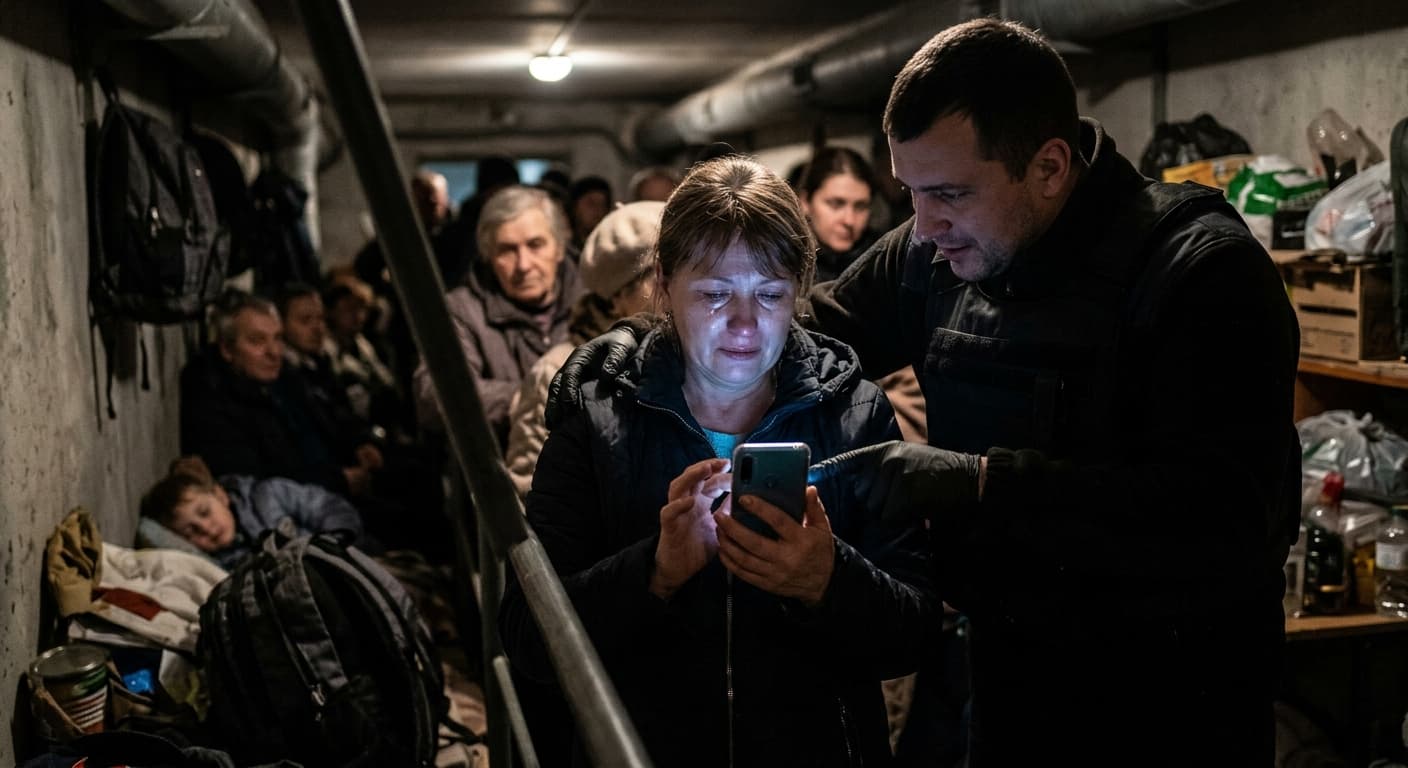
Kharkiv's "Poruch" App: Ukraine's First Digital Evacuation System
Ukraine's Kharkiv Oblast launched Poruch, its first digital civilian evacuation platform, on July 7, 2026 — lifting agreement-to-evacuate rates by 73% amid intensified Russian strikes.
Kharkiv Oblast on July 7, 2026 launched Poruch, the first end-to-end digital evacuation and internally-displaced-person (IDP) settlement platform ever fielded in Ukraine — and, in a two-week trial, the share of frontline residents agreeing to leave rose by 73%. That number is the story. Ukraine has spent four years discovering that the hardest part of evacuating civilians from an artillery zone is not the trucks or the fuel; it is persuading elderly villagers to get on the truck at all. Poruch is the first attempt to solve that persuasion problem with software, and it lands the same week Russian forces struck 109 settlements in the region, killed 14 civilians and wounded 143, according to the Kharkiv Regional Military Administration's statement carried by Kyiv Post.
What the platform actually does
Poruch — the Ukrainian word for "beside you" — digitises the transit evacuation centres operating in Kharkiv city and in Lozova, a rail hub in the oblast's south. Regional Governor Oleh Syniehubov, in remarks published by Interfax-Ukraine, described it as a single portal that "unites all stakeholders involved in the civilian evacuation process and generates analytical data on available resources, as well as the needs and requests of IDPs."
The consumer-facing layer is deliberately simple. Before agreeing to leave, a resident can view photographs of the temporary housing on offer, read the accommodation conditions — heating, wheelchair access, whether pets are allowed — and reserve a specific bed. The back-end layer is the more consequential one: it pipes real-time occupancy, demographic and needs data to the Regional Military Administration, the State Emergency Service, the National Police, and the humanitarian cluster leads.
The build was funded by the OCHA-managed Ukraine Humanitarian Fund and delivered in partnership with Ukraine's Ministry of Social Policy, Family and Unity and the Coordination Humanitarian Center, a Ukrainian charitable organisation that operates the transit sites.
The 73% is not a marketing number
In frontline social work, refusal rates are the entire game. Ukrainian officials have repeatedly acknowledged that the biggest obstacle to evacuation is not logistics but consent: elderly, disabled and rural residents who refuse to sign the papers, forcing repeated visits by "White Angel" police units into contested ground. The BBC documented the pattern in Kupiansk as early as 2023, when authorities had to demand residents either evacuate or sign a document accepting the risk of staying.
A 73% increase in agreement rates during a two-week trial, if replicated at scale, changes the arithmetic of every subsequent evacuation order. It means fewer return trips by police units into artillery range. It means fewer of the deaths the war has come to define — like the officer killed by a Russian drone during the Vovchansk evacuation, whose funeral NPR covered in 2024.
The trial figure is a self-report by the Kharkiv Regional Military Administration and has not been independently audited. The mechanism, however, is plausible: what residents refuse is usually not "evacuation" in the abstract but the black box of where they will end up. Showing them the room, the shower, the neighbours' language, before they leave, converts an existential decision into a housing choice.
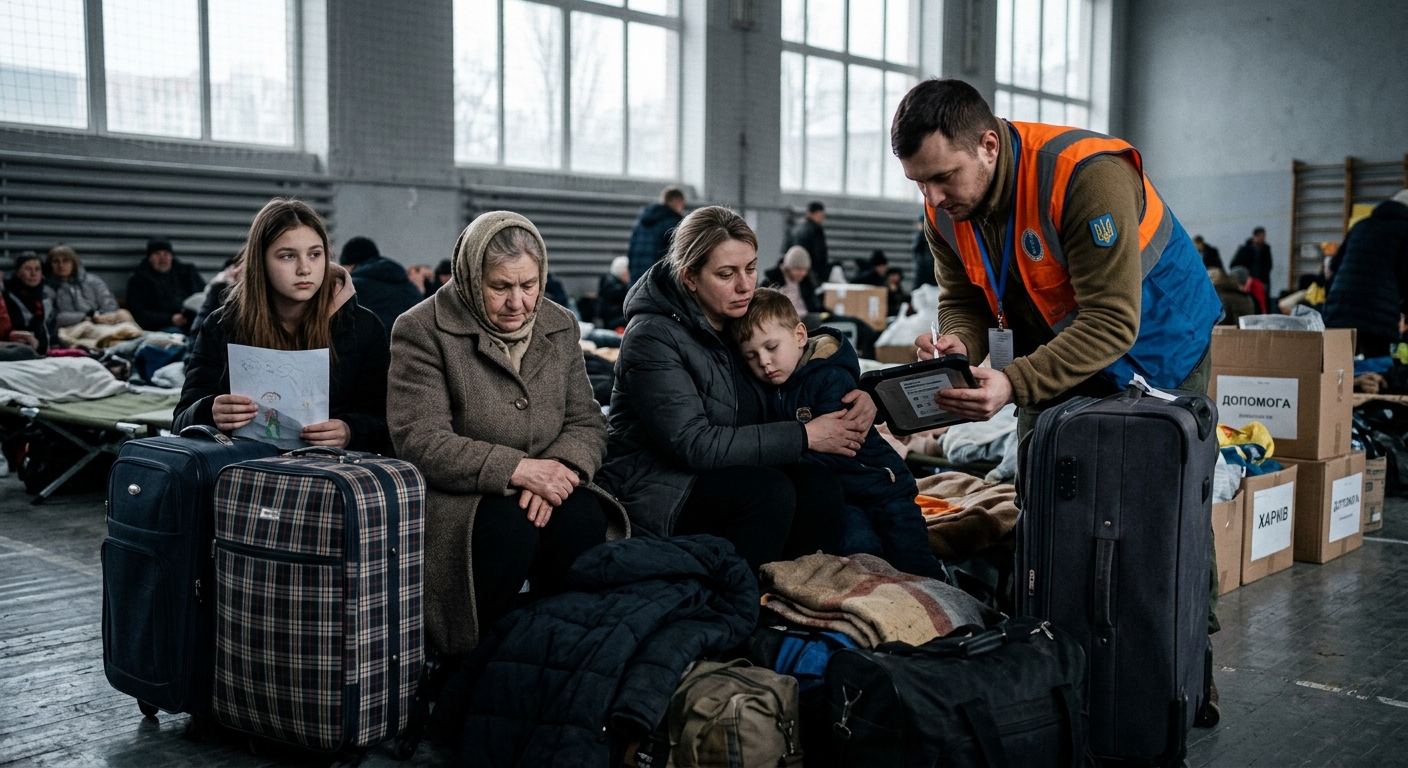
Why now: the operational context
The launch date is not coincidental. On July 3, 2026 the Kharkiv Regional Defense Council ordered a significant expansion of the mandatory evacuation zone across the Kupyansk, Bohodukhiv and Kharkiv districts — 60 settlements added to the compulsory list. That is a policy decision that only works if the throughput exists to match it. The regional humanitarian coordination centre has told local outlet
Radio Nakypilo that current capacity is up to 2,500 people per day.
The pressure on that capacity is unrelenting. Over the week ending July 7, according to Governor Syniehubov's tally, Russian forces fired four missiles, 49 guided aerial bombs, 17 Geran-2 drones, 66 Molniya drones and 51 FPV drones into the region, alongside 1,834 combat engagements along the front. Ukraine's Air War Monitor, published by the Konrad-Adenauer-Stiftung, notes that Kharkiv Oblast has been mentioned in strike reports roughly two out of every three days in 2025, more than any other region.
The wider casualty picture is bleak. The UN Office of the High Commissioner for Human Rights, in a report published on June 29, 2026 and summarised by Warsaw's OSW Centre for Eastern Studies, documented 1,272 civilian deaths and 6,871 injuries in Ukraine between December 1, 2025 and May 31, 2026 — a 40% year-on-year increase, driven mainly by long-range missile and drone strikes and by the growing use of short-range UAVs on the front line.
The military-logistics dividend
The reason Poruch matters to a defence planner, not just a humanitarian one, is that civilian data is military data in a war fought this close to cities. Kupiansk, Vovchansk and the border villages of northern Kharkiv sit inside the same road grid Ukrainian brigades use for resupply. Every civilian bus rolling out on an unpaved road is a bus the 14th Mechanised Brigade is not using for ammunition.
The commander of the Relief Coordination Centre, Oleksandr Kulyk, described the previous system's collapse in a UN briefing published by OCHA:
"At the start of 2024, we handled about 40 evacuations a day. By April, during the Vovchansk offensive, we were seeing up to 1,000 people daily. The data volume was overwhelming."
Until Poruch, RCC ran on Google Sheets, later upgraded to a Power BI dashboard co-built with OCHA's Information Management Unit. That dashboard visualised flows after the fact. Poruch is different: it is a booking engine that shapes flows in advance, letting dispatchers route buses to the settlements where beds match demographic profiles — wheelchair-accessible rooms to Kupiansk, family units to Bohodukhiv — rather than trucking evacuees to a transit centre and then sorting them.
The second-order effect is intelligence. Every reservation is a data point on who is still in a border village, when they intend to move, and what they need. That is precisely the kind of population map Ukrainian civil-military planners have lacked. The International Organization for Migration's methodology paper in Cambridge's Data & Policy journal argued as early as 2023 that Ukraine needed near-real-time displacement forecasting, not retrospective surveys. Poruch, at the oblast level, is the operational answer to that argument.
The wider Ukrainian digital-state pattern
Poruch belongs to a well-established Ukrainian pattern: bolting government functions onto smartphones under wartime pressure. The Brookings Institution's 2024 review of Ukraine's digital resilience tracked how the Diia super-app, launched in 2020, absorbed IDP registration, cash transfers, damage-report filings and diplomas — services other governments would have taken a decade to digitise. The Center for Strategic and International Studies documented in parallel how
Ukrainian displacement response has "gone fully digital", with cash and protection services routed through mobile channels because civilians carry phones even when they carry nothing else.
Poruch is smaller than Diia, but it is the first time that logic has been applied to the physical evacuation itself — the moment the road matters more than the app. The Ministry of Social Policy, Family and Unity is also the lead ministry on the World Bank-financed SPIRIT programme, the $880 million reform of Ukraine's social protection architecture approved in May 2026. Poruch's data pipes will plug into that spine.
Who benefits, who loses
The direct beneficiary is the Kharkiv Regional Military Administration, which now runs the country's most instrumented civilian evacuation and can credibly ask Kyiv and Geneva to fund replication in Sumy, Donetsk and Zaporizhzhia — the three other border oblasts absorbing most of the strike volume, according to the KAS Air War Monitor.
The second beneficiary is OCHA, which is fighting to justify a shrinking pool of Ukraine funding. The U.S. Government Accountability Office reported in July 2025 that donor officials expected humanitarian funding for Ukraine to keep falling, with roughly half of the previous year's resources already gone. A visible, measurable, cheap-to-scale tool like Poruch is exactly the kind of artefact OCHA needs to defend the Ukraine Humanitarian Fund envelope at the next donor conference.
The losers are less obvious but real. The platform makes it harder for local officials in soon-to-be-contested settlements to under-report the number of civilians still on the ground — a common practice that has protected budgets and political fiefdoms in border communities. And it hands central authorities a lever they did not previously have: the ability to see, in near real time, which mayor is moving people and which is not.
What to watch
- Rollout to other oblasts. Watch for a Ministry of Social Policy announcement extending Poruch to Sumy and the Donetsk-controlled districts. If it stays a Kharkiv pilot beyond autumn 2026, the 73% figure has not survived scrutiny.
- Kupiansk axis. OSW's July 3, 2026 assessment described Ukrainian supply lines on the left bank of the Oskil River as under severe strain. A further Russian advance would push Poruch's throughput ceiling of 2,500 people per day into direct test.
- Ukraine Humanitarian Fund pledging round. OCHA's next donor engagement will show whether tools like Poruch can slow the funding decline the GAO forecast in July 2025.
- Independent verification of the 73%. The figure is currently a self-report by the Kharkiv Regional Military Administration. An OCHA or IOM audit would either canonise it or quietly retire it.
The Bottom Line
Kharkiv's Poruch platform is not a humanitarian gadget — it is a piece of civil-military infrastructure that converts the hardest problem in frontline evacuation, civilian consent, into a booking transaction, and in doing so gives Ukrainian planners the first near-real-time map of who remains inside artillery range. If the 73% increase in evacuation agreements holds outside the pilot, Ukraine has quietly built the template every country facing urban warfare will copy next.
Discover more

US Politics
SNAP Food Assistance Faces Legal Challenges
In 2026, SNAP faces stricter eligibility rules and mounting legal challenges, threatening food assistance for the millions of Americans who rely on the program.

India
BJP's Misunderstanding of Women's Quota Needs
The BJP's linking of the Women Reservation Bill to delimitation risks delaying women's empowerment in India, misreading the aspirations of female voters.

India
Congress Accuses Modi of Stalling Women's Law
Congress accuses Modi of stalling women's reservation law by linking it to delimitation, revealing a deeper electoral strategy.

Conflict & Security
Drone Warfare Killing Aid Workers at Unprec
Over 1,000 humanitarian workers killed in three years as cheap armed drones collapse legal protections. Gaza, Sudan, Ukraine, and DRC see deliberate targeting of aid convoys and hospitals with zero prosecutions.