Khalil Supreme Court Case on Trump Deportion
Khalil's case could redefine immigration law and free speech.
Model Diplomat3 min readNorth America
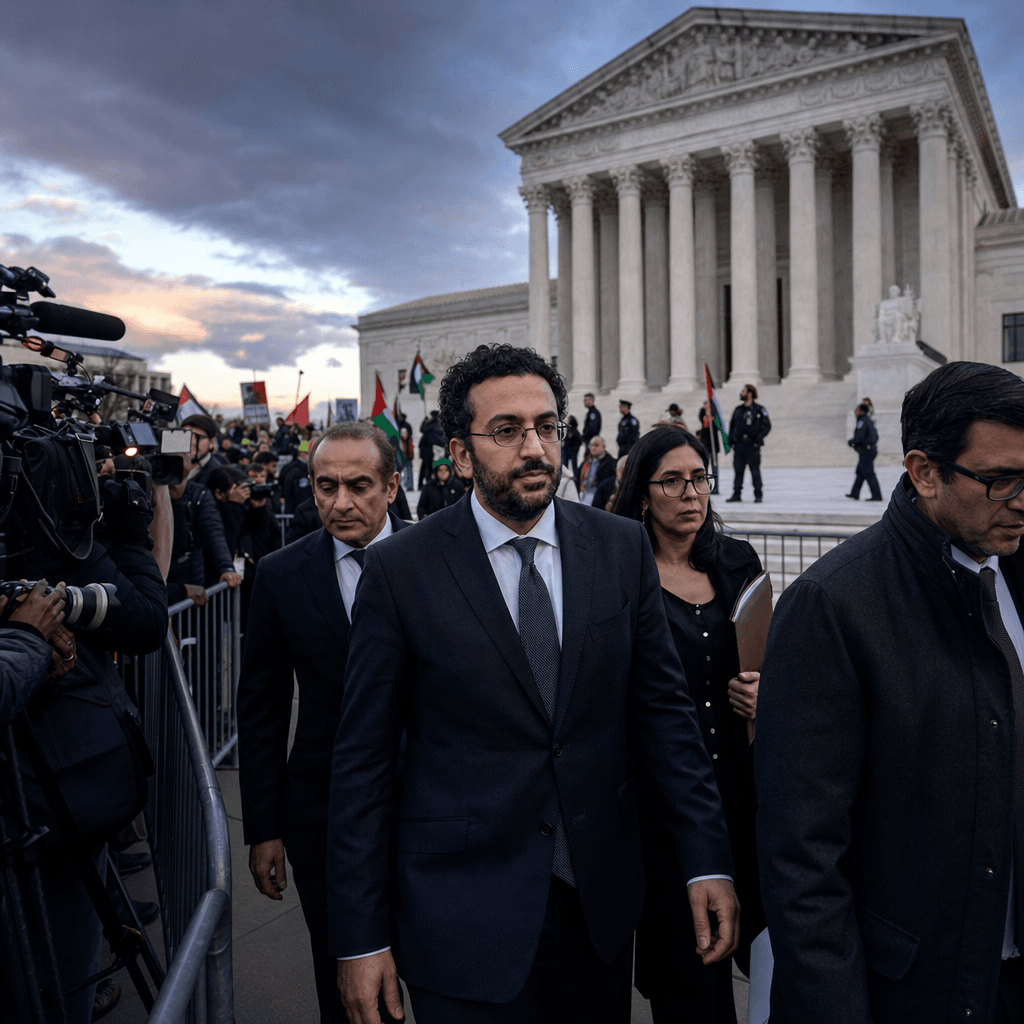
Khalil’s Supreme Court Appeal Tests Trump Deportation Power
Mahmoud Khalil’s fight could decide whether the Trump administration can use immigration law to punish pro-Palestinian speech and detain green-card holders.
Mahmoud Khalil will ask the Supreme Court to block his deportation after the U.S. Court of Appeals for the Third Circuit declined, in a 6-5 vote, to rehear his case, according to Al Jazeera. The administration wants more than one deportation order: it wants a precedent that lets it treat political advocacy as a removability issue, using a rare foreign-policy clause plus an after-the-fact misrepresentation claim that his lawyers say is retaliatory.
Trump’s leverage is procedural, not evidentiary
The power balance is straightforward. The White House does not need to prove Khalil committed a crime; it only needs to keep the case inside immigration machinery long enough to win on process. The New York Times reported that the administration has framed Khalil’s presence as contrary to its foreign-policy agenda and has used the case to signal that pro-Palestinian protest can carry immigration consequences. That is the point of the case: deterrence.
That deterrent effect reaches well beyond Khalil, a lawful permanent resident and Columbia graduate student whose activism made him a visible figure in the 2024 campus protests. CNN reported that a federal judge previously found the administration’s foreign-policy theory likely unconstitutional as applied, but the government kept the removal fight alive through parallel immigration proceedings. In other words, the executive branch is using the system it controls to pressure a critic it cannot easily silence in public debate.
For the broader precedent, this is a United States question as much as a campus one: whether lawful speech by noncitizens can be repackaged as a national-security problem.
The legal fight is about who gets to define “threat”
Khalil’s lawyers are arguing that the government is punishing protected speech, not regulating conduct. Al Jazeera said the case also involves a separate immigration ruling that ordered removal and a new filing alleging “procedural abnormalities,” including a report that the case was flagged as high priority before reaching the Board of Immigration Appeals.
That matters because it gives the justices two choices: treat this as a garden-variety immigration dispute, or acknowledge that the executive branch is stretching a rarely used statute to reach political expression. If the court accepts the administration’s theory, the precedent will travel quickly. Student organizers, foreign-born academics and other noncitizen protesters would all have a reason to think twice before taking on foreign-policy causes that anger the government.
The White House benefits from that chilling effect. Civil-liberties groups, universities and campus organizers do not. And because Khalil has never been charged with a crime, the administration’s strongest weapon is not proof; it is discretion.
What to watch next
The next decision point is the Supreme Court. If Khalil’s lawyers win emergency relief, the justices will be signaling that the lower courts may have let the executive overrun constitutional limits. If they do not, the administration gets a powerful message that its deportation strategy can proceed while appeals grind on. The New York Times reported that the case is still moving through the courts, which means the fight is not over either way — but the first question is whether the Court will stop the government now, or let the pressure campaign continue.
Discover more
US Politics
SNAP Food Assistance Faces Legal Challenges
In 2026, SNAP faces stricter eligibility rules and mounting legal challenges, threatening food assistance for the millions of Americans who rely on the program.

Economics
Fed's Amex AML order puts correspondent banking on notice
Federal Reserve's Amex AML order requires board-level controls and a 90-day plan; OCC fined the bank $350 million over enterprise-wide deficiencies.

Conflict & Security
Guatemala: El Niño 2026–27 becomes regional security test
UNICEF: 25.8M children face El Niño risks in Latin America; Guatemala maps 188 municipalities for drought and food insecurity amid regional security test.

Economics
Fed's stress-test overhaul is a capital-smoothing exercise
Federal Reserve finalized stress-test overhaul: two-year averaging for bank capital buffers and public input, expected to halve volatility.