Kash Patel's 113 Spy Arrests Explained
Analyzing the FBI's counterintelligence claims and implications
Model Diplomat8 min readNorth America

Kash Patel's 113 Spy Arrests: What the FBI's Numbers Really Say
Patel's counterintelligence tally is a semiconductor-export enforcement story dressed up as a spy-catching one — and it lands as Salt Typhoon still sits inside US telecoms.
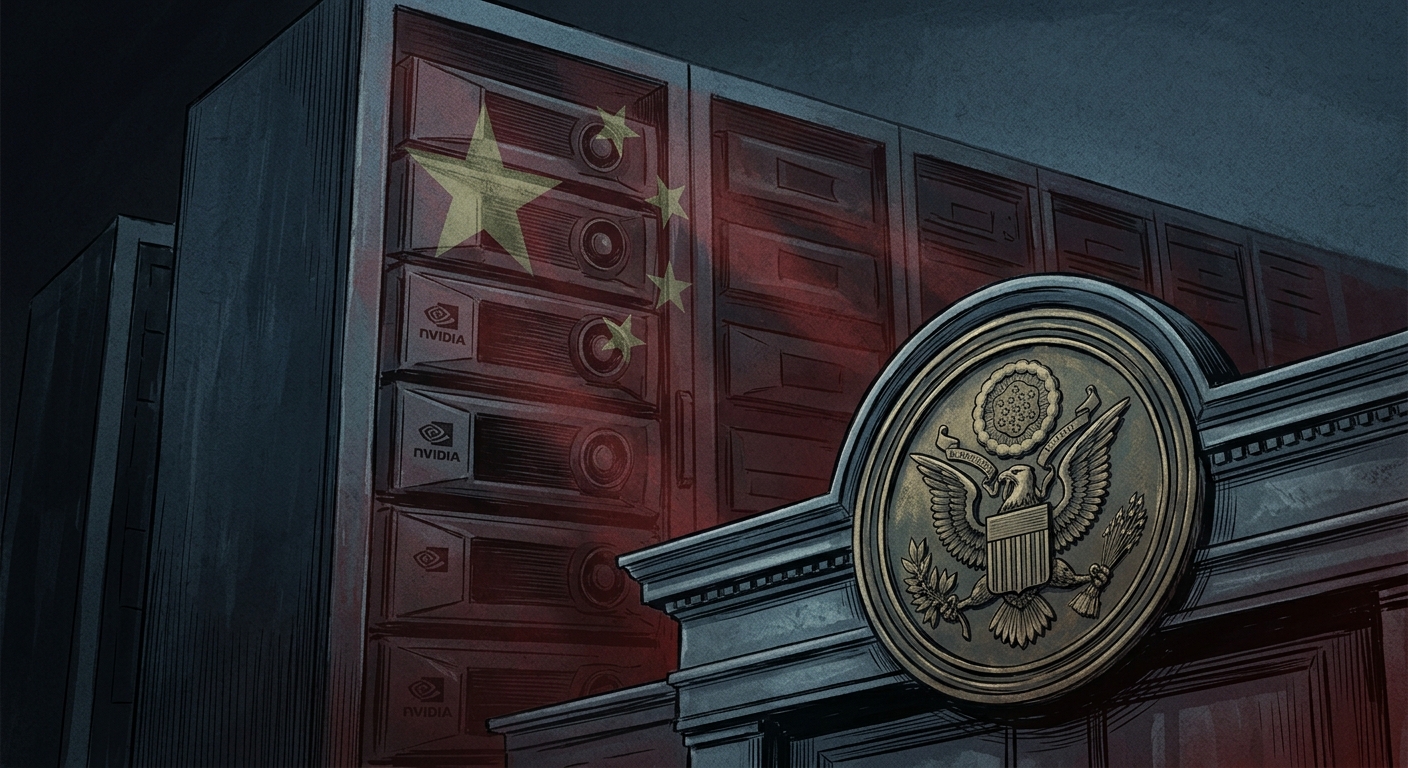
FBI Director Kash Patel's July 8, 2026 tally — 113 alleged foreign spies arrested, a 53% jump in cyber indictments, 62 Chinese intelligence-linked individuals expelled in 2026 — is best read not as evidence of a new threat wave, but as the political packaging on a durable rewiring of US counterintelligence into a semiconductor export-control enforcement arm. The numbers Patel emphasises are the ones the Justice Department is generating anyway, from a pipeline of Nvidia-chip smuggling cases that began before he took office. What the numbers do not address is the piece of the threat picture that remains unresolved: Salt Typhoon, the Chinese intrusion into US telecoms, which the FBI's own cyber assistant director in August 2025 called "one of the more consequential cyber espionage breaches we have seen here in the United States," per the Senate Commerce Committee.
That gap — between the arrests being counted and the intrusions still unmitigated — is the analytical core of the story.
What Patel actually announced
Patel's social-media post, first amplified in the IBTimes UK, listed the 113-arrest figure, 850 disrupted plots, a 53% cyber-indictment increase and support for the Justice Department's "Operation Red Circus" cyber initiative — highlighted by the Spanish arrest of an alleged member of the pro-Russia Cyber Army of Russia Reborn (also known as Z-Pentest). That hacktivist collective, according to a
Mandiant assessment cited by CSIS, is judged with moderate confidence to coordinate with Russia's Main Intelligence Directorate (GRU) — one of several Kremlin-adjacent groups swept up in the July 2025 Europol-led Operation Eastwood, which took down NoName057(16). The FBI's Los Angeles field office joined that Europol effort; Red Circus appears to be the DOJ-branded continuation.
The 113 figure itself has a paper trail. Patel testified to the House Judiciary Committee in September 2025 that the FBI had "arrested 59 foreign intelligence operatives for spying or smuggling dangerous substances into the country since January 20, 2025." The number has roughly doubled in nine months. In a defamation complaint Patel filed against The Atlantic in April 2026, publicly available via
CourtListener, his own attorneys listed "espionage arrests up by 43% from 2024" and "more than 456 cyber indictments (up 27%)" as fact. By July, that cyber figure had grown to a 53% jump.
The number nobody's disputing is the enforcement pipeline
Strip away the politics and Patel's cyber and espionage claims map onto a specific caseload: US-origin advanced semiconductors being diverted to China. The scale is documented in primary court filings.
The largest case, unsealed in the Southern District of New York on March 20, 2026, charged Super Micro Computer co-founder Yih-Shyan "Wally" Liaw and two others with routing roughly $2.5 billion in Nvidia-equipped AI servers to China through a Southeast Asian front company. Prosecutors alleged the defendants used dummy servers and hair dryers to swap serial-number labels past export-compliance audits, according to Al Jazeera and the
BBC.
That case sits atop a stack. In written testimony before the House Select Committee on the CCP on April 16, 2026, Silverado Policy Accelerator chair Dmitri Alperovitch catalogued: a November 2025 Florida indictment involving 400 A100 GPUs routed through Malaysia and Thailand; "Operation Gatekeeper," unsealed in December 2025, targeting up to $160 million in H100 and H200 shipments; and a January 2026 conviction of a former Google engineer on 14 counts of economic espionage over more than 2,000 pages of TPU documentation. A San Jose detention memo filed against defendant Cham "Tony" Li, on
CourtListener, quoted Li boasting that his father's Chinese Communist Party ties gave him "ways to import" chips the US had banned. Sentencing exposure: 151–188 months.
The pipeline also includes Cadence Design Systems, which pleaded guilty in July 2025 to 56 unlawful exports of electronic design automation tools to China's National University of Defense Technology through a front called CSCC, per the charging document.
Read as a whole, this is not a "spy wave." It is the maturation of an export-control enforcement regime built on the Bureau of Industry and Security's October 2022 chip rules and expanded through 2024, now processed through federal prosecutors. The Congressional Research Service noted in its June 2026 update that the Trump administration in 2025 also added 42 PRC entities to the Entity List, rescinded the January 2025 AI Diffusion Rule, and issued guidance treating any use of Huawei's Ascend AI chips as an export-control violation. Enforcement is expanding at both ends: more listings, more prosecutions.
That matters because it structurally reweights the FBI. Alperovitch told Congress the criminal-prosecution model is "appropriate for egregious violations but … a slow process." The FBI has resourced it aggressively anyway, because it produces countable outputs — indictments, arrests, expulsions — that map cleanly onto the ODNI's 2026 Annual Threat Assessment, which identifies China and Russia as "the most persistent and active" cyber threats.
The threat Patel didn't quantify
Contrast that with the Salt Typhoon file. In its January 17, 2025 designation of Sichuan Juxinhe Network Technology, the US Treasury confirmed that Salt Typhoon "compromised the network infrastructure of multiple major US telecommunication and internet service provider companies," calling it "a dramatic escalation." The
Congressional Research Service has documented that Salt Typhoon actors likely targeted the systems telecoms use to provide court-approved communications access to law enforcement — a bypass of the CALEA wiretap regime itself.
By early 2026, the picture had gotten worse, not better. Senator Maria Cantwell's February 3, 2026 letter to Commerce Committee Chairman Ted Cruz reported that Salt Typhoon actors "targeted more than 200 U.S. organizations and 80 countries" and that reports "indicate that Salt Typhoon hackers are likely still inside U.S. telecommunications networks." Mandiant assessments of AT&T and Verizon, she wrote, exist — but the carriers have refused to share them with Congress.
Representative Ritchie Torres, in a June 2026 letter signed by six House Democrats, framed Volt Typhoon — the sister PRC campaign that has, per the
DIA's April 2026 posture statement, pre-positioned since 2019 on US critical infrastructure — as "a loaded gun aimed squarely at America." Torres alleged that the Cyber Safety Review Board, chartered to investigate incidents like Salt Typhoon, has been "all but abolished," and that the administration is cutting the Cybersecurity and Infrastructure Security Agency budget by roughly $500 million and up to 1,300 staff.
Patel's press release does not address any of this. It cannot: the counterintelligence unit best positioned to work Salt/Volt Typhoon has been thinned by the same reorganisation that boosted his headline numbers. Senator Richard Blumenthal's September 15, 2025 letter to Patel and Attorney General Pam Bondi flagged "reported gaps in staffing at cybersecurity units both within and outside the Bureau" and noted that 18 of 53 Special Agents in Charge of FBI Field Offices had been forced out. Under questioning by Senator Patty Murray at an April 2026
Senate Appropriations hearing, Patel disputed that agents had been reassigned "solely" to immigration; Murray cited a Cato Institute estimate of more than 2,000 FBI agents redeployed to immigration enforcement in 2025.
The credibility question hovering over the tally
Patel's numbers arrive amid an active credibility fight. On May 18, 2026, Senator Blumenthal wrote to the DOJ Inspector General, in a letter posted by his office, asking for an investigation into allegations first reported by MS NOW and The Atlantic that Patel "artificially inflated the Bureau's arrest statistics" by changing how arrests are catalogued without disclosing the change. Patel has denied this and sued The Atlantic for defamation.
That fight matters here because the FBI, as the underlying IBTimes reporting notes, "has not, as of publication, released supporting data explaining how the figures were compiled" — no breakdown by country, no breakdown of whether the 53% cyber-indictment jump reflects state-sponsored intrusions, ransomware crews, or the semiconductor cases documented above. For a professional reader, this is the tell. FBI Director Christopher Wray's October 2020 CSIS speech said the FBI then had "about a thousand investigations involving China's attempted theft of U.S.-based technology in all 56 of our field offices." Patel's number is a subset of that population — arrests, not investigations.
Who wins and who loses
The direct beneficiaries of the current posture are the Southern District of New York, the Bureau of Industry and Security enforcement staff, and the DOJ's National Security Division prosecutors, whose caseload is being aggressively cleared. Nvidia is arguably a passive beneficiary too: each indictment reinforces the political rationale for keeping export controls that raise the price of grey-market H100s and legitimise the compliance overhead of Nvidia's own approved sales.
The losers are less obvious. First, US telecommunications carriers — AT&T and Verizon in particular — face intensifying pressure from Senate Democrats and, per the FCC's own November 2025 rulemaking record, have failed even elementary hygiene like patching seven-year-old router vulnerabilities. Second, CISA, whose institutional authority is being wound down at exactly the moment the primary intrusion it was set up to coordinate against remains unremediated. Third, the counterintelligence workforce inside the FBI, whose China-focused agents are being outnumbered in the field by immigration-focused ones.
The second-order winner: Beijing. Chinese state-linked actors face a criminal-prosecution regime that catches individual smugglers but leaves the underlying network access — Salt Typhoon inside CALEA systems, Volt Typhoon pre-positioned on power and water — untouched. The March 2026 CSIS analysis of the US-China export-control spiral found that in the first two months after China imposed rare-earth countermeasures targeting Japan in January 2026, rare-earth shipments to Japan dropped 78%. That is the leverage Beijing is exercising while US telecoms remain compromised.
Diplomat View
The forecast: Patel's headline numbers will keep rising through 2026 because the enforcement pipeline is built to produce them. Expect at least two more billion-dollar chip-smuggling indictments before the end of the fiscal year, likely centred on Singapore or Malaysia transshipment. Expect no comparable public accountability event on Salt Typhoon, because none is politically survivable for the carriers or the administration. The specific, falsifiable call: if by December 31, 2026, the Cyber Safety Review Board has not been reconstituted and CISA's fiscal-year 2027 appropriation lands below $2.2 billion, treat the "113 spies" framing as a substitution — high-visibility criminal enforcement in place of unglamorous defensive remediation. The forecast revises if (a) DOJ unseals a Salt Typhoon-specific indictment naming Chinese Ministry of State Security officers, or (b) the DOJ Inspector General opens the Blumenthal-requested probe and finds material stat manipulation, either of which would reset the credibility ledger.
What to watch next
- August 2026 — Senate Commerce hearing. Cantwell's requested oversight of AT&T and Verizon CEOs, if scheduled, will force the first sworn public accounting of Salt Typhoon remediation.
- September 30, 2026 — FY27 appropriations. Whether the FBI's proposed $545 million cut and CISA's proposed $500 million cut survive conference will determine the enforcement/defence balance for 2027.
- Late 2026 — Super Micro co-founder arraignment and pre-trial motions. The Liaw case is the largest chip-diversion prosecution to date; any plea deal would shape how DOJ prices future enforcement bargains.
Discover more

US Politics
SNAP Food Assistance Faces Legal Challenges
In 2026, SNAP faces stricter eligibility rules and mounting legal challenges, threatening food assistance for the millions of Americans who rely on the program.

US Politics
Next Generation Republicans
A leaked survey shows 39% of Republicans under 30 do not identify as MAGA, revealing a split in the GOP's future leadership.
India
Women’s Reservation Bill 2026
The Constitution (131st Amendment) Bill, 2026 was defeated in Lok Sabha, revealing deeper political conflicts over women's reservation and delimitation.

Conflict & Security
Drone Warfare Killing Aid Workers at Unprec
Over 1,000 humanitarian workers killed in three years as cheap armed drones collapse legal protections. Gaza, Sudan, Ukraine, and DRC see deliberate targeting of aid convoys and hospitals with zero prosecutions.