Kang Kon Tests Reset Indo-Pacific Naval
North Korea's naval buildup reshapes regional dynamics.
Model Diplomat8 min readAsia
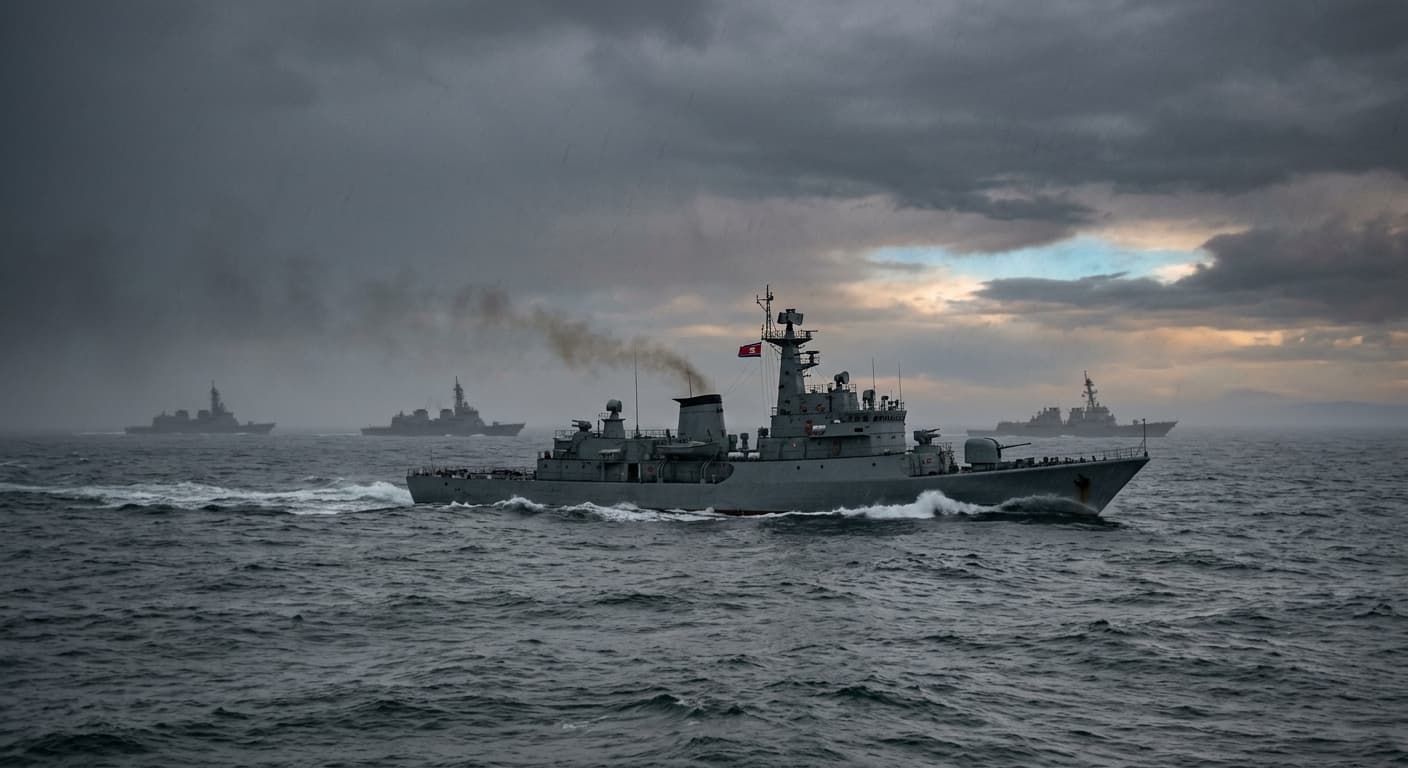
Kang Kon Tests Reset Indo-Pacific Naval Calculus
South Korea's Unification Ministry says Kim Jong Un's July 5 destroyer trials confirm a sustained naval buildup — one that has already pulled Washington, Seoul and Beijing into a new undersea arms race.
The single fact from Seoul's July 6 briefing that matters is this: North Korea has now conducted live-fire weapons trials on both of its 5,000-ton destroyers within six weeks, and the Unification Ministry says Pyongyang will not stop there. That sequence — Choe Hyon commissioned on June 23, Kang Kon firing strategic cruise missiles on July 5 — is the operational payoff of a maritime doctrine Kim Jong Un unveiled in December 2025, and it has already forced Washington to greenlight South Korean nuclear-powered attack submarines and pushed Xi Jinping to Pyongyang for the first time in seven years. The Indo-Pacific's undersea and surface balance is being rewritten around two ships that a year ago most Western analysts dismissed as prestige projects.
What Seoul actually said
South Korea's Ministry of Unification told reporters on July 6 that the Kang Kon trials fit a pattern Pyongyang has telegraphed at every recent Party Congress and plenum: naval power growth is a top-line objective, and destroyer commissioning is being followed immediately by armed-system testing, per the ministry's briefing carried by Aju Press. Kim personally oversaw the trials, which included strategic and supersonic cruise missile launches, anti-aircraft missiles, automatic cannons, electronic warfare systems and integrated fire control, according to
Pakistan Today. Kim ordered Kang Kon into service within two months, a compressed timeline reported by
Europe Says and consistent with the ministry's assessment that the Kang Kon programme has recovered from its May 2025 capsizing.
The trials also close a loop opened in March. That was when Kim first fired sea-to-surface cruise missiles from Choe Hyon at Nampo, calling the vessel a "new symbol of sea defence" and telling KCNA that "the arming of the Navy with nuclear weapons is making satisfactory progress," according to Al Jazeera. What was rhetoric in March is now a repeatable capability on two hulls.

The Russian fingerprint on Kim's fleet
The reason this program moved from embarrassment to threat in twelve months is not domestic ingenuity. It is Moscow. The Lowy Institute's Khang Vu estimates Russia has channelled between $5.6 billion and $9.8 billion in cash and technology to Pyongyang since the June 2024 alliance treaty, funding a defence-industrial revival that touches everything from artillery shells to destroyers, per the Lowy Institute. South Korea's own military assessed shortly after the Kang Kon relaunch that the vessel was "similarly equipped" to Choe Hyon, "which North Korea built with Russian assistance," according to
Al Jazeera. The AEI–ISW Coalition Defense of Taiwan project concurs, judging that "Russian technical assistance very likely aided the development of the Choe Hyon-class," in its
Korean Peninsula Update of June 30, 2026.
That matters for a specific reason. Kim used his June 6, 2026 sea trial to publicly order a 10,000-ton destroyer and unspecified "underwater secret weapons" — the first time North Korea has articulated that class, according to Reuters analyst Hong Min of South Korea's Institute for National Unification quoted by Al Jazeera. AEI–ISW assess that North Korea will "likely struggle to produce a vessel of such size and complexity without outside assistance," making the question of whether Russia — or China — will supply that assistance the load-bearing variable in the next phase of this program.
Why Xi flew to Pyongyang
Xi Jinping's June 8–9 visit to Pyongyang, his first since 2019, was choreographed against exactly this backdrop. Kim staged the Kang Kon sea trial and a visit to a new uranium enrichment facility in the days before Xi arrived — an unmistakable demonstration that Pyongyang's leverage over Beijing has grown, not shrunk, since the Russia pivot. Xi's readout, delivered via Xinhua and republished by KCNA, called for opposition to "hegemonism" and "power politics" and pledged to help North Korea "move towards modernisation," with denuclearisation notably absent from the agenda, per the BBC.
The AEI–ISW analysis reads Xi's statement as an implicit legitimisation of Kim's nuclear program, judging that Xi "acknowledg[ed] the regime's 'sovereignty and security' interests" in a way that raises the threshold for future engagement with Washington and Seoul, per its June 9, 2026 update. Kim's naval buildup is now bracketed by two treaty allies — Russia providing hardware and expertise, China providing political cover — neither of which will support new UN Security Council sanctions.
The undersea arms race Kim triggered
The second-order effect Kim probably did not want is already visible in Seoul. In October 2025, at the APEC summit in Gyeongju, President Lee Jae Myung persuaded Donald Trump to overturn two decades of US policy and approve South Korean construction of nuclear-powered attack submarines, framed against North Korean and Chinese underwater threats. The deal, formalised in a joint fact sheet on November 14, 2025, is tied to a $350 billion Korean investment package — $150 billion of it in US shipbuilding — and commits both governments to "move forward" on the SSN program, according to Al Jazeera.
The reason this matters for the Indo-Pacific, not just the peninsula, is what Lee told Trump in the meeting itself: "The limited underwater range of diesel submarines restricts our ability to track subs on the North Korean or Chinese side," Lee said, according to NPR's reporting from Seoul. US Navy Chief of Naval Operations Admiral Daryl Caudle, visiting Seoul in November, made the sub-text explicit — that Washington's "natural expectation" is that Korean SSNs will help counter "our pacing threat, which is China," per
NPR. North Korea responded in kind on Christmas Day 2025, releasing the first photograph of what it called an 8,700-ton nuclear-powered strategic guided missile submarine.
The historical parallel here is not Cold War Northeast Asia. It is AUKUS. The United States Studies Centre argues the October 2025 decision "overturned the Biden administration's position since 2021 that the transfer of naval nuclear propulsion to Australia under the AUKUS partnership was a 'one-off'," in this analysis. What Kim's destroyers accomplished — probably inadvertently — was to give Lee the political cover, and Trump the industrial pretext, to build a second AUKUS in Northeast Asia.
Who benefits, who loses
Beijing loses most from this sequence, not Washington. China's calculus assumed a nuclear-capable but naval-poor North Korea it could manage as a buffer state. Instead it now faces a North Korean surface fleet drifting into Russia's orbit, a South Korean SSN program aimed partly at PLA Navy submarines, and a US naval posture in the Western Pacific that Trump's own December 2025 National Security Strategy says will lean harder on allies "to confront its adversaries," per NPR. Xi's Pyongyang trip was damage control.
Russia benefits doubly. It receives North Korean munitions and manpower for Ukraine — Lowy notes Pyongyang has produced artillery shells, self-propelled guns and short-range ballistic missiles for Russia and gained Kursk combat experience for its own troops. And by helping Kim build a nascent green-water navy, Moscow acquires a proxy naval partner on the Sea of Japan.
The South Korean shipbuilding industry is the sleeper winner. Trump's tariff-linked deal folded HD Hyundai Heavy Industries and Hanwha Ocean into the US Navy's maintenance, repair and overhaul (MRO) pipeline, an arrangement the Lee administration is now institutionalising through a specialised export team under presidential-level strategic meetings, per South Korea's Ministry of National Defense. North Korea's naval push is, paradoxically, the best sales tool the South Korean chaebols have.
The clearest loser inside Seoul is the Unification Ministry itself. Minister Chung Dong-young is running a "peaceful coexistence" policy that his own briefings keep undermining every time Kim tests a missile from a destroyer, and the ministry has already publicly clashed with the Ministry of National Defence over whether North Korea should be labelled a "primary enemy" in the 2026 defence white paper, per the AEI–ISW June 23 update.
The blue-water bluff
None of this means the Choe Hyon-class is a good warship. RSIS's Collin Koh judged after the May 2025 capsizing that the two destroyers, worth roughly $1.4 billion combined, "will not substantially increase North Korea's maritime capability" and that a Choe Hyon operating in the Yellow Sea "would be quickly sunk" in wartime by South Korean forces, per the RSIS commentary. AEI–ISW similarly warn that Kim is centralising high-end capability on a "handful of platforms vulnerable to submarine or air attack," creating sustainment problems North Korea has not solved.
The Asan Institute reframes the whole exercise: Pyongyang is not building a fleet for war-fighting, it is redefining the maritime domain as a "multidimensional strategic space" and pushing concepts such as "maritime sovereignty," "blue-water navy" and "intermediate waters" — signals of intent to redraw maritime boundaries and pursue joint operations with Russia and China, per Asan's issue brief. The destroyers, in this reading, are floating flags, not floating threats. But floating flags in contested waters generate incidents, and incidents generate the same escalation dynamics that South China Sea and Taiwan Strait analysts already track daily.
What to watch next
- Late August 2026: Kang Kon's commissioning deadline under Kim's July 5 order. Slippage would signal the July trials were staged rather than operational.
- Autumn 2026: US–ROK 123 Agreement renegotiation on nuclear fuel for Korean SSNs. Without it, Lee's submarines remain political theatre.
- Chongjin and Nampo shipyards: satellite watchers at CSIS Beyond Parallel and 38 North for keel-laying of the announced 10,000-ton cruiser — the point at which the program becomes physically irreversible.
Diplomat View
Kim Jong Un's naval program has, in one year, done what a decade of sanctions diplomacy could not: it has aligned Seoul, Tokyo and Washington on a shared undersea threat picture that now explicitly includes China, and it has locked South Korea into a $350 billion industrial embrace with the United States that Beijing cannot match or block. The forecast: within 18 months, the peninsula debate stops being about denuclearisation and becomes a nuclear-propulsion race — North Korea's 8,700-ton SSBN prototype against South Korea's US-fuelled SSN, with Japan's own submarine modernisation trailing quietly behind. What would change this forecast is a single event: a demonstrable failure of Russian technical support to Pyongyang (a second capsizing, a failed missile test at sea, or a Moscow decision to prioritise Ukraine reconstruction over Northeast Asian adventurism). Absent that, the July 5 Kang Kon trial is not a stunt. It is the marker that Northeast Asia has entered a naval competition it will not exit this decade.
The Bottom Line
North Korea's destroyer program is militarily marginal but strategically decisive: it has legitimised a Korean AUKUS, drawn Xi to Pyongyang, and turned the peninsula into the primary trigger for Indo-Pacific undersea competition. The ships themselves may never fight a war. The arms race they set off already has consequences China cannot reverse and Washington will not slow.
Read today's full | | Country profile: South Korea
Discover more

US Politics
SNAP Food Assistance Faces Legal Challenges
In 2026, SNAP faces stricter eligibility rules and mounting legal challenges, threatening food assistance for the millions of Americans who rely on the program.
Global Politics
Xi Jinping Calls China-Russia Ties 'Precious'
Xi Jinping's description of China-Russia ties as 'precious' reflects a strategic imbalance, with Beijing dictating terms in the partnership.
India
700 Activists Accuse PM Modi of MCC Breach
Over 700 activists allege PM Modi breached election code with a televised address attacking opposition parties just before state elections.

Economics
Fed's Amex AML order puts correspondent banking on notice
Federal Reserve's Amex AML order requires board-level controls and a 90-day plan; OCC fined the bank $350 million over enterprise-wide deficiencies.