Jordan Intercepts Iranian Missiles Amid War
Jordan shoots down missiles as US-Iran tensions escalate.
Model Diplomat8 min readMiddle East
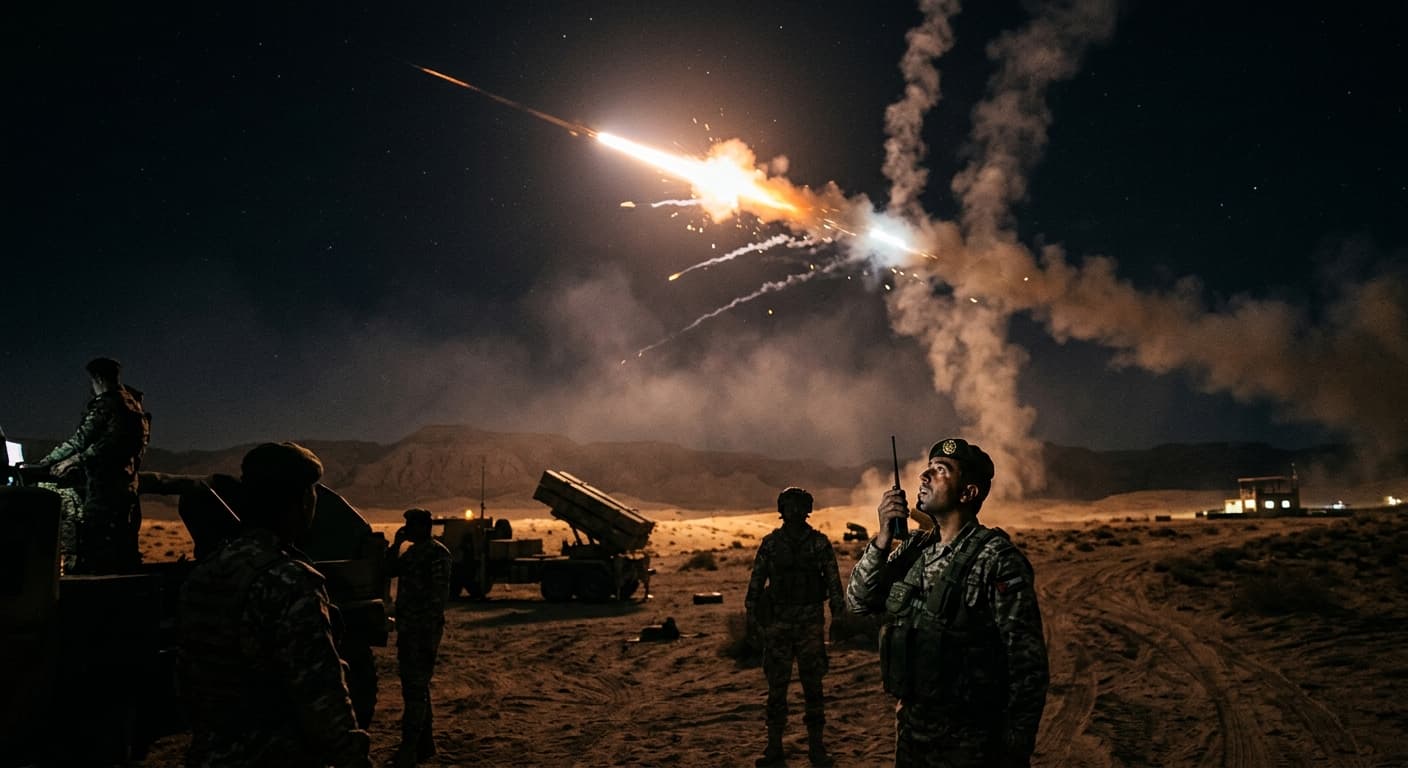
Jordan intercepts 8 Iranian missiles as US-Iran war reignites
Jordan shot down eight Iranian ballistic missiles fired at the Azraq air base on July 9, 2026, as a US-Iran ceasefire collapses and the Strait of Hormuz shuts to shipping.
Jordan's Armed Forces intercepted eight of ten Iranian ballistic missiles fired at the Muwaffaq Salti Air Base near Azraq on the afternoon of July 9, 2026 — a strike the Islamic Revolutionary Guard Corps openly claimed as retaliation for a second night of US bombing across Iran. No casualties or material damage were reported. The zero-damage headline conceals the actual story: Iran is now openly bombarding a US ally that shelters American aircraft, the Pakistan-brokered ceasefire signed on June 17 is functionally dead, and King Abdullah II's "positive neutrality" is once again the load-bearing wall of the regional escalation ladder. If Jordan's defences fail once — one leaker into a fuel bunker or a residential block outside Zarqa — the political geometry of the second US-Iran war changes overnight.
What Jordan actually said, and what it left out
Jordan's government spokesman Mohammad al-Momani confirmed to reporters that "all incoming fire from Iran had been intercepted," according to NPR carrying Associated Press wire copy. The Jordanian Armed Forces statement, relayed through state broadcaster Al-Mamlaka and quoted by
Al Jazeera, said eight missiles were destroyed in Jordanian airspace after sirens sounded across the kingdom, and that "falling shrapnel did not cause any casualties or material damage."
Tehran's version differs materially. The IRGC, in a statement carried by Fars, said it fired ten ballistic missiles at what it called the "US command-and-control centre" inside Azraq, and warned that "if the terrorist American army repeats its aggression, other American bases in the region will not be safe from our heavy fire," per the Al Jazeera live blog. The gap — Jordan says eight, Iran says ten — is the interception rate the Jordanian statement will not itself publish. Two missiles are unaccounted for in the official account.
Azraq is not an incidental target. The Muwaffaq Salti base has been the primary Middle East pivot for US airpower since Congress appropriated $143 million to upgrade it — more than double any other overseas airbase allocation that year, according to an Atlantic Council analysis of the shift away from Turkey's Incirlik. It hosts US F-16s and, per BBC Verify satellite imagery published earlier in the war, a Terminal High Altitude Area Defense (THAAD) battery whose AN/TPY-2 radar — a $485 million system — was damaged in an earlier Iranian barrage, contributing to
about $800 million in cumulative damage to US-used facilities across the region in the war's first two weeks.
The escalation ladder no one wanted
The July 9 strikes on Jordan, Kuwait, Bahrain and Qatar are the sharpest violation yet of a memorandum of understanding both sides signed on June 17 to freeze the four-month-old war. That deal — 14 points, 60 days of negotiation, US naval blockade lifted, sanctions on Iranian oil waived, Strait of Hormuz reopened — was described by BBC News as still technically in force, though Trump told reporters at the NATO summit in Ankara that the ceasefire was "over" and called Iran's leaders "scum" and "cuckoo," according to the
BBC's account of his remarks.
The trigger sequence is now legible: Iran attacked the Saudi-flagged Wedyan and the Qatari LNG carrier Al-Rekayyat on July 7 for using a US-backed transit route through the Strait of Hormuz outside Tehran's "authorised" corridor, per Al Jazeera. US Central Command struck roughly 80 Iranian targets that night, and 90 more on July 8, hitting sites near Iran's Bushehr nuclear plant and two railway bridges, according to
Al Jazeera's rundown of CENTCOM statements. Iran's parliamentary speaker and chief negotiator Mohammad Bagher Ghalibaf posted on X:
"The United States still has not learned that bullying and breaking its promises no longer come without consequences. Let me be clear: If you strike, you will be struck."
The Iranian Foreign Ministry, in its own statement, accused Washington of breaching Articles 1 and 5 of the MoU — the clauses covering cessation of hostilities and safe passage through Hormuz. That is the primary Iranian legal argument on the table.
Jordan's tightrope, quantified
The kingdom is not a bystander that got unlucky. It is a co-defendant of the US regional posture pretending to be a neutral. The Jordanian army disclosed in May that it had intercepted 222 missiles and drones fired at the kingdom since the war began on February 28, per Sada News; the earlier tally in early May put the figure at 281 projectiles fired, most intercepted, per an
Al Jazeera field report from Petra. The July 9 salvo pushes cumulative interceptions above the 230 mark using the more conservative count.
The Institute for National Security Studies in Tel Aviv, in a June assessment by Ofir Winter, described Jordan's stance as "positive neutrality": intercept Iranian projectiles in sovereign airspace, defend Jordanian territory from direct strikes, decline to publicly authorise use of Jordanian bases for offensive operations against Iran. INSS also confirmed that Iranian missiles have struck the al-Ruwaished (H4) and Muwaffaq Salti bases, "where American military forces are stationed under the 2021 Jordan–US security partnership agreement," and that "one of the attacks reportedly hit the radar of an American THAAD missile interception system."
That is the equation: Jordan hosts an estimated 2,800-plus US personnel and provides "unimpeded access" to Pentagon-designated facilities under the 2021 bilateral agreement, per the Stimson Center, while telling its own public — 60 percent of whom are of Palestinian origin — that interceptions are pure sovereignty defence. Foreign Minister Ayman Safadi's line has been consistent since April 2024: Jordan shoots down anything violating its airspace "irrespective of country of origin," per an
Atlantic Council reconstruction of the palace's public messaging.
The economic bill
The war's second act is already in the oil market. Brent crude rose 4.2 percent to $77.24 a barrel on July 8, the highest level in two weeks, Al Jazeera reported — off the $126 peak of late April, but climbing again. The US Navy–led Joint Maritime Information Center raised the Strait of Hormuz threat level to "severe" for the first time since June 15. Intertanko's marine director Phil Belcher told
the BBC that daily southern-route transits have fallen to "single figures" from 30 a week ago and 130 pre-war.
For Jordan specifically, tourism — 14 percent of GDP, employing 60,000 directly and supporting 300,000 more — has been gutted. Petra's monthly visitor count fell from 112,000 in the first two months of 2026 to roughly 28,000–30,000 by April, with revenue impact still cascading through hotels and licensed guides, per Al Jazeera's field reporting. Every additional interception raises Amman's insurance premium on the war it is officially not in.
Why "no damage" is not the story
The temptation is to read Thursday's Jordan interception as a data point in a boxed exchange — Iran shoots, allies catch, ceasefire wobbles, mediators call. That reading understates three things.
First, munitions economics. Each Patriot PAC-3 interceptor costs roughly $4 million, and the US and its Middle East partners have already expended some 800 of them, more than were delivered to Ukraine in four years, according to Ukrainian President Volodymyr Zelenskyy, cited by Al Jazeera as the US sought cheaper Ukrainian interceptor drones for the Middle East theatre. Jordan's shield is expensive, finite, and increasingly dependent on Kyiv's improvised technology.
Second, the political off-ramp is narrowing. Qatar's Prime Minister Sheikh Mohammed bin Abdulrahman Al Thani phoned Iranian Foreign Minister Abbas Araghchi on Thursday urging both sides to "commit to diplomacy," according to Al Jazeera, while the Gulf Cooperation Council condemned the Iranian strikes on Jordan, Kuwait and Bahrain as a "flagrant violation" of sovereignty. Every Iranian missile fired at an Arab capital hosting Americans reduces Tehran's Gulf diplomatic capital — and hardens the argument in Riyadh, Abu Dhabi and Amman that the regional order will need explicit US security guarantees, not implicit ones.
Third, the subversion problem. The Jerusalem Institute for Strategy and Security has documented Iranian and Hezbollah-run smuggling of arms and drugs into Jordan, which the JISS analysis frames as a deliberate destabilisation campaign against the Hashemite state. Tehran's aerial strikes and its ground-based subversion are one strategy: raise the cost to Amman of hosting Americans until the calculus flips. Kataib Hezbollah's January 2024 drone strike on Tower 22 that killed three US soldiers was the proof of concept.
What to watch
- August 21, 2026. The 60-day MoU negotiation window brokered by Pakistan and Qatar expires. If US and Iranian negotiators cannot re-anchor talks on the Strait of Hormuz administration and Iran's nuclear programme before that date, the interim architecture legally lapses. Trump has already said he sees further talks as "a waste of time," per
BBC News.
- The next Iranian salvo on Jordan. A single interception failure at Azraq — a leaker into fuel storage, a residential impact in Zarqa or Mafraq — would force King Abdullah II to choose publicly between condemning Iran and reassuring a majority-Palestinian domestic base that has spent 20 months of protests demanding Amman abrogate the Wadi Araba peace treaty with Israel.
- CENTCOM's next target list. US strikes on July 8 hit railway bridges on the Mashhad funeral route for Ayatollah Khamenei, according to
Al Jazeera. If subsequent US strikes hit inside Tehran or against Supreme Leader Mojtaba Khamenei — whom Israeli officials have publicly threatened, per the same Al Jazeera report — Iranian retaliation will not stay contained to eight-missile salvos at Azraq.
- Jordanian THAAD replenishment. BBC Verify reported the US redeployed THAAD components from South Korea to the Middle East after earlier damage in Jordan and the UAE. Watch for a formal US notification to Congress on emergency munitions transfers under Foreign Military Sales.
The Bottom Line
Jordan's interception of eight Iranian ballistic missiles on July 9, 2026, matters not because nothing was hit, but because it confirms the June 17 US–Iran memorandum of understanding is dead in fact if not in text, and because it hands Tehran a proof of doctrine: that it can and will strike US-linked bases in Arab capitals whenever Washington bombs Iran. The Hashemite Kingdom is now the load-bearing bridge between the US regional posture and any surviving diplomatic off-ramp — and the price of that role is measured in Patriot interceptors, tourism revenue, and the political patience of a Jordanian street that watches its army shoot down Iranian missiles fired at Americans.
Discover more
Global
China's SLBM Test and Indo-Pacific Security
China's July 6 SLBM test over the Philippines signals a strategic shift in Indo-Pacific security, reinforcing Manila's alignment with U.S.-Japan.
Global
China's SLBM Overflew the Philippines
China's SLBM test over the Philippines on July 6, 2026, boosts Manila's push for missile transparency and strengthens regional security alliances.
Global
China's Pacific Missile Test Boosts Australia
China's July 6 missile test coincided with Australia's signing of a military alliance with Fiji, enhancing Canberra's strategic position in the Pacific.

Global
Taiwan's Gray-Zone Coalition Faces Test
Taiwan's President Lai pitches democratic cooperation as China tests military might, raising questions about regional stability and defense budgets.