China's SLBM Test and Indo-Pacific Security
Manila's response reveals a shift in regional alliances.
Model Diplomat9 min readAsia
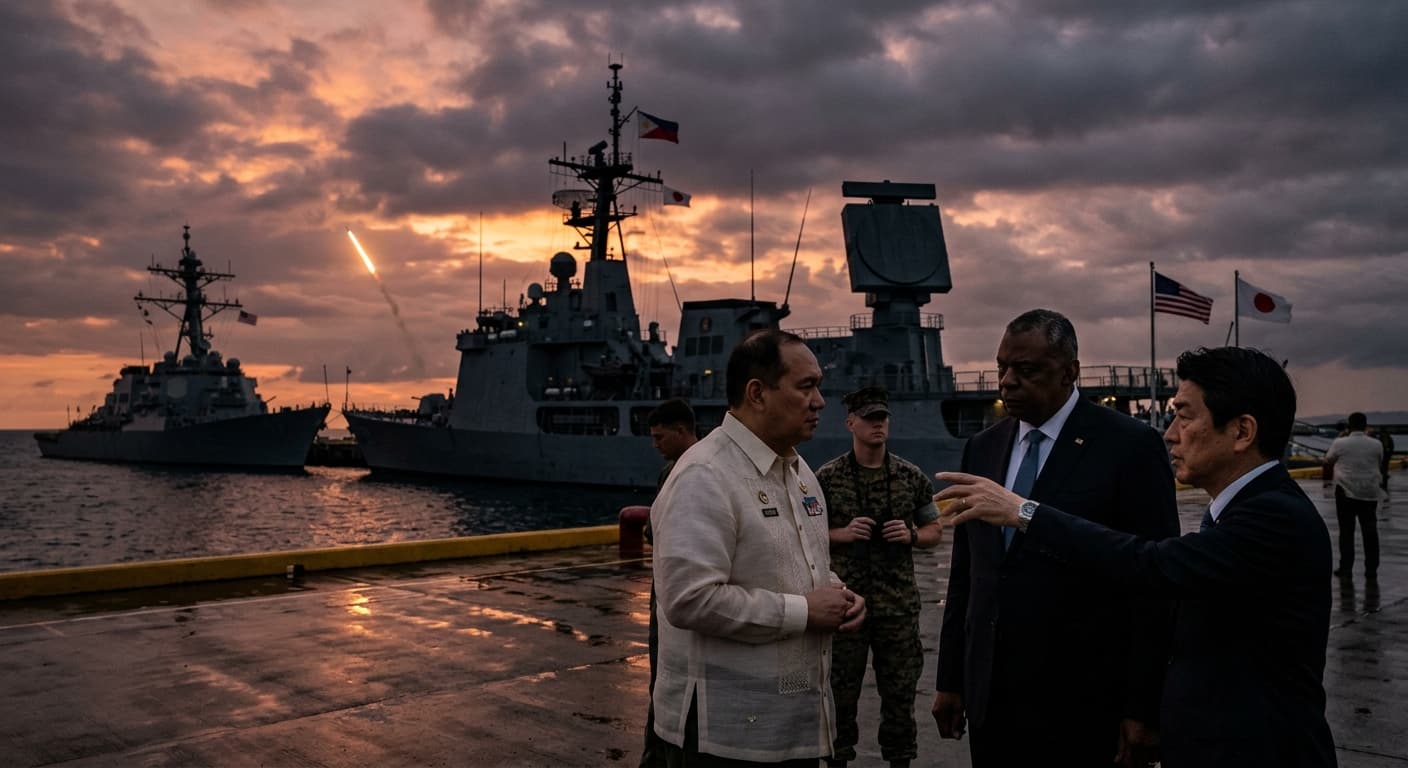
Manila reads the missile: how China's SLBM test hardens the Indo-Pacific
Beijing's July 6 submarine-launched missile likely overflew the Philippines and landed inside a nuclear-free zone. Manila's response tells you where Indo-Pacific security is heading.
The Chinese submarine-launched ballistic missile that arced 7,300 kilometres over the Western Pacific on July 6, 2026, was pitched by Beijing as an "annual training" event — but its flight path almost certainly crossed the Philippines, and the response from Manila two days later reveals the real story: the archipelago that spent 2024 hedging between Washington and Beijing has, by mid-2026, effectively completed its pivot into the U.S.-Japan security architecture, and China's missile test has now made that alignment popular at home. That is the strategic shift that matters — not the warhead, which was a dummy, but the political consolidation the test just accelerated across the first island chain.
The Department of Foreign Affairs said on July 8 it "notes with concern China's launch of an unarmed ballistic missile from a submarine into the Pacific Ocean," urging Beijing to "exercise restraint" and act "with greater transparency," per the Philippine Star. The Department of National Defense went further, calling the launch a "reckless display of military power" that "undermines smaller countries and fragile ecological systems." Defense Secretary Gilberto Teodoro — himself sanctioned by Beijing on June 11 and barred from entering China, Hong Kong and Macau, as
Al Jazeera reported — is now the face of the Philippine response.
What actually happened, and why the geography is the story
At 04:01 UTC on July 6, a Chinese nuclear-powered ballistic missile submarine fired what analysts at the Center for Strategic and International Studies assess to be either a JL-2 or the newer JL-3 from a bastion inside the South China Sea. The missile carried a simulated warhead roughly 7,300 kilometres and splashed down inside the South Pacific Nuclear Free Zone, according to a CSIS analysis published the same week. It was, CSIS notes, the first time China has ever launched an SLBM into international open waters — a change in Beijing's decades-long posture of testing internally into the Taklamakan Desert.
The trajectory matters more than the missile designation. CSIS assesses the flight path "likely overflew parts of the Philippines," and navigation warning data indicates Beijing had queued a second option — a Bohai-Sea-to-Pacific track that would have overflown Japan — but chose the southern route. That routing choice, whether deliberate or operational, delivered a message no Xinhua statement about "annual training" can walk back. As the Economist noted, China has never confirmed its boomer patrols in more than a decade; publicising this one was the point.
The landing zone compounds the diplomatic damage. The United Nations records that China ratified Protocols II and III of the 1985 Treaty of Rarotonga on October 10, 1988 — protocols that require nuclear-weapon states not to test nuclear explosive devices within the South Pacific Nuclear Free Zone and not to threaten its parties with such weapons. The July 6 warhead was inert. But as Lowy Institute analyst Oliver Nobetau put it in a
sharp assessment published the next day, "the missile that carried it can carry a real one, and that capability, deployed in the same waters and on the same day as the Ocean of Peace Alliance was agreed, is exactly what Pacific nations have spent decades trying to keep out of their backyard."
The angle: Manila's alignment is now bipartisan common sense
The load-bearing shift is domestic. Through 2023 and early 2024, opposition figures — the Makabayan bloc, former Cagayan governor Manuel Mamba, elements of the Duterte camp — argued that Philippine hosting of U.S. Typhon missiles at Enhanced Defense Cooperation Agreement sites was needlessly provocative. The Congressional Research Service documents how the Typhon deployment to northern Luzon in April 2024, and Manila's stated intention to purchase the system, drew Beijing's warning of an "arms race."
The July 6 test collapses that argument. When a Chinese SSBN fires a nuclear-capable missile from waters Beijing itself claims — the South China Sea "bastion" — on a trajectory that likely overflies Filipino territory, the case that U.S. medium-range fires in Ilocos Norte are the escalatory variable becomes harder to make. This is precisely what Philippine Defense Secretary Teodoro exploited on July 8, framing the test as vindication of the government's alliance policy. It is also why the U.S. embassy in Manila moved within 24 hours to reaffirm mutual-defence commitments, per Politiko.
The nut of the analysis: Beijing has now supplied the political oxygen its critics in Manila needed. The 2028 presidential election — the first serious test of whether the Marcos administration's hard turn toward Washington and Tokyo survives — was expected to open space for a Duterte-style rapprochement. CSIS-affiliated analysts at CNAS warned in their 2026 trilateral report that "domestic political constraints within the Philippines in the lead-up to the Philippine presidential election in 2028" could complicate cooperation. A missile overflight closes that window considerably.
Why the notification protocol is the diplomat's real fight
Behind the outrage over the flight path sits a narrower, more consequential dispute over rules of the road. China is not a party to the Hague Code of Conduct against Ballistic Missile Proliferation. CSIS records that Beijing gave "mere hours of advance notice" to the United States and Japan before the July 6 launch, and roughly 23 hours to Australia — a pattern that mirrors its September 25, 2024 DF-31 test, when the BBC documented similar complaints from Tokyo and Canberra.
Manila's July 8 DFA statement notably concedes that "prior notification" was in fact provided to Philippine authorities on July 5 — a first. That single acknowledgment is doing significant diplomatic work. It signals Manila will not accuse Beijing of a surprise attack scenario, preserving space for the People's Republic to argue that a bilateral notification protocol is workable. But it also positions the Philippines to demand — with Japan, Australia and New Zealand — that any such protocol conform to the HCOC standard rather than to Beijing's ad hoc practice. As CSIS argues, without codified procedures, tests like these "mirror a real missile attack in several ways" and "increase the chance of miscalculation."
The wider pattern is a Chinese nuclear force emerging from decades of opacity. The Pentagon's 2025 China Military Power Report, cited in a CSIS breakdown of Beijing's September 3, 2025 Victory Day parade, estimates China's arsenal at roughly 600 nuclear weapons — double its 2020 stockpile — with a trajectory toward 1,000 by 2030. The parade unveiled the JL-3 SLBM publicly for the first time. Ten months later, an SLBM launched into international waters is no longer a surprise; it is the operational demonstration of a doctrine Beijing has now decided to advertise. Missile analyst Ankit Panda told the BBC the test "will be a stark reminder to the region and to the US that nuclear dynamics in Asia are quickly changing."
The regional realignment the test accelerated
The choreography around the launch is what makes this a strategic inflection rather than a tactical incident. Within hours of the missile's splashdown:
- Australia's Prime Minister Anthony Albanese was in Suva signing the "Ocean of Peace Alliance" with Fiji — the fourth in a run of Pacific security pacts that also includes agreements with Papua New Guinea, Vanuatu and Nauru, per the
Lowy Institute;
- Solomon Islands' Prime Minister Matthew Wale, who signed the 2022 China security pact that first alarmed Canberra, publicly called the test "not something a friend does";
- The U.S. State Department, per multiple outlets including
Al Jazeera, demanded China honour its UN Security Council commitments on ICBM notifications;
- Manila's DFA and DND issued paired condemnations coordinated with U.S. embassy messaging.
Add to this the trilateral U.S.-Japan-Philippines architecture consolidated at the July 11, 2025 Kuala Lumpur ministerial recorded by the Philippine DFA, plus Canada's upgraded role in the 2026 Balikatan exercises, and the direction is unmistakable: China's demonstration of reach has coincided with — and reinforced — a hardening ring of security agreements running from northern Luzon through the Ryukyus and out into the South Pacific.
The counterview deserves airtime. The United States Studies Centre has argued the test was primarily a technical validation of the JL-3, timed to a Sino-Russian Joint Sea 2026 exercise in Qingdao rather than a signal to Fiji or Manila. Carnegie Endowment's
Proliferation News briefing on July 7 highlighted a New York Times analysis suggesting the launch was aimed as much at domestic Chinese audiences — a PLA Navy that has been "battered for years by mass removals of commanders" — as at foreign capitals. Both are plausible. Neither undoes the political effect in Manila.
What Manila does and does not have to worry about
Two second-order effects deserve attention.
First, the South China Sea grey zone continues on a separate track. The Asia Maritime Transparency Initiative's AIS analysis of Scarborough Shoal for the first half of 2026 found 112 days of observed interactions between China Coast Guard and Philippine vessels, and CCG presence "beyond any previously observed CCG activity in the South China Sea since AMTI began regular AIS tracking in 2019." A May 27 encounter between the CCG 21563 and BRP Datu Pagbuaya sits alongside the deployment and June 17 removal of a floating "research facility" inside the shoal lagoon. The missile test does not change this ledger; if anything, it provides Manila cover to escalate diplomatic protest at Scarborough while the Pacific outrage runs.
Second, the ecological line the DND took — "fragile ecological systems" — is not throwaway rhetoric. It anchors the Philippine response inside the Rarotonga framework, aligning Manila's messaging with Pacific Island Forum states rather than treating this as a bilateral spat. That is smart diplomacy: it makes Beijing negotiate with a bloc rather than a claimant.
What to watch next
Three concrete catalysts will tell you whether the July 6 test hardens into a durable realignment or fades into background noise:
- July 10–11, 2026, Honiara. Albanese hosts PNG Prime Minister Marape and Tongan Prime Minister Lord Fakafanua as the Pukpuk Treaty with PNG comes into force. Watch whether Wale's proposed regional security treaty gains traction — a Pacific-wide instrument would be the most durable answer to the missile.
- The next Philippine diplomatic protest at Scarborough. Manila now has political room to escalate. A summoning of Chinese Ambassador Jing Quan over the missile overflight, rather than only over shoal encounters, would signal a shift from managed friction to sustained pressure.
- Beijing's response on notifications. China has two moves: codify a bilateral notification arrangement with regional states (a limited win for Xi), or continue the ad hoc pattern and further isolate itself in the Pacific. The former requires the PLA to accept transparency it has resisted; the latter guarantees more Ocean-of-Peace-style agreements.
Diplomat View
The Philippines has been telling anyone who would listen since 2023 that the South China Sea is not a bilateral dispute. On July 6, Beijing accidentally proved the point by firing a nuclear-capable missile across an arc that touched three regional theatres at once — Filipino territory, the Pacific Nuclear Free Zone, and an Australia–Fiji signing ceremony. Our forecast: the practical effect of this test is not to intimidate Manila but to price out any Duterte-style rapprochement in the 2028 Philippine election cycle, and to lock in a trilateral U.S.-Japan-Philippines defence posture that would otherwise have been vulnerable to Trump-era transactional bargaining. We would revise this call if two things happen: if Beijing offers a codified missile-notification protocol acceptable to Manila within six months, or if a serious Chinese economic package to a post-Marcos front-runner reopens the door Duterte closed on U.S. bases. Neither looks likely today. What looks likely is that the JL-class submarine that fired the missile has, at a stroke, converted every ambiguity in Philippine alliance politics into a settled fact.
The Bottom Line
China's July 6 SLBM test was pitched as annual training and framed by Beijing as a technical exercise, but its 7,300-kilometre flight path over the Philippines and into the South Pacific Nuclear Free Zone made it a political act with regional consequences. By supplying the very evidence Filipino advocates of the U.S.-Japan alignment have long invoked, Beijing has effectively guaranteed the durability of a security architecture — Typhon missiles in Luzon, Japanese reciprocal access, Canadian and Australian force integration — it had every strategic incentive to disrupt. The lesson of this week is that the Indo-Pacific's realignment is no longer a Washington project; it is now, unmistakably, a Beijing-accelerated one.
Discover more

US Politics
US Launches $166B Tariff Refund Portal
The US is launching a $166 billion tariff refund portal to aid importers hit by Trump-era tariffs, with major implications for trade and supply costs.
India
700 Activists Accuse PM Modi of MCC Breach
Over 700 activists allege PM Modi breached election code with a televised address attacking opposition parties just before state elections.

US Politics
SNAP Food Assistance Faces Legal Challenges
In 2026, SNAP faces stricter eligibility rules and mounting legal challenges, threatening food assistance for the millions of Americans who rely on the program.

Economics
Fed's Amex AML order puts correspondent banking on notice
Federal Reserve's Amex AML order requires board-level controls and a 90-day plan; OCC fined the bank $350 million over enterprise-wide deficiencies.