Japan's Yield Shock: $1.2T Trade Impact
How Japan's bond yields affect global markets and Bitcoin.
Model Diplomat7 min readAsia
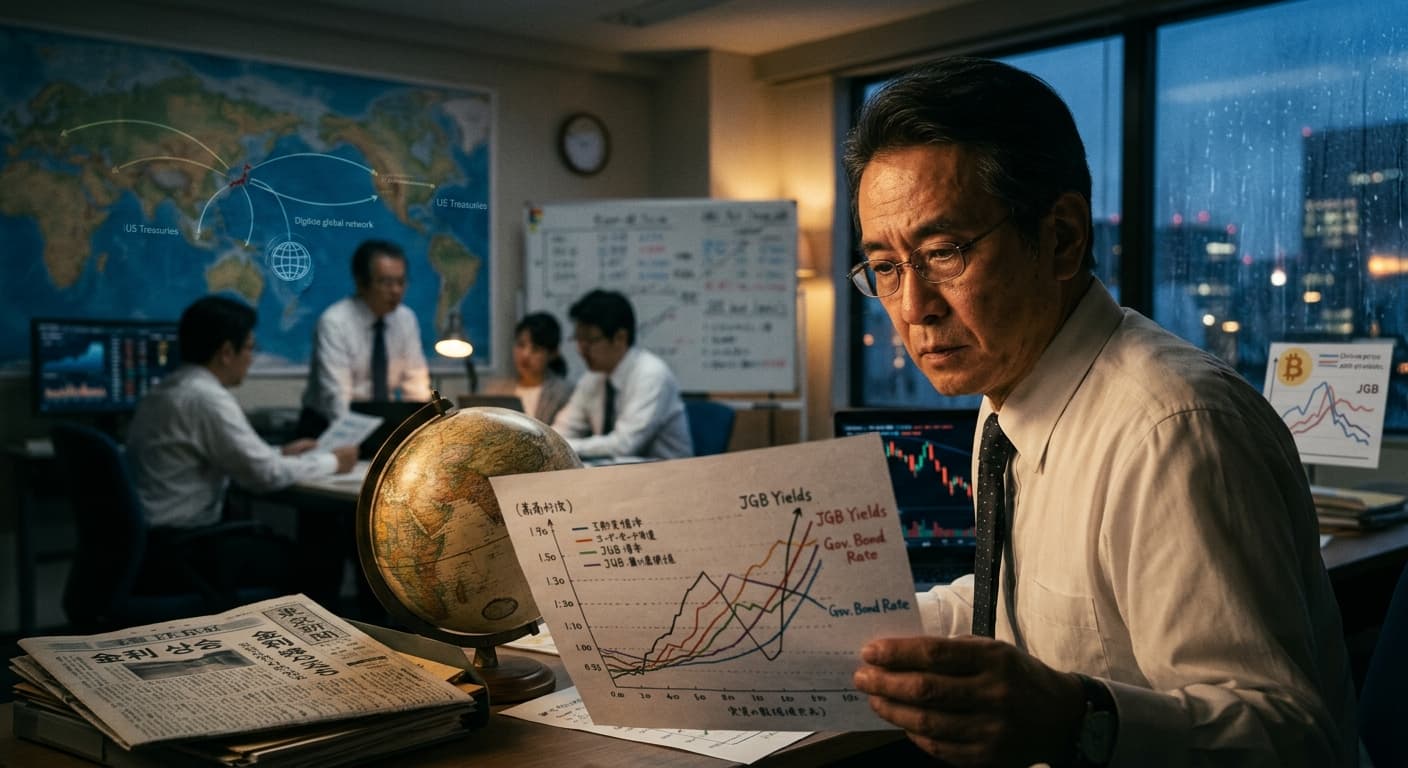
Japan's 30-Year Yield Shock Puts a $1.2 Trillion Trade — and Bitcoin — on Notice
Japan's 10-year JGB hit 2.83% on July 7, 2026, a 30-year high. The real risk isn't Tokyo — it's the yen carry trade funding global crypto and US Treasuries.
Japan's 10-year government bond yield closed at 2.828% on July 7, 2026 — its highest print since 1999 — and the 30-year is flirting with 4%. That's the headline. The story underneath it is that Tokyo, not Washington, has quietly become the marginal price-setter for global risk assets: the Bank of Japan's march from -0.1% to 1% has drained the funding leg of a roughly $500 billion yen carry trade, and every 25-basis-point squeeze now telegraphs directly into Bitcoin, US Treasuries and the emerging-market bid. The question in front of traders isn't whether Japan matters. It's whether Governor Kazuo Ueda's board hikes again on July 31, and how much leverage gets margined out on the way there.
The number, in context
The 10-year JGB has moved roughly 210 basis points in eighteen months. According to the IMF's April 2026 Article IV report on Japan, the yield rose "by around 100 bps in 2025 to reach 2.1 percent by year-end, its highest level since 1999," peaked at 2.3% in January 2026, and has now punched through that on fresh fiscal news. Cryptobriefing reported the 10-year at
about 2.85% and 30-year yields near 4% in early July, with markets pricing roughly a 55% probability of another 25 bp hike this month.
The BOJ has already done the heavy lifting. On June 16 it voted 7–1 to raise the policy rate to 1%, the highest since 1995, citing oil-price pass-through from the US–Israel war on Iran. The
BBC put the move in blunt terms: a 31-year high, executed while Ueda himself was hospitalized. The
BOJ's own Summary of Opinions from that meeting is unusually direct on where the board is headed:
"Unlike in the United States and Europe, Japan's policy interest rate remains below the estimated range of the neutral interest rate. It is necessary to bring the policy rate closer to the neutral rate as soon as possible."
The IMF pegs neutral at 1.1–2.2%. Board members explicitly named 2%. In other words, the July print is not the destination — it is roughly the midpoint.
Why this became a crypto story
Since the August 2024 unwind, the transmission mechanism from Tokyo to risk assets has become almost mechanical. A CSIS analysis published in June 2025 sized yen-funded positions alone at "approximately JPY 80 trillion (USD 500 billion) before the August unwind," with total carry-trade exposure globally "likely exceeds USD 3.6 trillion — representing roughly 3.5 percent of global GDP." The
IMF's October 2024 Global Financial Stability Report attributed the August 2024 volatility spike — TOPIX down 12% in a session — directly to yen carry unwinding after a 25 bp BOJ hike.
Bitcoin sits on the receiving end of that plumbing. A cheap yen, borrowed short and swapped into dollars, funded a meaningful slice of the leveraged bid that took BTC from $60,000 in early 2024 to a $127,000 peak in October 2025. When funding costs rise in Tokyo, the trade compresses. NPR, in its post-mortem on the February 2026 "crypto winter," noted that Bitcoin's collapse from $126,000 to roughly $60,000 was accelerated by "rampant speculation" financed on borrowed money — the classic carry signature. Al Jazeera reported the drop
wiped out every gain since Trump's re-election.
That's the pattern to hold in mind reading today's tape: every BOJ hike since March 2024 has been followed, within four to eight weeks, by a Bitcoin drawdown of 20% or more.
The Takaichi problem
The June and July yield moves are not purely a BOJ story. They are the market pricing a specific fiscal risk: Prime Minister Sanae Takaichi's spending program. Takaichi took office in October 2025 and promptly pledged to pause the consumption tax and expand outlays. Al Jazeera reported that her January announcement sent 40-year JGBs above 4% "for the first on record," with the sell-off spilling into 30-year US Treasuries.
The Economist framed it as "a fiscal–monetary clash": a prime minister who wants easy money, a central bank forced to tighten because oil-fed inflation is spreading through business-to-business pricing, and a bond market caught between them. Japan's
Ministry of Finance already blinked in the FY2026 issuance plan, cutting monthly issuance of 40-, 30- and 20-year bonds by ¥100 billion each — an implicit admission that duration demand has thinned. Yet on June 3, 2026, the MOF was already
revising the plan upward to fund a supplementary budget.
Net public debt of roughly 130% of GDP is not, by itself, the trigger. What has changed is the buyer base. The IMF notes foreign investor participation in JGB auctions "expanded substantially in 2025," offsetting a structural decline in domestic demand — but making the market "more sensitive to fiscal news and global developments." Japan is, for the first time in a generation, being disciplined by price-sensitive money.
The non-obvious spillover: Treasuries, not Tokyo, take the hit
The Council on Foreign Relations warned in 2024 that Japanese investors held enormous foreign bond stockpiles built during a decade of yield-curve control. Al Jazeera pegged the Japanese Treasury holding at $1.2 trillion in late 2025 — the single largest foreign owner of US government debt. When the JGB curve offers 2.8% at 10 years, hedged into yen, US Treasuries at 4.2% no longer clear on a risk-adjusted basis. The
Financial Times reported fund managers now expect Japanese life insurers and megabanks to sell Treasuries to buy JGBs — the "repatriation trade" that has been theorized for a decade and is finally showing up in the flow data.
That is the second-order effect that reframes the whole story. The country most exposed to Japan's yield shock is the United States. Higher long-end US yields tighten global financial conditions, weigh on risk assets from Bitcoin to Brazilian equities, and raise Washington's own debt-service bill at a moment when the US deficit is running above 6% of GDP. A CryptoBriefing analysis of the yen's 40-year low put the currency at 162.30/USD despite the widening rate gap — a signal, the IMF confirms, that "a large portion of yen movements since mid-2025 cannot be accounted for by differentials or other fundamentals" and instead reflect positioning in futures markets.
Translation: the yen is now being pushed around by hedge-fund flow rather than macro fundamentals. That is exactly the setup that snapped in August 2024.
Who benefits, who bleeds
The winners are narrower than the panic suggests. Japanese life insurers — Nippon Life, Dai-ichi, Meiji Yasuda — finally get a domestic yield they can match against yen liabilities without taking currency risk. Japanese megabanks (MUFG, SMFG, Mizuho) see net interest margins expand for the first time since the 1990s. Norinchukin, which took spectacular losses on unhedged Treasuries in 2024, gets a domestic escape valve.
The losers are more consequential. US Treasury issuance now has to clear at a higher price without its largest marginal buyer. Emerging-market sovereigns that funded in dollars during the free-money era face refinancing walls into a tighter global rate environment. Leveraged crypto — particularly Bitcoin-collateralized lending desks and perpetual-futures books running yen-denominated funding — faces the same margin-call math that produced the August 2024 flush. And Takaichi herself is boxed in: her fiscal program requires low yields the BOJ is no longer willing to guarantee.
Diplomat View
The June hike was not the end of Japan's normalization — it was the beginning of the fiscal-monetary confrontation the country has avoided for 25 years. The base case is that the BOJ hikes again on July 31 to 1.25%, sending the 10-year JGB toward 3% and the 30-year through 4%. That would compress the carry trade further, trigger another leg of Japanese Treasury selling, and put fresh pressure on Bitcoin as leveraged longs de-risk. Expect a Bitcoin drawdown of 15–25% within eight weeks of the next hike, tracking the pattern of every BOJ move since March 2024.
What would change the call: a formal US–Japan currency intervention (the FT has flagged rumors); a Takaichi retreat on the consumption-tax pause; or a Middle East de-escalation that pulls oil below $70 and lets the BOJ pause. Absent one of those, the July 31 meeting is the pivot. Watch the 40-year auction results and the wording of the BOJ's Outlook Report — if "neutral" is repeated, the terminal rate reprices to 1.75%, and crypto has its next macro problem.
What to watch next
- July 15, 2026 — 20-year JGB auction. First real test of super-long demand after the MOF's June supplementary issuance revision.
- July 31, 2026 — BOJ Monetary Policy Meeting and quarterly Outlook Report. Markets pricing ~55% odds of a hike to 1.25%.
- August 1, 2026 — Anniversary of the 2024 carry-trade unwind. Positioning data from CFTC and BIS will show whether the $500 billion yen-funded stack has been reduced or merely rolled.
The Bottom Line
Japan's 30-year yield high is not a Tokyo story — it is the moment the world's cheapest funding currency stopped being cheap, and that reprices every leveraged trade downstream, from US Treasuries to Bitcoin. If the BOJ hikes again on July 31, the carry trade that has quietly underwritten this cycle's risk rally comes apart in slow motion, and the biggest loser is not Japanese debt but American duration. Traders who still think Japan is a sideshow are about to find out otherwise.
Discover more

US Politics
SNAP Food Assistance Faces Legal Challenges
In 2026, SNAP faces stricter eligibility rules and mounting legal challenges, threatening food assistance for the millions of Americans who rely on the program.

India
Women’s Reservation Bill 2026
The Constitution (131st Amendment) Bill, 2026 was defeated in Lok Sabha, revealing deeper political conflicts over women's reservation and delimitation.
India
Congress Accuses Modi of Stalling Women's Law
Congress accuses Modi of stalling women's reservation law by linking it to delimitation, revealing a deeper electoral strategy.

Economics
Fed's Amex AML order puts correspondent banking on notice
Federal Reserve's Amex AML order requires board-level controls and a 90-day plan; OCC fined the bank $350 million over enterprise-wide deficiencies.