Israel Defies Trump on Lebanon, Syria and
Israel's three-zone entrenchment threatens the US-Iran ceasefire
Model Diplomat9 min readMiddle East
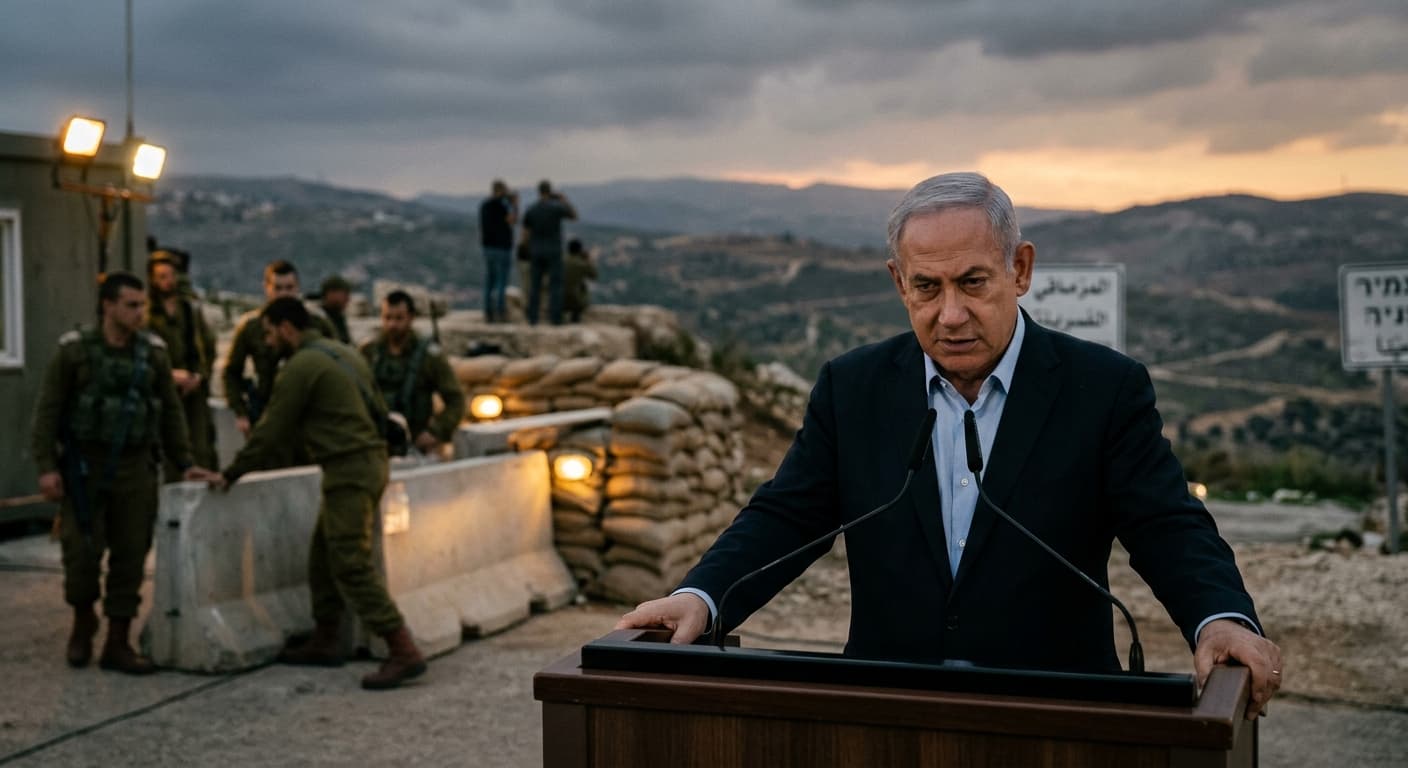
Israel Defies Trump on Lebanon, Syria and Gaza — Betting Its Security Veto Outlasts the US-Iran Deal
Israel's July 16 refusal to withdraw from "security zones" in Lebanon, Syria and Gaza is the single greatest threat to the US-Iran ceasefire — and Tehran is using Israel's occupation as a legal pretext to slow-walk the 60-day clock toward an August deadline for a binding UN deal.
Israel's Defence Minister Israel Katz told Pentagon chief Pete Hegseth overnight on July 16, 2026 that Israel is "determined" to keep forces in security zones carved out inside Lebanon, Syria and the Gaza Strip, according to a statement from Katz's office The Straits Times. The call came days after US President Donald Trump told Prime Minister Benjamin Netanyahu to pull Israeli forces out of Syria and Lebanon, with Trump telling him, "They don't want you there. You should redeploy," according to Axios
BBC. Israel is betting that its security veto outranks Trump's peace agenda — and the structural evidence says Israel is right.
The reason this matters is not the troop count. It is that the Israeli deployment directly contradicts the first clause of the US-Iran Memorandum of Understanding signed at Versailles on June 17, which declares "the immediate and permanent termination of military operations on all fronts, including in Lebanon" and binds both sides to "ensuring the territorial integrity and sovereignty of Lebanon" BBC. Iran has warned that any continued Israeli presence in Lebanese territory constitutes a violation of the MoU. Israel's answer — to ring-fence roughly 1,000 sq km of neighbouring territory as permanent "security zones" — gives Tehran both a legitimate grievance and a reason to stall the final-status talks that must conclude within 60 days, around August 16
Al Jazeera Investigative Unit.
Three Zones, One Logic
The "security zone" is not new terminology. Israel maintained a self-declared security zone in southern Lebanon from 1985 until its chaotic unilateral withdrawal in 2000 — a precedent analysts cite as a cautionary tale of strategic overextension. What is different now is the scale and the simultaneity: Israel is running three buffer zones at once, backed by a security logic that frames every neighbouring territory as a potential staging ground for Iranian-aligned forces.
In Lebanon, Israeli forces remain deployed in a zone extending roughly 10 km into Lebanese territory, covering approximately 570 sq km — about 6 percent of the country Al Jazeera. Netanyahu has said the military "will not leave" the area as long as Hezbollah remains a "threat," and Katz has vowed Israel will not withdraw "a millimetre" until Hezbollah is disarmed. Israeli troops have crossed the Litani River — the line that UN Security Council Resolution 1701 (2006) designates as the northern limit of an area that should be "free of any armed personnel, assets and weapons" other than the Lebanese army and UNIFIL peacekeepers
UN Peacemaker. UNIFIL has confirmed that Israeli forces have built concrete walls across the Blue Line, making more than 4,000 sq m of Lebanese territory inaccessible, and has fired on peacekeepers — actions the UN force called "serious violations" of Resolution 1701
Al Jazeera.
In Syria, Israel moved troops into the UN-patrolled buffer zone on the Golan Heights after the fall of Bashar al-Assad in December 2024, and has since built what Al Jazeera's investigative unit estimates as a 235 sq km network of fixed military positions beyond the 1974 "Alpha Line" disengagement boundary, stretching from Mount Hermon to the Yarmouk River. The UN Disengagement Observer Force (UNDOF) has reported "severe violations" of the 1974 ceasefire agreement, with Israeli trenches crossing into the Area of Separation BBC. The UN Security Council adopted Resolution 2799, calling for "the full sovereignty, unity, independence, and territorial integrity of Syria," and the UN's deputy envoy for Syria, Najat Rochdi, urged Israel to halt its operations in the Golan
Al Jazeera. Trump has repeatedly suggested that Syria's new government, led by Ahmad al-Sharaa, should "handle Hezbollah" — an idea Damascus has explicitly rejected
Al Jazeera.
In Gaza, Israel's military controls 60 percent of the territory and is present on the entire perimeter along the borders with Israel and Egypt. Following an October 2025 ceasefire, the Israeli military introduced a "Yellow Line" delineating control over roughly 200 sq km. Katz said in April 2025 that Israeli troops would remain in security zones in Gaza, Lebanon and Syria "indefinitely" as a "buffer between the enemy and [Israeli] communities" Al Jazeera.
The MoU's Central Contradiction
The US-Iran MoU was designed to end the regional war that began on February 28, 2026, when the US and Israel launched strikes on Iran, killing Supreme Leader Ayatollah Ali Khamenei on the first day. The 14-point agreement, signed by Trump and Iranian President Masoud Pezeshkian, commits both sides to negotiating a final deal within 60 days, extendable by mutual consent. That final deal is to be "endorsed by a binding United Nations Security Council (UNSC) resolution" BBC.
But Point 1 of the MoU — the cessation clause covering Lebanon — is structurally unenforceable without Israel's compliance, and Israel is not a signatory. The agreement obligates the US and Iran to ensure "the territorial integrity and sovereignty of Lebanon," but the US has no mechanism to compel Israeli withdrawal short of cutting military aid, which Trump has not threatened. Instead, the US has pursued a parallel track: a separate framework agreement between Israel and Lebanon, brokered by Secretary of State Marco Rubio and announced on June 26 Al Jazeera. That framework envisages "pilot zones" in southern Lebanon from which Israeli forces would begin withdrawing, in exchange for the Lebanese army taking control and disarming Hezbollah. Rubio declared: "Iran is out, Hezbollah is out, and the road to peace between Israel and Lebanon is in"
BBC.
The problem is that the framework does not set a timetable for Israel's full withdrawal, and Israeli officials have vowed to remain in the 10 km security zone regardless. Hezbollah, which was not party to the agreement, has rejected it outright. Leader Naim Qassem demanded Israel leave "unconditionally." The result is an agreement that satisfies neither party to the actual conflict.
Who Benefits, Who Loses
The winner in this configuration is not Israel, despite the territorial gains. It is Iran. Tehran has insisted since the first round of US-Iran talks in April 2026 that an end to Israeli military operations in Lebanon is a prerequisite for any broader peace deal. By remaining in Lebanon, Israel hands Iran a legal basis to argue the US is failing to uphold its own MoU obligations. Iranian Foreign Minister Abbas Araghchi has warned that "any continuation of Israeli military operations in Lebanon would constitute a violation of the understanding" and that "necessary measures will be taken" Al Jazeera. The first round of final-status talks in Switzerland produced what mediators Qatar and Pakistan called "encouraging progress," including a "de-confliction cell" for Lebanon — but Araghchi called Lebanon "the first real test" of the deal's viability
BBC.
Israel's security establishment gains a "picture of victory" for its domestic base — territory it can point to as proof the October 7, 2023 failure will not be repeated. Analyst Orni Jabareen, cited in Al Jazeera's investigation, argued that "because he cannot say that Hamas is finished, nor that Hezbollah has been disarmed, nor that Iran is permanently deterred… control over the land becomes the 'language of victory' when the language of decisive military success fails" Al Jazeera Investigative Unit. But this is a short-term political gain against a long-term strategic cost: controlling 1,000 sq km across three fronts requires supply routes, fortifications, and sustained reserve mobilisation — what Jabareen called "structural attrition."
The losers are clear. Lebanon's territorial sovereignty is shredded: 2,036 Israeli violations were documented in October–December 2025 alone, and entire villages near the border are slated for demolition under what Katz described as a model "according to Rafah and Beit Hanoun in Gaza" BBC. Syria's new government, already fragile, faces an open-ended Israeli military presence in its southwest that undercuts its authority. The UN's institutional credibility erodes: both Resolution 1701 and the 1974 disengagement agreement are being openly flouted with no enforcement mechanism beyond complaints.
The Historical Parallel That Should Worry Jerusalem
Israel's last attempt at a permanent security zone in southern Lebanon lasted 15 years and ended in a unilateral withdrawal that Hezbollah framed — and the Arab street largely accepted — as a military defeat. The 1985–2000 occupation cost Israel 256 soldiers' lives, fed Hezbollah's rise as a political and military force, and produced no durable security arrangement. Analyst Wiam Abu Amer, cited in Al Jazeera's investigation, drew the parallel directly: "Israel's historical attempt at maintaining a 'security belt' in southern Lebanon ended in a chaotic withdrawal in 2000. Today, acting with an 'imperial mindset,' Israel is severely overstretching its relatively small reserve army and pressured economy" Al Jazeera Investigative Unit.
There is also a more recent precedent. A 1983 tripartite agreement between Lebanon and Israel collapsed, followed by attacks on international peacekeepers and the US embassy — after which Hezbollah emerged as a dominant security actor in southern Lebanon Al Jazeera. The current framework, which sidesteps Hezbollah's buy-in, risks repeating that cycle.
The Pressure Point: Trump's Leverage
Trump's leverage over Netanyahu is real but bounded. In a phone call reported by Axios, Trump told Netanyahu: "Bibi, you better be careful, or you will be on your own very soon" — a threat to withdraw US backing if Israel reignited the Iran conflict BBC. Trump also publicly described Netanyahu as "effing crazy" and accused him of ingratitude over the Lebanon campaign
BBC. When Trump announced a Lebanon ceasefire in April, Israel's security cabinet was given five minutes' notice and no vote
BBC.
But Trump has not conditioned military aid on withdrawal, and Netanyahu has calculated that Trump's domestic political base will not tolerate a public breach with Israel. Netanyahu dismissed the tensions as "tactical disagreements" and told CNBC that the two "always find a way to work them out." The question is whether Trump will escalate from private exasperation to public coercion — and whether that would come before or after the 60-day MoU clock expires.
The sixth round of US-brokered Israel-Lebanon talks concluded in Rome on July 15, with a US official calling the meetings "productive and positive" and saying the parties "agreed on the structure and guidelines for the pilot zone process, to be finalised and implemented in the coming days" Al Jazeera. The towns under discussion for the first pilot zones include Zawtar al-Gharbiyah, Zawtar al-Sharqiyah, al-Ghandouriyah, Burj Qalawiyah, Sarifa and Frun — all within the area Israel now occupies. Sami Halabi, director of policy at the Badil Institute, warned that the process "could fall apart at any time" and that "any misstep could lead us to an all-out conflict."
What to Watch
- Pilot zone implementation, late July 2026. The Rome talks agreed on structure and guidelines for two pilot zones. If Israel physically hands over even one zone to the Lebanese army, it tests whether incremental withdrawal is possible. If it stalls, the framework collapses and Iran's argument that the US cannot deliver on the MoU strengthens.
- US-Iran final-status talks, August 16 deadline. The 60-day MoU clock runs out around August 16, extendable by mutual consent. Iran's willingness to extend — or its refusal — will be conditioned on whether Israel has moved on Lebanon. Araghchi has called Lebanon "the first real test."
- UNSC engagement on Resolution 2799 and 1701 enforcement. Lebanon has filed formal complaints documenting 2,036 violations in three months. If the Security Council moves from complaint to resolution — particularly with European support — Israel faces a binding legal challenge it cannot dismiss as bilateral.
- Hezbollah's response to pilot zones. Hezbollah has rejected the framework and demanded unconditional withdrawal. If Lebanese army deployment to pilot zones triggers clashes with Hezbollah fighters rather than with Israel, the framework's core premise — that Beirut can substitute for Jerusalem as the security actor in the south — fails.
The Bottom Line
Israel's three-zone entrenchment is not a negotiating position — it is a fait accompli designed to outlast whatever diplomatic instrument the US and Iran produce. The 60-day MoU clock gives Iran a deadline and Israel a veto, and the side that moves first will determine whether the region gets a binding UN Security Council resolution or a return to open war. If the pilot zones fail, the MoU fails with them — and Israel will have traded 1,000 sq km of temporary control for the permanent conflict it claims the zones were built to prevent.
Discover more
India
Congress Accuses Modi of Stalling Women's Law
Congress accuses Modi of stalling women's reservation law by linking it to delimitation, revealing a deeper electoral strategy.
Global Politics
US-Iran Tensions Rise
Tensions escalate in the Strait of Hormuz as Iran and the US clash over maritime control, with a ceasefire hinging on a contested MoU paragraph.

International Relations
Pakistan's Key Role in US-Israel-Iran Meddle
Pakistan is seeking to mediate the US-Israel-Iran conflict, balancing high-stakes diplomacy against severe economic pressures and steep regional challenges.

Conflict & Security
Drone Warfare Killing Aid Workers at Unprec
Over 1,000 humanitarian workers killed in three years as cheap armed drones collapse legal protections. Gaza, Sudan, Ukraine, and DRC see deliberate targeting of aid convoys and hospitals with zero prosecutions.