Iskander Missiles: 34 Western Parts Each
Ukraine reveals foreign components in Russian missiles
Model Diplomat7 min readEurope
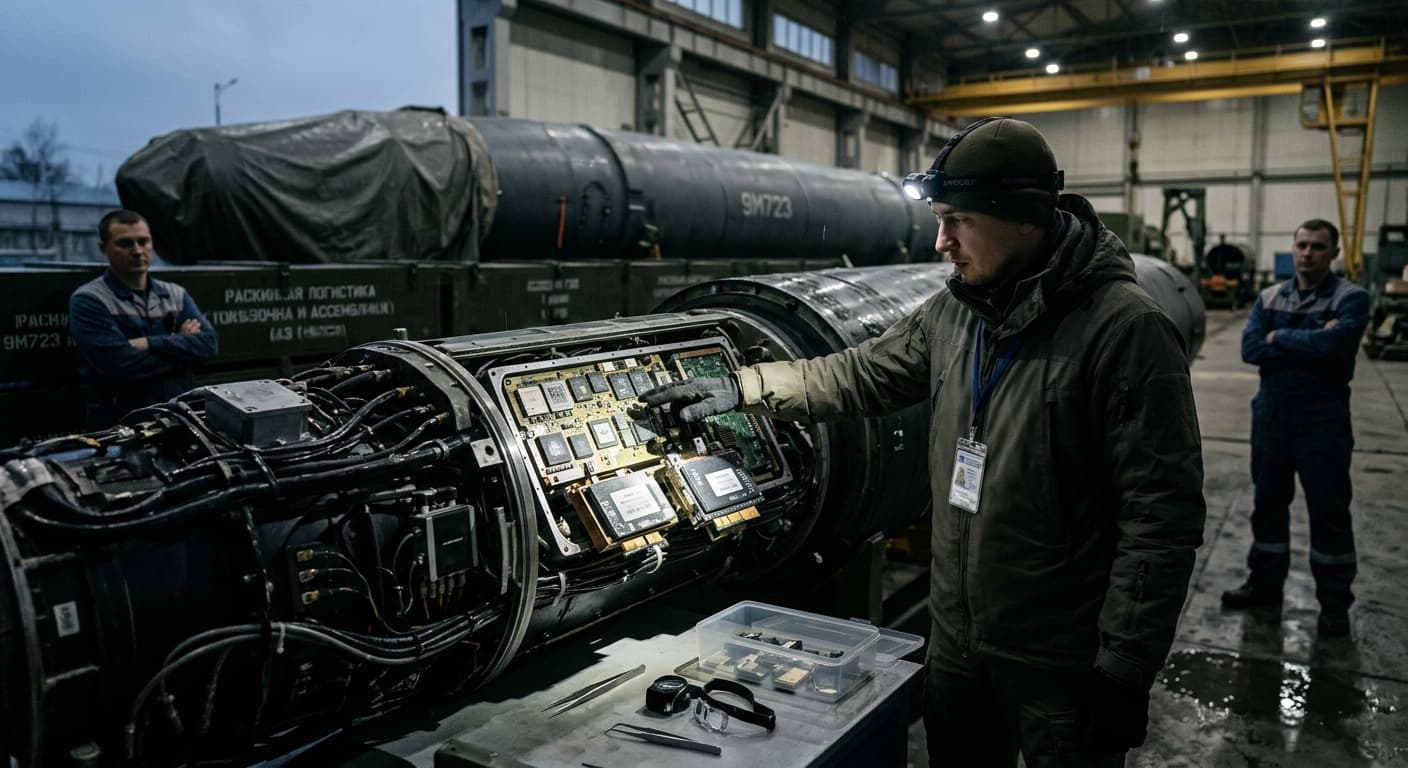
Iskander missiles: 34 Western parts per warhead, and none get shot down
Ukraine says each Russian Iskander-M contains 34 foreign components — mostly American chips — and 23 of them hit Kyiv on July 6 without a single interception.
Each Russian Iskander-M ballistic missile fired at Ukraine carries roughly 34 foreign-made components — the bulk of them microelectronics from American firms including AMD, Texas Instruments, Xilinx and Microchip — and on the night of July 6, 2026, Ukrainian air defences failed to intercept even one of the 23 Iskander-M and modified S-400 ballistic missiles launched at Kyiv, according to Ukraine's presidential sanctions commissioner Vladyslav Vlasiuk. That single salvo delivered an estimated 782 Western-origin parts to their targets. The story is no longer whether sanctions have "leaked" — it is that Russia has industrialised the workaround faster than the G7 has industrialised enforcement, and the delta is now measurable in dead civilians per interceptor missing from a Patriot magazine.
The numbers behind the July 6 salvo
The July 6 attack killed at least 11 people on the eve of the NATO summit in Ankara, per Al Jazeera, and formed the second wave of a bombardment that killed 30 in Kyiv three days earlier. The
BBC reported the Ukrainian Air Force acknowledged a "serious shortage" of interceptor missiles: of 23 ballistic missiles fired, zero were shot down. Across the first week of July, the
Atlantic Council tallied four intercepts out of 49 incoming ballistic missiles — an 8% success rate against the class of weapon that does most of the killing.
Vlasiuk told LIGA.net that the "analysis of the component base of the Iskander-M missile once again confirms that Russia has not been able to get rid of its critical dependence on foreign electronics." He named programmable logic chips, digital signal processors, processors and power modules manufactured by AMD, Texas Instruments, Altera (majority-owned by Silver Lake, with a 49% stake retained by Intel), Xilinx, Microchip Technology, Integrated Device Technology, Cypress Semiconductor and Maxim Integrated — plus power modules from Swiss firm Traco Power. The most damning detail: microelectronics dated 2025 were recovered from Iskander-M airframes manufactured in 2026 — meaning the parts moved from Western fabs to Russian assembly lines in under a year.
The finding is consistent with a much older baseline. In August 2022, the Royal United Services Institute inspected 27 Russian weapons systems and identified more than 450 foreign components, with roughly two-thirds manufactured by US-based firms. In 2024, Bruegel
estimated Russia imported $12.5 billion in Common High Priority List (CHPL) goods in 2023 alone — essentially back to pre-war levels — with more than 90% of foreign parts found in Russian military hardware sourced from Western producers. Four years of sanctions have not moved the composition of a Russian missile.
The industrial gap that sanctions can't close
The scale problem is the story. In early 2023, according to Ukrainian intelligence cited by RUSI, Russia produced roughly six Iskander 9M723 ballistic missiles per month, with a total stockpile of about 50 rounds. By June 2025, the
Konrad-Adenauer-Stiftung put Russian long-range missile production at 200–250 systems per month, citing Ukraine's HUR. The
Atlantic Council documented that Rostec and United Shipbuilding — both under Western sanctions — together posted a 23% year-on-year increase in arms revenue to $31.2 billion in 2024, and that Russia produced roughly 700 Iskander short-range ballistic missiles that year.
RAND assessed in January 2026 that Russia's Votkinsk Machine-Building Plant — the sole assembler of Iskander airframes — had brought on thousands of new machine tools and workers since 2022, with open hiring continuing into 2025. MKB Novator, part of Almaz-Antey, shifted to 24/7 production of Kalibr and Iskander missiles early in the war. Konrad-Adenauer's Air War Monitor tallied roughly 600 Iskander-M and Kinzhal ballistic missiles fired across 2025 and estimated the remaining stockpile at close to 800 units by year-end. That is not a war-fighting inventory. It is strategic reserve — a stockpile aimed as much at future European coercion as at Ukraine.
The Iskander is also getting harder to kill. Al Jazeera quoted Zelensky telling the NATO-Ukraine Council that Russia produces 120 ballistic missiles per month — "twice as many as the Patriot interceptors the United States produces." RUSI's dataset, confirmed by CSIS, puts Ukraine's cumulative intercept rate against Iskander and Kinzhal missiles at 24% since September 2022. In December 2025, a new Iskander-1000 variant — a stretched airframe with a range up to 1,300 km, capable of striking targets deep inside NATO territory — appeared in Russian salvos for the first time.
The three channels — bans that weren't bans
Understanding how 2025-dated chips reach a 2026 Iskander requires understanding the plumbing, and the best forensic work has been done by academic economists. A CEPR / VoxEU analysis by Scheckenhofer, Felbermayr and colleagues, published in early 2026, used transaction-level Russian customs data to separate the three channels through which CHPL-listed goods reached Russia: partial bans written too narrowly, transit loopholes, and re-routing through third countries.
The finding: full product-code-level bans covering all 42 CHPL military-relevant categories were not in place until January 2024 — nearly two years after the invasion. In 2022, imports of partially-sanctioned goods averaged around $36 million monthly, roughly one-fifth of pre-war levels; between September and December 2022 they spiked to 30–40% of pre-war volumes. Transit through Russia to third destinations averaged around 4% of pre-war levels for the year after the invasion because EU sanctions banned exports to Russia but not transit through it. Brussels only began closing this in mid-2023.
The third channel — re-routing through intermediaries — is now the dominant one. Firms outside EU jurisdiction buy in the bloc, ship to Russia via Kyrgyzstan, Kazakhstan, Turkey, the UAE or Hong Kong, and face little legal risk. Vlasiuk stressed this to LIGA.net: enforcement, he argued, must extend beyond direct suppliers to "distributors and intermediary companies through which such products can reach the military-industrial complex of the aggressor country."
Brussels is finally responding. Per the Atlantic Council, the EU's late-April 2026 sanctions package used the bloc's anti-circumvention tool for the first time, banning CNC machine exports to Kyrgyzstan after documenting an 800% surge in EU dual-use technology exports to Bishkek since 2022 and a 1,200% surge in Kyrgyz exports of the same technologies to Russia. That is a first — not a solution. Iskander components arrive through many corridors.
The UK government's own countering-evasion guidance — the primary document that codifies the CHPL for British exporters — is explicit that the list "highlights items that pose a heightened risk of illegal diversion to Russia" and that Russia continues to procure these items "often via third countries." It flags the KSE-run War Sanctions portal and the Trade Integrity Project as the operational databases Western compliance departments should be consulting. That such tooling has to be handed to industry by governments — instead of enforced against industry by them — tells you where the political will has landed.
Who wins, who loses
Winners are easy to name. The Kremlin's air campaign is now built on a technology stack it did not design and cannot replicate — and it works. Votkinsk and MKB Novator are the industrial beneficiaries; the intermediary networks in Hong Kong, Almaty, Dubai and Bishkek take a mark-up on every diverted reel of chips. On the Western side, the semiconductor manufacturers whose parts keep appearing in wreckage face reputational damage but negligible legal exposure — the American Enterprise Institute documented Russian customs entries in which shippers simply added the words "not for military use" to prohibited semiconductor cargoes.
Losers are just as clear. First, Ukrainian civilians in Kyiv, Kryvyi Rih and Dnipro — 57 killed in the first week of July 2026 alone, per the Atlantic Council. Second, the Patriot inventory: Kyiv has received at least ten Patriot batteries and 600-plus interceptors since April 2023, and it is still running dry. Third, European deterrence. If Russia can build 700 Iskanders a year today, on Western silicon, the
RAND analysis is direct: production has decoupled from war-fighting demand and is now stockpiling capacity aimed beyond Ukraine.
The historical parallel worth naming: this is Cocom in reverse. During the Cold War, the Coordinating Committee for Multilateral Export Controls policed a Western-to-Soviet technology transfer regime that, for all its holes, meaningfully slowed Soviet microelectronics for decades. Today's regime — a G7 CHPL plus national implementing rules — replicates Cocom's ambition without its enforcement teeth: no shared prosecutorial forum, no financial-sector screening obligation of the kind Bruegel proposes, and no unified sanctioning entity for third-country intermediaries.
RUSI concluded in 2024 that Western governments have been "overly cautious" and "slow to grant permission" for the kinds of end-to-end procurement disruption that would degrade Russian production. Two years on, the pattern is unchanged.
What to watch
- Ankara NATO summit outcomes (July 2026): whether Zelensky secures firm commitments on additional Patriot batteries and PAC-3 interceptors from European stockpiles, and whether the Prioritized Ukraine Requirements List (PURL) mechanism is expanded beyond its current 70% share of interceptor deliveries.
- The EU's next sanctions package: whether the anti-circumvention tool applied to Kyrgyzstan in April is extended to Kazakhstan, the UAE and Turkey — the routes RUSI, CEPR and KSE all identify as dominant.
- Ukrainian long-range strikes on Votkinsk and the Penza sensor plant:
Atlantic Council reporting indicates Ukraine's "shoot the archer" strategy is targeting semiconductor and launcher infrastructure inside Russia; successful strikes on Votkinsk would do more to constrain Iskander output than any sanctions package to date.
- The Iskander-1000 deployment tempo: if the 1,300-km variant becomes routine in salvos, the threat envelope extends to Warsaw, Berlin and Bucharest, and the political case for pre-emptive European air-defence build-out changes shape overnight.
The bottom line
The bottom line: Russia is now assembling ballistic missiles from Western silicon less than a year old, at a rate faster than the United States produces the interceptors that stop them — and Ukraine's air defence is failing in real time because sanctions enforcement never caught up with Russian procurement. The Iskander is no longer a story about a missile. It is the clearest evidence yet that the G7's export-control regime is a paper Cocom, and that until financial-sector screening and third-country enforcement match the ambition of the Common High Priority List, every ballistic salvo on Kyiv will keep arriving with roughly 34 Western parts each.
Discover more
Conflict & Security
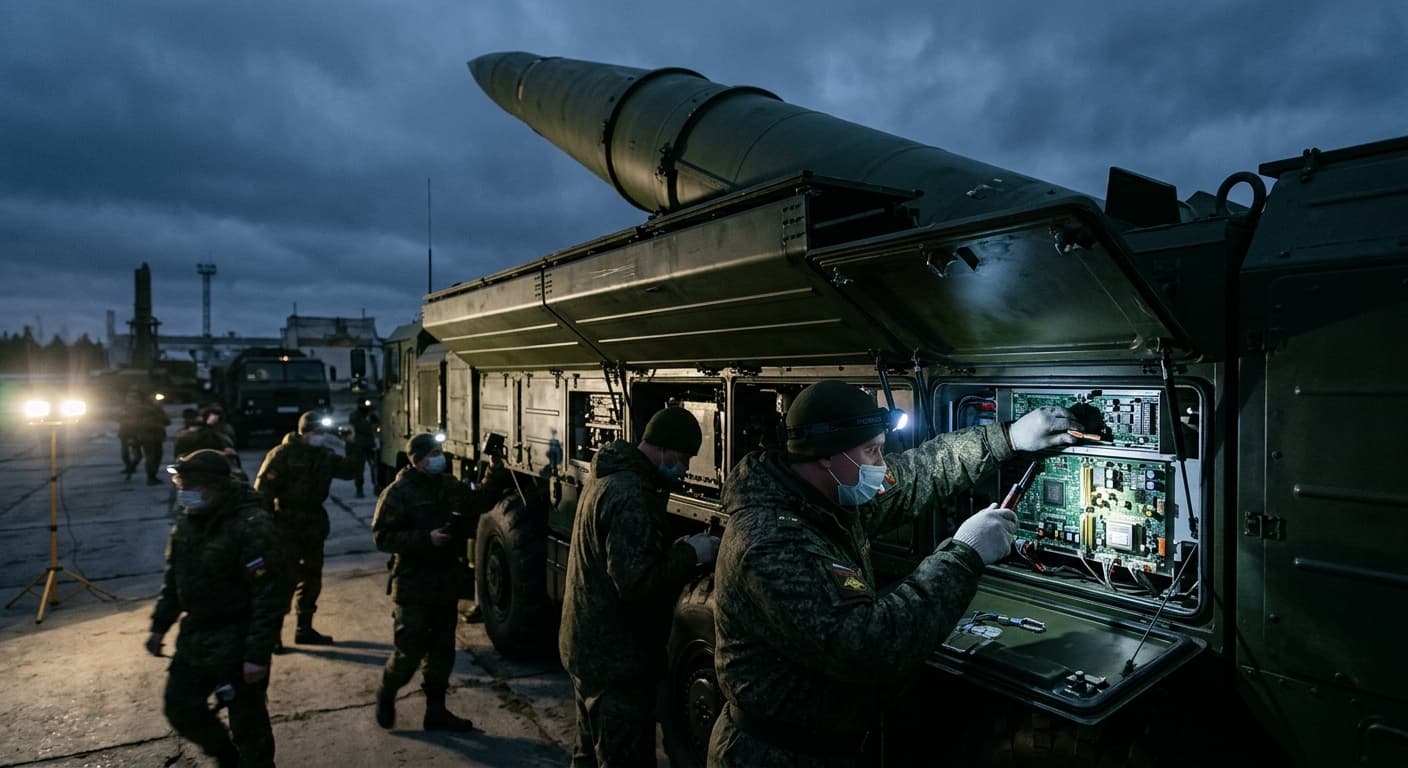
Iskander Missile: 34 Western Parts Feeding
Russia's Iskander missiles contain 34 Western components, undermining sanctions and escalating attacks on Kyiv amid a critical intercept gap.
International Relations
Non-State Actors Winning Africa's Drone Wars
Non-state armed groups in Africa are effectively using drones, challenging state air dominance and forcing a military reckoning.
US Politics
Kyiv’s Robot Army: Ukraine’s AI Warfare
Ukraine is deploying AI-driven drones and battlefield robotics to offset severe manpower shortages against Russia, redefining modern warfare and military tech.

Economics
Fed's Amex AML order puts correspondent banking on notice
Federal Reserve's Amex AML order requires board-level controls and a 90-day plan; OCC fined the bank $350 million over enterprise-wide deficiencies.