Iskander Missile: 34 Western Parts Feeding
Western components bolster Russia's missile attacks on Kyiv.
Model Diplomat9 min readEurope
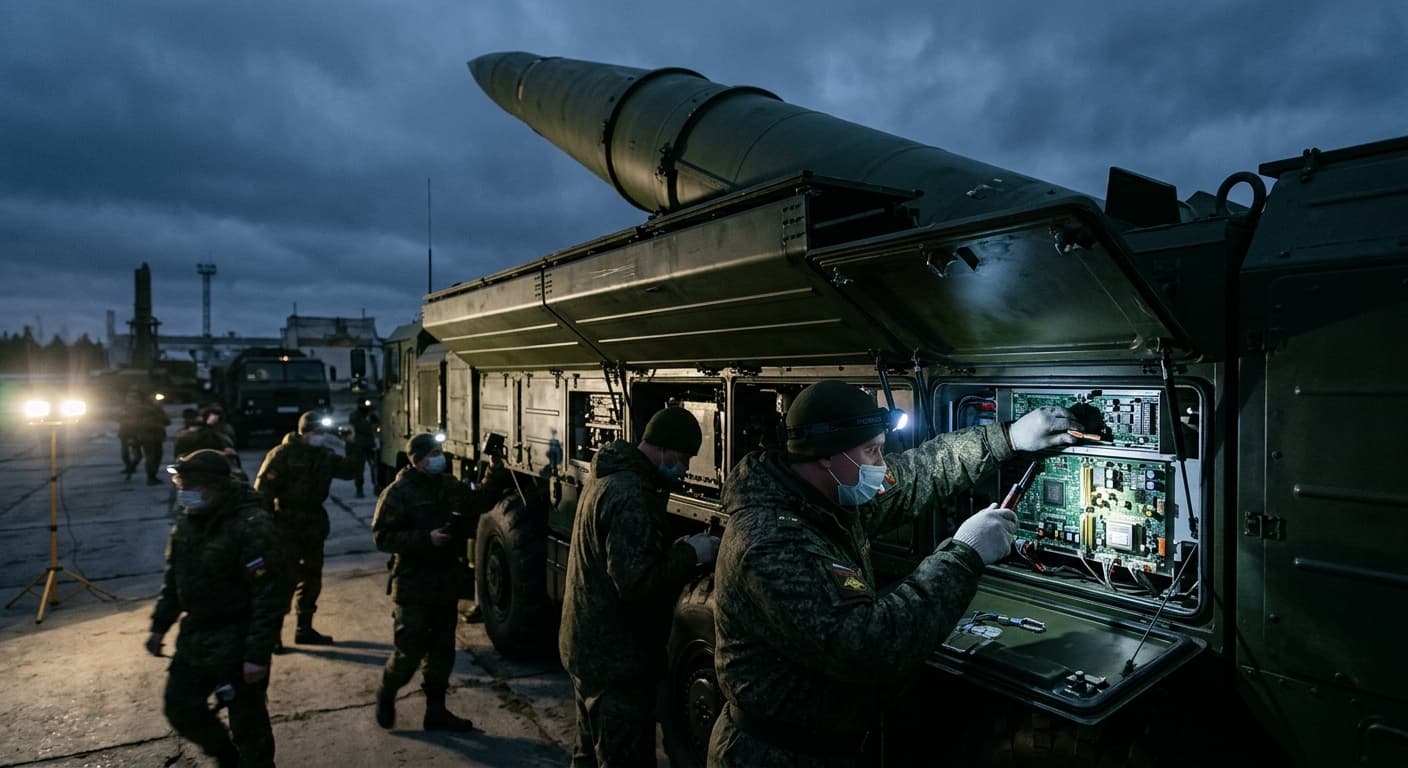
Iskander Missile: 34 Western Parts Feeding Russia's July Barrage on Kyiv
Every Russian Iskander-M carries 34 foreign components sourced through sanctions evasion. Ukraine intercepted 4 of 49 ballistic missiles in early July 2026.
Every Iskander-M ballistic missile Russia fired at Kyiv this month contained roughly 34 Western-made components — chips from Advanced Micro Devices, Texas Instruments, Xilinx, Altera, Microchip Technology and Swiss power-module maker Traco Power, according to Vladyslav Vlasiuk, Ukraine's presidential commissioner for sanctions policy. In the July 6 salvo alone, 23 ballistic missiles carried an estimated 782 foreign parts into Ukrainian apartment blocks. Ukraine shot down none of them. That single figure — 782 — is the load-bearing evidence in an argument Kyiv has been making for eighteen months: the reason Russia's ballistic terror is scaling faster than Ukraine's defenses is that two Western semiconductor supply chains are failing simultaneously — the one that is supposed to keep chips out of Russian missiles, and the one that is supposed to put PAC-3 interceptors in Ukrainian launchers.
What Vlasiuk actually found — and why the date matters
Speaking to LIGA.net on July 7, Vlasiuk said forensic teardowns of Iskander-M debris show programmable logic chips, digital signal processors, processors and power modules manufactured by nine identifiable companies: AMD, Texas Instruments, Altera (49% owned by Intel), Xilinx, Microchip Technology, Integrated Device Technology, Cypress Semiconductor, Maxim Integrated and Traco Power. Eight are American; one is Swiss. Vlasiuk's key detail is not the list — it is the timestamp.
"Microelectronics manufactured in 2025 were found in Iskander-M missiles produced in 2026," Vlasiuk told LIGA.net.
That sentence collapses the West's preferred narrative that Russia is burning through pre-invasion stockpiles. It is not. The procurement pipeline is running in near real time — chips leaving Western fabs in 2025 are being soldered into Russian warheads within months. The FPGAs and DSPs identified by Vlasiuk are precisely the class of parts required to run the terminal-phase maneuvering software that RUSI analysts believe explains the collapse in Patriot intercept rates against the 9M723 in 2025.
Vlasiuk showed the same components to EU ambassadors in Kyiv earlier this year, including remnants of an Iskander-K missile that struck a residential building in the capital, according to a briefing readout published by the Office of the President of Ukraine. His office has since pushed Brussels toward a 20th sanctions package after the 19th cleared in late June, per a separate
presidential readout. The Ukrainian ask is narrow and specific: expand designations against re-export distributors, banking institutions and alternative payment rails, not just direct suppliers.
| Company | Country | Component type |
|---|---|---|
| Advanced Micro Devices (AMD) | United States | Processors, FPGAs (Xilinx line) |
| Texas Instruments | United States | Digital signal processors, power ICs |
| Altera (Intel / Silver Lake) | United States | Programmable logic chips (FPGAs) |
| Xilinx (AMD-owned) | United States | Programmable logic chips |
| Microchip Technology | United States | Microcontrollers |
| Integrated Device Technology | United States | Timing / interface chips |
| Cypress Semiconductor (Infineon) | US / Germany | Memory, controllers |
| Maxim Integrated (Analog Devices) | United States | Analog / power management |
| Traco Power | Switzerland | DC-DC power modules |
Source: Vlasiuk to LIGA.net, July 7, 2026; corroborated by RUSI's Silicon Lifeline methodology.
The scale problem: 120 ballistics a month, four intercepted per week
The Iskander teardowns matter because Russia has industrialized this attack pattern. Al Jazeera reported in June, citing figures Zelenskyy gave the Ukraine-NATO Council, that Russia now produces 120 ballistic missiles a month — twice the monthly output of American Patriot PAC-3 interceptors — and keeps a strategic reserve of 180–250 Iskanders on top of that, according to Ukrainian Deputy Defence Minister Serhiy Beskrestnov, Al Jazeera reported. Multiply Vlasiuk's 34-parts-per-missile figure by Russia's annualized production run and the pipeline is moving something on the order of 49,000 sanctioned Western components into Iskander warheads each year — before counting Kh-101 cruise missiles, Shahed-136 variants, Kinzhals or the Kh-69.
The intercept math has collapsed accordingly. In the first week of July 2026, Ukraine's air defenses shot down four of 49 incoming ballistic missiles — an 8% intercept rate against a weapon RUSI's earlier data set had historically intercepted at around 24%, according to a July 6 Atlantic Council analysis. Twin strikes on Kyiv on July 3 and July 6 killed at least 57 civilians, according to figures compiled by Ukrainian city authorities and reported by the
BBC. On Monday's attack, Ukrainian city administration head Tymur Tkachenko told reporters at least 14 died in central Kyiv alone, with six more killed in surrounding districts,
Al Jazeera reported.
The intercept gap: 4 of 49 Russian ballistic missiles intercepted, week of July 1–7, 2026. Source: Atlantic Council, citing Ukrainian Air Force data.
The RUSI Iskander study updated in November 2025 argues the collapse in intercept rates reflects software-driven terminal-phase maneuvering and the re-emergence of the 9B999 decoy — both improvements that require exactly the kind of programmable logic chips Vlasiuk keeps finding in the wreckage. Whatever the specific engineering pathway, the pattern is that the missile is out-cycling the defender's stockpile faster than either the Pentagon or Lockheed Martin can replenish it. Even if Ukraine received the full annual output of 620 PAC-3 interceptors Lockheed produced last year, the Atlantic Council notes Ukrainian planners estimate they need roughly 2,000 per year to defend critical civilian and energy infrastructure. The US-Israeli air war against Iran alone reportedly consumed about 1,430 Patriot munitions in 39 days, further draining a global inventory whose new-order delivery timeline now stretches up to seven years.
Why the sanctions regime keeps losing this race
The Vlasiuk figure — 34 foreign parts per missile — sits inside a much larger data set. RUSI's original 2022 Silicon Lifeline report catalogued 450 distinct Western components across 27 Russian systems, with roughly two-thirds sourced from US companies, and identified 80-plus specific microchips that were already subject to US export controls as of 2014. A June 2023 Kyiv School of Economics/Yermak-McFaul study catalogued 1,057 foreign components across 58 captured Russian weapons, according to reporting by the
BBC. The top five manufacturers, in that data set, were all American — Analog Devices, Texas Instruments and Intel among them.
A 2025 IISS/Conflict Armament Research paper traces the plumbing: procurement networks exploit distributor-centric supply chains and third-country intermediaries — overwhelmingly in China and Hong Kong — with shell companies rotating faster than sanctions designations can catch them. The IISS analysis found that of nearly 2,000 components sampled from 20 Shahed-136-pattern UAVs, all but 15 were foreign in origin, produced by companies headquartered in 13 countries other than Russia or Iran. AEI's Chris Miller, drawing on C4ADS customs data,
estimates that more than 80% of chips Russia has purchased since 2022 arrive through China, largely via ordinary trade rather than clandestine smuggling — meaning the enforcement problem is not primarily one of intelligence, it is one of political will to confront Beijing.
The G7 and EU response — a Common High Priority List of 50 tariff lines organized into four tiers of diversion risk — is published and updated by the UK Foreign Office and mirrored by BIS. The full list, last updated in August 2024 to add five CNC machine-tool codes, is maintained by the UK government. The core US legal architecture sits at
15 CFR § 746.8, which places license requirements on virtually all covered exports to Russia under a policy of denial. What it does not do is compel non-US distributors to police re-exports at scale. Malaysian semiconductor firm Jatronics made more than 50 shipments to Russian entities worth over $3 million between April 2022 and September 2023, including deliveries to already-sanctioned OOO Planar, before Washington designated it in May 2024,
Al Jazeera documented. By the time Jatronics was named, the chips it had shipped were already in warheads.
That is the structural gap. Ben Hilgenstock, senior economist at KSE, described the enforcement game to the BBC as "cat and mouse" — sanction five intermediaries, five more incorporate in Dubai, Almaty or Shenzhen. The Yermak-McFaul working group housed at Stanford's Freeman Spogli Institute has published successive action plans arguing for a systematic blacklist of suspect distributors rather than the current whack-a-mole approach, but the design constraint remains: dual-use chips move through the same global logistics networks as consumer electronics, and the Missile Technology Control Regime — by its own scope — was never built for uncontrolled commercial parts. Chatham House's July 2025 assessment of Russia's
military-industrial base concluded that indigenous substitution has failed and Chinese-domestic-made chips generally cannot meet Russian precision requirements. The Western chip supply is not a marginal input to the Iskander program — it is the load-bearing beam.
The historical parallel — and who actually benefits
The pattern is not new. The BBC Russian Service, summarizing RUSI's original findings, noted that the Soviet Union ran essentially the same procurement architecture during the Cold War: front companies, false end-user certificates, and a diversion focus on major electronics distributors in permissive hubs. What is new in 2026 is the tempo. Where Soviet-era diversion cycles measured in years — build the shell company, place the order, wait for shipment, integrate into a weapon — Russia's current cycle measures in months, because dual-use commercial chips no longer require bespoke Cold War-style smuggling; they move through licit e-commerce and distributor channels.
The concrete winners of that speed are twofold. First, the Chinese and Hong Kong distributors who take an intermediation margin on every re-exported reel of Texas Instruments or Xilinx product bound for a Russian defense buyer — a business the Chinese government has, as Miller documents at AEI, chosen not to disrupt. Second, Russia's high-precision weapons buyers, who effectively receive a subsidy in the form of Western R&D they do not have to reproduce. The losers are Ukrainian civilians in Kyiv's residential blocks, and — less obviously — the Western chipmakers themselves, several of whom face growing reputational and legal exposure. RUSI has separately flagged that the Chinese-backed buyer of a UK microchip plant produced components later recovered from Russian missiles, an episode that has fed European debates about screening foreign investment in dual-use fabs.
There is also a second-order effect Kyiv is now betting on directly. Because the ballistic archer is harder to knock down than the arrow, Ukraine has begun "shooting the archer" — striking Russian production nodes deep in the interior. The Atlantic Council notes that over the past month Ukrainian long-range drones have hit a semiconductor plant in Voronezh, a ballistic-launcher hub in Volgograd and a missile-sensor factory in Penza. If Russia's Iskander line depends on Western chips arriving via Chinese distributors, degrading the final assembly plants is the only lever Ukraine still fully controls.
What to watch next
- The EU's 20th sanctions package. Vlasiuk's office is pushing hard for coverage of alternative payment systems and re-exporter designations. The 19th passed in late June; a 20th is now the ask, per the
Office of the President.
- NATO Ankara summit outcomes. Zelenskyy is asking allies at this week's summit to release Patriot interceptors from national stockpiles and to expand licensed PAC-3 production in Europe, per the
BBC.
- The next Kyiv barrage. Two large-scale attacks in a week suggest a shift in Russian targeting doctrine. Watch whether the Iskander-M/S-400 launch ratio in the next salvo rises above the July 6 baseline of 23 ballistics.
The Bottom Line
Russia's Iskander program is not surviving despite Western sanctions — it is running on Western chips delivered in 2025 and installed in 2026, at a rate of roughly 34 foreign parts per warhead across a production line pushing 120 ballistic missiles a month. The decisive variable in Ukraine's air defense crisis is not Patriot inventory in Warsaw or Rzeszów; it is whether the G7 is willing to force Chinese and Hong Kong distributors to stop shipping Texas Instruments and Xilinx product to buyers with Russian end-users. Until that happens, the intercept gap widens and Kyiv's apartment blocks stay in range.
Discover more

US Politics
SNAP Food Assistance Faces Legal Challenges
In 2026, SNAP faces stricter eligibility rules and mounting legal challenges, threatening food assistance for the millions of Americans who rely on the program.

India
BJP's Misunderstanding of Women's Quota Needs
The BJP's linking of the Women Reservation Bill to delimitation risks delaying women's empowerment in India, misreading the aspirations of female voters.

India
Congress Accuses Modi of Stalling Women's Law
Congress accuses Modi of stalling women's reservation law by linking it to delimitation, revealing a deeper electoral strategy.

Economics
Fed's Amex AML order puts correspondent banking on notice
Federal Reserve's Amex AML order requires board-level controls and a 90-day plan; OCC fined the bank $350 million over enterprise-wide deficiencies.