Iron Dome Deployment Redefines Gulf Security
Israel's Iron Dome in UAE reshapes regional alliances.
Model Diplomat8 min readMiddle East
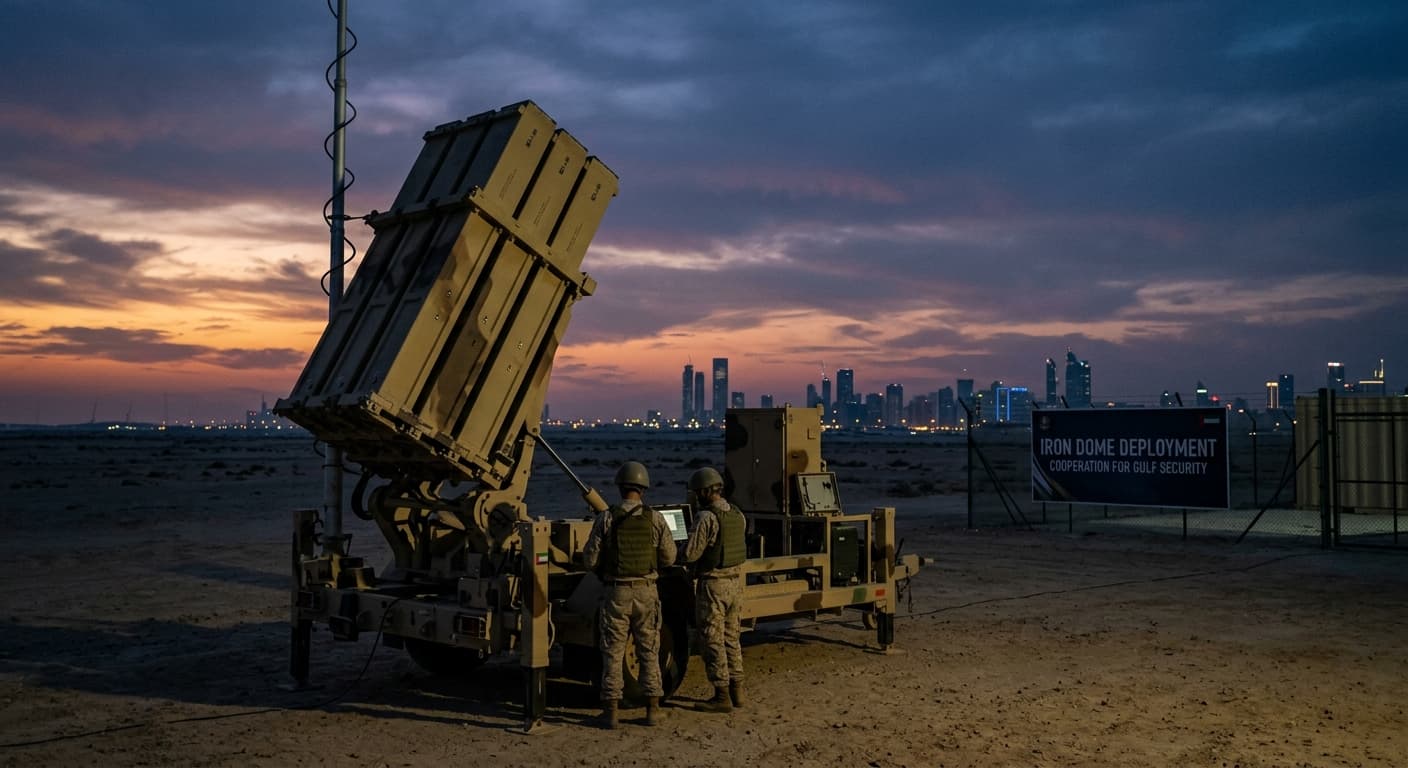
Iron Dome in the UAE: How One Battery Redrew the Gulf
Israel's first-ever combat deployment of Iron Dome outside its borders — confirmed July 5, 2026 — has split the Gulf into two rival security blocs and rewritten Iran's target list.
Israeli Transportation Minister Miri Regev confirmed on July 5, 2026 that an Iron Dome battery and its Israel Defense Forces crew were sent to the United Arab Emirates at the start of the February war with Iran — the first operational deployment of the system outside Israeli territory in its 15-year history. The disclosure, made on Israel Army Radio and reported by AzerNews, formalises what US Ambassador Mike Huckabee let slip in Tel Aviv on May 12: Israeli air-defence hardware, operated by Israeli soldiers, intercepted Iranian ballistic missiles over Emirati soil. That single deployment has done more to redraw the Gulf's security map than any document signed since the 2020 Abraham Accords — it has locked Abu Dhabi into an overt Israeli security orbit, driven Riyadh toward a competing Pakistan-Egypt-Turkey quartet, and given Tehran a permanent grievance to justify targeting UAE infrastructure.
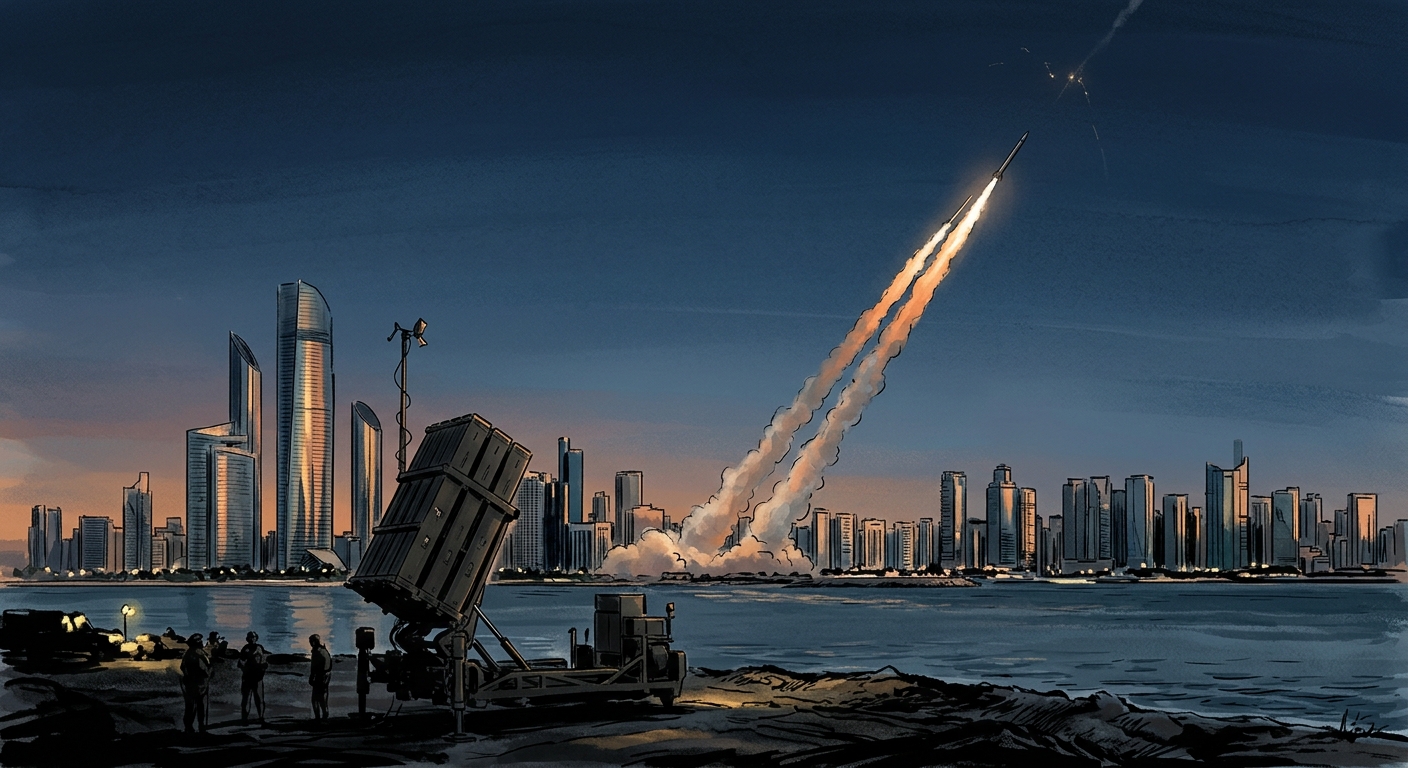
What actually happened, in order
The battery arrived after a February 28 phone call between Prime Minister Benjamin Netanyahu and UAE President Mohammed bin Zayed Al Nahyan, hours after the United States and Israel opened their bombing campaign against Iran's nuclear sites. Regev told Galei Tzahal that Emirati officials had "understood that the ballistic missiles were one of the biggest challenges" — a candid acknowledgement, carried by Baku.ws, that Abu Dhabi's US-supplied Patriot and THAAD batteries could not saturate the incoming volume.
The volume was extraordinary. Between February 28 and the April 8 ceasefire, the UAE was hit by roughly 551 ballistic missiles, 29 cruise missiles and more than 2,265 drones, according to figures released by the UAE Ministry of Defence and compiled by the BBC. Al Jazeera, citing Emirati authorities, put the five-week total at
roughly 2,800 projectiles — more than any other Gulf state, and more drones in absolute terms than Iran fired at Israel. On May 4, an Israeli-operated Iron Dome interceptor downed an Iranian missile over Emirati airspace, an event the Royal United Services Institute called the
first combat use of Israeli-manned hardware on Emirati soil.
The Iron Dome was not alone. The RUSI note adds a detail the wires largely missed: Israel also transferred the Rafael-built "Spectro" surveillance package and a variant of the Iron Beam directed-energy system designed to knock down short-range rockets and drones. This is not a token battery; it is a layered Israeli air-defence node inside the Arabian Peninsula. Huckabee's May 12 confirmation, carried by Al Jazeera, removed the plausible deniability both governments had worked to preserve. He framed it as a reward for early normalisation: "Look at the benefits that they have had as a result: Israel just sent them Iron Dome batteries and personnel to help operate them."
Netanyahu then went further. On May 13 his office announced a "secret visit" to the UAE during the war — a claim the UAE foreign ministry publicly denied hours later, insisting Emirati–Israeli relations "are not based on secrecy or clandestine arrangements." The
NPR account of the exchange captured the political dilemma cleanly: Abu Dhabi wants the hardware, but not the photograph.
Why this matters more than the Abraham Accords ever did
The 2020 Abraham Accords were a normalisation instrument dressed in security language. The Iron Dome deployment is the reverse: a hard-security instrument that has quietly become the load-bearing wall of the entire Israel–UAE relationship. Read the Congressional Research Service brief on the Arab Gulf states and the Iran conflict, released this spring, and the assessment is unusually direct: "To the extent that UAE–Israeli security cooperation and integrated air and missile defense efforts are perceived to have been successful during the conflict, Gulf states may be relatively more open to pursuing similar initiatives."
That is the pivot. Air-defence integration — not diplomatic ceremony — is now the ticket of admission to a US-anchored regional bloc. And the entry price has just been demonstrated in combat.
Three concrete consequences follow.
First, the Gulf has bifurcated. In Foreign Affairs on June 16, 2026, analysts describe an emerging Abrahamic coalition anchored by Israel and the UAE — with India and Greece as economic outriders — set against an "Islamic coalition" of Saudi Arabia, Pakistan, Egypt and Turkey that coalesced during Pakistan's mediation of the April 8 ceasefire. Jeffrey Feltman writes for
Brookings that Riyadh was "furious" about "the Emiratis' deepening military and intelligence ties with Israel in the absence of progress on the Palestinian issue," and that the personal rift between Crown Prince Mohammed bin Salman and Sheikh Mohammed bin Zayed is now the operative variable in Gulf politics. The Carnegie Endowment's Middle East programme puts it more starkly: the war has
exposed the emptiness of the Abraham Accords, US bases and economic deals as protective instruments — none of them shielded the UAE from the 2,800 projectiles.
Second, Iran now has a permanent doctrinal justification to target the UAE. The spokesperson for Iran's Khatam al-Anbiya Central Headquarters flatly denied on May 5 that Iranian forces had struck the UAE, calling Emirati accusations "baseless" — a diplomatic fiction that RUSI reads as Tehran keeping ambiguity in reserve. From Tehran's vantage point, the deeper Israel embeds inside UAE air defence, the more legitimate a target the UAE becomes. Fujairah — the Gulf-of-Oman oil terminal that handles roughly 1.7 million barrels per day and lets Emirati crude bypass the Strait of Hormuz — was hit twice after the ceasefire, and a drone strike sparked a fire at the Barakah nuclear power plant perimeter on May 17. The BBC's Jeremy Bowen
judged the UAE "the main target for Iran among their Gulf Arab neighbours" — a status the Emiratis inherited precisely because they chose the Israeli side of the fence.
Third, this is the deployment Israel refused to give Ukraine. For four years Kyiv has asked Jerusalem for Iron Dome batteries to knock down Shahed drones; Israel repeatedly declined, citing operational needs. It took Abu Dhabi 96 hours. Bowen's BBC analysis notes that the Iron Dome and its IDF operators were "a significant gesture they refused to offer to Ukraine" — a comparison that will resonate in European chancelleries the next time Israel asks for anti-Houthi intelligence-sharing from NATO. The Al Jazeera write-up makes the same point, flagging that the system has been "funded by billions of dollars from the US government" and had never been used outside Israel before — a US-financed asset whose first foreign combat deployment served Emirati, not Ukrainian, skies.
The Saudi story is the real story
Focus on the Iron Dome deployment misses the more consequential fact: Riyadh watched the same war, drew the opposite conclusion, and is building a hedge. Mohammed Alyahya writes in Foreign Affairs that Saudi Arabia, unlike the UAE, "did not call for the war" and instead accelerated a defence pact with Pakistan — the same Pakistan that then mediated the April 8 US–Iran ceasefire in Islamabad. That coordination was not an accident; it was the operationalisation of a Sunni-heavyweight bloc designed to survive both Iranian and Israeli hegemony. Alyahya adds that the pact "became the basis for a broader regional coalition, also including Egypt and Turkey."
The Carnegie Endowment's pre-war reassessment of the Abraham Accords had already flagged the erosion: the 2023 China-brokered Saudi–Iran deal, it argued, "reduced the imperative for geopolitical hedging against Iran and the 'security umbrella' rationale underlying the Abraham Accords." That analysis has now been vindicated in reverse. The UAE stayed with the Israeli umbrella; Saudi Arabia stayed with the hedge; the war forced both bets to be shown.
President Donald Trump's response was to try to force the issue. On May 25, 2026 he posted on Truth Social that it "should be mandatory" for Saudi Arabia, Qatar, Pakistan, Turkey, Egypt and Jordan to "simultaneously, sign onto the Abraham Accords" as part of any comprehensive Iran deal — a demand documented in the Congressional Research Service brief and reported at the time by
Al Jazeera. None of the six countries responded publicly. Saudi Arabia repeated its adherence to the 2002 Arab Peace Initiative, which conditions normalisation on a Palestinian state along 1967 borders.
The June 2026 US–Iran Memorandum of Understanding, celebrated at the White House as a Trump breakthrough, ultimately did not carry a mandatory-normalisation clause. Senator Lindsey Graham's endorsement statement conceded the point in the technical register of consolation: normalisation is now "the ultimate goal," not a pre-condition. Read: Saudi Arabia won that round.
The Begin-Sadat Center's post-war assessment argues that Israel's 2021 reassignment to US Central Command was the pre-condition for what happened in the UAE — enabling "joint exercises, intelligence sharing, and coordinated missile defense with regional partners and US forces." In that reading, Iron Dome in Abu Dhabi is not an event; it is the maturation of an architecture built quietly over five years. The Al-Monitor analysis by Nimrod Goren, hosted by
Mitvim, calls it the moment Emirati–Israeli ties shifted from "political normalization toward military coordination."
Diplomat View
The battery in the UAE has ended the era in which Gulf states could enjoy Israeli capability without owning Israeli politics. Abu Dhabi has taken the Israeli side of the fence in an active, hardware-forward way that even the 2020 Accords carefully avoided; Riyadh has taken the opposite bet by leaning on Pakistan, Turkey and Egypt as a Sunni counterweight to both Tehran and Tel Aviv. The forecast: over the next 18 months, expect Israeli air-defence exports to become the primary diplomatic currency of the Abrahamic bloc — replacing free-trade rhetoric — while the Saudi-led quartet formalises a Gulf-Iran non-aggression track under Chinese cover, along the lines Foreign Affairs describes. That forecast would need to be revised if two conditions change: if Riyadh accepts a US defence treaty in exchange for symbolic Palestinian-state language Netanyahu can accept (unlikely under this Israeli coalition), or if Iran breaches the June MoU and forces the Saudis back under the American umbrella on Emirati terms. Neither is the base case.
What to watch next:
- US–Iran follow-on talks in Islamabad — the technical annex to the June MoU is due for signature this quarter; watch for whether Gulf security guarantees are attached.
- UAE arms package before Congress — the CRS brief flags pending arms-sale notifications that will test how much of the Israel-UAE air-defence architecture Washington intends to underwrite.
- Saudi–Iran Beijing summit — diplomats have floated a Helsinki-style Gulf security process; a date in the second half of 2026 would confirm the split.
The Bottom Line
The bottom line: an Iron Dome battery in Abu Dhabi is not a technical footnote to the Iran war — it is the moment Gulf security ceased to be an American monopoly and became a two-bloc contest between an Israel-UAE Abrahamic axis and a Saudi-Pakistani-Turkish hedge. The UAE has bought hardware and inherited a target list; Saudi Arabia has bought optionality and inherited a coalition. Whichever bet ages better will define the next decade of Middle Eastern order.
Discover more
Global Politics
Xi Jinping Calls China-Russia Ties 'Precious'
Xi Jinping's description of China-Russia ties as 'precious' reflects a strategic imbalance, with Beijing dictating terms in the partnership.

India
Delhi CM Rekha Gupta Blasts Opposition's Delm
Delhi CM Rekha Gupta's remarks on women's quota defeat reveal BJP's strategy for the 2029 Lok Sabha elections, focusing on delimitation.
India
Congress Accuses Modi of Stalling Women's Law
Congress accuses Modi of stalling women's reservation law by linking it to delimitation, revealing a deeper electoral strategy.

Economics
Fed's Amex AML order puts correspondent banking on notice
Federal Reserve's Amex AML order requires board-level controls and a 90-day plan; OCC fined the bank $350 million over enterprise-wide deficiencies.