Iraq's Oil Route to Syria Signals Change
Baghdad reopens oil route to Banyas, defying Iran's influence.
Model Diplomat7 min readMiddle East
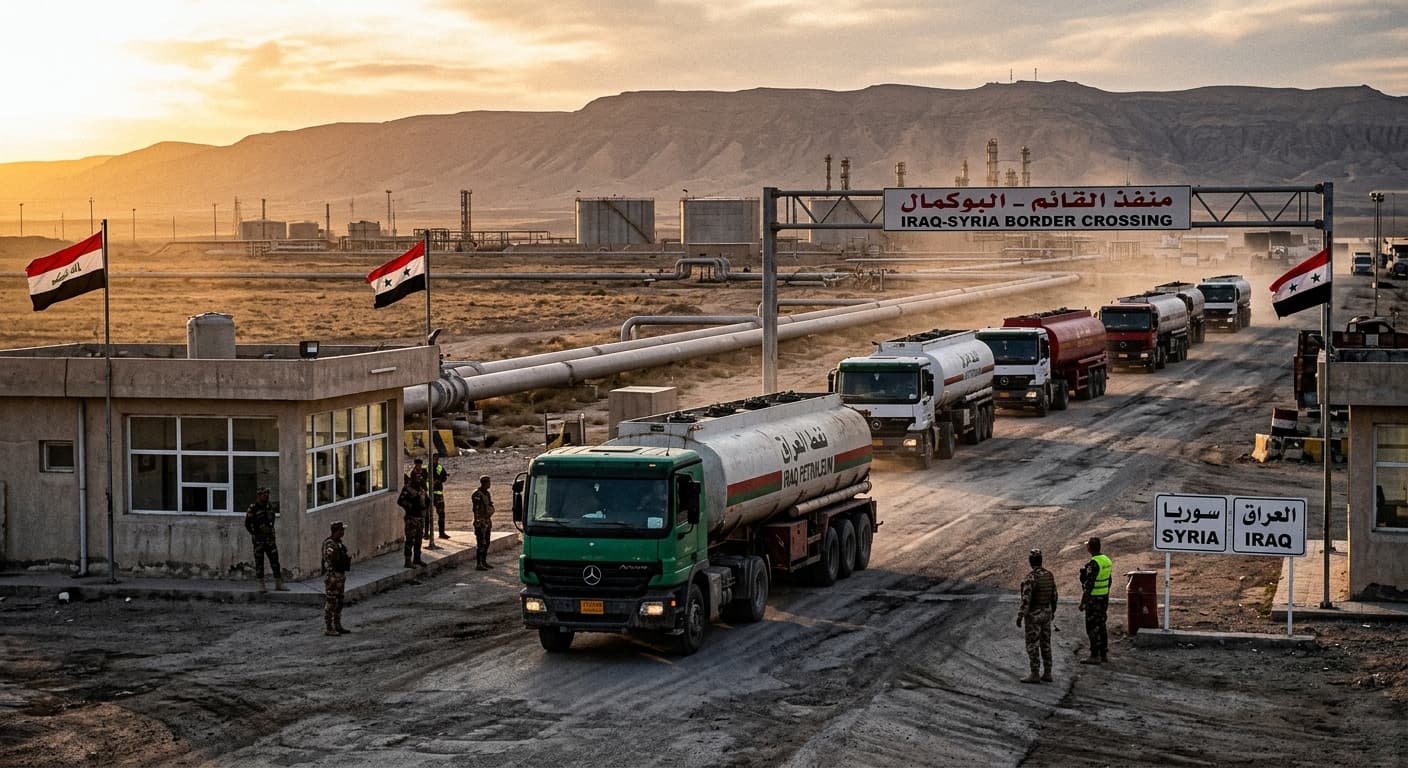
Iraq's Syria Oil Route Signals Break From Iran's Playbook
Baghdad will truck 50,000 bpd of Basra crude to Syria's Banyas port from July 2026 — a symbolic volume that quietly buries a 40-year Iranian veto on Iraq's western outlets.
Iraq's oil ministry will begin trucking up to 50,000 barrels a day of Basra crude across the Syrian border to the Mediterranean port of Banyas within weeks, according to statements by ministry expert Asim Jihad reported by Anadolu Agency on July 6. The volume is a rounding error against the roughly 3.5 million bpd Baghdad lost when the Strait of Hormuz was effectively shut for five months. But the real story is not the trucks. It is that a route Tehran spent four decades keeping closed — the
Iraq–Syria corridor to the Mediterranean — is being reopened by a Baghdad government that until 2024 could not have contemplated it. The Syrian truck route is a political signal, not a logistics fix, and it changes who controls Iraq's next 2 million barrels of export capacity.
The number tells you it is not about barrels
At 50,000 bpd, the Syrian corridor covers roughly 1.5% of the volumes Iraq was moving through Basra before the US–Israel–Iran war began on February 28, 2026. Ministry spokesman Salim al-Rikabi told Iraqi state media in June that the extension of a formal Iraqi export pipeline to Banyas "is still under study," per Zawya. For now, the ministry is moving heavy Basra crude by tanker truck across the western desert to two new unloading bays at the Banyas refinery, according to reporting collated by
Middle East Monitor.
The economics are ugly. A standard oil truck carries between 100 and 700 bpd depending on how many trips it makes, meaning even 50,000 bpd requires hundreds of round-trips daily across contested terrain, as energy analyst George Voloshin noted to Al Jazeera in March. Jihad conceded to Anadolu that revenues will be "limited," and framed the operation primarily as a way to relieve refinery blockages caused by heavy crude piling up onshore in southern Iraq.
What actually changed: the Iran-aligned veto
For most of the last 40 years, Iraq's dependence on Basra's Gulf terminals was not an accident of geography — it was a choice preserved by Iran-aligned factions in Baghdad. The Gulf International Forum's Madeline Stahle put it directly in a June 2026 analysis: "An influential segment of the Iraqi political establishment remains closely aligned with Tehran and has little interest in diversifying away from Gulf export routes that pass through the Strait. This continued dependence preserves Iran's ability to gain direct leverage over global energy markets during periods of regional escalation."
The Kirkuk–Banyas pipeline itself, an 880-km line completed in 1952 with a design capacity of 700,000 bpd, has been shut since April 1982 — Damascus closed it in solidarity with Tehran during the Iran–Iraq war. According to a detailed inventory by the Gulf Research Center, the line is one of six major Iraqi export pipelines currently entirely or partially suspended, alongside the Kirkuk–Tripoli, Kirkuk–Haifa, and the Iraq–Saudi IPSA line dormant since 1990. That the GRC is now openly discussing rehabilitation reflects a shift Baghdad's political class would have blocked as recently as 2023.
Three developments broke the veto. Assad fell on December 8, 2024, ending Syria's role as an extension of Iran's forward defense. The Kirkuk–Ceyhan pipeline reopened on September 27, 2025 after a 30-month closure, restoring a northern outlet. And the February 28, 2026 war exposed the fiscal catastrophe of Hormuz-only exports: Iraqi output collapsed from 4.3 million bpd in February to below 1.3 million bpd within weeks, according to the Atlantic Council. Nearly 90% of Iraq's 2025 government budget depended on oil revenue. The state ran out of storage before it ran out of politics.
Chevron is the unexpected winner
The commercial dimension is where the story gets sharper. Over the past four months, Prime Minister Mohammed Shia al-Sudani's government has signed a cluster of major deals with US oil majors that would have been politically impossible under his 2022 platform. Chevron secured exclusive talks in February to take over West Qurna-2 from Russia's Lukoil, a field that produces close to 10% of Iraqi output and could rise to 800,000 bpd, per reporting summarised by the Gulf International Forum. ExxonMobil, HKN, and KBR have signed alongside.
Chevron is also in advanced talks in Damascus. Syrian President Ahmed al-Sharaa met Chevron representatives in December 2025 to discuss developing Syria's own reserves, Al Jazeera reported in January. Brenda Shaffer of the US Naval Postgraduate School told the outlet that Chevron already holds gas assets in neighbouring Israel and Cyprus and a long-term LNG supply arrangement with Turkey — the geographic footprint required to monetise an Iraq–Syria–Mediterranean corridor end-to-end.
That combination — Iraqi upstream, Syrian midstream, Israeli/Cypriot gas, Turkish LNG offtake — is the outline of a US-anchored energy corridor across an axis Iran once controlled. As the Atlantic Council noted in a June analysis of Sudani's US pivot, "Al-Sudani has discovered what the Kurdistan Regional Government learned years ago: Oil and gas deals buy political leverage in Washington."
The countervailing pressure is real. On May 7, the US Treasury sanctioned Iraq's own deputy oil minister, Ali Maarij al-Bahadly, for allegedly facilitating Iranian oil smuggling through Iraqi channels, per Al Jazeera. That sanction — rare against a sitting Iraqi official — was Washington's signal that the space for Iran-aligned figures in Iraq's oil bureaucracy is narrowing.
The pipeline that could actually matter
Trucking will not last. The volumes are too small and the logistics too costly to run indefinitely. What Baghdad and Damascus are really building toward is a rehabilitated or replacement pipeline. A study by the New Lines Institute, cited by the Gulf International Forum, concluded that a new Iraq–Syria line with capacity of 1.4 million bpd is "technically feasible" and could address Iraq's "urgent need to diversify its export routes away from the Basra terminals." Turkish analysts at SETA estimate that even a modest 300,000 bpd revival of the historic Kirkuk–Banyas line would generate $150–200 million annually for Syria — money the al-Sharaa government urgently needs to rebuild.
But the physical constraint is severe. Iraq's Al-Bayan Center, in a policy paper on the risks facing Iraqi oil exports, is blunt:
"Iraq's overland transport system is limited to a few thousand barrels daily via a small, often deteriorated tanker fleet. Moving one million barrels per day would require a massive fleet and infrastructure that do not currently exist. While overland transport may serve symbolic shipments, it cannot function as a reliable strategic alternative during a complete strait closure."
That is the Bayan Center's own assessment — a Baghdad-based think tank close to Iraq's political establishment. The Basra–Haditha "Strategic Pipeline," ratified by cabinet in late 2024 at $4.6 billion with 2.25 million bpd design capacity, is the essential missing link connecting southern crude to any western outlet. It is scheduled for completion within two years. Nothing serious moves through Syria at scale until that line exists.
Hormuz is open, but the argument for bypass just got stronger
The paradox of the July 6 announcement is that it comes after Hormuz has largely reopened. Iran and the US signed a memorandum of understanding on June 17 committing Tehran to "best efforts for safe passage of commercial vessels with no charge for 60 days," per shipping data cited by the BBC. Brent crude has fallen back to $72 a barrel — below its pre-war level — and OPEC+ announced on July 6 a fifth consecutive monthly output increase of 188,000 bpd, per
Al Jazeera.
Yet transits are still running at 38–48 ships per day against a pre-war baseline of 138. Brookings senior fellow Bruce Jones warned in a July 2 podcast that Iran has established a "Persian Gulf Strait Authority" to license transiting vessels, that mines remain in the strait and will take months to clear, and that the 60-day sanctions-relief window "does not commit Iran to never again assert control." The Congressional Research Service noted in its
June 2026 update that global spare capacity — 4.4 million bpd as of February 2026 — is "more than 75%" located in Middle Eastern countries that themselves export through the Strait, "thereby limiting the effectiveness of this standby source of supply."
Translation for Baghdad: the next Hormuz closure is a scenario, not a black swan. Building the Syrian option in a quiet market is far cheaper than trying to build it during the next war.
Diplomat View
The 50,000-bpd Syrian route is not a supply story — it is a sovereignty story. For the first time since 1982, an Iraqi government is physically moving crude westward across a border Tehran spent four decades keeping shut, and doing so while its own deputy oil minister is under US sanctions for pro-Iran smuggling. The likely trajectory over 18–36 months is a Chevron-anchored Iraq–Syria energy corridor, financed on the back of the $4.6 billion Basra–Haditha strategic pipeline and a rehabilitated Kirkuk–Banyas line, marketed to European buyers seeking non-Russian, non-Gulf-chokepoint supply. The forecast fails if Iran-aligned factions win Iraq's post-election government formation and reverse Sudani's US-major contracts, or if Israeli strikes on Iran-backed militias trigger sabotage of the western pipeline corridor before it is hardened. Watch the government formation talks and the Basra–Haditha construction milestones; those, not the truck count at the Al-Qaim border crossing, will tell you whether this is a pivot or a stunt.
What to watch
- Iraqi government formation (July–September 2026): Whether Sudani secures a second term and keeps the Oil Ministry out of Iran-aligned hands after the May parliamentary elections.
- Basra–Haditha "Strategic Pipeline" milestones: Ratified at $4.6 billion in late 2024, scheduled for completion by end-2026. Without it, no serious westward flow is possible.
- August 2 OPEC+ meeting: Whether Iraq's expanding quota accommodates a formal Syrian export line, or forces Baghdad to choose between OPEC discipline and route diversification.
- Hormuz 60-day MOU expiry (mid-August 2026): If Iran reasserts transit fees or the Persian Gulf Strait Authority begins charging, the Syrian route's economics improve overnight.
Discover more
Global Politics
Xi Jinping Calls China-Russia Ties 'Precious'
Xi Jinping's description of China-Russia ties as 'precious' reflects a strategic imbalance, with Beijing dictating terms in the partnership.
US Politics
Virginia's Redistricting Referendum
Virginia's redistricting referendum is drawing a flood of dark money, shaping future elections and the fight for congressional control amid party stakes.
US Politics
House Ethics Committee Pushes Sexual Miscond.
The House Ethics Committee has shifted responsibility for sexual harassment settlement records to the Office of Congressional Workplace Rights, complicating disclosure efforts.

Economics
Fed's Amex AML order puts correspondent banking on notice
Federal Reserve's Amex AML order requires board-level controls and a 90-day plan; OCC fined the bank $350 million over enterprise-wide deficiencies.