Iran's Leverage Grows in Nuclear Talks
Zolghadr warns Trump amid rising oil prices and nuclear negotiations.
Model Diplomat8 min readMiddle East
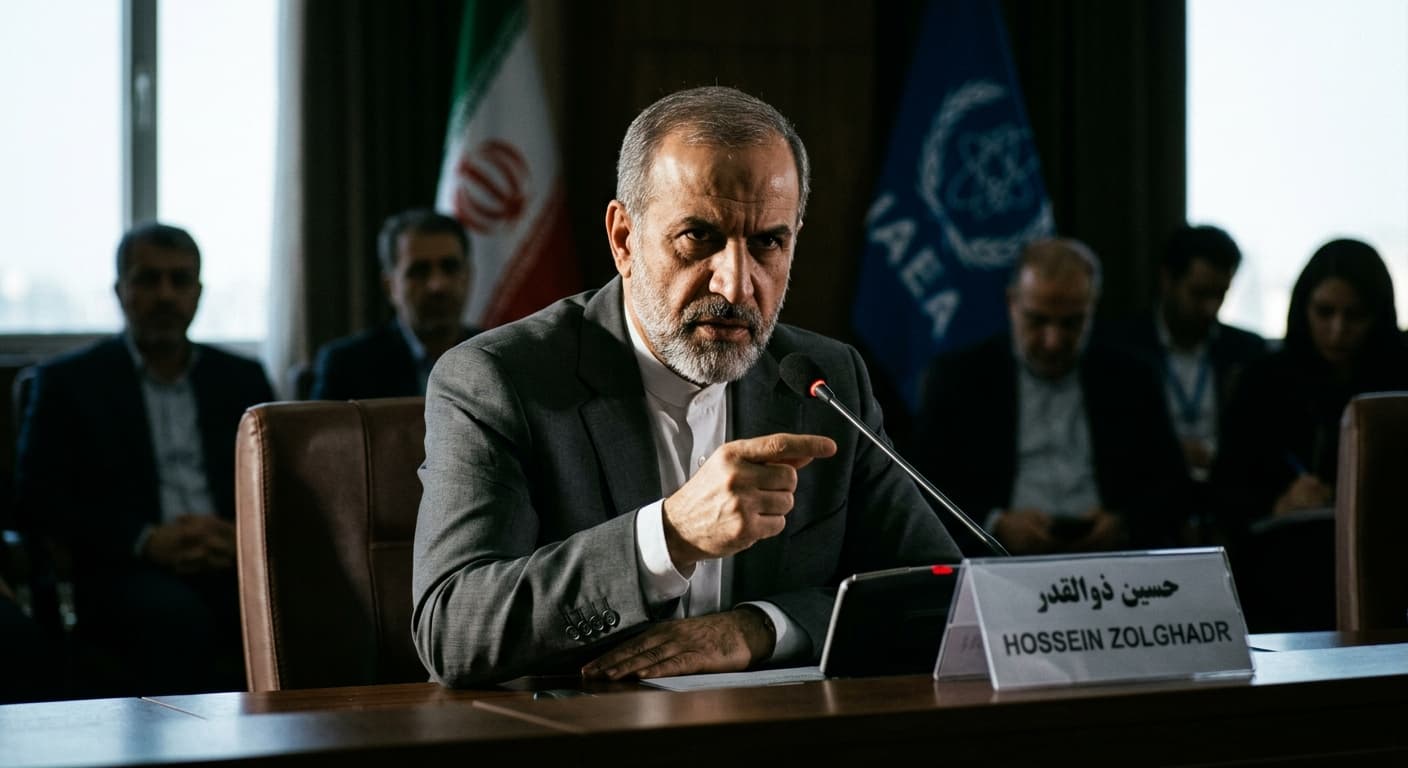
Zolghadr's Warning to Trump Shows Iran's Deal Leverage Is Growing
Iran's security chief tells Trump to "speak with respect" as Tehran uses the funeral of the Supreme Leader — and $72 oil — to harden its terms in the 60-day nuclear talks.
Mohammad Bagher Zolghadr's July 6 rebuke of Donald Trump — "Speak to the Iranian people with respect, or we will respond in a different language" — is not the bravado of a cornered regime. It is the opening move of Tehran's post-war negotiating strategy: with the Strait of Hormuz reopened, Brent crude back at pre-war levels, and a fragile June 17 memorandum of understanding still holding, Iran now believes it holds the leverage in the second phase of talks and is pricing that leverage into its rhetoric. The Islamabad MoU gave both sides 60 days to reach a final deal. Half that clock has run. The signal from Iran's Supreme National Security Council secretary is that no final agreement will be signed while Trump keeps threatening the country's grid.
Zolghadr, a former Islamic Revolutionary Guard Corps commander who replaced the assassinated Ali Larijani in March, is not a hardline outlier. He is the gatekeeper any Iranian negotiator must satisfy. "Whoever is sitting at the negotiation table will have to get Zolghadr's approval before anything passes," an Al Jazeera correspondent in Tehran said after his appointment. When he speaks, he speaks for new Supreme Leader Mojtaba Khamenei's inner circle.
What Trump actually said — and why Tehran chose this moment to answer
Trump's Monday remarks, the immediate trigger, were softer than his April rhetoric but built on the same threat architecture. He told reporters he preferred a deal because he did not "want the lives of 91 million people to be affected" — while reiterating that Iran's civilian infrastructure remained on the target list, according to WANA. That framing — mercy conditional on submission — is what Zolghadr threw back at him.
The rhetorical escalation matters because of what is buried underneath it. On June 22, Iran and the United States concluded a first round of talks in Bürgenstock, Switzerland, and agreed on what mediators Qatar and Pakistan called "a roadmap towards reaching a final deal within 60 days," per the BBC. The clock runs out in late August. On July 1, Doha technical talks focused on the release of $6bn in frozen Iranian funds and the reopening of communication channels,
Al Jazeera reported. Foreign Minister Abbas Araghchi's July 7 warning — that "no talks on a final deal will begin if threats continue" — is a direct threat to walk away from that timeline.
Why Tehran believes it can raise the price
Three factors have shifted the negotiating floor beneath Trump.
The oil market has already digested the war. Brent crude futures for September delivery stood at $72 on July 6, below the $72.48 settlement on February 27 — the day before US–Israeli strikes began — according to Al Jazeera. Prices peaked above $126 in April during Trump's "Power Plant Day" ultimatum. That collapse is Iran's asset, not Washington's: the White House cannot credibly threaten to blow up Iranian infrastructure without spiking the market it has just calmed, and Saudi Arabia, Iraq, Kuwait and their OPEC+ partners announced on July 6 they will add another 188,000 barrels per day in August — a fifth consecutive monthly hike that leaves Riyadh with no spare capacity headroom for a renewed shock.
The Strait of Hormuz remains partially closed on Iran's terms. Traffic through the strait sat at 38 confirmed transits on July 2, compared with roughly 130 daily crossings before the war, MarineTraffic data cited by Al Jazeera shows. On July 3, Iran warned commercial vessels against "unapproved routes," reasserting sovereign control of a waterway that carried a fifth of global oil and LNG in peacetime. The BBC, reporting from Bandar Abbas, found seized container ships still held by the IRGC three months after the ceasefire. Iran has, in effect, converted geography into a durable revenue and leverage stream — Deputy communications aide Seyyed Mehdi Tabatabaei has already floated a "new legal regime" of permanent transit fees.
The nuclear file is unresolved and Iran controls the pace. Parliament Speaker Mohammad Bagher Ghalibaf confirmed on July 3 that IAEA inspectors have access only to Bushehr and the Tehran research reactor — not to the bombed Fordow, Natanz or Isfahan sites — because "Parliament itself passed the law, and the Supreme National Security Council has also adopted a corresponding resolution." IAEA Director-General Rafael Grossi told reporters on June 26 that a "very strong system of verification" was needed "as soon as practicable," acknowledging a "war of statements" between Washington and Tehran. Iran's pre-war stockpile of 60%-enriched uranium — estimated at 440kg by the IAEA — has not been downblended, despite MoU commitments.
The Zolghadr doctrine: symmetric threats, asymmetric costs
Read the specific words. Zolghadr called Trump the leader of "a rootless country with a 250-year history" threatening to erase "Iran's millennia-old civilization." This is not decorative. It is a deliberate echo of Trump's April 7 Truth Social post that "a whole civilisation will die tonight, never to be brought back again," which UN Secretary-General António Guterres condemned as "deeply troubling" and Pope Leo XIV called "unacceptable," per the BBC. Iran's mission to the UN put the legal frame plainly in an April statement: deliberate destruction of infrastructure "essential to civilian survival" would violate the laws of war and demand action from all states. That position has since been endorsed by more than 100 international-law scholars in an
open letter alleging violations by all three belligerents.
The IRGC's April threat was operational, not rhetorical: "We will do to the infrastructure of America and its partners what will deprive them and their allies of the region's oil and gas for many years," it said, warning that any US strike on Iranian civilian sites would trigger a response that "will extend beyond the region." Iran demonstrated capability during the war — a reported strike on US Camp Buehring in Kuwait using unguided bombs, and attacks on Gulf-state facilities hosting US forces. The Zolghadr warning is a shorthand for that escalation ladder, reheated for a president Iran has now watched pull back twice from his own deadlines.
Who benefits from restraint, who benefits from collapse
The tactical winner from this posture is Mojtaba Khamenei. The new Supreme Leader has never given a public speech and has kept himself invisible since the March 8 succession announcement, per NPR. Delegating the loudest rhetoric to Zolghadr — a securocrat with no reformist baggage — lets Khamenei consolidate hardline authority during the six-day mourning period for his father, which drew mass turnouts Tehran is now citing as popular ratification of resistance. Culture Minister Seyyed Abbas Salehi's parallel statement invoked exactly that: "Take a lesson from the massive and passionate presence of millions of Iranians bidding farewell to their martyred Leader."
Israel is the loser. Defence Minister Israel Katz told Israeli media on June 30 that targets were already selected and the air force awaited an order — an implicit threat to blow up the very MoU Trump signed. If Iran walks from the 60-day process, Netanyahu recovers the option to resume large-scale strikes with US backing. If Iran doesn't walk — and Zolghadr's language is calibrated to stay just short of that — Israel loses. Trump on June 16 already told Netanyahu to be "more responsible with respect to Lebanon" and dismissed the Hezbollah front as a "minor war" and a "pinprick," per Al Jazeera. The Israeli veto over US Iran policy that existed before February 28 has narrowed.
Russia and China are the quiet winners. Iranian air-force commanders are in "early negotiations" with Russian and Chinese counterparts to purchase fighter aircraft, Iranian outlets and Al Jazeera reported — a rearmament pipeline that would have been politically unthinkable before the war shattered Iran's Western-facing reformist camp.
The primary document that anchors the current framework is the June 17 memorandum of understanding, described by Vice President JD Vance to the BBC as "about a page and a half" and "very general." Its paragraph one, per Vance, commits Iran to "regional peace and stability" including a halt to "funding of terrorist organisations"; another provision, per US Treasury Secretary Scott Bessent, ties a 60-day US sanctions waiver — the first authorising Iranian oil sales in US dollars in decades — to Iran keeping Hormuz open and admitting IAEA inspectors. The document has not been publicly released. That opacity is now the fight.
Diplomat View
Zolghadr's threat is not a rupture. It is a bid to reprice the deal Trump thinks he already won on June 17. Iran's calculation is that Trump wants a signable agreement before US midterm season more than he wants to bomb power plants at $85 oil — and that a rhetorical wall now buys Tehran concessions on inspections, on Hormuz transit fees, and on the size and speed of frozen-asset releases in the next four weeks. That reading is falsifiable: if Trump orders even a limited strike on Iranian energy infrastructure before mid-August, the Zolghadr doctrine collapses and Iran will have overplayed a weak hand still recovering from a war that killed at least 3,600 people, per BBC reporting on Human Rights Activists News Agency figures. If Israel, seeing the MoU harden, launches unilaterally and drags Washington in, the same collapse follows. Absent either, expect a partial, ambiguous, and asymmetric final text — one that formalises Iran's post-war status as a coastal-state gatekeeper of Hormuz and a threshold nuclear power, wrapped in Trump-friendly language about "the greatest deal ever made." Watch the
Iran files, not the tweets.
What to watch
- Mid-August 2026 — 60-day MoU deadline. If no final text, either side can declare the framework dead. Araghchi has said negotiations will not proceed under threat; Trump has said he "will do what I have to do."
- IAEA Board of Governors, September 2026 — verification report. Grossi's language on Iranian cooperation will trigger or defuse the automatic snapback mechanisms embedded in UN Security Council Resolution 2231.
- OPEC+ ministerial, early August 2026. Any Saudi decision to pause the 188,000 bpd monthly hikes signals Riyadh sees renewed conflict risk — and gives Trump political cover for a harder line.
- Israeli cabinet moves on Lebanon and Iran targeting. Katz's June 30 remark that targets are pre-selected is the fastest path to a broken ceasefire.
The Bottom Line
Zolghadr's warning is not the tantrum of a defeated regime — it is Tehran signalling that the price of a final deal has gone up now that oil markets, mediators and even the IAEA have absorbed the war and moved on. If Trump wants a signable agreement before the 60-day clock expires, he will pay for it in inspections access, transit-fee tolerance and asset releases; if he escalates instead, he does so into a market that has just returned to $72 and an Iranian leadership that has convinced itself its geography, not its enrichment plant, is now the decisive weapon. *
Discover more
US Politics
Next Generation Republicans
A leaked survey shows 39% of Republicans under 30 do not identify as MAGA, revealing a split in the GOP's future leadership.

US Politics
House Ethics Committee Pushes Sexual Miscond.
The House Ethics Committee has shifted responsibility for sexual harassment settlement records to the Office of Congressional Workplace Rights, complicating disclosure efforts.

US Politics
SNAP Food Assistance Faces Legal Challenges
In 2026, SNAP faces stricter eligibility rules and mounting legal challenges, threatening food assistance for the millions of Americans who rely on the program.

Conflict & Security
Drone Warfare Killing Aid Workers at Unprec
Over 1,000 humanitarian workers killed in three years as cheap armed drones collapse legal protections. Gaza, Sudan, Ukraine, and DRC see deliberate targeting of aid convoys and hospitals with zero prosecutions.